
The jar sits on the table like a small brown bomb: unglazed earthenware, a lid sealed down with clay, the outside stained dark with years of handling. Cracking it open releases a smell that arrives in two parts — first the soy and the fermented chilli, then, behind that, the fat, which is the real message. Inside, packed tight, are slabs of pork belly that have gone a colour somewhere between amber and rust, their skin translucent, their meat falling into fibrous layers at the touch of a chopstick. The sauce is thick enough to stand a spoon in. You are supposed to eat this in small quantities with large amounts of rice. Nobody does. 桂阳坛子肉 Guìyáng tánzi ròu — Guiyang jar pork — is the county’s most stubbornly old-fashioned dish, and it is made in a way that would horrify a food-safety inspector: sealed in a pot and left to sit for a season.
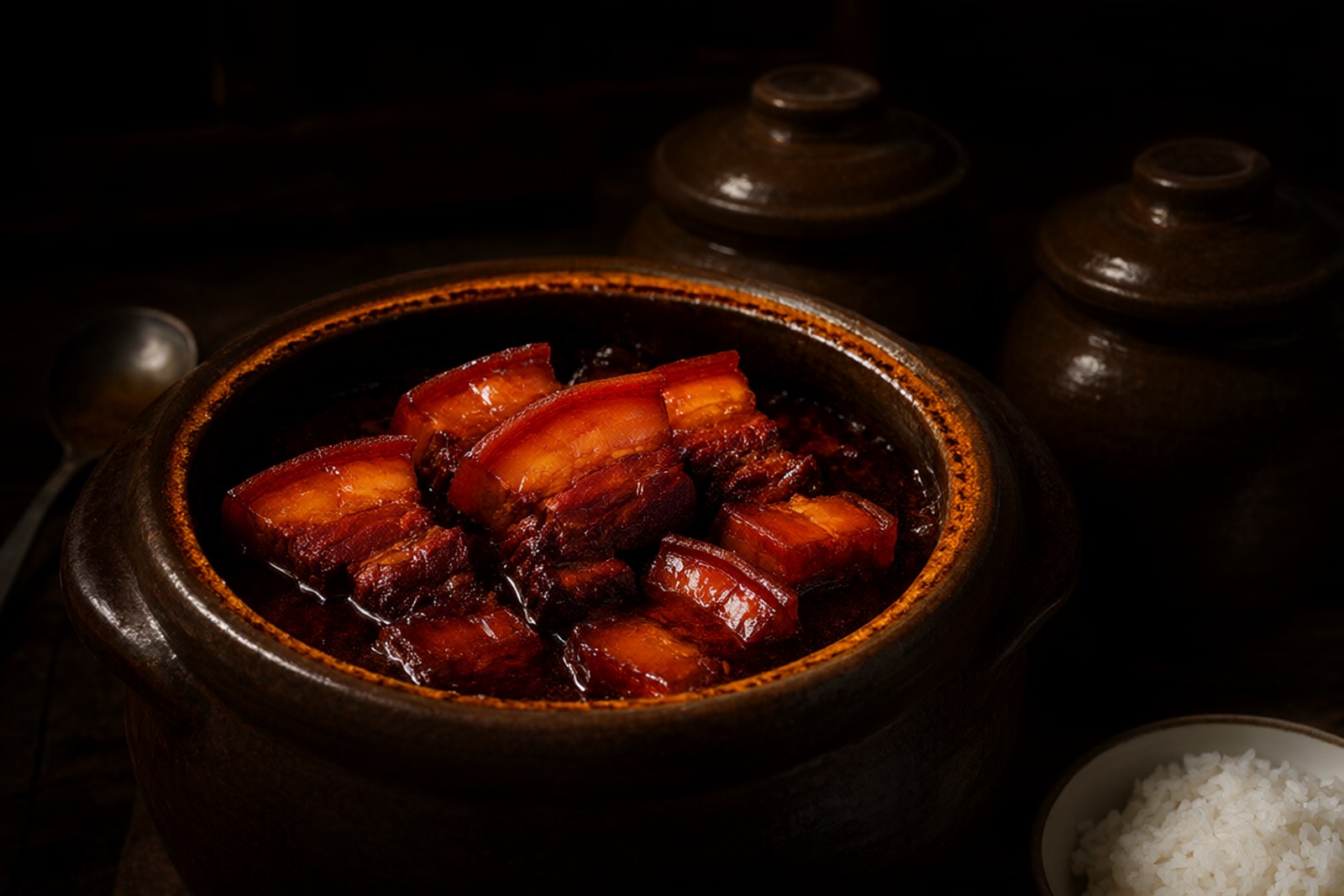
The story the county tells about its own dish involves a general. In the Three Kingdoms period, 赵云 Zhào Yún — Zhao Zilong — took the commandery of 桂阳 Guìyáng and, rather than letting his army strip the place, encouraged the farmers to raise pigs and plant more. The pigs grew fat. The farmers, who had lived through enough wars to be cautious about abundance, did not dare eat them all at once, and hit upon a method of preserving the meat in jars with salt and local chilli, which turned out to be delicious rather than merely durable. The dish got the general’s name attached to it, and one village in particular, 子龙郡 Zǐlóng Jùn, still claims to make the truest version. This is a legend with a suspiciously convenient moral about thrift and good governance, but it is also the sort of story a county keeps because it explains why the dish is emphatically not a banquet showpiece: it was invented by people who had too much of a good thing and no way to eat it fast.
What Makes It Work
The chilli is the engine and it is specific. 方元五爪辣椒 Fāngyuán wǔzhuǎ làjiāo — the five-claw chilli of Fangyuan township, so called for the way the fruit splits into fingers at the tip — is grown in the county and nowhere else at scale. It is dried, ground and fermented into a paste, and it does two jobs at once: it provides heat, and its acidity and salt pull water out of the pork so the meat firms up instead of turning to mush. The other component is 朝天龙 cháotiānlóng, a smaller, harder chilli used in the spicier “lean meat” variant.
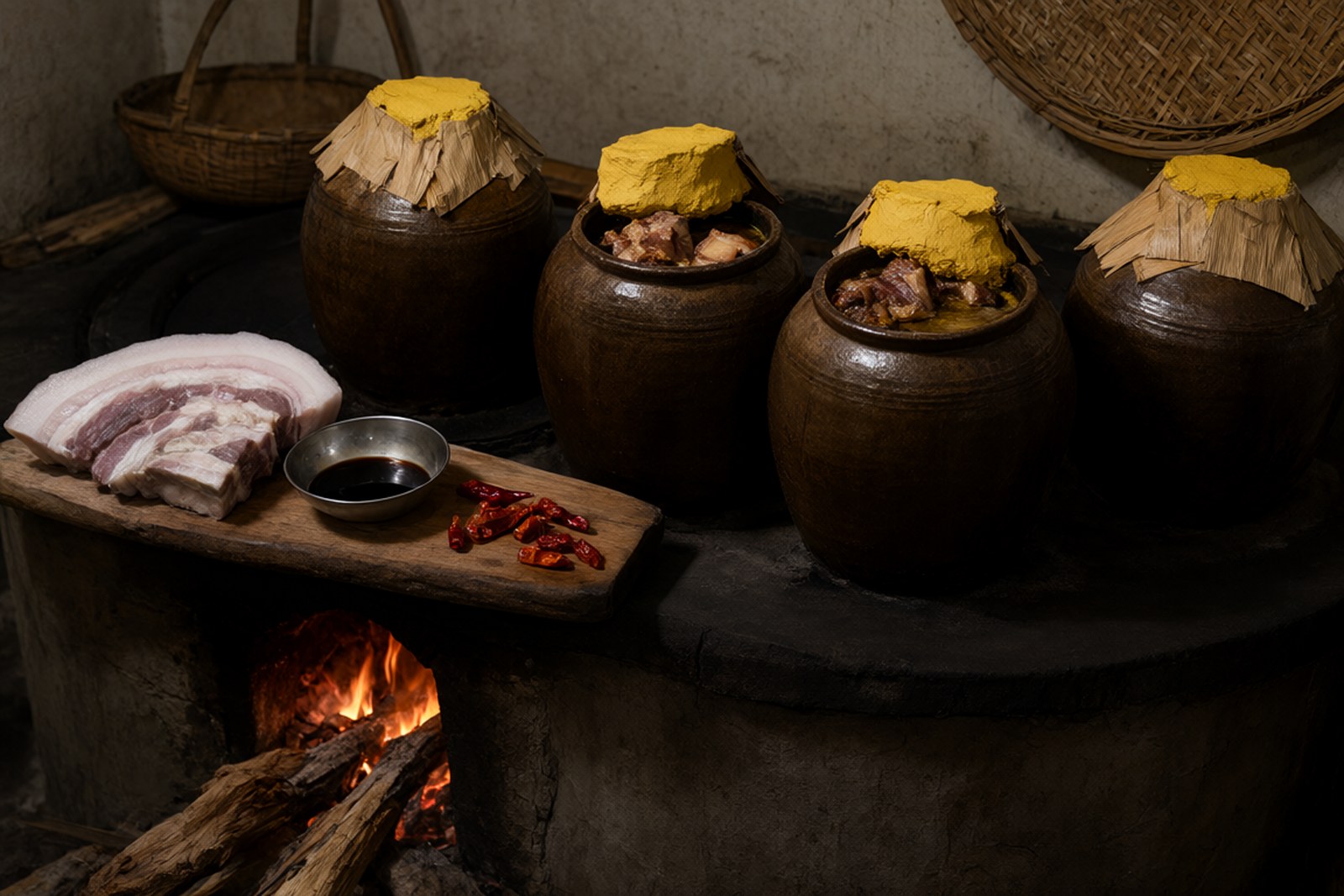
The pork is belly, cut into slabs with the skin on, blanched, then packed into the jar in alternating layers with the chilli paste, salt, a little rock sugar and sometimes a spoonful of rice wine. The jar is sealed and either left in a cool room for two to four months, or, in the faster modern method, buried in a bed of rice husks under a low smouldering fire for some hours. The slow version tastes noticeably better, and the county’s producers know it, which is why the labels that say 古法 gǔfǎ — traditional method — cost more.
Words and Names
坛子 tánzi is a jar, the wide-mouthed earthenware sort that in Hunan is used for pickling, brining and preserving; 坛子菜 tánzi cài is the whole family of jar-preserved foods and 坛子肉 is the meat member of it. The dish is also called 辣酱肉 làjiàng ròu, chilli-paste pork, which is arguably the more honest name. 五爪 wǔzhuǎ means five claws, and it turns up in the names of several Hunan chilli varieties, all of them named for the shape of the fruit. 桂阳 Guìyáng is the county; the same characters appear in a much larger city in Guizhou, so check which one you are buying from.
What the Locals Know
The dish is eaten in winter and at festivals, and the families who still make it do so in autumn, when the chillies are dried and the weather is cold enough that a jar left in a back room will not spoil. The commercial product is a different creature: cooked quickly, vacuum-packed, and shelf-stable, and while the big producers have improved it a great deal over the past twenty years, it has lost the specific sourness that slow fermentation gives.
Locals eat it in one of two ways. The first is straight from the jar, steamed, with plain rice. The second is as an ingredient: shredded into a stir-fry with garlic shoots, or used to flavour a soup of dried bamboo. The pairing that everybody in the county will suggest is 抖辣椒 dǒu làjiāo, mashed chilli from the neighbouring county of Anren, whose bright, fresh, sharp heat cuts through the fat and resets the mouth between mouthfuls. That combination — heavy and light, fermented and fresh — is the actual local logic of the table, and it is worth copying.
flowcloud would say that jar pork is a 1,800-year-old answer to a problem we have mostly forgotten: how to have meat in February, and how to make the waiting taste like something.
Where to find it: 桂阳县 Guìyáng Xiàn is an hour’s drive west of 郴州 Chēnzhōu, and the county town has a market hall where the jar producers sell directly. In the city, gift shops near the bus and rail stations stock several brands; the ones in clay rather than glass are the ones to buy.