
古劳 Gǔláo is a wetland on the west bank of the 西江 Xī jiāng, the West River, in the north of 鹤山 Hèshān, and it is a place of fish ponds, lotus, mulberry banks and banyan trees, worked by boat and crossed by stone slab bridges. It is also, per head of population, one of the most famous places in Guangdong for a single food, and that food is the 鱼皮角 yú pí jiǎo, the fish-skin dumpling. The name says what it is: a dumpling whose wrapper is not flour but pounded fish, so that the skin and the filling are both fish and the whole thing collapses into a single soft mouthful with no seam of dough anywhere in it.
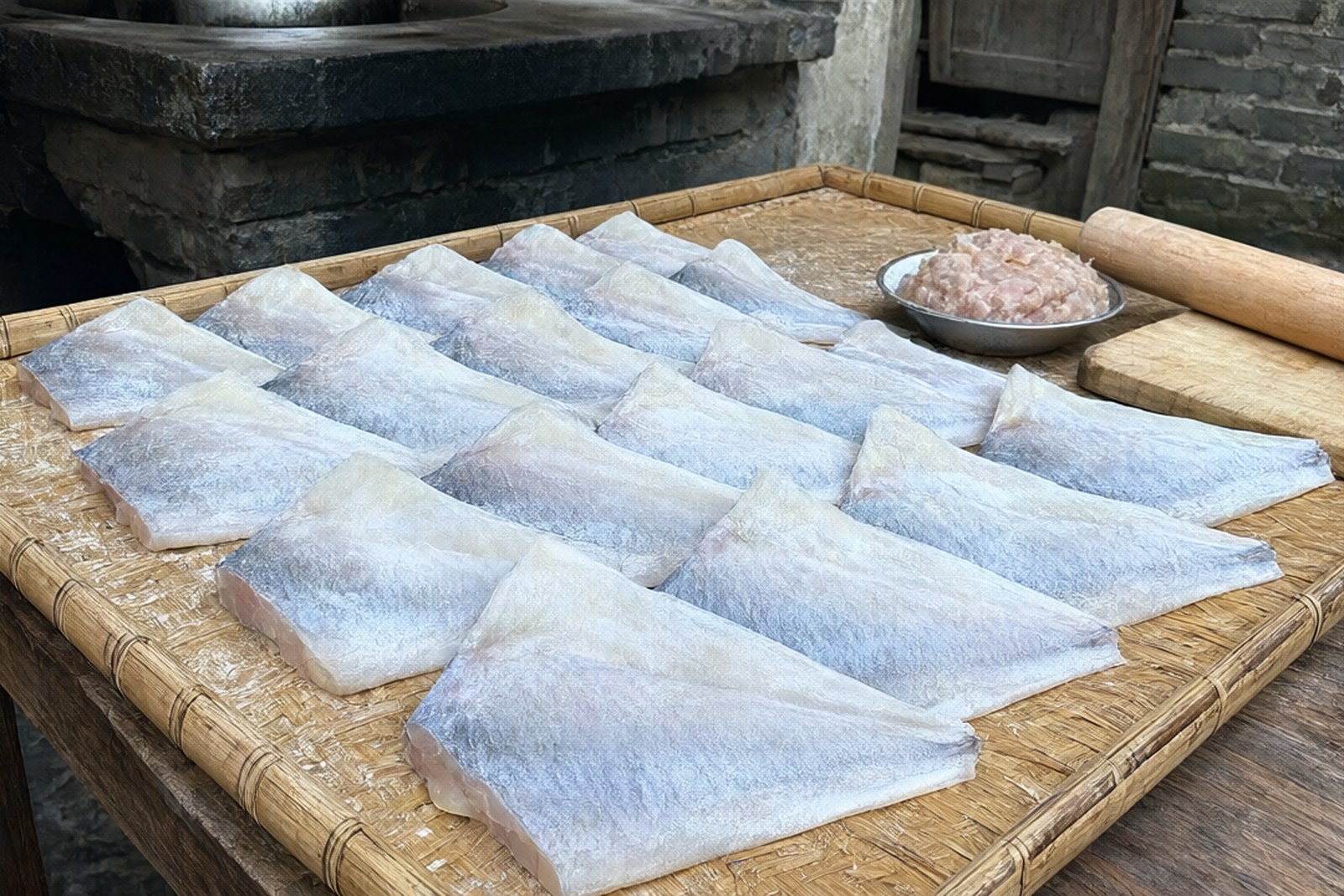
Making the wrapper is the hard part and the reason the dish has stayed in 古劳 rather than spreading. A 鲮鱼 líng yú, the mud carp that the ponds grow, is filleted, the flesh is scraped off the skin with a spoon, and the resulting paste is put on a wooden block and beaten – with a cleaver’s flat or a mallet – until it becomes elastic and slightly tacky. Salt and a little 生粉 shēng fěn, potato or corn starch, go in as it is worked, and after ten or fifteen minutes the paste can be rolled into a thin sheet like a soft leather, which is then cut into triangles. The filling is a mix of minced pork, a little of the same fish, 虾米 xiā mǐ, dried shrimp, and 头菜 tóu cài, preserved mustard root, seasoned with white pepper and a little sesame oil. The triangle is folded around the filling like a paper horn – 角 jiǎo is the horn or the corner, and that is the shape – and the dumplings are then poached in a light broth, not steamed, until they float.
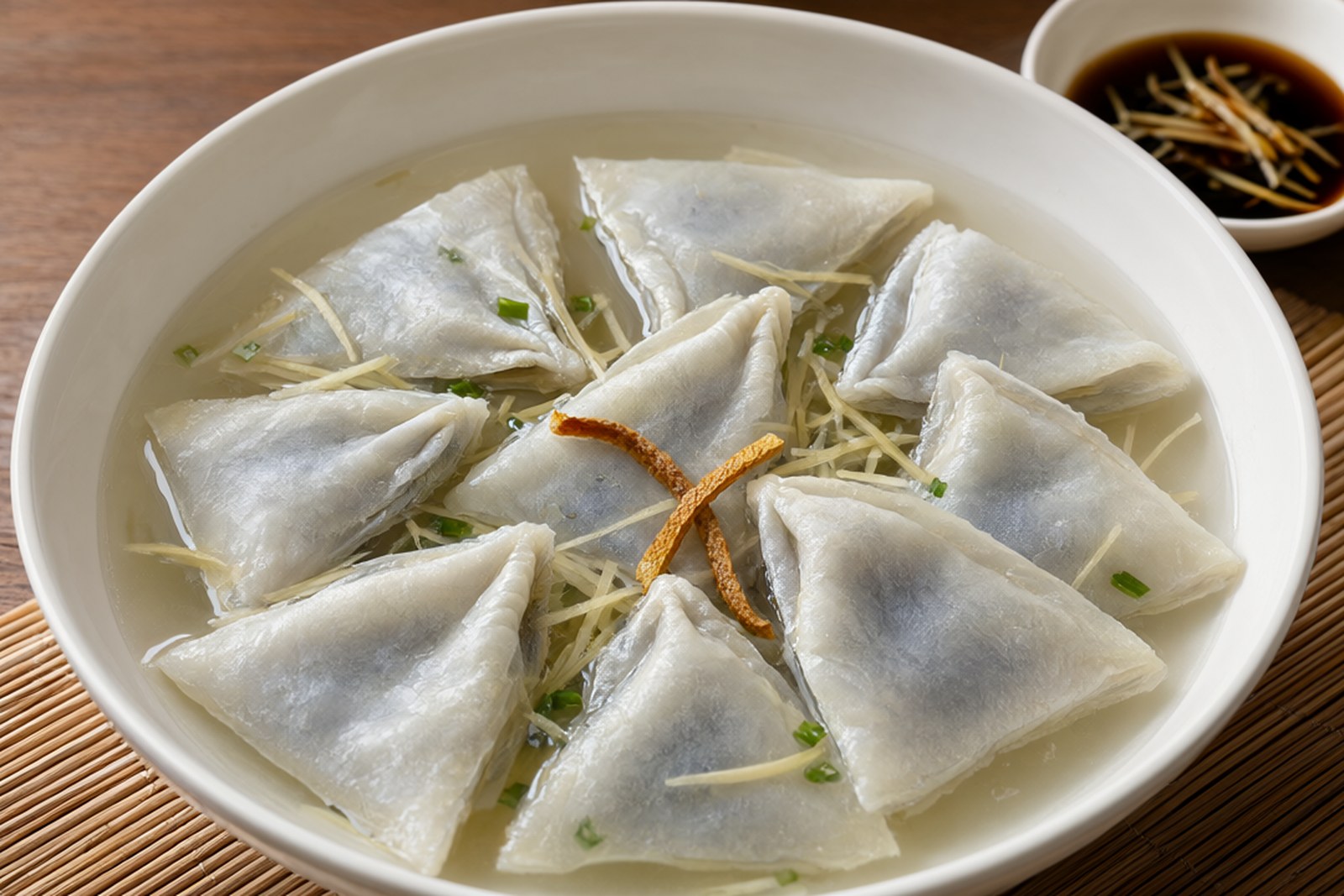
What you get at the table is a bowl of perhaps eight or ten pale dumplings in a clear soup, with shredded ginger, spring onion and a few threads of 陈皮 chén pí, and a saucer of light soy with more ginger. Because the wrapper is fish, it is softer than a wheat dumpling and has a faint bounce; because there is no dough, the dumpling cooks in ninety seconds and overcooks just as fast, which is why they are made to order in a shop and never held. 古劳 restaurants serve them two ways: in soup, which is the classic, and 煎 jiān, pan-fried with a little oil until the base of each one is browned, which is a modern variation that the older cooks regard as a waste of the broth. Alongside the dumplings the village sells 鱼球 yú qiú, fish balls made from the same paste and thrown into soup with 丝瓜 sī guā, the ridged loofah gourd, and 塘虱 táng shī, pond catfish, braised with black beans.
Words and Names
鱼皮角 yú pí jiǎo is the fish-skin dumpling, 鱼 yú being fish, 皮 pí skin and 角 jiǎo the horn shape; 鱼球 yú qiú is a fish ball from the same paste. 鲮鱼 líng yú is mud carp, the pond fish the paste is made from, and 生粉 shēng fěn the starch that holds it together. 西江 Xī jiāng is the West River that floods the wetland, 古劳 Gǔláo the village and 鹤山 Hèshān the city it belongs to. 头菜 tóu cài is preserved mustard root and 丝瓜 sī guā the loofah gourd cooked with the fish balls.
What the Locals Know
A good 鱼皮角 is eaten within ten minutes of being made, so order it only in the morning or at lunch, when the kitchen is still beating paste; in the evening what you get is often yesterday’s, which shows as a wrapper that is slightly tough at the edge. Ask to see a raw one before it is cooked, and press it: it should be soft and faintly springy and should not tear at the fold. If you like the dumpling, buy the raw paste instead and take it home, because 古劳 fish paste freezes well and can be used for 鱼滑 yú huá, the paste poached in spoonfuls in soup, or as the wrapper for anything you would otherwise wrap in dough. And eat the dish in 古劳 itself: twenty minutes away in 鹤山 city the same name is on menus at twice the price and half the freshness.
flowcloud would say that a dumpling with no dough in it is a dish that exists to prove a point about the water, and that a village which beats fish paste with a cleaver until it can be rolled like leather is doing with its hands what the delta has always done with its geography.
Where to find it: the 古劳水乡 Gǔláo shuǐ xiāng lanes and pond-side restaurants of 古劳镇 Gǔláo zhèn, in the north-west of 鹤山市 Hèshān shì, ten minutes by taxi from the town centre and about an hour by bus from 江门. A bowl of 鱼皮角 in soup is ¥15 to ¥30 and a jin of the raw paste ¥30 to ¥50. Order in the morning, take the boat through the ponds first, then eat the dumplings in soup with a plate of 鱼球 and a braised 塘虱, and finish with lotus seed soup, which the same ponds supply.