
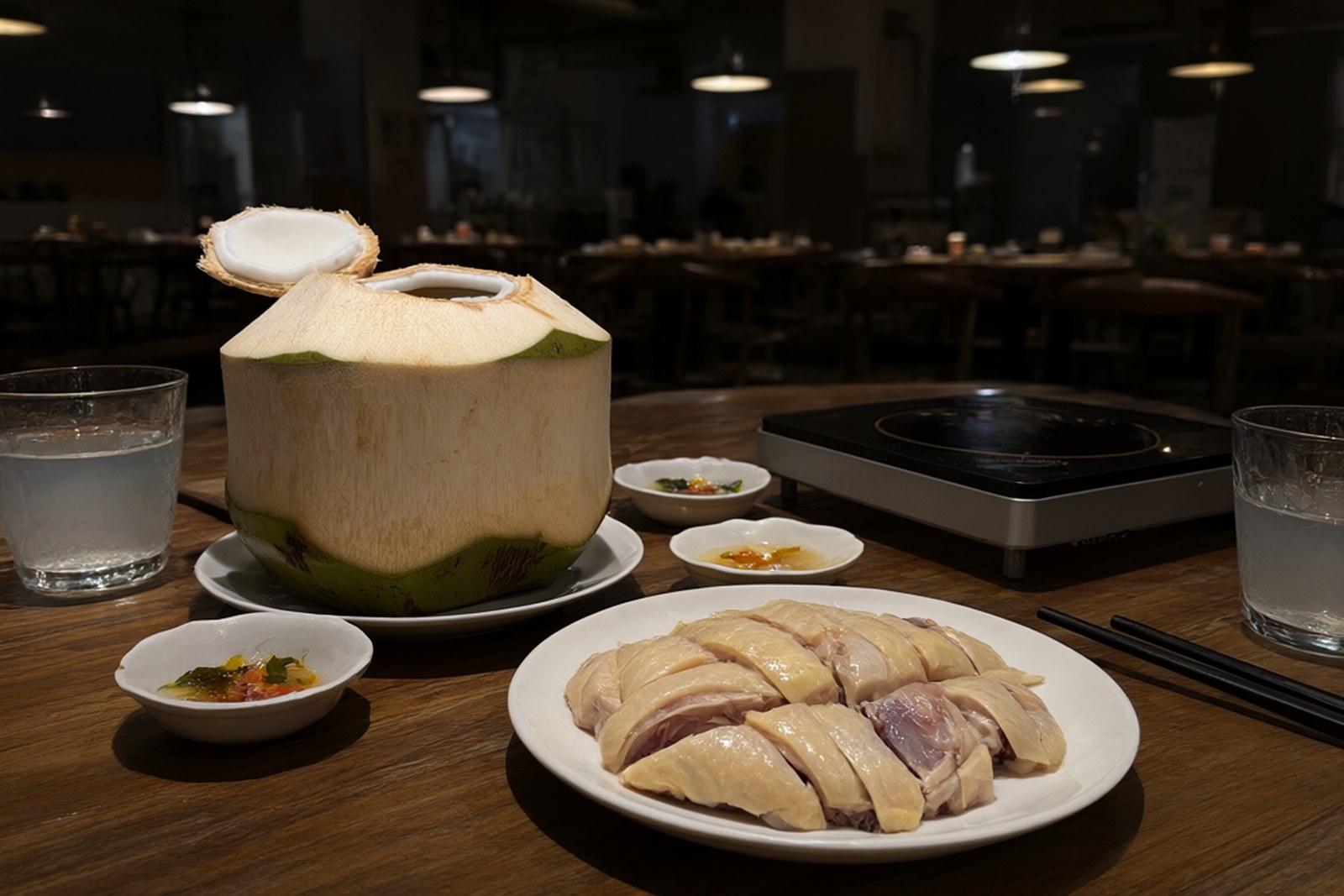
The pot comes to the table as two things that have not met yet. On one side is a pot of clear liquid, brought to a hard boil in front of you, and it is coconut water — not stock, not broth, just the water drained out of green coconuts, sometimes with a few pieces of the soft flesh floating in it. On the other side is a plate of raw chicken, jointed into pieces, skin on, pale yellow and firm. Someone tips the chicken into the boiling water, puts the lid on, and sets a timer. Six minutes later the lid comes off and the pot is coconut chicken: 椰子鸡 yēzi jī, the dish that Hainan exports to the rest of China and that Haikou eats in enormous quantities, at long communal tables, with the air conditioning turned up.
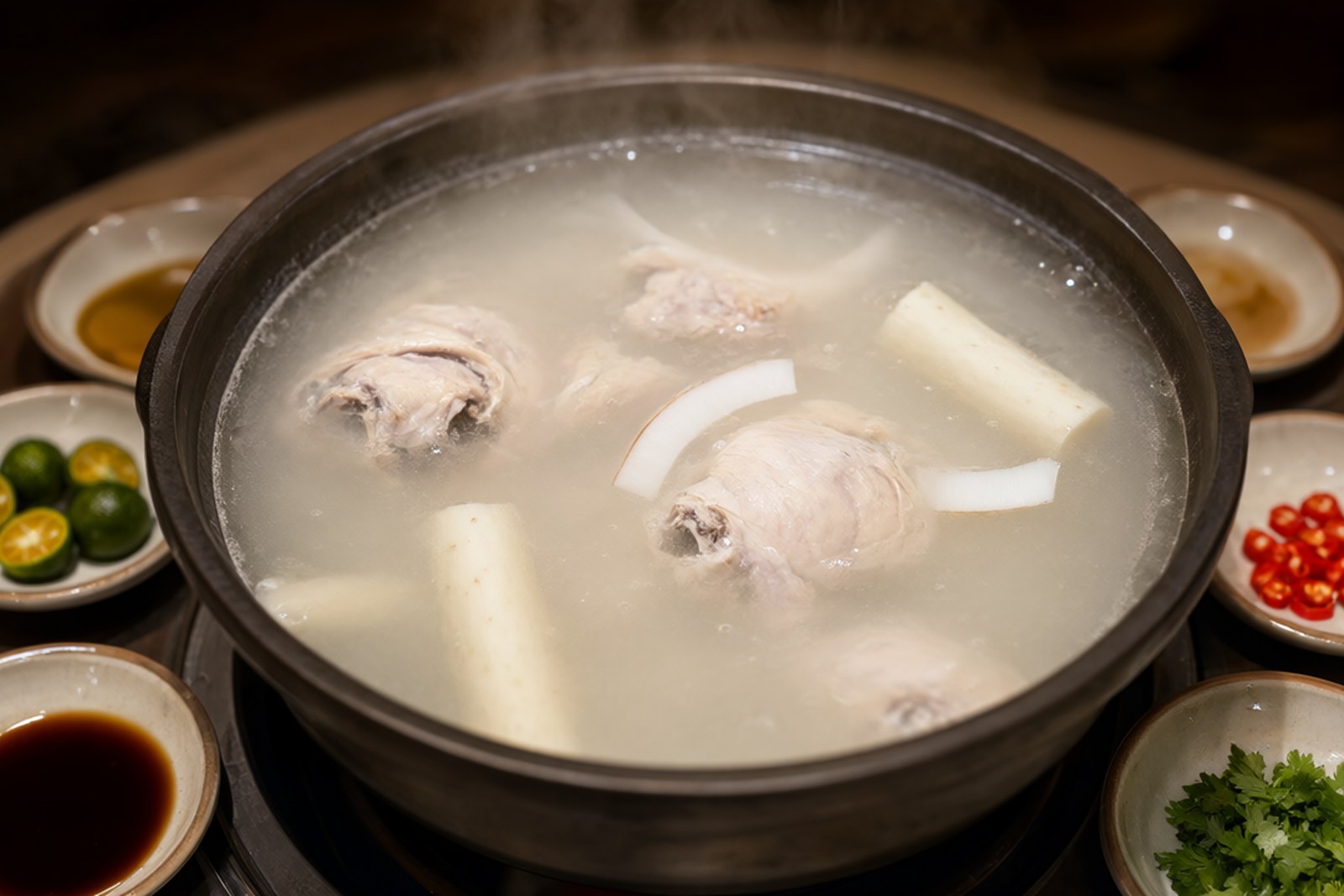
What makes it work is a piece of arithmetic. Coconut water is sweet, faintly saline, and almost fatless; chicken poached in it gives up its own fat and savour into the liquid, and the liquid gives the meat back a sweetness it did not have. Cook it too long and the meat goes stringy and the broth becomes a stew. Cook it for the six minutes a Hainanese restaurant will tell you, and the meat is just set at the bone, the skin slightly gelatinous, and the coconut water in the pot has turned into something that tastes of both. Then the pot is drunk, not discarded. Mugs are filled and passed around, and it is the broth rather than the chicken that people come for.
The Chicken and the Sauce
The bird is where the argument lives. 文昌鸡 Wénchāng jī, the chicken from Wenchang on the island’s northeast coast, is the traditional choice and the name you want to see on the menu: a slow-grown free-range breed with yellow skin and a good layer of subcutaneous fat, raised to a set of local expectations and sold at several times the price of an ordinary bird. Restaurants that use it will say so loudly. Restaurants that do not will use 三黄鸡 sānhuángjī or a generic free-range chicken, which is not a disaster — the coconut water is forgiving — but the meat is leaner and the skin less fragrant. Fresh birds are cut to order; frozen ones are detectable immediately, because freezing breaks the texture and the pieces go watery in the pot.
The dipping sauce is not an afterthought; it is the other half of the dish, and every table gets a small bowl of soy sauce and a set of things to put in it. The constants are 沙姜 shājiāng, sand ginger, a small aromatic root with a flavour somewhere between ginger and camphor, chopped fine and stirred into the soy; 小青桔 xiǎo qīngjú, the small green calamansi limes that grow all over the island, squeezed in at the table until the sauce is sharp; and fresh chili, either chopped or as a 辣椒酱 làjiāo jiàng on the side. Some places add garlic, some add a spoon of the coconut broth, and a few add 香菜 xiāngcài, coriander, which divides people. The correct sequence is to dip the chicken, then drink a mouthful of the pot, then dip again.
Words and Names
椰子鸡 yēzi jī is the dish and 椰子鸡火锅 yēzi jī huǒguō the hotpot version, which is what is almost always served. 文昌鸡 Wénchāng jī is the breed and the regional brand. 沙姜 shājiāng is sand ginger, also called 山奈 shānnài; 小青桔 xiǎo qīngjú are the small sour limes, sometimes written 青金桔 qīng jīn jú. 椰青 yē qīng is the whole green coconut you drink from a straw, 椰肉 yē ròu the soft flesh inside it, and 老椰子 lǎo yēzi a mature brown coconut, whose water is used when a stronger flavour is wanted. 竹笙 zhúsheng is the bamboo fungus that most tables add to the pot, and 马蹄 mǎtí water chestnut, 玉米 yùmǐ sweetcorn and 珍珠马蹄 are the other near-universal additions.
What the Locals Know
Order the pot, then order the sides in the order you want to cook them, because the broth changes as you go. Vegetables that release starch — corn, taro, potato — go in late or they cloud the coconut water and you lose the reason for the whole meal. The chicken goes in first and is eaten first, and the second round of broth, after the vegetables have been in, is considered by many locals the best part. Ask for 文昌鸡 by name and check the price before ordering, because it varies by a factor of three between restaurants. The best tables do not need rice; the pot itself is the food. Expect to pay somewhere between eighty and two hundred yuan for two people depending entirely on the bird, and expect the restaurant to be busy without booking from about six in the evening.
flowcloud would say that coconut chicken is the rare hotpot that argues for restraint, since everything it needs is already in the pot and the entire technique is knowing when to take the lid off.
Where to find it: the clusters of 椰子鸡 restaurants along 国贸 Guómào and 世贸 Shìmào in the newer part of the city, and the older establishments near 府城 Fǔchéng in the south. Look for a menu that names 文昌鸡 and a table with a built-in induction ring, ask for 沙姜酱油 and squeeze the little limes yourself, and drink the broth between courses rather than at the end.