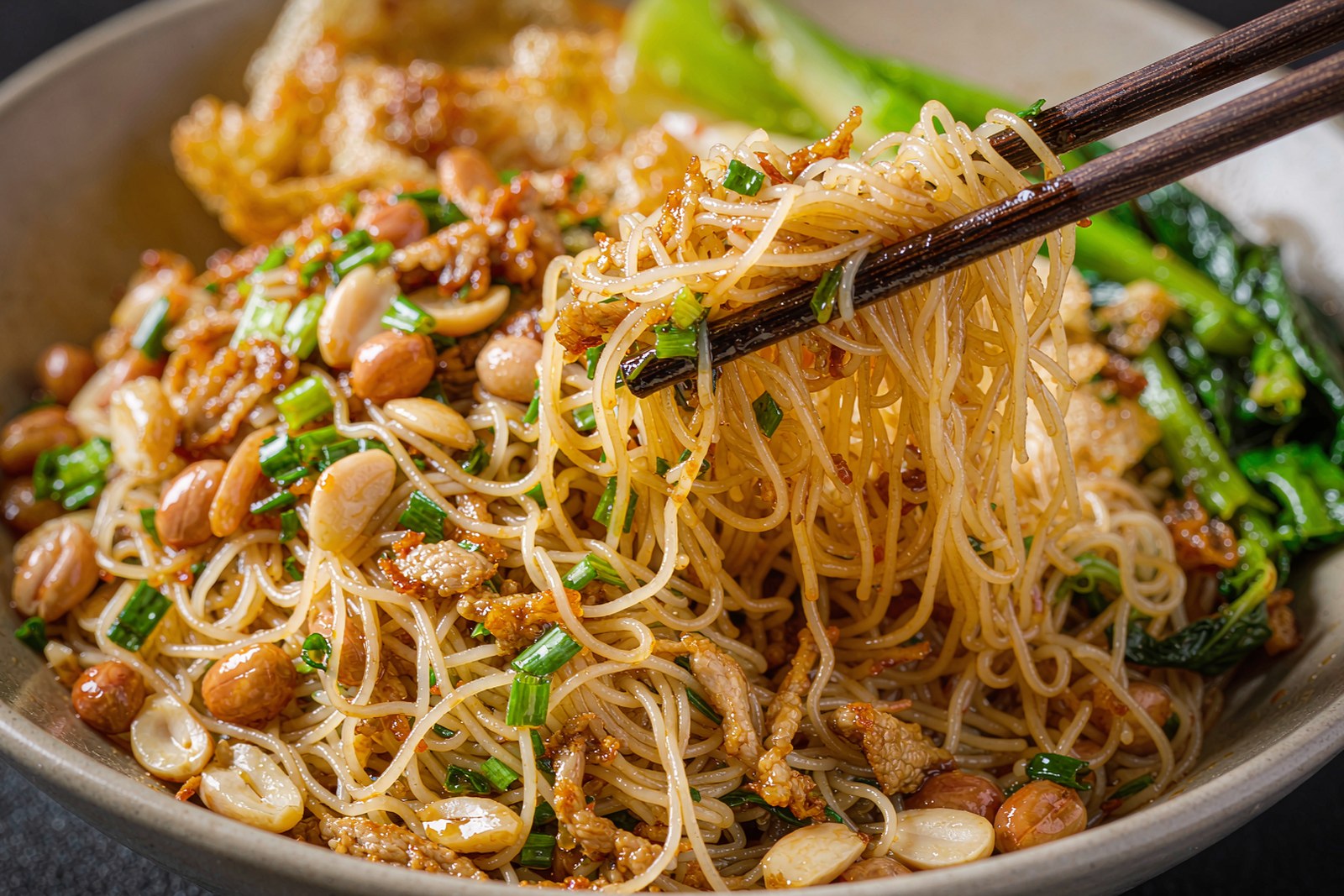
Hainan Fen
The bowl arrives dry-looking, which is the first surprise. Fine white rice noodles sit in a neat mound, and on top of them is a small landscape — peanuts, pickled bamboo shoot, shredded pork, a few crisp-fried pieces, some dried shrimp, a scatter of scallions. There is no broth in sight. It looks like a salad, and the person who serves it knows exactly what you are thinking.
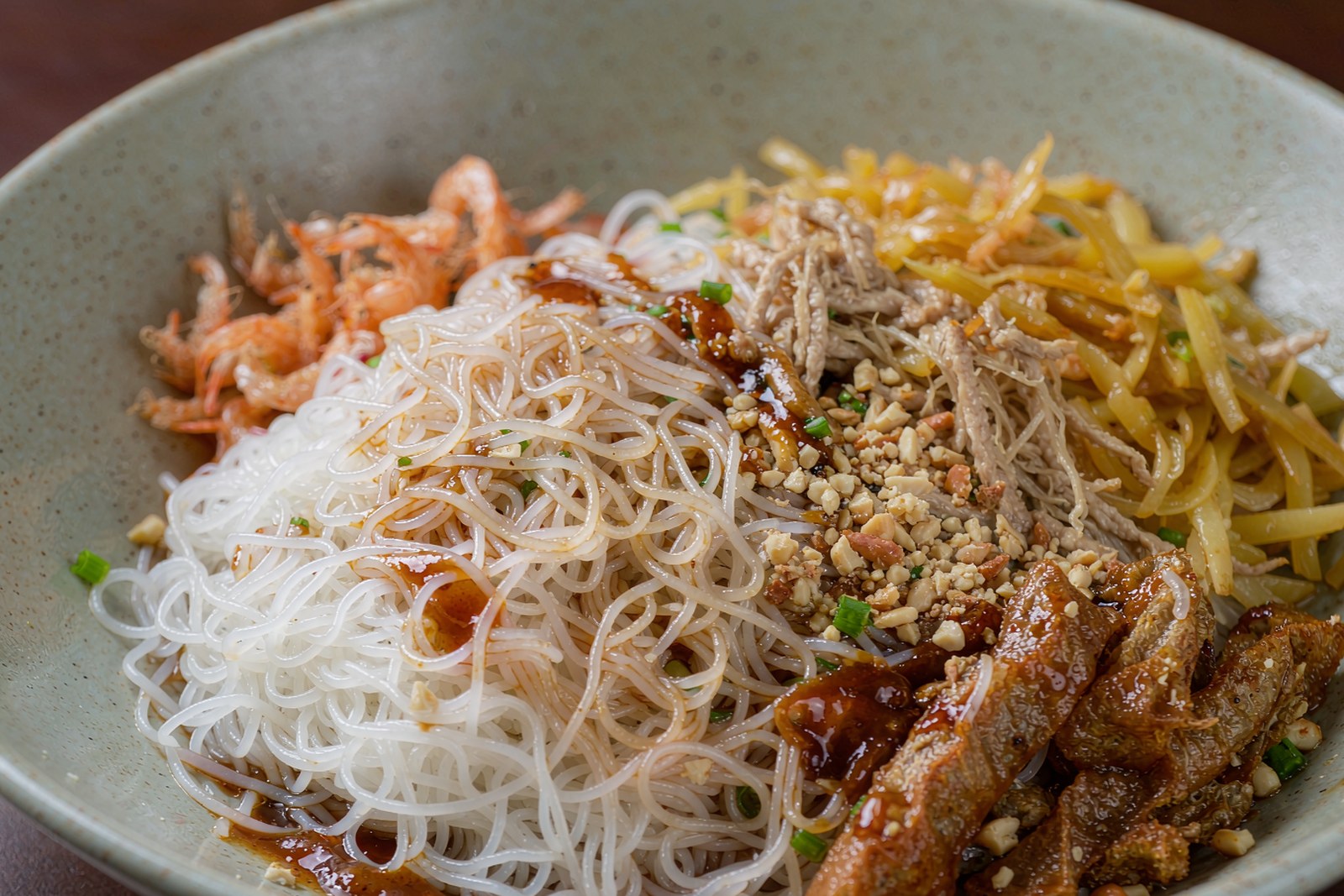
Then they pour a spoonful of dark amber sauce over the top, and everything changes.
This is 海南粉 (Hǎinán fěn), the province’s own signature rice noodle, and it is the dish that gave Hainan its daily rhythm. Every place in China has a noodle it calls its own; 海南粉 is the one that a whole province is named after, and the one that — for the people of 海口, at least — is the quiet reference point against which all other Hainan noodles are judged.
A Noodle with a History Longer Than the Province
海南粉 is not called 海口粉 even though it is most associated with the capital, and the reason matters. The name is bigger than any one city because the noodle is bigger than any one city.
The tradition goes back to the 明代 (Míng Dài, Ming dynasty) and the migration of people from 闽南 (Mǐnnán, southern Fujian) to the island. The 正德琼台志, the earliest surviving Hainan gazetteer, records a Chen family craftsman who came to 澄迈 (Chéngmài) old town and made a living making noodles — and that the craft took root and spread. By the 清代 (Qīng Dài) there were noodle workshops in all 121 of the island’s market towns. The noodle took the island’s name, 海南粉, because it belonged to the island, not to any one city, and because by the time the dish was fully formed, 海口 had become the place where everyone came to — the capital, the port, the meeting point — and where a bowl of 海南粉 was what every visitor and every native gravitated toward.
In 2009, the making of 海南粉 was added to the Hainan provincial list of intangible cultural heritage, which confirmed what the island already knew: that this is not a snack, it is a craft, passed down through families.
The Thirty-Hour Noodle
The noodle itself is the slowest part of the dish, and there is no shortcut.
The rice is a good 籼米 (xiānmǐ, indica rice), washed and then soaked in water — and here is the number that matters — for roughly thirty hours, a full day and a half, until the grains are swollen and saturated. It is then ground on a stone mill into a fine slurry, and the slurry is put into a cloth bag and pressed and pressed, squeezing out the water, until a smooth, dense paste remains. That paste is pushed through tiny holes to form fine threads — 细如银丝, as fine as silver thread — which are blanched in boiling water and then plunged into cold water to set.
The result is a noodle that is strikingly fine compared to the other Hainan noodles, almost threadlike, and with a soft, slightly springy texture that is the ideal vehicle for the sauce. The old makers say it cannot be hurried: 急火做不出好粉, “you cannot make a good noodle over a fast fire.”
The Sauce, and the Twelve Toppings
What makes 海南粉 distinct from 抱罗粉 or 后安粉 is that it is not a soup. The classic way to eat it is 腌 (yān, “dressed” or “pickled”) — the dry-mix method.
The dressing is a thick, dark, glossy sauce — 卤汁 (lǔzhī), a seasoned and thickened gravy — built on a pork-bone base and simmered with various seasonings. The most celebrated modern version, from the 罗家杏 family’s 海南粉 shop, is said to add 党参 (dǎngshēn) and 当归 (dāngguī), a couple of traditional medicinal herbs, which give the sauce a subtle sweet aftertaste — 甜而不腻, sweet without being cloying.
Then the toppings, which the old 海口 hands describe as a balancing act of about twelve tastes and textures:
- 油炸花生米 — fried peanuts, for crunch
- 酸笋 and 豆芽 — pickled bamboo shoot and bean sprouts, for the sour and the fresh
- 牛肉干 — strips of dried beef, chewy and savoury
- 虾片 — crisps of dried shrimp
- 肉丝 — shredded pork
- 炸面片 — crisp-fried dough pieces
- 蒜蓉油 and 芝麻 — garlic oil and sesame
- 黄灯笼椒酱 — the yellow lantern chilli paste, to add heat
You mix it with your chopsticks until every strand is coated, and you eat it as a dry noodle. And then you do the second thing, the one that the locals call 先拌后汤 — “mix first, then soup.” When the noodles are gone, you take a scoop of 海螺清汤 (hǎiluó qīngtāng, a clear whelk broth) and you pour it into the bowl, and you drink what is left, which by then has absorbed all the flavour of the sauce and the toppings. It is two dishes in one bowl, and it is the mark of a proper 海南粉.
The Old Shops on the Old Streets
海南粉 is at its best in 海口’s old streets, and the two shops you will hear about more than any others are the 骑楼老街 (Qílóu Lǎojiē, the arcade old street) institutions.
亚妹正宗海南粉店 is the grand old name. It began in the 1950s with 潘亚妹’s father, who carried his noodles on a shoulder pole through the streets of 海口, selling them from the roadside — 挑着担 (tiāozhe dàn). In the 1980s, 潘亚妹 took over and opened a shop, and it became one of the most famous 海南粉 houses on the island. Today she is in her seventies and the shop has passed to her son 阿甘. It sits at 新民西路 64号, in the 骑楼老街.
黄氏二老海南粉店 is the other one, older in the shop sense — opened in 1983 on 文明中路, next to the 宏翔大厦, by 郑鸿军’s parents. The name 黄氏二老 (“the two 黄 elders”) honours the founders, and the shop is run today by their daughter 郑鸿军, a famously forthright woman whom the regulars love for exactly that. It opens at 6 a.m.; the staff are at the stove from four, making the sauce. Unless it is Spring Festival or a typhoon, it does not close.
Both shops are the kind of place where the same people have eaten the same bowl for thirty years, and both are worth the queue.
What the Locals Know
- Order it 腌, not as a soup. The dressed dry-mix is the authentic 海南粉; a brothy bowl is a different dish.
- Do the 先拌后汤. Eat the noodles, then pour the 海螺清汤 into the empty bowl and drink what is left.
- Add the yellow chilli in stages. The 黄灯笼椒 paste is hot; a little goes a long way.
- The pickled bamboo shoot is the sour. Do not pick it out — it is the counterpoint to the sweet sauce.
- Go to the arcade street for the old shops. 亚妹 on 新民西路 and 黄氏二老 on 文明中路 are the two reference points.
The Name
海南 (Hǎinán) is the island, and 粉 (fěn) means noodles. The name means simply “Hainan noodles,” and it is used across the island to mean this specific fine, dressed noodle — not any noodle in Hainan. The distinction is the point: when a 海口 person says 海南粉, they mean this one, the fine noodles in the dark sweet-savoury sauce, the province’s own dish. 海口 has dozens of noodle genres; 海南粉 is the one that belongs to the island itself.
flowcloud would say that a noodle named after an entire province is a heavy burden, and that the only way to carry it is to keep making the sauce the same way for fifty years — which is exactly what the old shops on the old streets did.
Where to find it: In 海口’s 骑楼老街 (Qilou Old Street) — 亚妹正宗海南粉店 at 新民西路 64号 (open since the 1950s, hand-carried on a shoulder pole by 潘亚妹’s father), and 黄氏二老海南粉店 on 文明中路 (opened 1983, open from 6 a.m.). Fine thirty-hour-soaked rice noodles dressed in a dark sweet-savoury sauce with peanuts, pickled bamboo shoot, shredded pork, dried beef, dried shrimp, crisp-fried dough and yellow lantern chilli. Around ¥10 a bowl. Eat it 腌, then pour the 海螺清汤 into the empty bowl and drink it.