
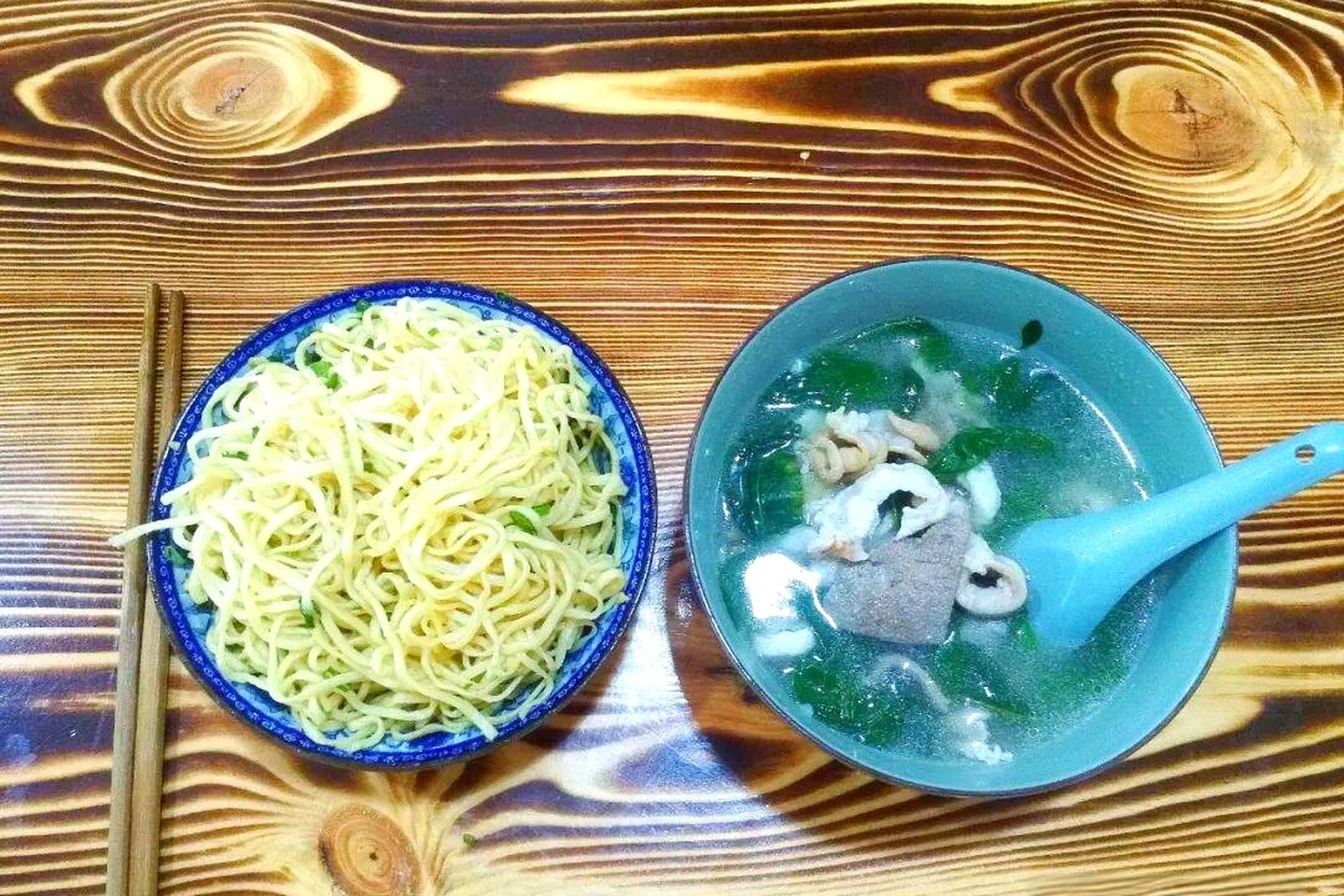
Breakfast in 梅州 Méizhōu is a bowl of noodles and a bowl of soup, and the noodles are the one that gets argued about. 腌面 yān miàn is wheat noodles, boiled and drained, then tossed while still hot with pork lard, dark soy sauce, a spoonful of fried shallot and a little sugar, and eaten within about two minutes of leaving the pot. It is not a soup noodle and it is not a stir-fry. Nothing is cooked into it; the sauce is assembled under it and the whole thing is stirred at the table until every strand is coated. The noodles are the thick, slightly springy 碱面 jiǎnmiàn made with an alkaline water that gives them a faint yellow cast and a bite that ordinary wheat noodles do not have. A bowl costs eight to twelve yuan and the stall will assume you want 三及第汤 sān jí dì tāng beside it, which is the pork-and-liver soup described elsewhere on this site. Order one without the other and you will be asked twice whether you are sure.
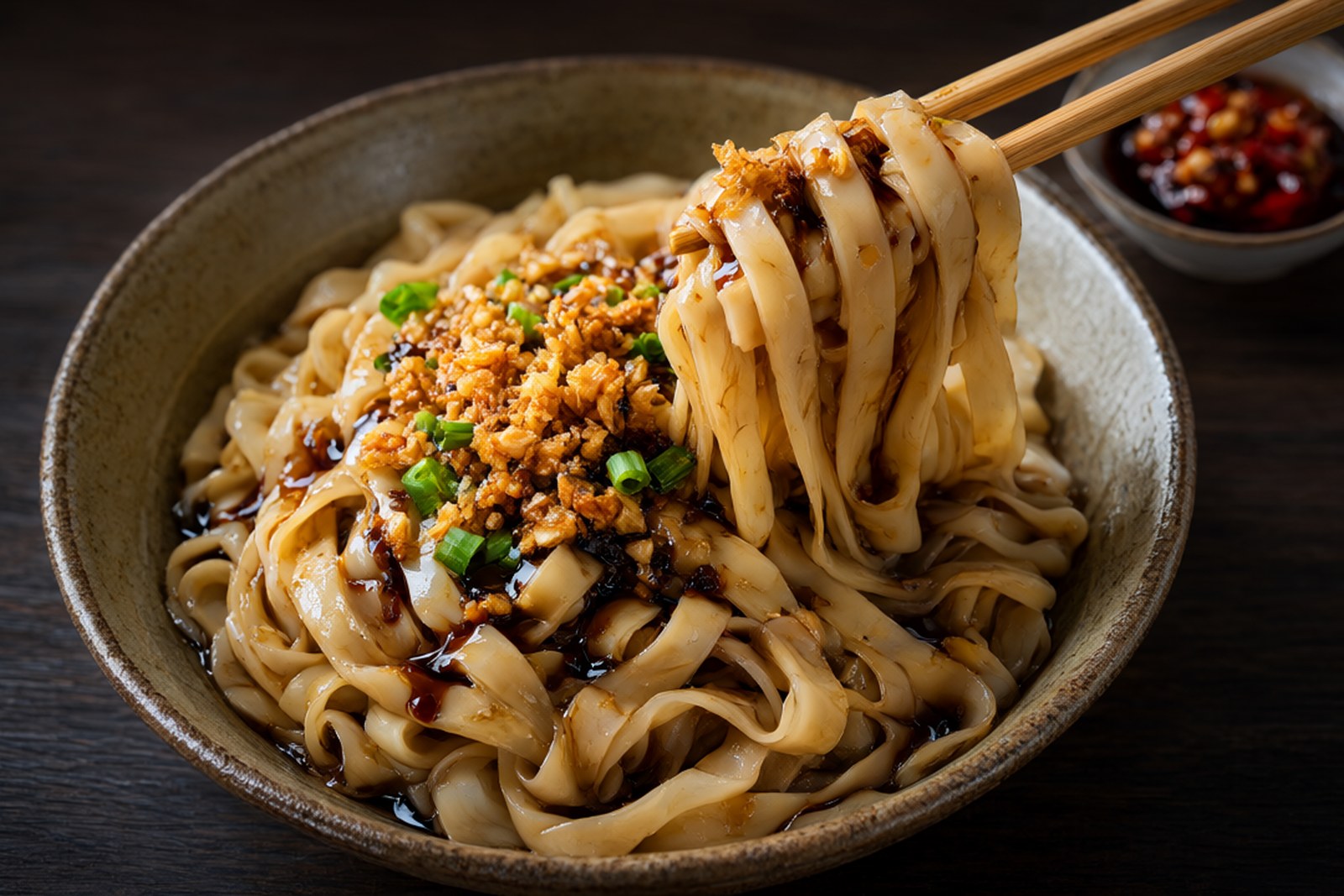
The noodles matter more than they look. 碱面 is made with a dough that has been rested long enough to develop gluten, rolled thick and cut square rather than round, so the strands hold sauce on four flat faces instead of one curved one. They are blanched to order, not held; a bowl of 腌面 that has been sitting in a colander for ten minutes is a different and much worse dish, because the surface dries and the lard no longer adheres. Cooks work in a rhythm that looks careless until you notice that each bowl is drained, shaken twice, tipped into a bowl already holding the soy and lard, and sent to the table before the next one goes into the water.
The dressing is where houses differ, and locals have opinions. The base is always lard, rendered from pork fat and kept warm, because it carries aroma in a way that vegetable oil does not. Fried shallot or fried garlic follows, and both are common; some stalls add a pinch of five spice, some a spoon of minced pork cooked in soy, and a few add nothing else at all. The soy is usually a light one, not the heavy dark sauce of a braised dish, and there is often a small amount of sugar to round it. 葱花 cōnghuā, the chopped spring onion, goes on last and is meant to stay crisp. What is not in it: no chilli unless you ask, and no vinegar at all.
A Northern Noodle in a Rice Province
The obvious question about 腌面 is why the Hakka of northeast Guangdong eat wheat at breakfast at all, in a province that grows two rice crops a year. The answer is that the Hakka are migrants, and the migration carried a wheat habit south. The ancestors of the 客家 Kèjiā, the guest families, moved out of the north in several waves from the Tang onward, and they arrived in the hills of what is now 梅州 with a preference for noodles that rice does not satisfy. Wheat does not grow well in the subtropical hills, so the flour was historically imported and noodles carried a small premium; they were a breakfast and a treat rather than a staple. That is why the dish is plain. It was never a vehicle for expensive ingredients, and the whole aesthetic is one of making a little lard and a lot of shallot taste like something worth waking up for.
The pairing with 三及第汤 is the other half of the story. The soup is a quick poach of pork liver, lean pork and small intestine in a clear broth, and it is on the same stall, in the same bowl size, at the same hour. The combination is roughly the local equivalent of coffee and a pastry: the dry noodles carry the flavour, the soup carries the liquid and the protein, and eating one without the other is considered incomplete rather than wrong. Stalls in 梅城 Méichéng, the old city, run from about six in the morning until the noodles sell out, which in a busy lane can be before nine.
Words and Names
腌面 yān miàn is the dish: 腌 yān here means to dress or to cure by tossing with seasoning rather than to pickle, and 面 miàn is noodles. 碱面 jiǎnmiàn is the alkaline wheat noodle used for it, 碱水 jiǎnshuǐ the alkaline water in the dough. 猪油 zhūyóu is pork lard, 生抽 shēngchōu light soy sauce, 蒜蓉 suànróng minced garlic, 葱 cōng spring onion and 葱花 cōnghuā the chopped green. 客家 Kèjiā is Hakka and 梅城 Méichéng is the old city of Meizhou. 三及第汤 sān jí dì tāng is the accompanying soup, and 梅江 Méi Jiāng the river the city is named for.
What the Locals Know
Go before eight, because the noodles are cooked to order and by nine the good stalls have run out of the fried shallot even if they still have noodles. Ask for the lard to be mixed in the kitchen rather than at the table if you like it thoroughly coated; some stalls bring the lard separately so the customer can control it, which is friendlier to first-timers but gives a less even bowl. If you want the full local order, say 一个腌面一个三及第 yī ge yān miàn yī ge sān jí dì, one of each. Prices are eight to twelve yuan for the noodles and similar for the soup, and there is rarely a menu in English, so pointing at what the next table has is a perfectly respectable strategy. The dish does not travel: 腌面 is a Meizhou breakfast, and outside the Hakka country the same words usually produce something else.
flowcloud would say that 腌面 is the clearest proof that a cuisine is a history rather than a landscape, since the hills grow rice and the breakfast is wheat, and the reason is a migration that ended eight hundred years ago.
Where to find it: the breakfast stalls of 梅城 Méichéng and the lanes around 江北 Jiāngběi in 梅州市, where the noodle pots and the soup pots stand side by side from about six in the morning. Order one 腌面 and one 三及第汤, eat the noodles first while they are hot, and do not ask for the lard to be left out unless you actually want a plain bowl of noodles.