
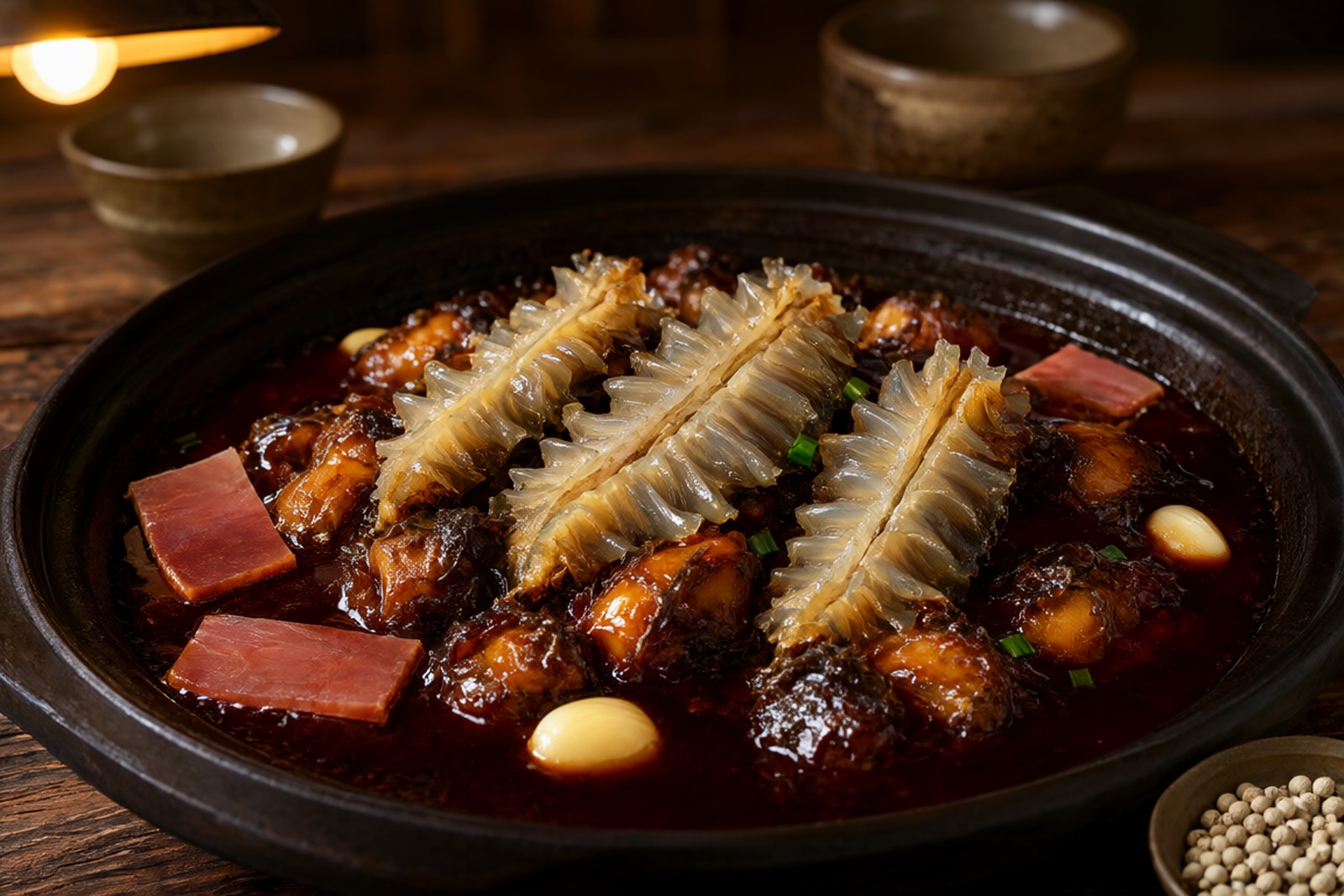
The bowl is brought to the table still bubbling and the thing in it does not look like an animal by the time it reaches you. What you see is a dark, glossy mass of gelatinous edges and firm pale meat in a thick soy-red sauce, with a few cloves of garlic and a piece of ham buried in it, and a smell that is rich and slightly sweet and unlike anything else on a Chinese table. The best part is not the meat, it is the 裙边 qúnbiān — the soft, frilled edge of the shell, which cooks down to a translucent, trembling jelly that has no texture equivalent in European cooking: it is what a very good braised tendon wants to be. 汉寿甲鱼 Hànshòu jiǎyú, the softshell turtle of Hanshou, is the banquet dish of the West Dongting wetlands, and it has been the pride of this county for well over a century.
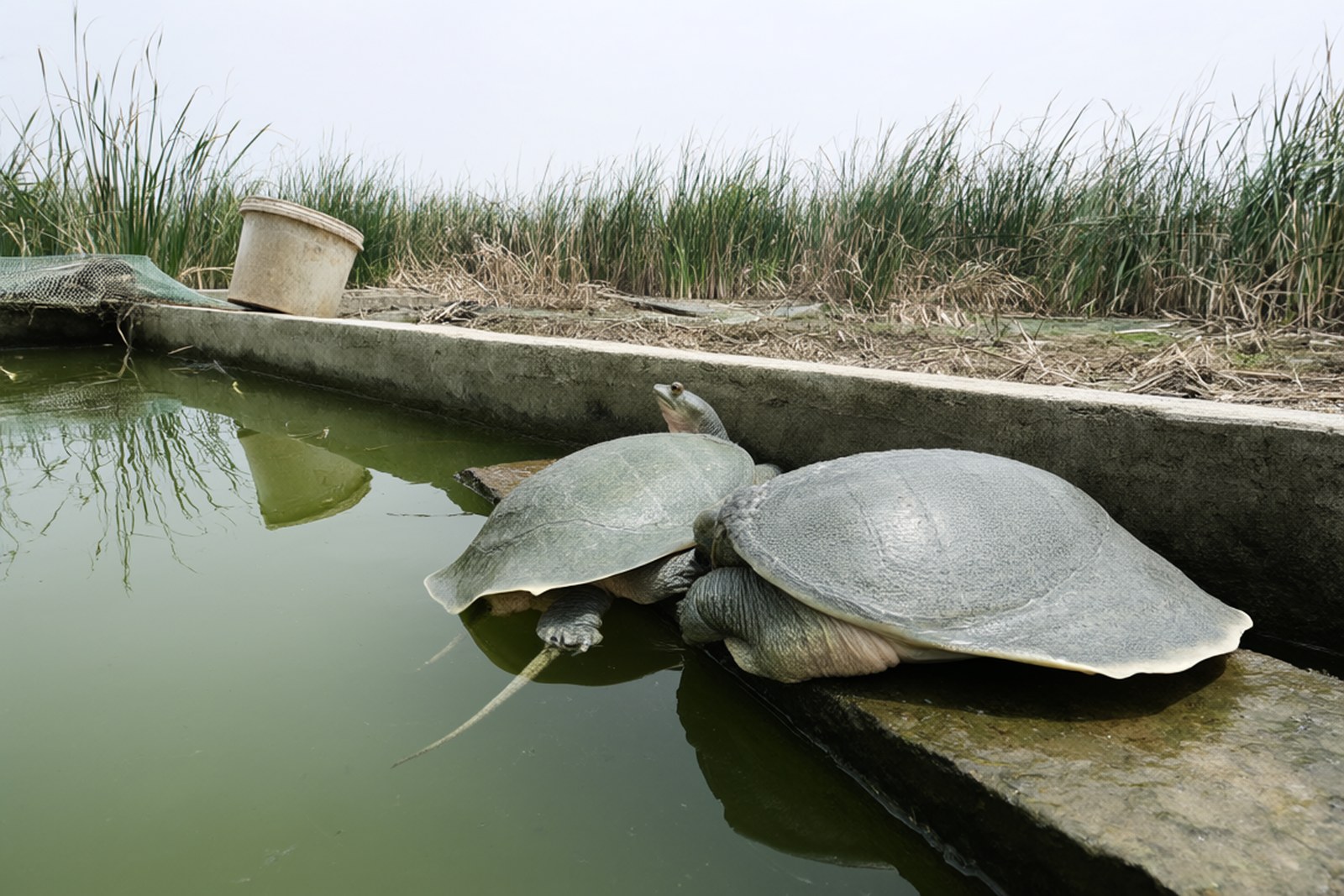
汉寿县 Hànshòu Xiàn sits on the western shore of 洞庭湖 Dòngtíng Hú, and its geography is the reason for the dish: a maze of lakes, channels, reed beds and flooded paddies, which is the natural habitat of the Chinese softshell turtle, 中华鳖 Zhōnghuá biē. The county has been farming them for a very long time and now produces them at a scale that has made 汉寿 one of the acknowledged centres of the trade, with the product carrying national geographical indication protection. The local restaurants make a point of the distinction between the farmed animal, which is what you will be served, and the wild one, which is protected — the difference is mostly size and price, and the wild ones have not been legally on the menu for years.
The classic preparation is 红烧 hóngshāo, red-braised, and it is slow. The turtle is killed, scalded to remove the skin, gutted and cut into pieces, and then cooked with pork belly or a piece of cured ham, ginger, garlic, star anise and soy, at a low simmer for at least an hour and often two. The collagen in the shell edge dissolves into the sauce and thickens it; the meat stays firm and faintly sweet, with a flavour somewhere between chicken and frog. In the more delicate version, 清炖 qīngdùn, it is stewed in clear stock with ginger and a little wine and served as a soup, which is how it is eaten in the home when someone is recovering from illness.
That medicinal framing is central and should not be dismissed as marketing. In the Chinese system the softshell turtle is 滋阴 zīyīn — it nourishes the cool, moist aspect of the body — and it is the standard food prescribed for convalescents, pregnant women, and anyone described as 虚 xū, depleted. The dish appears at weddings, at the recovery of a family member, and at any banquet where the host wants to signal that this is not an everyday meal. A 汉寿 restaurant will ask whether you want it 红烧 or 清炖 and will assume the second if the party includes anyone elderly.
Words and Names
鳖 biē is the standard word for softshell turtle; 甲鱼 jiǎyú, “armour fish”, is the polite restaurant euphemism, and 王八 wángba is the impolite one, also slang for a cuckold. If you are ordering, use 甲鱼. 裙边 qúnbiān, “skirt edge”, is the frill of skin around the carapace and the part everyone competes for. 汉寿 Hànshòu as a place name means “Han longevity”, a name it received in the Three Kingdoms period.
The county’s other old institution is 春华轩 Chūnhuáxuān, a restaurant group whose history is traced to the twenty-ninth year of the Guangxu reign, 1903, which makes it the only century-old establishment in the county’s catering trade.
What the Locals Know
Order it for a group. A whole turtle is a table dish, not a portion; two to four people is right, and the price makes sense only that way.
Eat the 裙边 qúnbiān first. It is the reason the dish exists and it goes cold into rubber if you leave it.
Ask about the source. 汉寿 restaurants trade on the county’s name and will tell you which farm the animal came from. If they will not, that is information.
Take the clear version if there is an invalid at the table. 清炖 qīngdùn rather than 红烧 hóngshāo. It is what a local family would cook.
Where to Eat It
汉寿县 Hànshòu Xiàn, in the county town and around the wetland reserves, and in the larger restaurants of 常德 Chángdé city which source from here. A whole turtle for two to four people, prepared properly, runs ¥300–800 depending on size and the year — prices move with the farming cycle. Look for a house that has been doing it for a long time and that asks you how you want it cooked, which is the sign that it is being made to order rather than reheated.
flowcloud would say that a dish whose entire prestige rests on the part of the animal that is not meat — the frill, the edge, the bit that dissolves — is a reminder that the best food is often the food that had a job, and that the job was structural.
Where to find it: 汉寿甲鱼 (Hànshòu jiǎyú), 汉寿县 (Hànshòu Xiàn), 常德市 (Chángdéshì), 湖南 (Húnán). Whole turtle for 2–4 people ¥300–800. Ask for 红烧 (hóngshāo) or, if feeding someone recovering, 清炖 (qīngdùn). Eat the 裙边 (qúnbiān) first and ask which farm it came from.