
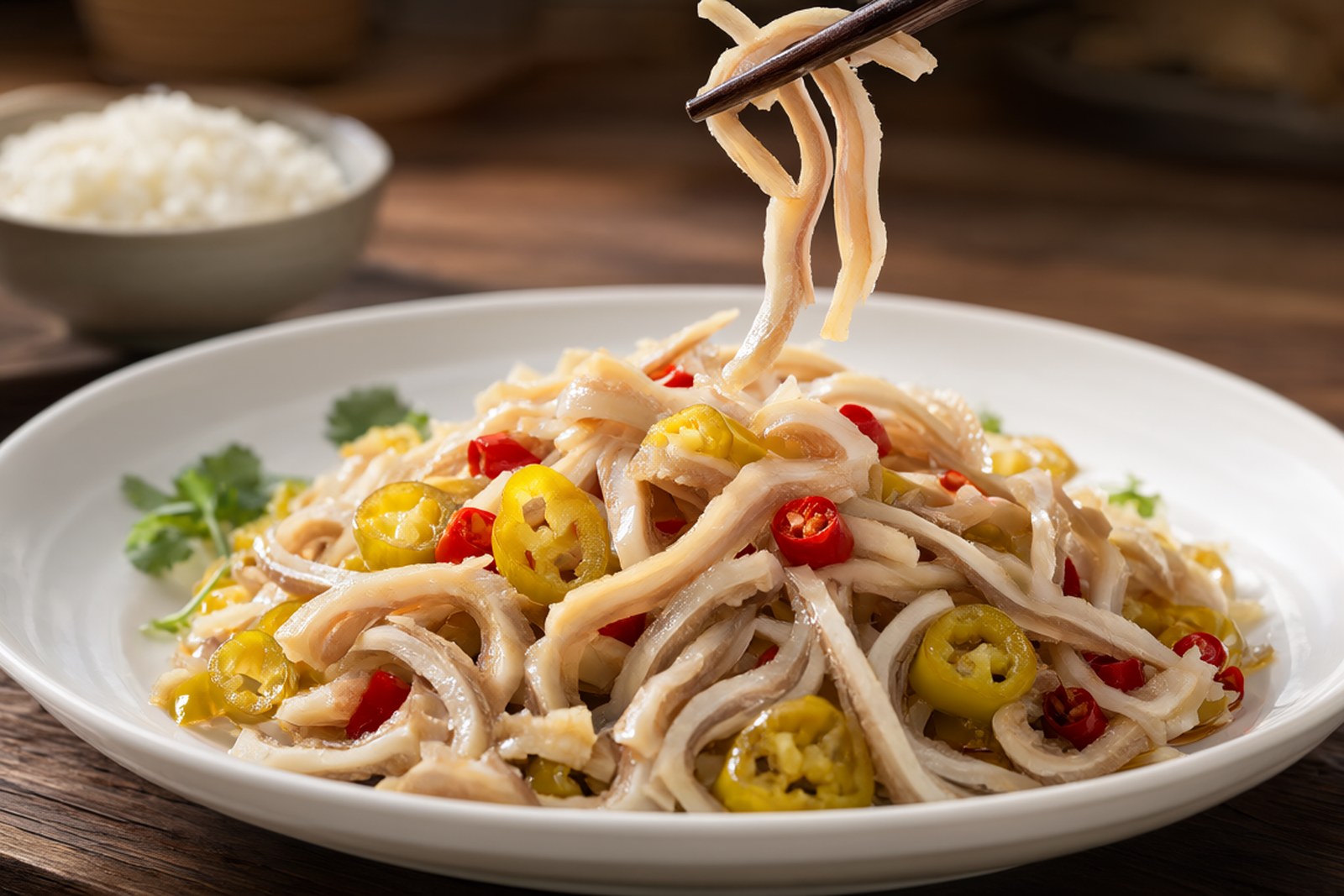
Crispness in Chinese cooking is a technical achievement, and 衡东脆肚 Héngdōng cuìdù is one of its purest demonstrations. What arrives is a shallow pile of something that looks more like a nest of pale ribbons than like meat: threads of pork tripe, curled and slightly translucent, tossed through with rings of green and yellow chili and lit up with red. You take a forkful, and the sound it makes is the point. Each strand snaps. There is no chew, no resistance that goes on, and no hint of the smell that puts most people off tripe, only a bright sour-savoury heat from the chili that has clearly been in the pan for seconds rather than minutes. In a county that calls its own cooking 鲜 xiān, 辣 là, 简 jiǎn, 土 tǔ — fresh, hot, simple, local — this is the dish that argues the case best.
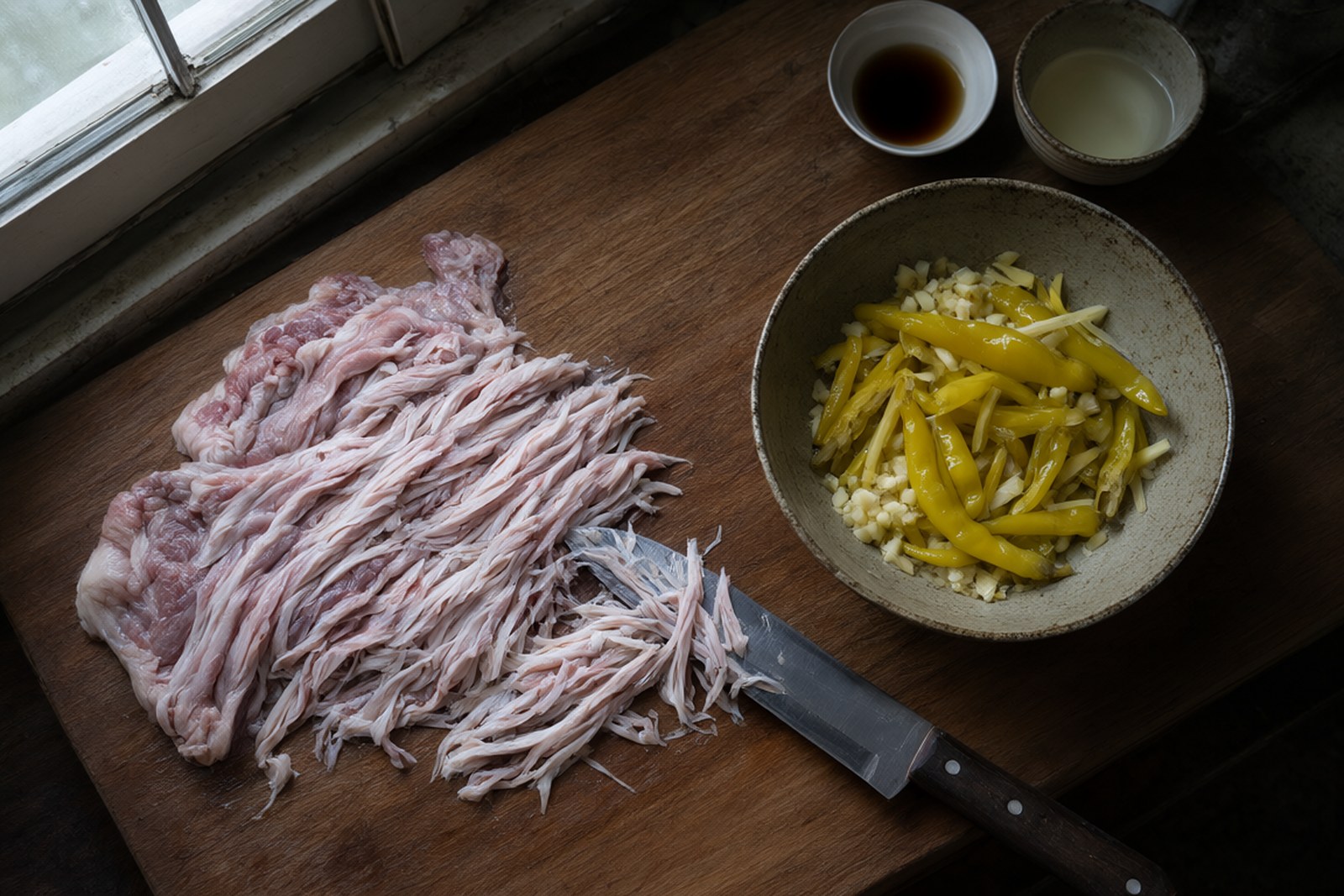
The tripe has to be worked before it is cooked. Only the 肚尖 dùjiān, the smooth, thin upper part of the stomach, is used; the thicker lower sections will never get crisp and are set aside for soups. The piece is scrubbed repeatedly with flour, white vinegar and sometimes lemon to strip the slime and the smell, then frozen briefly so that it firms up enough to be sliced. That last step is not a shortcut but a requirement — a soft tripe cannot be cut thin — and the standard here is threads, as fine as the cook can manage, because a thin thread is a thread that cooks through in twenty seconds. The threads are marinated for a quarter of an hour in light soy, oyster sauce, rice wine, white pepper and a pinch of bicarbonate of soda, and the bicarb is the second technical trick: it keeps the protein from tightening into rubber under a blast of heat.
Three Xiang Thunder
The dish is also called 三湘惊雷 Sānxiāng jīngléi, the thunderclap of the three Xiang, which is a grand name for a plate of offal and has an origin story to match. It is said to come from the dragon-boat villages of 石湾 Shíwān, 三樟 Sānzhāng, 大桥 Dàqiáo and 白莲 Báilián in 衡东县 Héngdōng Xiàn, where at the festival for 屈原 Qū Yuán in the late Yuan and early Ming the households could not afford meat for the feast and built the banquet out of 猪下水 zhūxiàshuǐ, the pig’s offal. 生炒脆肚 shēngchǎo cuìdù, tripe stir-fried from raw, was made as the reward dish — the plate you got for rowing hardest. Whether or not the genealogy is literally true, the dish is now the calling card of Hengdong cooking, and the county has registered the variations as heritage.
Words and Names
脆 cuì is crisp in the audible sense and is the word that matters. 肚 dù is tripe; 肚尖 dùjiān specifies the thin upper stomach. 生炒 shēngchǎo means stir-fried from raw without pre-boiling, which is the whole method. 黄贡椒 huánggòngjiāo, the yellow tribute chili, is 衡东 Héngdōng’s own cultivar — long, thin, aromatic, and pickled as often as used fresh — and it is non-negotiable; substitute bells and you have made a different dish. 茶油 cháyóu, tea-seed oil, is the fat; 米酒 mǐjiǔ, rice wine, is the degreaser; 小苏打 xiǎosūdá, bicarbonate of soda, is the tenderiser you will not be told about.
What the Locals Know
Judge the plate by temperature and by speed. This is a thirty-to-forty second dish, so it must reach you immediately; if it has been sitting under a pass light the threads will have gone limp, and there is nothing to be done. Look for the curl: correctly cooked tripe arches like a cooked prawn, and straight strips mean the heat was too low. Ask for it 微辣 wēilà if you must, but the chili is the dish, and Hengdong people will tell you that the version without it is just offal. Eat it with plain rice and nothing else; a soup alongside is fine, a sweet dish is not. Prices run ¥48 to ¥88 depending on the restaurant and whether it is dinner or a banquet, and it is one of the few dishes in the region that is often better in a county-town 土菜馆 tǔcàiguǎn than in a city hotel.
flowcloud would say that 衡东脆肚 is the rare dish in which the technique is visible to the eater, since you can hear whether the cook got it right, and that this makes it the most honest plate in Hunan.
Where to find it: the 土菜馆 tǔcàiguǎn of 衡东县 Héngdōng Xiàn — 石湾镇 Shíwān Zhèn and 新塘镇 Xīntáng Zhèn are the classic stops — and the 衡东 Héngdōng country restaurants that have opened across 衡阳市 Héngyáng Shì. Order 衡东脆肚 by name, ask whether the 黄贡椒 is the pickled kind, and insist it comes straight from the wok.