
Breakfast in Huizhou is often a bowl of noodles, and the bowl that sets the standard is rarely more than ten yuan. It arrives plain-looking: a heap of flat rice noodles, pale and glossy, sitting in a dark, nearly clear broth with a thin skin of oil on top. Then the toppings land on it, and the bowl becomes a different proposition. There are chunks of pig trotter braised until the skin gives way under a chopstick, half a braised egg with a tea-coloured ring, a few leaves of green, a scatter of chopped scallion, and under all of it a broth whose smell arrives a moment before the bowl does — savoury, faintly marine, with something toasted in it that is hard to place. This is 横沥汤粉 Hénglì tāngfěn, Hengli soup noodles, and asking a Huizhou person where to eat it is asking them where to eat, full stop.
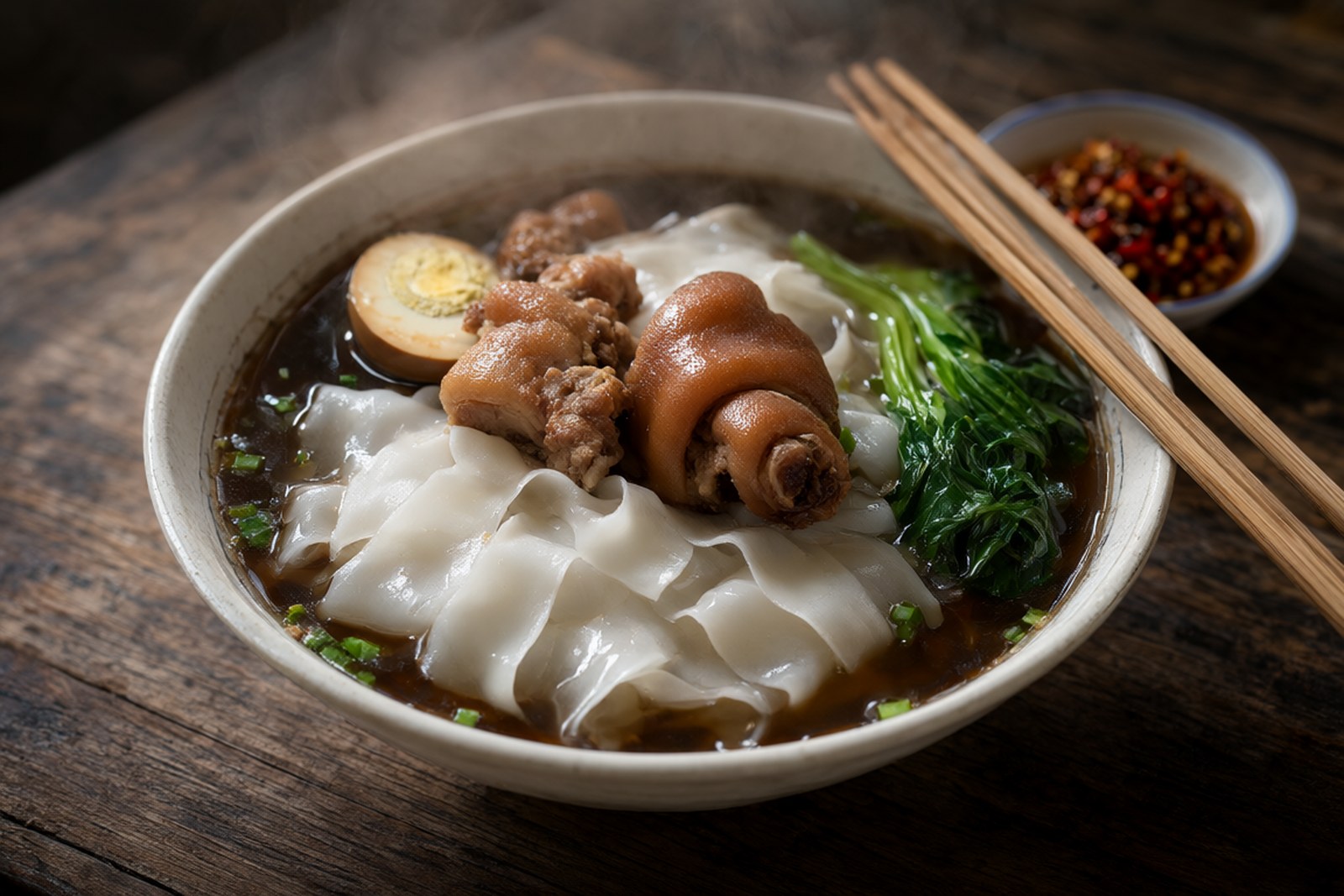
The broth is the whole reason the dish has a name. Where a Cantonese 猪脚粉 elsewhere in the province would lean on a handful of dried shrimp for its savour, this one starts with 左口鱼 zuǒkǒuyú — the flatfish sold dried and known in kitchens as 大地鱼 dàdìyú — which is held over a flame until the skin blisters and the oil comes out, then pounded and simmered with pork marrow bones, shrimp heads and shells, ginger and sometimes a few dried scallops. The fish is what gives the soup its particular toasted depth, and it is the same trick that makes the broth of a good Cantonese wonton. What the Huizhou version adds is a slow, unglamorous patience: three to four hours over a low fire, and no short cuts with powder. A cook here will tell you the broth should taste of something caught and something roasted, not of a seasoning packet.
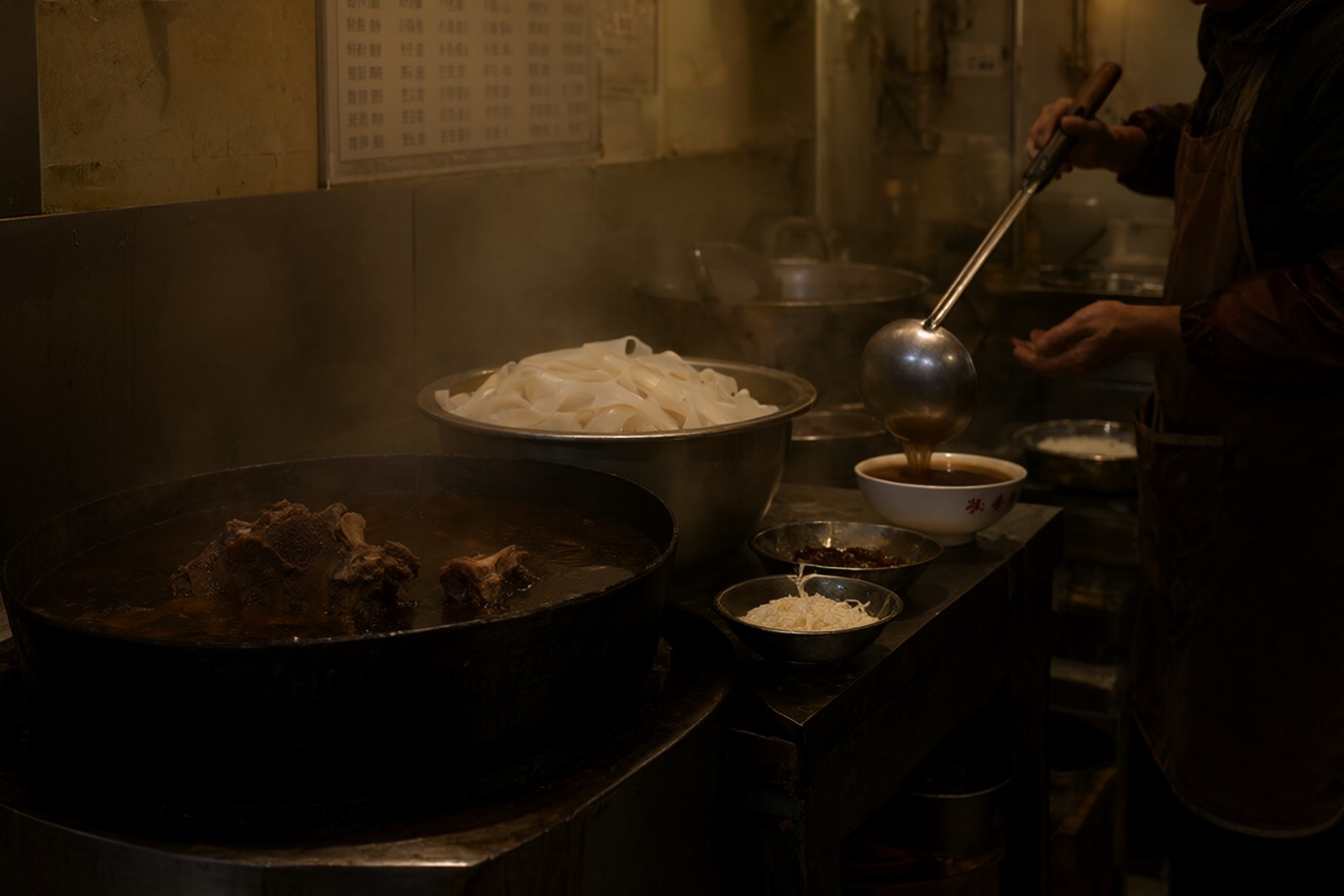
From the Wharf, and Not Quite From Hengli
The dish is older than the town’s fame. 横沥镇 Hénglì Zhèn sits on the 东江 Dōng Jiāng, the East River, about twenty-four kilometres from the centre of 惠城区 Huìchéng Qū, and for most of its history it was a river port rather than a place anyone visited. The 惠阳县志 records that the town’s commercial street took shape in the Xianfeng reign of the Qing, and that its market days fell on the second, fifth and eighth of each lunar month, when traders from the surrounding townships came in by water. A crowd at a wharf needs feeding, and noodles are quick. What made the local version distinctive is, by the usual account, a piece of borrowing: the neighbouring township of 仍图 Réngtú — since merged into 汝湖 Rǔhú — had the reputation for making 河粉, flat rice noodles, and its cooks set up stalls along the Hengli waterfront to catch the boat trade. The name stuck to the place rather than the people. The same story is told to explain why Guangzhou’s 沙河粉 shāhéfěn tastes like a cousin: the technique travelled down the river with the same families and was reworked in the city.
The noodles themselves are worth the name. Winter rice is soaked overnight, ground into a slurry, spread thin on flat trays and steamed for three or four minutes, then peeled, rolled while still hot around a bamboo tube, laid out on bamboo racks to dry in the air and finally cut into ribbons. The variables are the ones you would expect — the rice, the thickness of the slurry, the heat, even the breeze during drying — and the result when it goes right is a noodle that is white, faintly translucent, and simultaneously slippery and resistant. The town’s own dish is recognised as one of the 惠州十大名小吃 Huìzhōu shí dà míng xiǎochī, the ten famous snacks of Huizhou.
Words and Names
汤粉 tāngfěn is soup noodles, and 粉 fěn alone means the rice noodle, never the wheat one, in this part of Guangdong; 河粉 héfěn is the flat ribbon itself. 左口鱼 zuǒkǒuyú and 大地鱼 dàdìyú are the two names for the dried flatfish, with 比目鱼 bǐmùyú as the biological word; 筒骨 tǒnggǔ is a marrow bone. 猪脚 zhūjiǎo is pig trotter, 牛腩 niúnǎn beef brisket, 卤蛋 lǔdàn a braised egg, 肉丸 ròuwán the hand-beaten pork balls, and 酿猪皮 niàng zhūpí the local speciality in which a piece of puffed fried pig skin is stuffed with minced pork and braised. 卤水 lǔshuǐ is the master braising liquid, kept and topped up for years in a good shop. 横沥镇 Hénglì Zhèn, 仍图 Réngtú and 东江 Dōng Jiāng are the geography; 松柴 sōngchái, pine firewood, is the fuel the old kitchens used for the stock, the noodles and the braise alike.
What the Locals Know
Order by the topping, because that is the real choice: 猪脚 zhūjiǎo for people who want the collagen and the mess, 牛腩 niúnǎn for a cleaner beef flavour, 肉丸 ròuwán if you want to judge the kitchen’s hand, and 酿猪皮 niàng zhūpí if you want the thing that is hardest to find anywhere else. Then drink the broth before you touch the noodles. A good bowl is finished to the bottom; a bowl that has been sitting will have lost the fish, and no amount of chili oil will bring it back. The blanching is a matter of seconds, so a plate of noodles that arrives stuck together in a block is a warning, not an accident. Most shops put a jar of pickled chili and a dish of 酸菜 suāncài on the table and expect you to help yourself. One more local habit worth copying: in a Huizhou restaurant, when the food is ordered, the server often asks 主食要米饭还是汤粉 zhǔshí yào mǐfàn háishì tāngfěn — rice or soup noodles with that — because the noodle bowl here counts as the staple of the meal rather than as a dish. It is eaten at six in the morning, at noon, at nine at night, and by anyone who has just got off a train.
flowcloud would say that 横沥汤粉 is the honest kind of local food, since the recipe has no expensive ingredient in it and the entire difference between a great bowl and a forgettable one is three hours of somebody’s attention.
Where to find it: everywhere in 惠州市 Huìzhōu Shì and best in the places that made it — the lanes around the market in 横沥镇 Hénglì Zhèn in 惠城区 Huìchéng Qū, and the older shops scattered through 惠城区 Huìchéng Qū itself. Order by naming your topping, ask for 加底 jiādǐ if you want extra noodles, and look for a shop that keeps a jar of pickled chili on the table and a visible pot of stock at the back. Expect to pay around ¥10.