
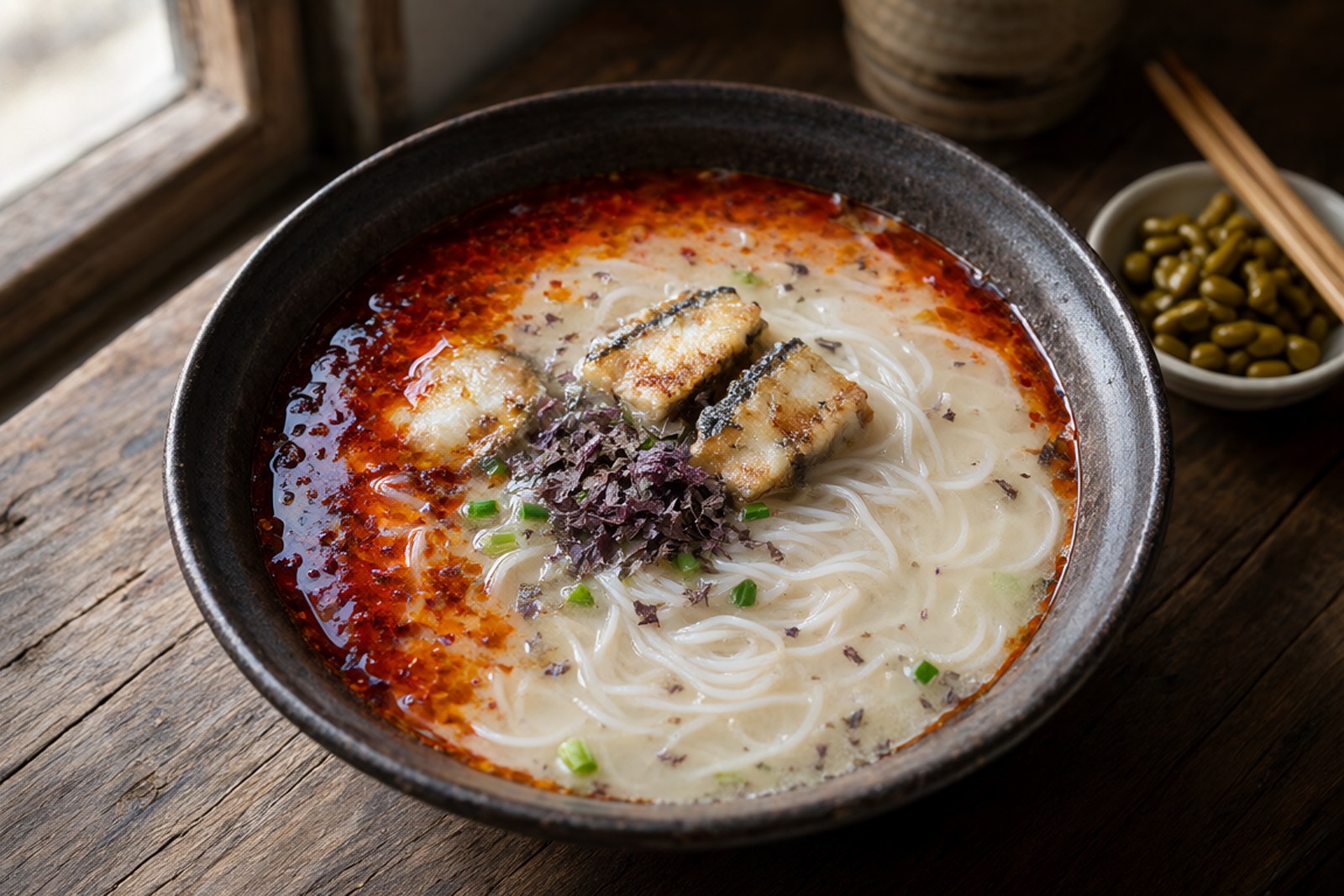
The bowl lands in front of you still moving. A skim of scarlet chili oil drifts across the surface of a broth that is otherwise the colour of milk, and under it there are noodles, and under the noodles there are pieces of fish with golden edges where they met the pan. You are supposed to drink the soup first, and you will, and the first mouthful will be saltier and hotter and fishier than you expected, and then you will understand why the entire city organises its morning around this. 衡阳鱼粉 Héngyáng yúfěn, Hengyang fish noodles, is breakfast in 衡阳 Héngyáng, and asking a local where to eat it is like asking them where to breathe.
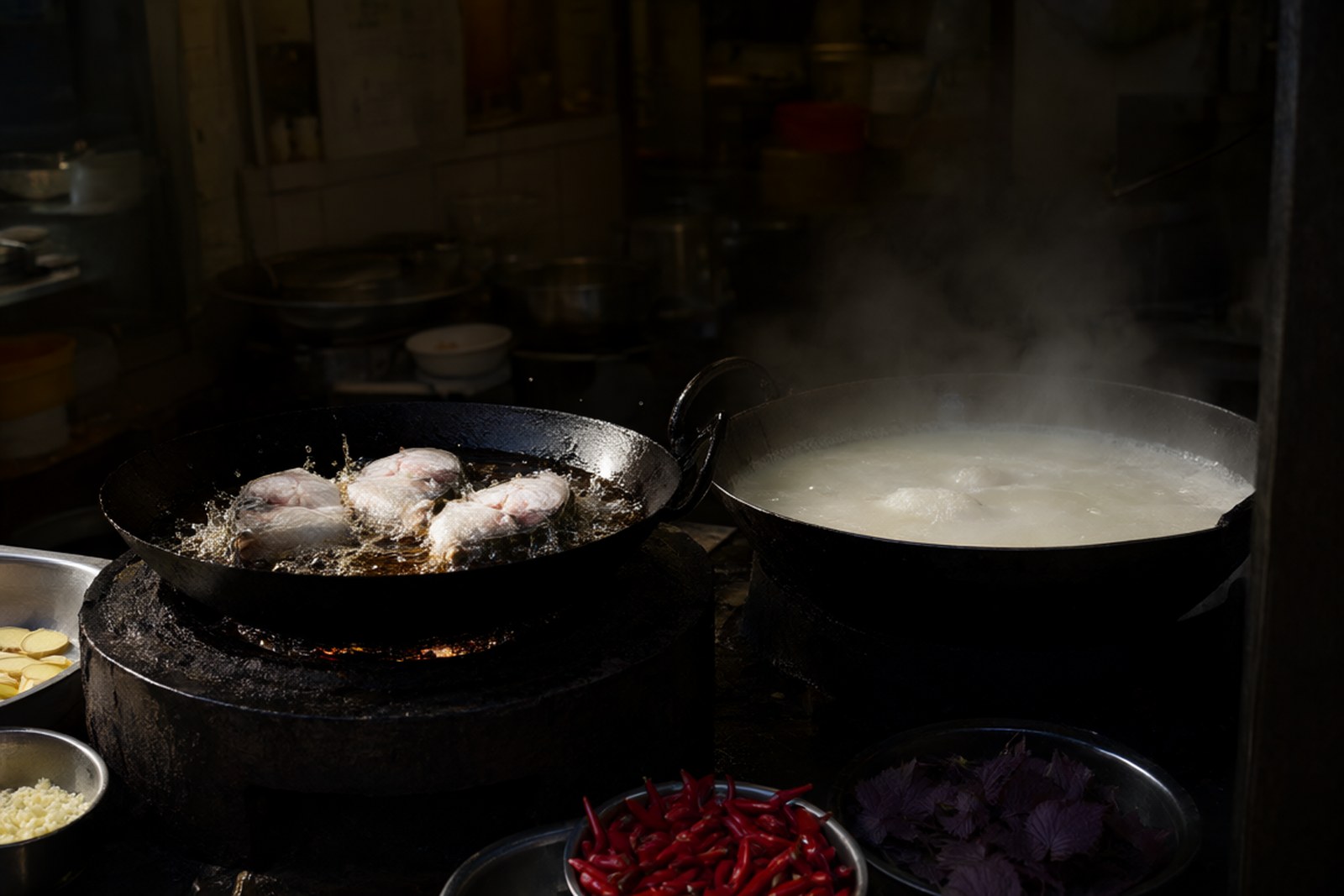
The broth is the whole argument. It starts with pork leg bones, smashed and simmered overnight until the water has gone opaque and faintly gelatinous, and it is finished with fish that was swimming that morning — usually 草鱼 cǎoyú, grass carp, sometimes bighead carp or crucian. The fish is killed, cut into chunks and dropped into smoking 茶油 cháyóu, tea-seed oil, where it browns before it is deglazed with a splash of local rice wine and covered with the bone stock. Then the pot is left alone. That detail matters more than any ingredient list: a cook in Hengyang will tell you that lifting the lid to stir while the fish is breaking down is what puts a muddy smell into a bowl, and that the broth turns white because nobody touched it.
From Zhajiang to Santang
The dish has a documented lineage and locals will recite it. It begins in 渣江镇 Zhājiāng Zhèn, a town in 衡阳县 Héngyáng Xiàn on the upper reaches of the river system, where fish noodles were already well known in the last century; for decades they stayed there, because the roads were bad and the economy was thin. In 1985 the first shop opened in 西渡镇 Xīdù Zhèn, the county seat, and the dish began to travel. Then, at the start of this century, 三塘镇 Sāntáng Zhèn in 衡南县 Héngnán Xiàn took it over. Santang shops were more consistent, and the reputation moved; today most signs across the city read 三塘鱼粉 Sāntáng yúfěn rather than Zhajiang, and people still drive out to Santang on a weekend morning as a small ceremony.
What the noodle itself is matters too. The local preference is 渣江米粉 Zhājiāng mǐfěn, a fine, dense rice noodle that holds its bite through a hot bath and does not turn to paste. It arrives cooked, is reheated in boiling water, and goes into the bowl before the broth so that the noodles and the soup meet at the table rather than in the kitchen.
Words and Names
鱼粉 yúfěn is fish noodles, and 粉 fěn alone is the default word for these rice noodles in Hunan. 三塘鱼粉 Sāntáng yúfěn and 渣江鱼粉 Zhājiāng yúfěn name the two schools. 茶油 cháyóu, tea-seed oil, is the cooking fat of the region; 湖之酒 húzhījiǔ is the local amber rice wine, used here to kill the fishiness. 紫苏 zǐsū, perilla, is the herb that does the same job in the bowl; 黄贡椒 huánggòngjiāo, the yellow tribute chili of nearby 衡东 Héngdōng, is what gives the broth its particular heat. Named variants on every menu are 鱼头粉 yútóu fěn with the head, 鱼杂粉 yúzá fěn with the innards, 鲫鱼粉 jìyú fěn with crucian carp, and 黄沙古粉 huángshāgǔ fěn with yellow catfish.
What the Locals Know
Order by the fish, not by the shop. A serious kitchen will name what is in the tank that day, and 黄沙古 huángshāgǔ, the yellow catfish, is the order that separates people who know from people who do not — it is sweet, boneless in the right places, and takes the chili better than carp. Ask for the chili 少辣 shǎolà if you need to; the default here is genuinely hot and the adjustment is not an insult. The correct extra is a fried egg or a spoon of crisp fried soybeans, and the correct drink is plain hot tea, not beer. A bowl costs ¥8 to ¥15 and the best ones are usually in shops with plastic stools, a single tank, and a queue at seven in the morning. Two names that recur: 彭海军鱼粉 Péng Hǎijūn yúfěn, whose branches are the most cited in the city, and the older shops around 三塘 Sāntáng itself, which are worth the drive.
flowcloud would say that Hengyang fish noodles are the clearest proof that a cuisine’s real signature is often its breakfast, and that the reason nobody can copy it elsewhere is that the recipe is mostly the absence of interference.
Where to find it: the whole city, from about six in the morning. The greatest concentration is in 雁峰区 Yànfēng Qū and around 白云路 Báiyún Lù, with the traditional heartland out at 三塘镇 Sāntáng Zhèn in 衡南县 Héngnán Xiàn, and a cluster of older shops near the 衡阳站 Héngyáng Zhàn station for anyone arriving early. Say 一碗鱼粉 yì wǎn yúfěn and name your fish.