
米排粉 mǐ pái fěn is the rice noodle of 河源市 Héyuán shì, and the name describes how it is made rather than how it eats: 米 mǐ rice, 排 pái the rows of frames it is laid on, 粉 fěn the noodle itself. It is a flat, slightly translucent strand, no thicker than a matchstick and generally sold in stiff dried bundles, and it is the noodle the city eats in soup for breakfast and fried at night. Where the rice noodles of the delta are eaten fresh and soft the same day, 河源 dries its own in the sun, and a bundle of 米排粉 keeps for months and travels, which is why the city’s noodle has a name outside the city at all.
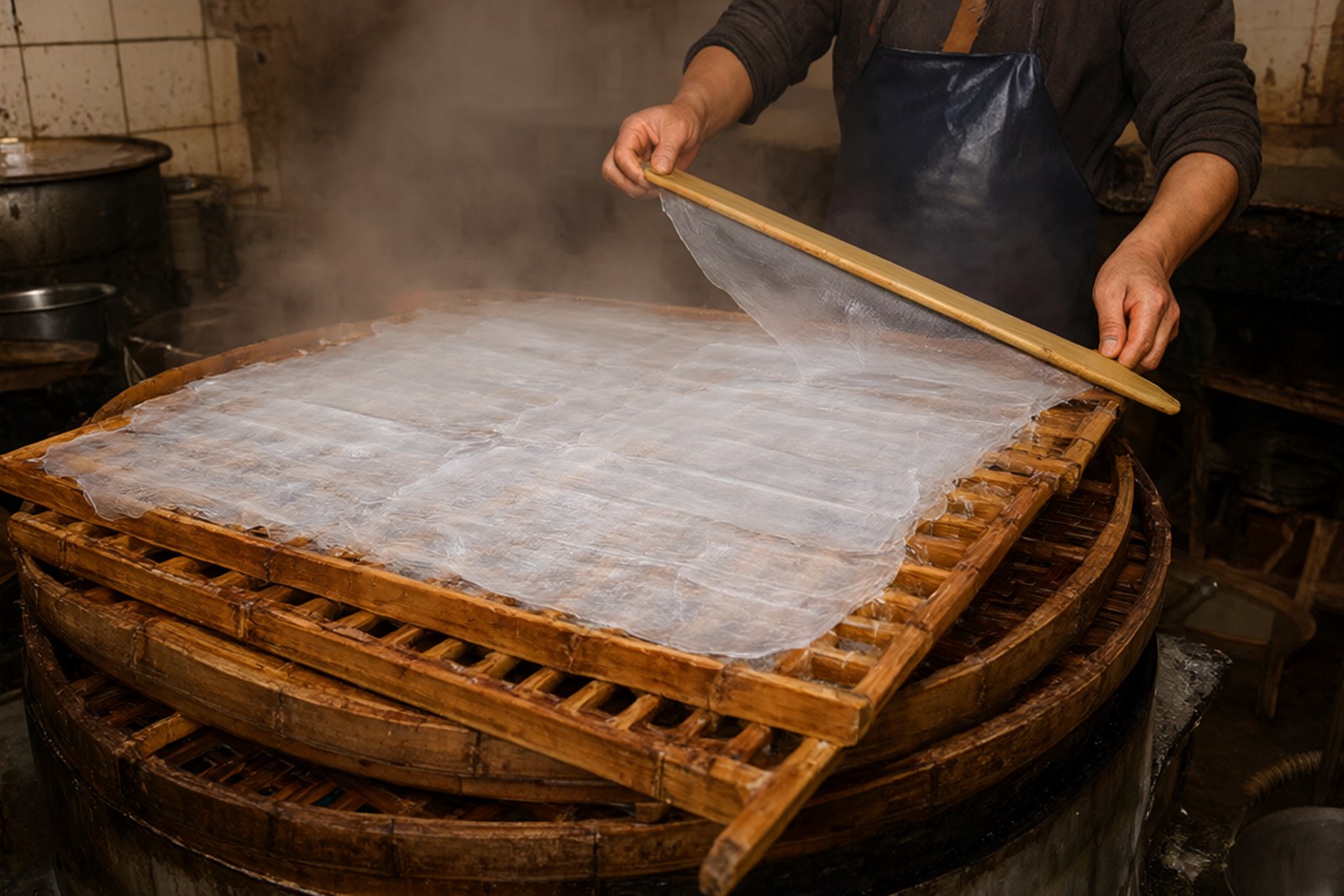
The making is a small industry and it is mostly done by hand. Long-grain rice is soaked until it crushes easily, ground with water into a thin slurry, and then steamed: a ladle of the slurry is spread across a cloth or a wooden tray over boiling water, and in a minute or two it sets into a translucent sheet. The sheet is lifted, brushed with a little oil so it will not stick, and cut into ribbons, or left whole and cut only after drying. The ribbons are laid out in rows on bamboo frames and left in the open air until they are stiff and brittle, which in this climate takes a day or two; a farmyard full of drying frames is one of the sights of the county in the dry months, and the smell while it dries is faintly sour and very particular.
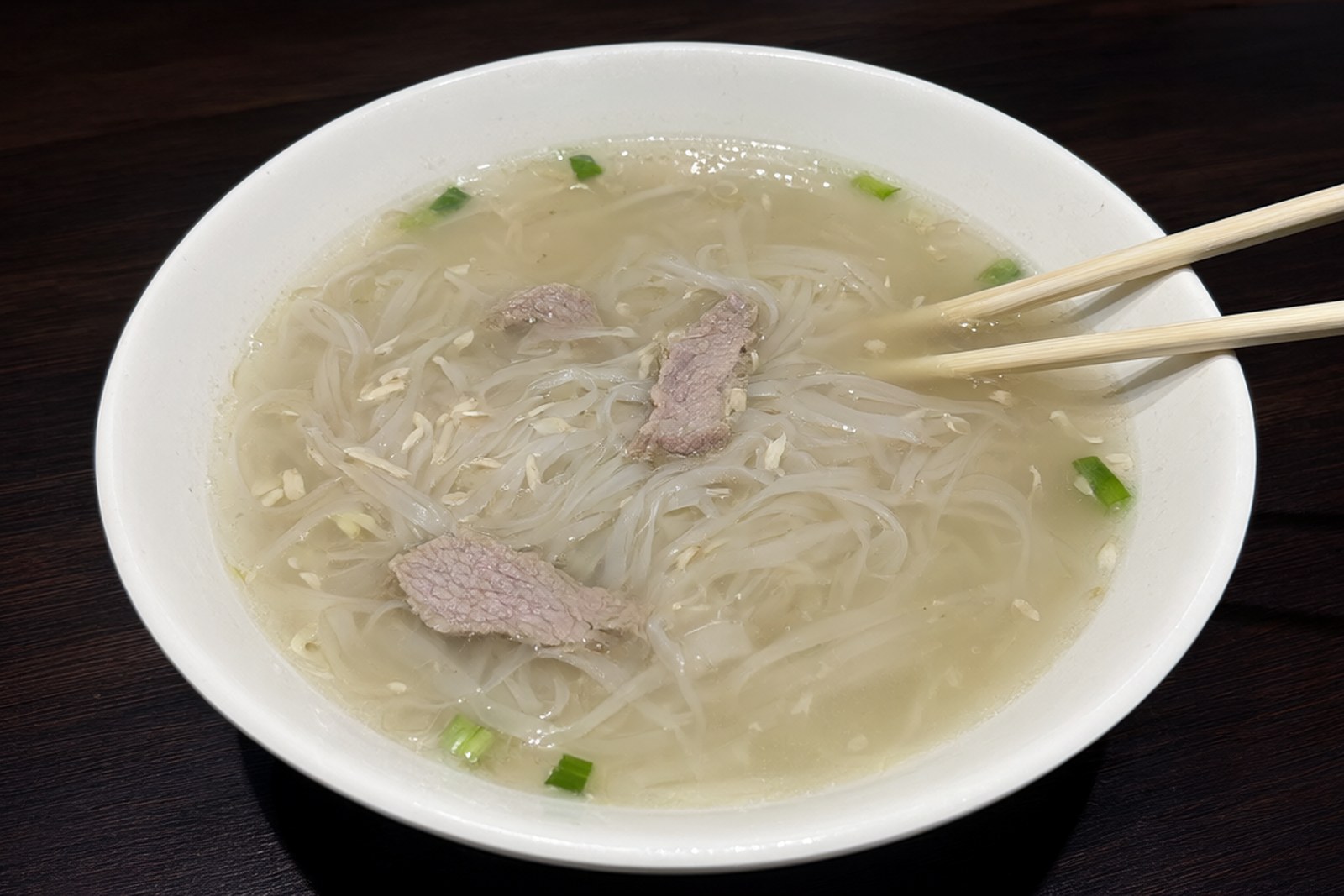
The broth is what the city eats it in. A bowl of 汤粉 tāng fěn is the dried noodle softened in boiling water and then served in a light pork or chicken stock, with a few slices of lean pork, a scatter of 葱花 cōng huā, spring onion, and sometimes a spoon of fried garlic or a little 酸菜 suān cài, pickled greens. It is deliberately plain, because the point of 米排粉 is the noodle and not the sauce. A plate of 炒粉 chǎo fěn is the other half of the trade: the soaked noodle fried hard in a wok with bean sprouts, chives and a little pork, the strands staying separate and taking on a faint toasting rather than going soft, which is what a dried rice noodle does better than a fresh one.
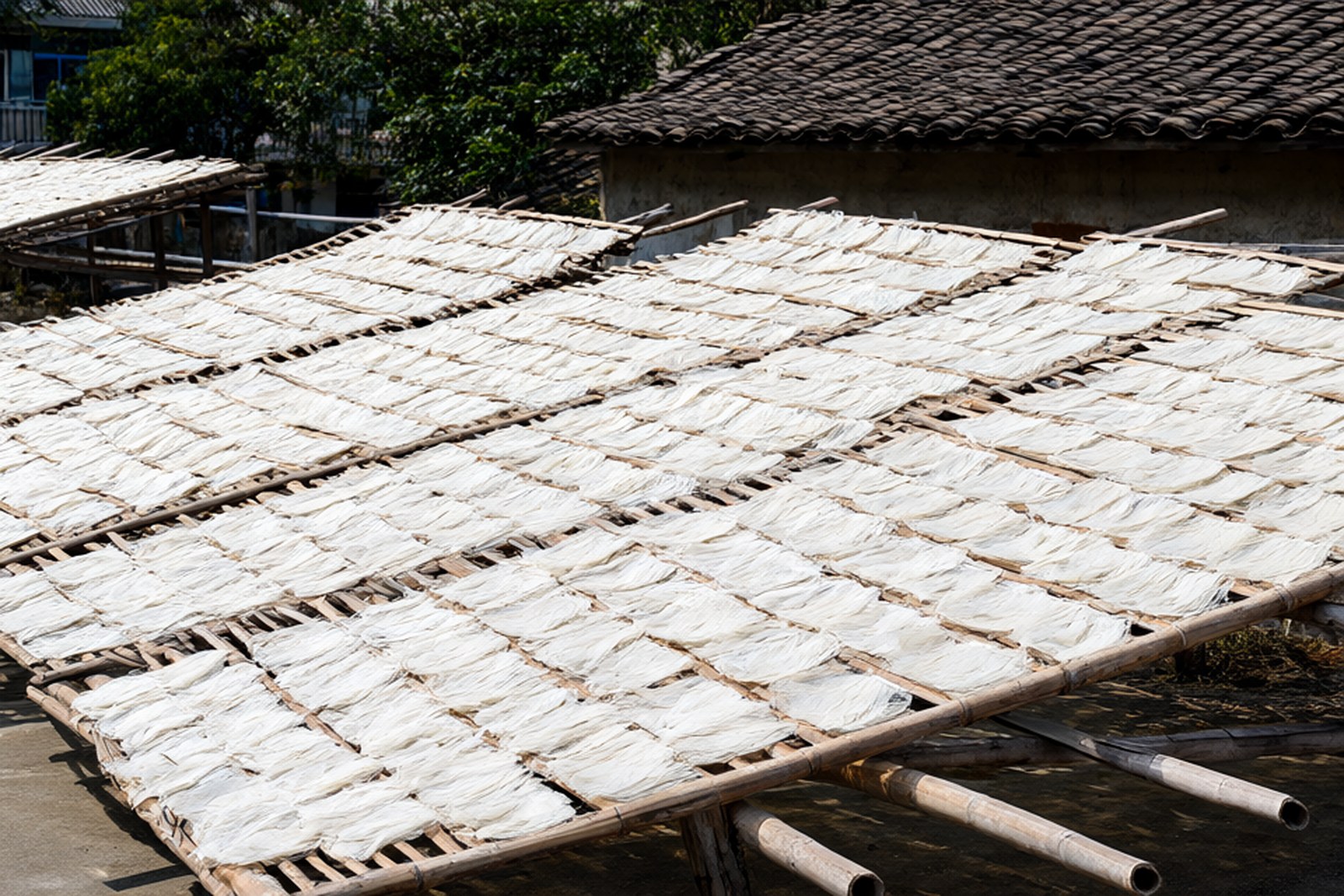
Because it dries, 米排粉 is the noodle that leaves home. Bundles are sold in the markets of 河源 and shipped out through the province and to the Hakka diaspora, and a family in 深圳 or 广州 with roots up the 东江 will have a bundle in the cupboard the way another household keeps dried pasta. In the city itself it is a breakfast food first: the noodle shops open before six, the price of a bowl is a few yuan, and by nine the trade is mostly over. Come for the soup in the morning and the fried version at night, and buy a couple of bundles to take away, because it is light, cheap and keeps.
Words and Names
米排粉 mǐ pái fěn is the dried flat rice noodle of 河源, 米 mǐ rice, 排 pái the rows of drying frames, 粉 fěn noodle. 汤粉 tāng fěn is the noodle in soup and 炒粉 chǎo fěn the fried version. 葱花 cōng huā is chopped spring onion, 酸菜 suān cài pickled mustard greens, 瘦肉 shòu ròu lean pork, 豆芽 dòu yá bean sprouts and 韭菜 jiǔ cài Chinese chives. 河源 Héyuán is the city, 东江 Dōng jiāng the East River it stands on, and 万绿湖 Wàn lǜ hú the reservoir upriver whose water the trade uses.
What the Locals Know
Buy the dried bundles from a market stall rather than a supermarket, and squeeze one: a bundle that crackles and snaps was dried properly, and a bundle that bends was finished in a machine and will cook to paste. At home, soak it in warm water for a few minutes rather than boiling it, and put it into the soup or the wok still slightly firm, because it goes on softening in the bowl. In the city, ask for 汤粉 for breakfast and 炒粉 in the evening, and if you are offered a bowl with offal in it, that is a normal variant and not a mistake.
flowcloud would say that a city which worked out that the way to keep a fresh rice noodle is to dry it in the sun, and then built its breakfast and its supper around the dried one rather than mourning the fresh, has turned a problem of the climate into a product with a name, which is most of what regional cooking is.
Where to find it: the noodle shops and market stalls of 河源市, with 汤粉 from about six in the morning and 炒粉 through the evening, and bundles of the dried noodle sold by weight in every wet market in the city and the county towns. A bowl of 汤粉 is ¥6 to ¥15, a plate of 炒粉 ¥10 to ¥20, and a bundle of dried 米排粉 ¥8 to ¥20. 河源市 is on the 赣深 high-speed line, which runs the length of the 东江 valley south through 惠州北 to 深圳北 and carries through trains on towards 广州.