
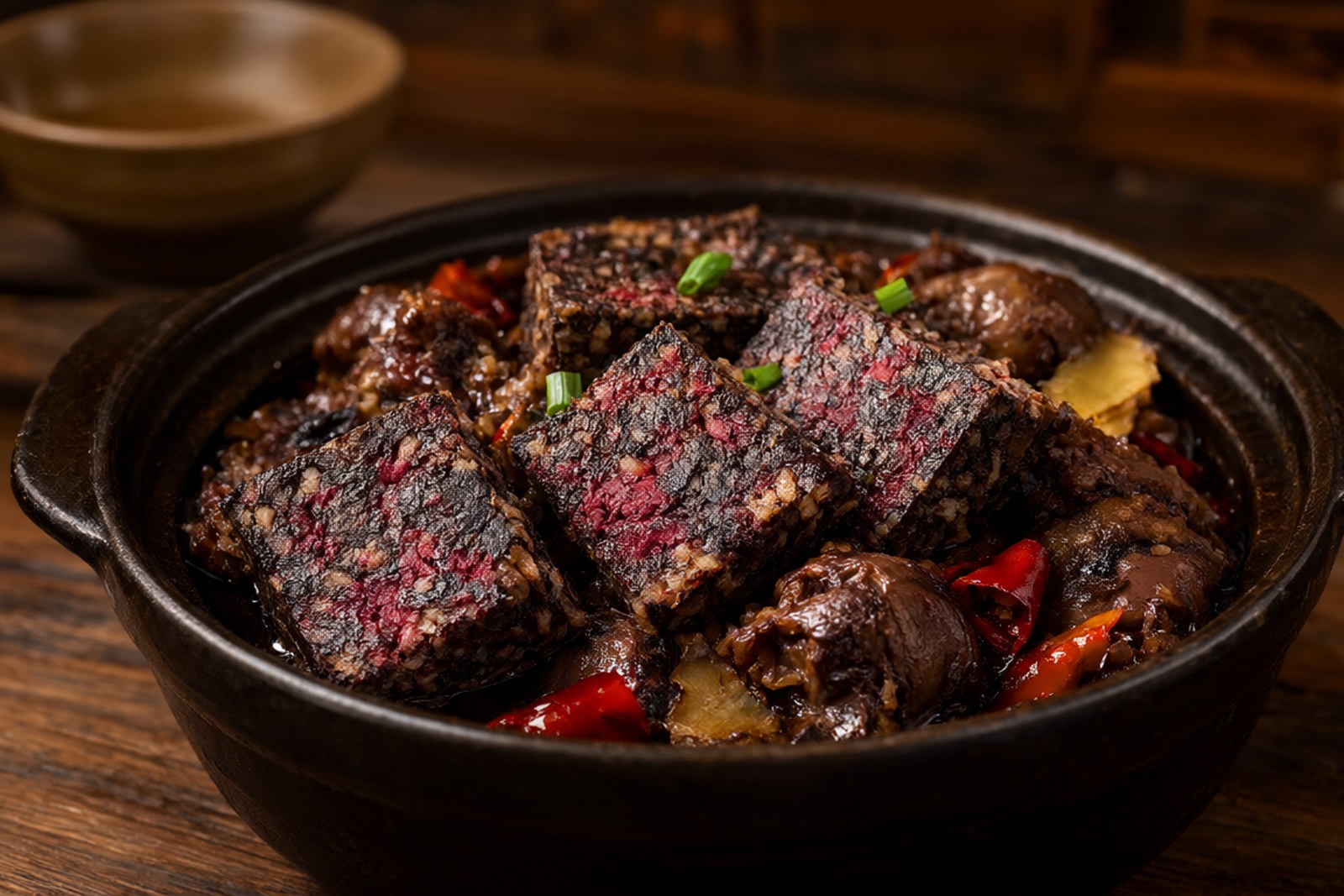
The dish arrives dark. 洪江血粑鸭 Hóngjiāng xuèbā yā is a duck braised with 血粑 xuèbā — cakes of glutinous rice set in duck blood and then fried — and the two things together produce a pan of near-black, faintly sweet, unusually rich food that does not look like anything else in Hunan. The rice cakes have the texture of a firm dumpling with a crust; they soak up the sauce and thicken it; and by the end of the meal they are what everyone is fighting over, not the duck.
洪江 Hóngjiāng is a small town on the 沅水 Yuánshuǐ that was, for about three hundred years, the most improbable place in China: a mountain market town, two days by boat from anywhere, that handled the timber, tung oil, cinnabar and opium trade of five provinces and was known as 西南大都会 Xīnán Dàdūhuì, the Great Metropolis of the Southwest. Eighty counties maintained guild halls here. There were seventeen newspapers, twenty-three banks, and a proverb — 一个包袱一把伞,来到洪江当老板 yī gè bāofu yī bǎ sǎn, lái dào Hóngjiāng dāng lǎobǎn — one bundle and one umbrella, come to Hongjiang and be a boss. The food of the town reflects it: merchants from Jiangxi, Anhui, Fujian, Guizhou and Shanxi all ate here, and the local kitchen absorbed the sweet-savoury habits of the north and the pickles of the south.
What Makes It Work
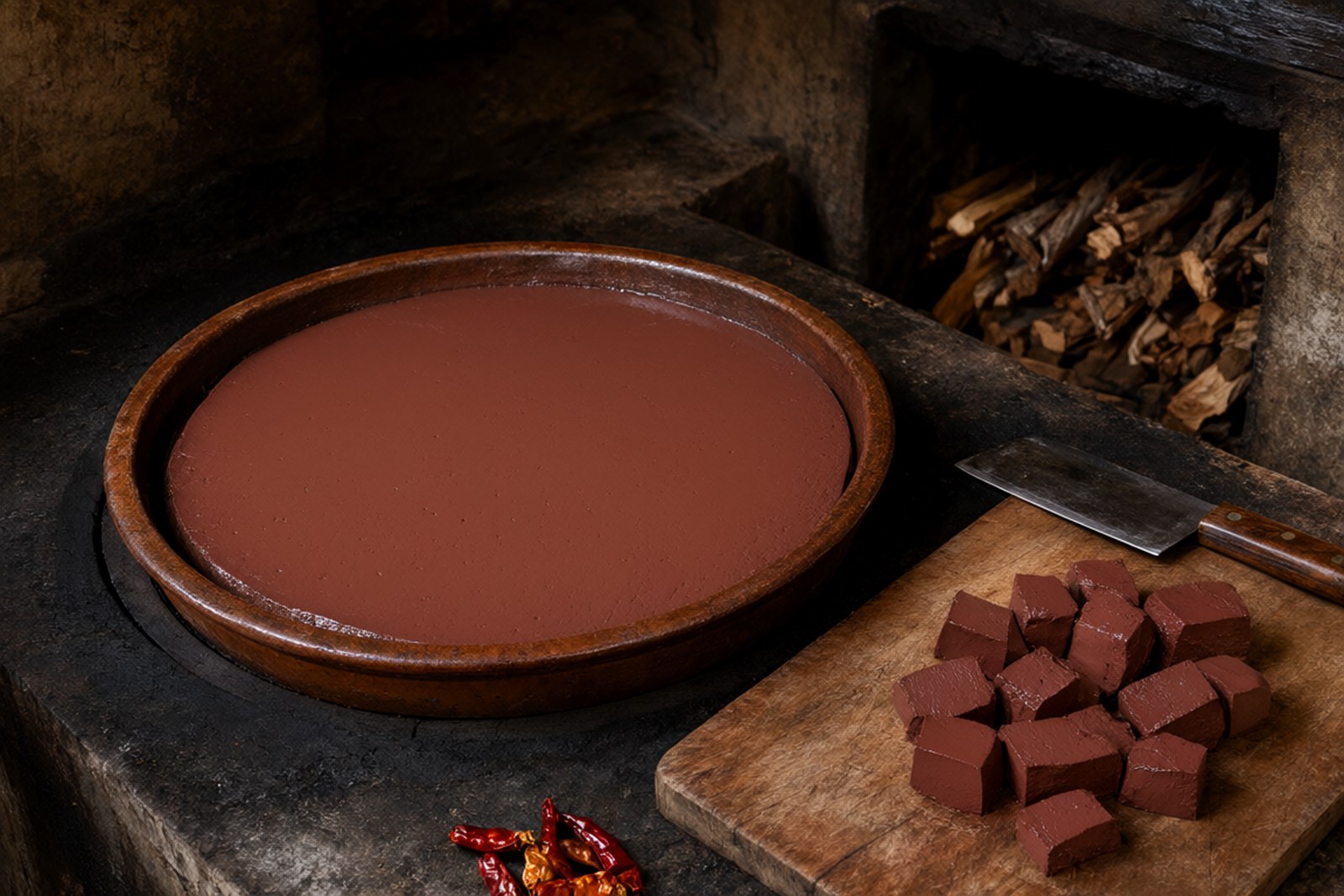
血粑 xuèbā is made first and it is not difficult once you have seen it done. 糯米 nuòmǐ, glutinous rice, is soaked, cooked, and then mixed while still hot with fresh duck blood — collected at the killing and stirred so it does not clot — plus a little salt, 花椒粉 huājiāofěn and sometimes 腊肉 làròu diced fine. The mixture is packed into a mould or a length of bamboo, steamed until set, cooled, and cut into slabs. Those slabs are then fried in a little oil until the outside browns and crisps. Only then does the duck enter the story.
The duck is chopped small and browned hard with ginger and 洪江甜酱 Hóngjiāng tiánjiàng, the town’s own sweet fermented bean paste, which is the second element you cannot substitute. Water or stock goes in, the fried blood cakes go on top, and the whole thing simmers for twenty to thirty minutes with the lid on, then comes off the heat with 青椒 qīngjiāo and, often, a handful of 蒜苗 suànmiáo. The rice cakes absorb sauce and release starch; the sauce tightens; and what you get is something between a braise and a stew, sweet at the front, chilli at the back, and thick enough to hold a chopstick upright.
Words and Names
血粑 xuèbā — blood cake; 粑 bā is the general southwestern word for a food made from pounded or set grain, and it shows up in 糍粑 cíbā, 蒿子粑 hāozi bā and a hundred other names across Hunan, Guizhou and Guangxi, an echo of the non-Han languages that were here before Chinese. 洪江 Hóngjiāng is not certain to mean “flood river”; older forms suggest 洪 as a local lineage or place name rather than the modern word for flood. 窨子屋 yìnziwū — the high-walled courtyard houses of this town, whose windowless outer walls were for fire and theft — is a vocabulary word you will need both for the architecture and for the inns.
What the Locals Know
Order 血粑鸭 and a plain 米粉 mǐfěn on the side. The sauce on a bowl of plain rice noodles is how locals finish the pot; the noodles are not a second dish, they are the mop.
Ask whether the blood cake is 现做 xiàn zuò, made on site. Frozen blood cake has a rubbery bite and no crust, and it is the difference between a good version and a bad one.
Eat it the day it is made. Like all blood cookery this does not improve overnight; the cakes go hard and the sauce separates.
Walk the 古商城 gǔshāngchéng before you eat. The 380-odd surviving 窨子屋 of the old market, laid out in the 七冲八巷九条街 qī chōng bā xiàng jiǔ tiáo jiē — seven lanes, eight alleys, nine streets — pattern, are what paid for the dish, and the town’s story is easier to taste with it in your head.
Where to Eat It
A duck with blood cakes serves three or four for ¥100–160. The restaurants are concentrated in and around the old market quarter; the family places with a courtyard and a handwritten sign do it better than the ones on the main road. 怀化南站 Huáihuà Nán Zhàn is about an hour by road; the old town itself is small, walkable, and best between four and seven in the evening when the light goes sideways down the stone alleys.
flowcloud would say that the whole strange history of this town is in the dish — a place built by people who arrived with one umbrella and no intention of going home, who took what the mountains gave them and the merchants taught them, and made something dark, sweet and unrepeatable out of it.
Where to find it: 洪江血粑鸭 (Hóngjiāng xuèbā yā), 洪江市 (Hóngjiāngshì), 怀化市 (Huáihuàshì), 湖南 (Húnán). Best in the family restaurants of the 洪江古商城 (Hóngjiāng Gǔshāngchéng) old market quarter. A duck for three or four ¥100–160. Ask whether the blood cake is made on site, order plain noodles to finish the sauce, and eat it the day it is cooked.