
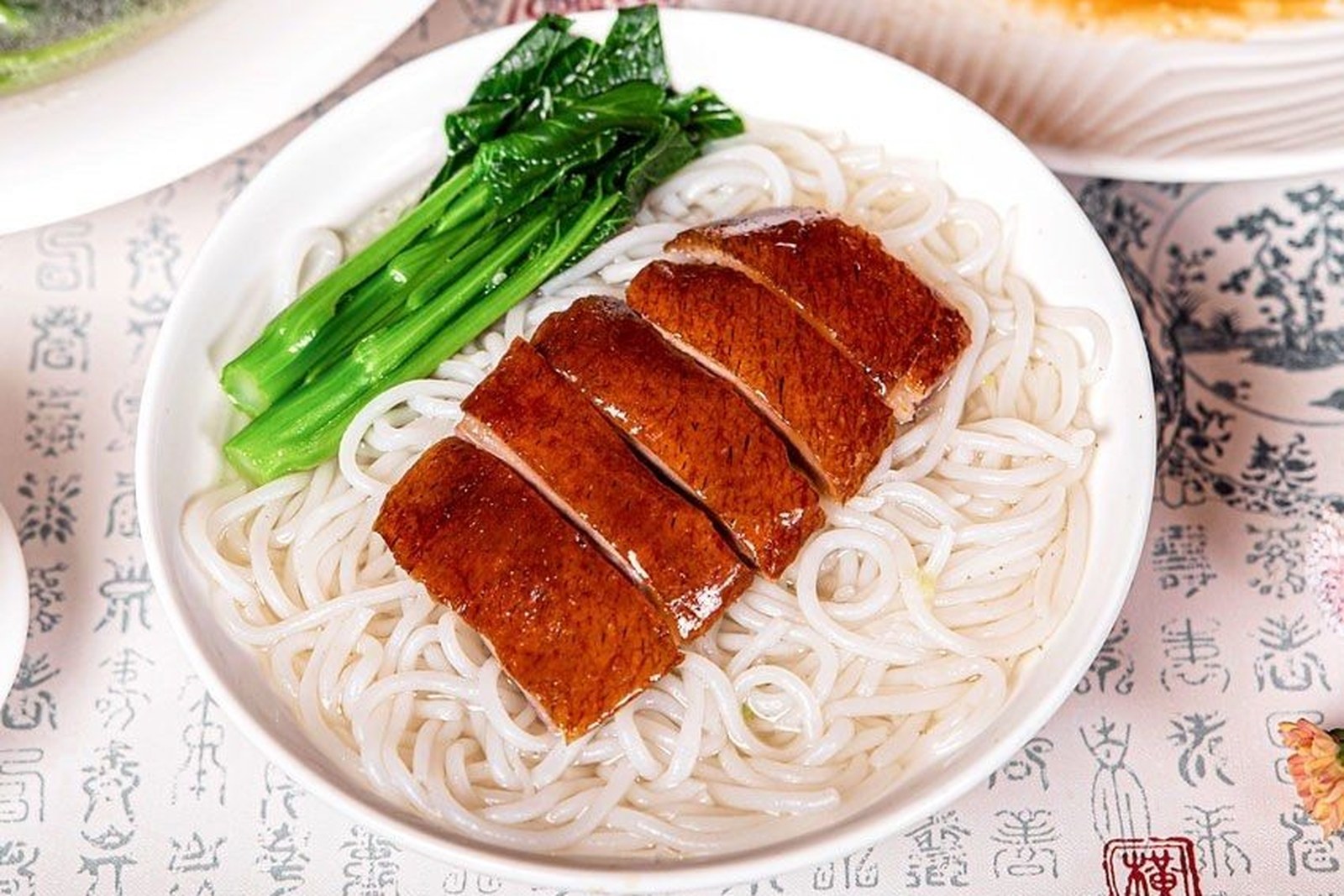
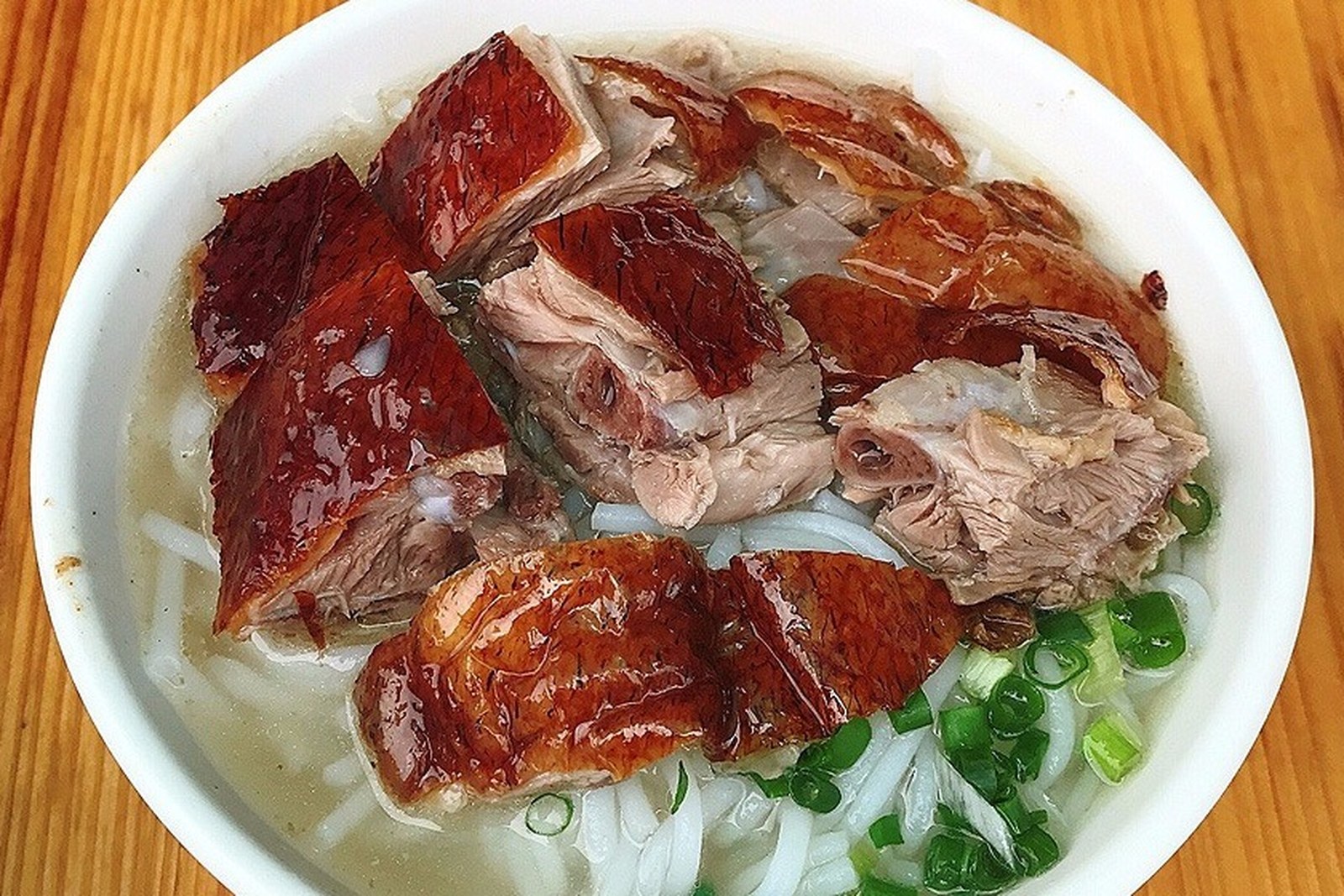
厚街濑粉 Hòujiē lài fěn, the lai fen of Houjie, is a pressed rice noodle from 厚街镇 Hòujiē zhèn Houjie Town in Dongguan – pressed, not cut and not rolled: a rice dough worked smooth, then forced through a perforated board straight into boiling water, the word 濑 lài meaning exactly that, to pour or press through holes. The strand comes out round, long, springy and slippery, and dressed under chopped roast goose with a ladle of the roasting juices it becomes the bowl the town is known by – 金鹅银濑, golden goose and silver lai fen, the goose’s lacquered skin over the noodle’s white. The site’s other rice formats are different objects: rice-noodle rolls are steamed sheets, beef ho fun is the wide Shahe noodle of the wok; lai fen is the pressed round strand, and the pressing is the whole craft.
The heritage attribution must be exact, because the dish carries a trap: what the registers list is the lai-fen making technique – into Dongguan’s second municipal batch in May 2010, into Guangdong’s sixth provincial batch in November 2015 – the craft of the noodle, not of the goose combination; the roast goose is the bowl’s most famous partner, and no listing covers the pair. What the technique does carry is weight in the town’s ritual life: lai fen is the longevity food, the bowl that opens birthday feasts for 长长久久, long-long life, and sits on Mid-Autumn, New Year, winter-solstice and wedding tables – the local saying has families scrambling so hard for the Mid-Autumn bowl that the pot nearly breaks. And the town moved to own its name: in 2019 the Houjie town government registered Houjie Lai Fen as a trademark and licensed six shops to use it – three street kitchens, three hotel dining rooms – a municipal trademark over a noodle, which tells you what the craft is worth.
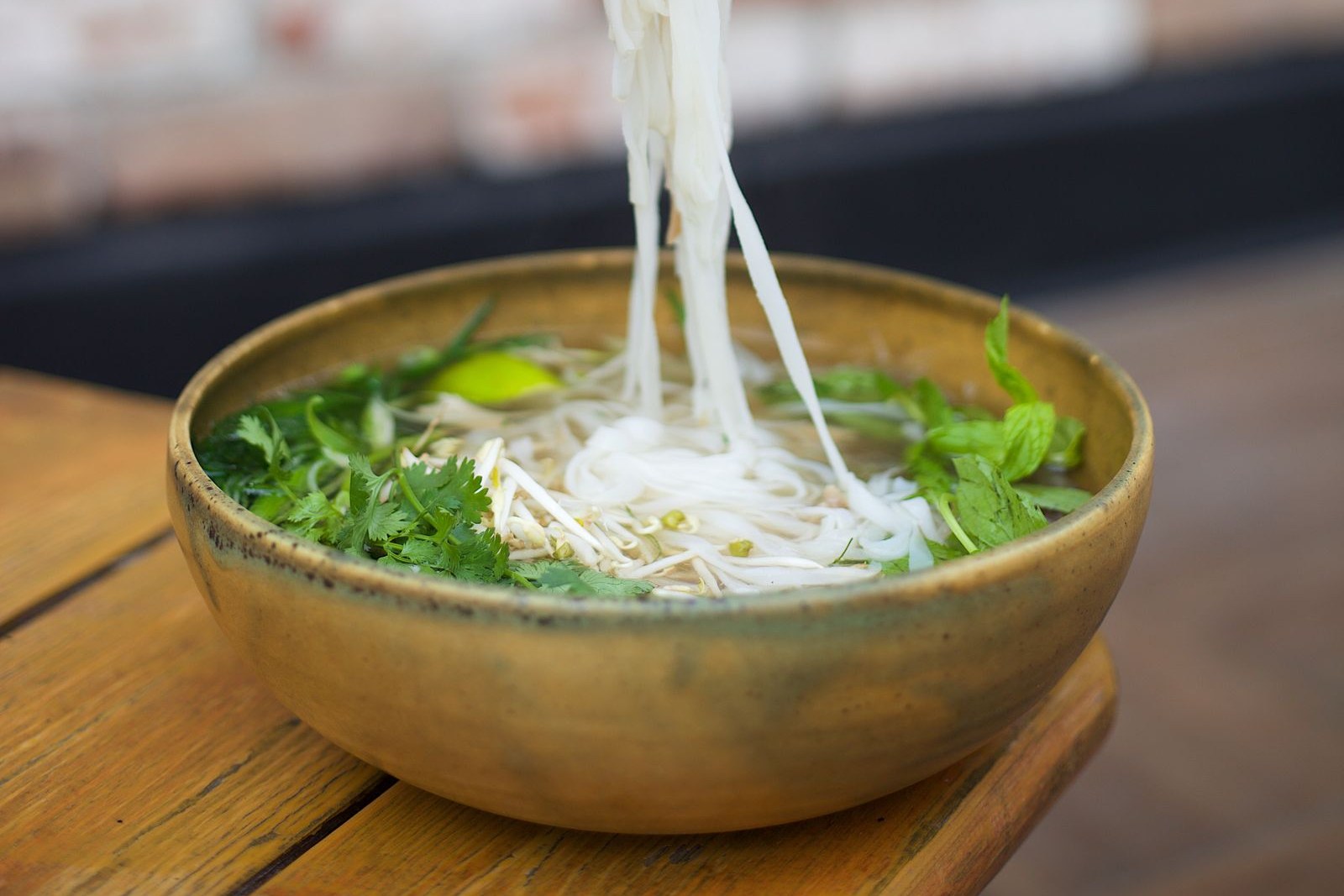
The method runs soak, pound, knead, press, scald, chill, comb. The rice is the year’s new late-crop indica, soaked and pounded and sifted, worked with hot and cold water into a dough the master judges by hand – feel, not a thermometer. The pressing: the dough loaded into a bag or board faced with perforated copper, squeezed so the strands fall straight into the hot water – that fall is the lai. Scalded, then shocked in cold water – 过冷河, crossing the cold river – then combed straight by hand and dried. The broth is the other half of the bowl, in two local registers: a white broth of whole chicken, pork and bones with herbs and spices, and a black broth deepened with rehmannia; both start from pork bones, chicken frames, dried ground-fish and dried shrimp simmered for hours to the local standard of rich yet clear. Assembly is fast: noodles scalded, broth over, chopped roast goose on top, a spoon of the goose’s own roasting juices, scallions, and sour-plum sauce at the side to cut the fat.
The craft’s people are the register’s own line: 余球 Yu Qiu, third generation, and his son 余植华 Yu Zhihua, at it since fifteen and forty years deep, the current name on the list. His verdict is the craft’s defence: handmade lai fen drinks the soup – machine-made keeps powder powder and soup soup, nothing soaking in. Nearly all the lai fen on the market is machine-made now; the handmade benches are rare, which is the point of the trademark – a name strong enough to sell is also a craft thin enough to lose. The town’s own couplet, printed by the Dongguan dailies, gives the format its history: thick gravies and clear, a couple of centuries of fame; golden goose and silver lai fen, several hundred years of fragrance. Older origins are thinner than they look: one folk tale traces pressed noodles to Qin-dynasty army cooks copying a mountain people’s rice threads – a story, not a record, and printed as one; what the dailies actually support is a craft of a hundred years and more.
The money is modest and honest. A roast-goose lai fen bowl runs roughly 20 to 40 yuan as of the late-2026 snapshots, goose-leg bowls near 35 at the older houses – floating figures, printed with their float. The city has taken the bowl up as a brand: in 2022 Dongguan’s cooking-competition finals and its roast-goose lai-fen brand contest ran at Houjie’s Aotai park, and city officials have named the bowl in their own introductions of Dongguan – a municipal dish by proclamation, on a noodle by craft.
Words and Names
濑 lài is the verb the noodle is named by – to press through holes; 濑粉 lài fěn the pressed noodle. 金鹅银濑 jīn é yín lài is golden goose, silver lai fen, the dressed bowl. 过冷河 guò lěng hé is crossing the cold river, the cold-water shock after scalding. 白汤底 and 黑汤底 are the white and black broths, the second deepened with rehmannia. 长长久久 cháng cháng jiǔ jiǔ is the long-long-life pun that puts lai fen on the birthday table. And the site’s rice pages keep their distances: rice-noodle rolls are steamed sheets, ho fun is the wide fried noodle, lai fen is pressed and round – three rice formats, three towns.
What the Locals Know
Find the plaque: six shops hold the licensed Houjie Lai Fen name, and the sources do not print the full list, so the advice is to look for the licence in the window rather than a name in a guide. The old houses the visitor accounts name – a handmade lai fen house in Xintang started 1993, a Shanhu Road shop started 1990 that locals grew up on – are snapshots and tips, printed here as tips.
Eat it the way the town does: hot, soup boiling, goose on top, the sour-plum sauce doing the fat-cutting; if the goose has cooled, a quick reheat brings the skin back. Timing is the only difficulty: the licensed shops and the old houses alike fill at lunch, and the handmade benches run out when the day’s pressing runs out. Pair the bowl with the town’s other formats – the same houses serve the noodle under char siu or roast duck if the party wants a second register – and let the goose drippings decide the return visit.
What the record refuses: any claim that roast-goose lai fen itself is heritage-listed – the listing belongs to the lai-fen making technique, and the body has kept that straight; any four-great-lai-fen-of-Guangdong ranking, which rests on a single commercial page; the Qin legend as history; and any only-inheritor line – the register prints a father and son, Yu Qiu and Yu Zhihua, and that pedigree stands.
flowcloud would say that 厚街濑粉 is a noodle defined by a verb – rice pressed through holes, shocked cold, combed straight – wearing roast goose the way a long life wears a birthday, and a town that trademarked the bowl to keep a handmade craft from going machine all the way down.
Where to find it: the licensed Houjie Lai Fen shops and the older handmade houses of 厚街镇 Hòujiē zhèn Houjie Town, Dongguan – look for the licence plaque in the window, arrive before the noon fill; a roast-goose lai fen bowl roughly 20 to 40 yuan as of the late-2026 snapshots, goose-leg bowls near 35. Eat it hot with the sour-plum sauce, and let the handmade benches, not the clock, set the second bowl.