
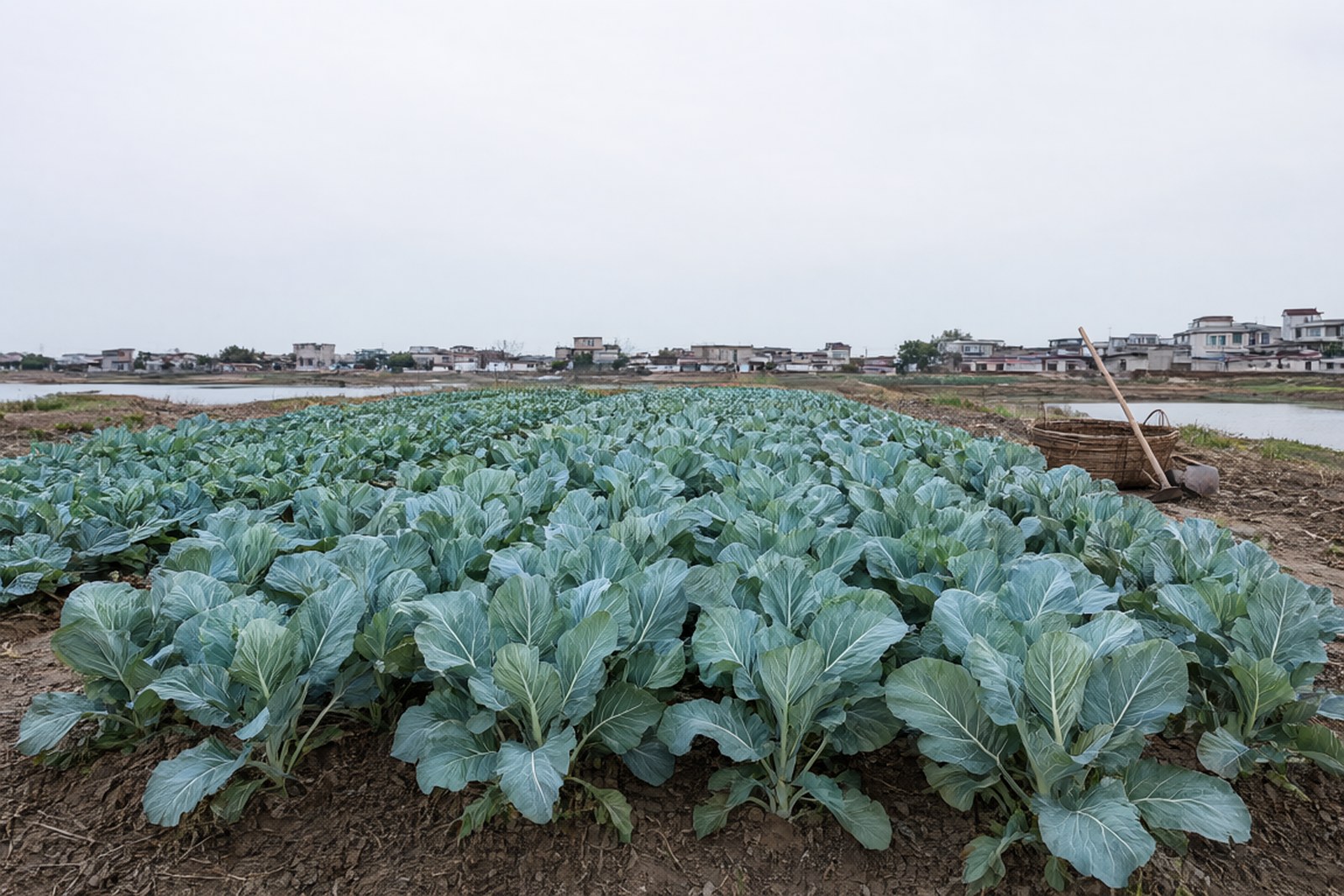
A field of mustard greens before harvest looks like a low sea of broad, pale, slightly blue-green leaves. Anyone walking past in 华容县 Huáróng Xiàn, a low-lying county on the western shore of Dongting Lake, would see a vegetable; what they are actually looking at is the raw material of one of the largest pickle industries in China. The county grows a thick-stemmed, mild mustard called 华容芥菜 Huáróng jiècài, and almost none of it is eaten fresh. It is salted, packed into large earthenware vats, left to ferment, and then shipped out as the sour chopped greens that fill packets, jars and instant-noodle sachets across the country.
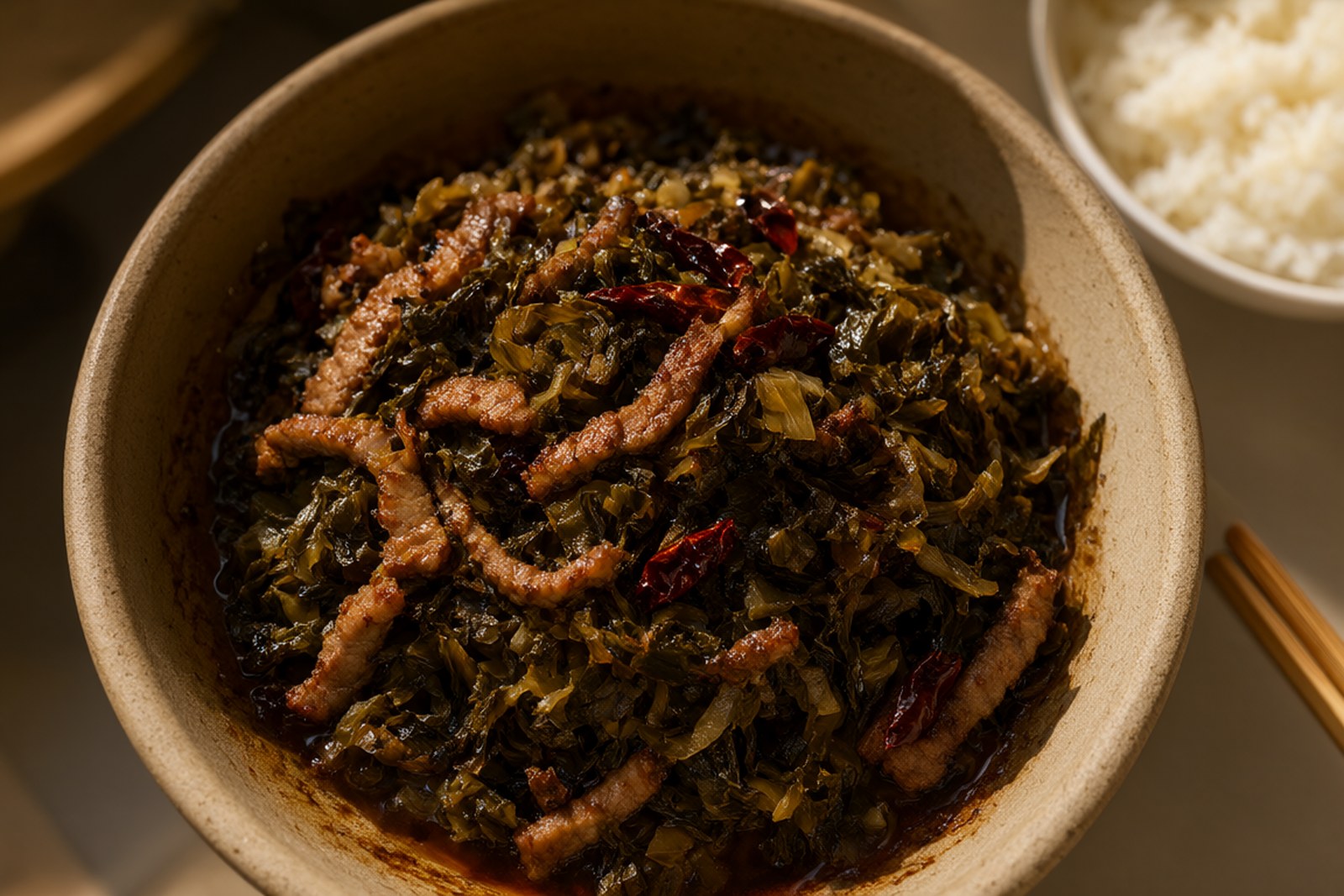
At home it is a working vegetable, not a delicacy, and the local cooking treats it accordingly. The fermented green, 酸菜 suāncài, is rinsed to knock back the salt, squeezed dry, chopped fine, and fried with pork — belly or minced, and always a little fat, because the greens have none of their own. Dried chili and garlic go in, and if there is a piece of cured pork or a few freshwater shrimp in the kitchen they go in too. What comes out is dark, sour, deeply savoury and slightly crisp, and it is eaten over plain rice in quantities that surprise visitors: the dish is a condiment that behaves like a main course. A second use is as a soup base — a handful of the greens simmered with a little pork or a few fish heads, a bowl of 酸菜汤 suāncài tāng, which is what the county eats on cold mornings.
Ferment, Not Pickle
There is a distinction worth holding on to, because the two are constantly confused. A Western pickle is preserved in acid — vinegar does the work, and the flavour is sharp and bright. Chinese 酸菜 from this part of Hunan is fermented: the greens are layered with salt in a sealed vessel, their own juices are drawn out, and lactic acid bacteria turn the sugars sour over weeks. The result is more complex than vinegar, with a fermented depth that has something in common with sauerkraut and with kimchi, and it changes as it matures — the first fortnight is aggressively sour, a month in it becomes rounder, and cooks disagree about the ideal point.
The scale of the county’s production is recent, and it is a story about convenience food. The industry grew on the back of demand for the sour green that comes in instant noodles and in pouches of prepared 酸菜鱼 suāncài yú, and the county now has both the fields and the vats to supply it. That has brought money into a flood-prone agricultural area, and it has also brought the usual problems of scale: the market has taken a hard look at how the fermentation is done, and both regulators and producers have tightened up. What has not changed is the household version, made in a jar in the corner of a kitchen, which is what the county actually eats.
Words and Names
芥菜 jiècài is mustard greens, the broad-leaved brassica used here, distinct from 梅菜 méicài, the dried mustard of Guangdong, and from 雪里蕻 xuělǐhóng, the smaller red-stemmed sort. 酸菜 suāncài simply means sour vegetable and refers to the fermented product; the word is used across China for whatever the local fermented green happens to be. 华容 Huáróng is the county. 腌 yān means to salt or cure, 发酵 fājiào to ferment, and 坛子 tánzi or 缸 gāng are the jar and the vat it happens in. 酸菜炒肉 suāncài chǎo ròu, sour greens fried with pork, is the everyday dish; 酸菜鱼 suāncài yú is the fish soup it flavours nationally.
What the Locals Know
Homemade is better and everybody says so. The industrial product is consistent, but it is made to a salt level and an acidity that suit long shelf life, which is why cooks rinse it before use and often add sugar to round it off. A jar fermented at home is saltier, sourer, and far more aromatic. The greens should be squeezed dry before they hit the wok, or they will steam rather than fry and the texture will be limp. Never cook them in a dry pan — the fat is not a garnish, it is what carries the flavour — and do not add soy sauce, which dulls the sourness. In the county, ask for 老坛 lǎotán, old-vat, if there is a choice; the term is used to signal a slow ferment rather than a fast one.
flowcloud would say that the mustard in Huarong is a vegetable with two lives, since it leaves the field tasting of nothing much and comes out of the vat tasting of a month of patience and a great deal of salt.
Where to find it: the farm stalls and pickle workshops around 华容县城 Huáróng xiànchéng, and every Hunan restaurant in 岳阳市 that lists 酸菜炒肉. At the market, ask to smell the vat before buying loose greens; a clean sour smell is right, a musty one means the ferment went wrong. Otherwise buy the smallest jar you can find, and use it within a couple of months.