
The bowl comes to the table upside down, which is the whole point of the name. The cook holds a plate over the top, flips the two together in one movement, lifts the bowl away, and what is left behind is a dome: overlapping slabs of pork belly, skin up, each one carrying a band of amber fat, resting on a bed of dark, glistening greens that have spent two hours drinking the juices out of the meat. The greens are 梅菜 méicài, salted and dried mustard, and in 惠州 Huìzhōu they are not a garnish or a side. They are the reason the dish exists, and the reason anyone in this city argues about whose grandmother’s version is correct. 梅菜扣肉 méicài kòuròu is the single most ordered dish in Huizhou, and it is the one that tells you fastest whether a kitchen knows what it is doing.
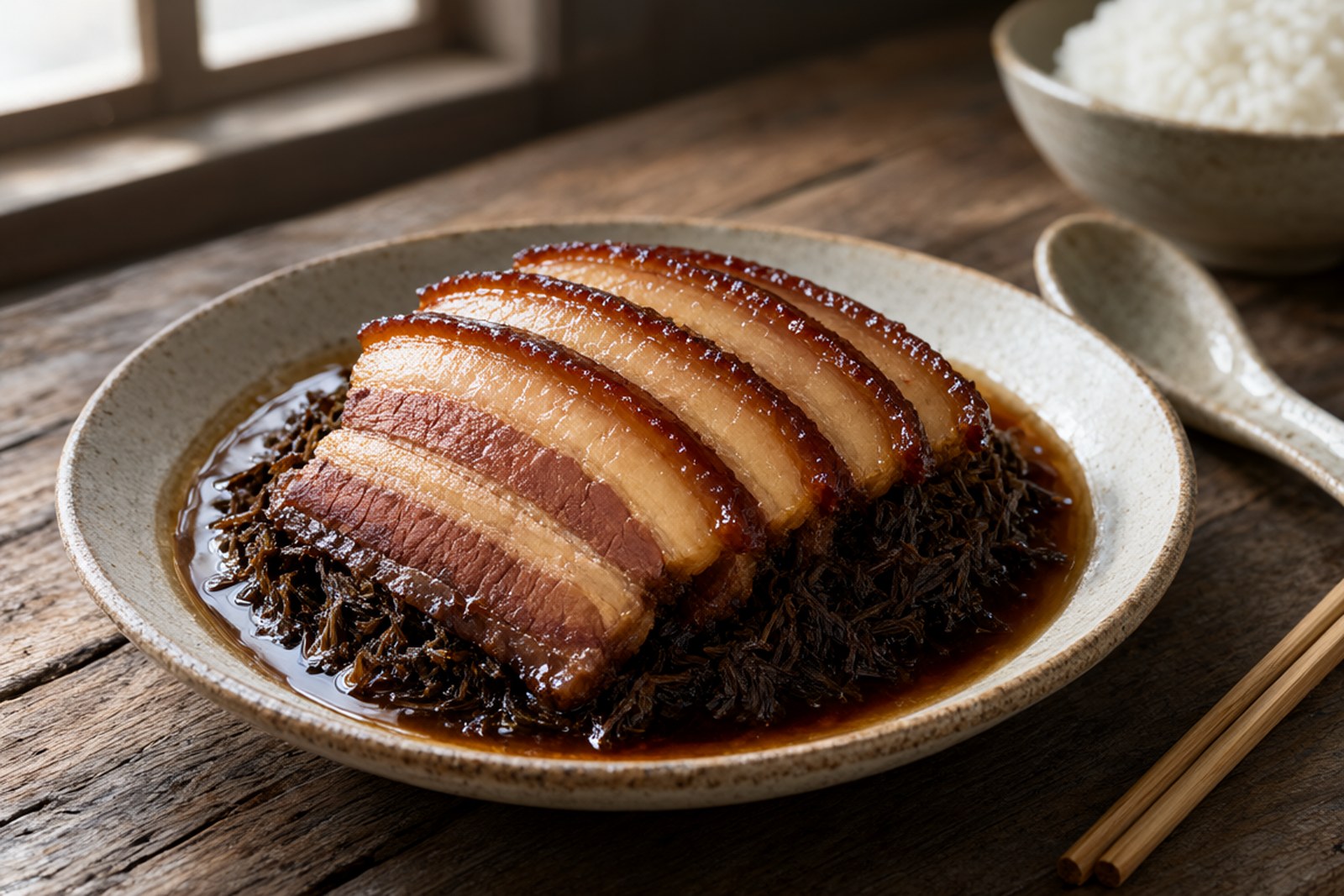
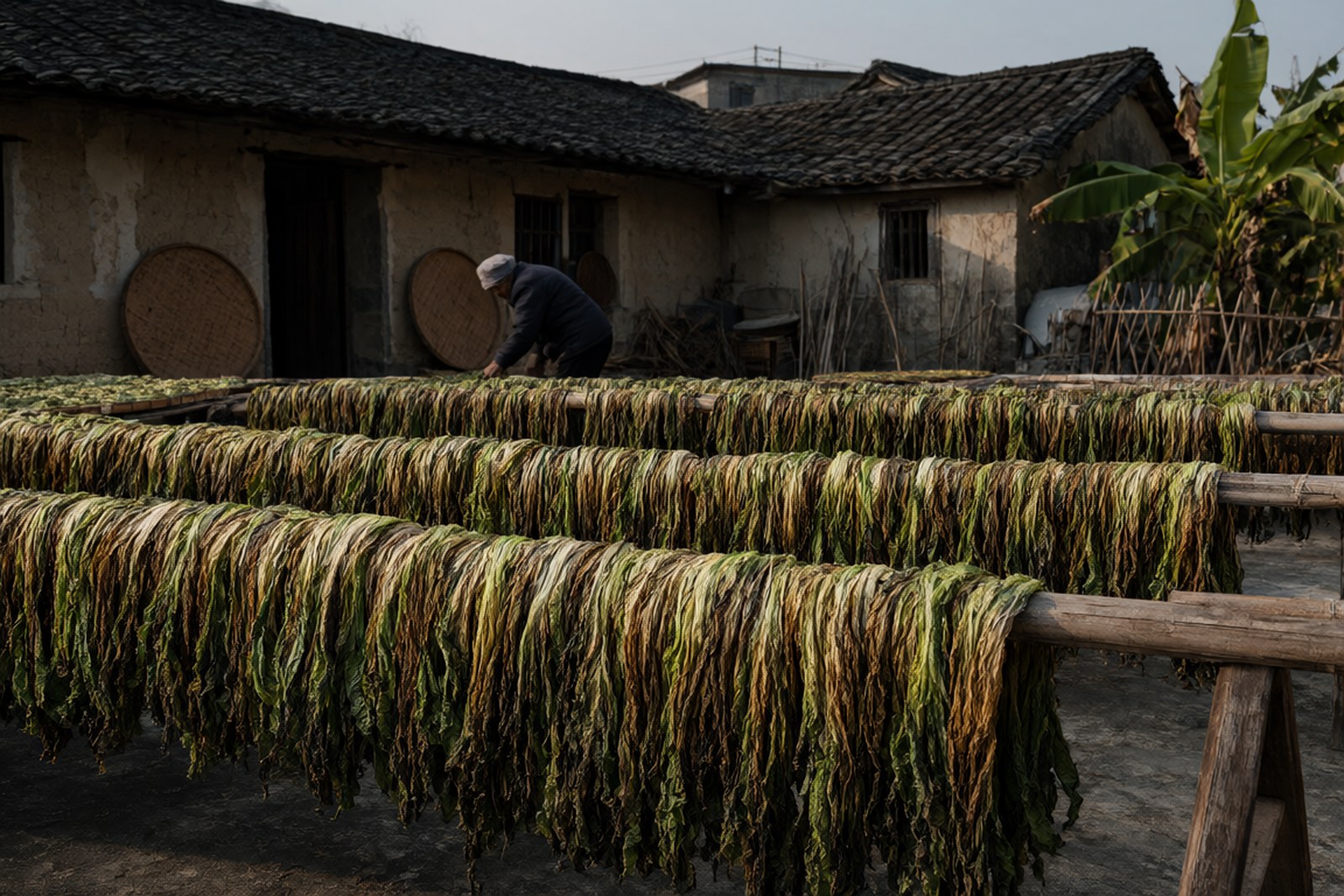
The two halves are made separately and meet only at the end. The 梅菜 starts as a mustard green with a thick, slightly bitter stem. It is salted, pressed, and dried in the sun over several days until the leaves turn from olive to a deep tobacco brown and the whole thing becomes leathery and intensely savoury. Before cooking it is soaked, rinsed, and chopped fine, then fried with garlic and a little sugar until the last of its raw edge is gone. The pork belly is the other half. A whole slab is simmered with dark soy and spices until the skin softens, then dried and lowered into hot oil, where the skin blisters and puffs into what cooks here call 虎皮 hǔpí, tiger skin — a wrinkled, honeycombed surface that will later hold sauce like a sponge. Only then is it sliced, layered skin-down in a bowl with the greens packed on top, and steamed for an hour or two.
Why the Greens Matter Here
Huizhou is the centre of China’s 梅菜 méicài production, and the local trade is organised around a stretch of the East River where the soil and the winter weather suit the crop. The area around 矮陂 Ǎibēi in the city’s Huiyang district is the most often cited, and the dried vegetable from there carries a protected regional name. What separates it from an ordinary pickle is the sugar in the stem. A properly made 惠州梅菜 Huìzhōu méicài is not just salty; it has a faint sweetness and a long, meaty finish, which is why it can carry a dish almost by itself and why local cooks use it with fish, with aubergine and, in 梅菜蒸肉饼 méicài zhēng ròubǐng, steamed with minced pork as a plain weeknight dinner.
Fat is the other half of the equation, and this is where the dish is easy to get wrong. Pork belly is chosen for its layers, five distinct bands of meat and fat if the butcher is honest, because lean meat steamed for two hours becomes sawdust. The greens absorb what renders out. By the time the bowl is turned over, the meat has given up its richness to the vegetables beneath it and taken back their salt and aroma, and neither component tastes like what it started as.
Words and Names
梅菜 méicài is the dried mustard itself; 梅菜扣肉 méicài kòuròu is the dish. 扣 kòu means to turn out or invert, and it describes the final move, not the cooking. 虎皮 hǔpí, tiger skin, is the blistered surface left by the hot oil. 五花肉 wǔhuā ròu is pork belly, literally five-flower meat, named for its bands. 客家菜 Kèjiā cài is Hakka cooking, the tradition this dish belongs to; 东江菜 Dōngjiāng cài, East River cooking, is the regional name for the same tradition in this part of Guangdong. 矮陂梅菜 Ǎibēi méicài pins the vegetable to its best-known source. A 扣碗 kòuwǎn is the bowl it is steamed in, and 芋头扣肉 yùtou kòuròu is the variant layered with taro instead of greens.
What the Locals Know
Order it and watch the fat. A correct piece holds its shape when you pick it up with chopsticks and does not collapse; if it does collapse, the meat was steamed too long or was the wrong cut. Taste the greens first — if they are still bitter or rubbery, they were not soaked and fried properly, and nothing later in the meal will rescue that. Huizhou people eat this with plain rice and a plate of blanched greens, not with noodles and not with bread, because the sauce is salty and needs somewhere to go. It is also a dish that improves overnight: the version reheated the next day is usually better than the one served the night before, which is why families make it in a big bowl rather than portions. Prices are modest and honest — around ¥45 to ¥70 in an ordinary restaurant, more in a hotel, and the tea-house and 大排档 dàpáidàng versions are often the best value in the city.
flowcloud would say that 梅菜扣肉 is a dish about patience in both directions, since one ingredient waits in the sun for a week and the other waits in a steamer for two hours, and the point of the whole exercise is that neither of them tastes like waiting.
Where to find it: the old restaurants and family kitchens of 惠城区 Huìchéng Qū, the city’s central district, plus the Hakka 农家菜 nóngjiā cài farm restaurants in 惠阳 Huìyáng and 博罗 Bóluó. Order it as 梅菜扣肉, ask whether the greens are 矮陂 Ǎibēi, and if the menu offers 芋头扣肉 take whichever the kitchen says it made that morning.