
They come out on a black lacquered round table in a ring, one small dish after another, and it takes a moment to work out what you are looking at. Green chilli, hollowed out and packed tight with pork. Bitter melon cut into rings, each ring full. Pale cubes of tofu with a faint seam where a chopstick went in and a filling was pushed through. Aubergine, taro, garlic cloves, a whole pumpkin flower, a piece of pomelo peel. All of them stuffed, all of them cooked differently — some steamed, some pan-fried, some braised, one or two deep-fried — and all of them arranged so that the table looks like an argument in favour of abundance. This is 瑶家十八酿 Yáojiā shíbā niàng, the Eighteen Stuffed Things of the Yao, and it is the single most characteristic meal of 江华瑶族自治县 Jiānghuá Yáozú Zìzhìxiàn, the Yao autonomous county in the mountains at the southern tip of Yongzhou.
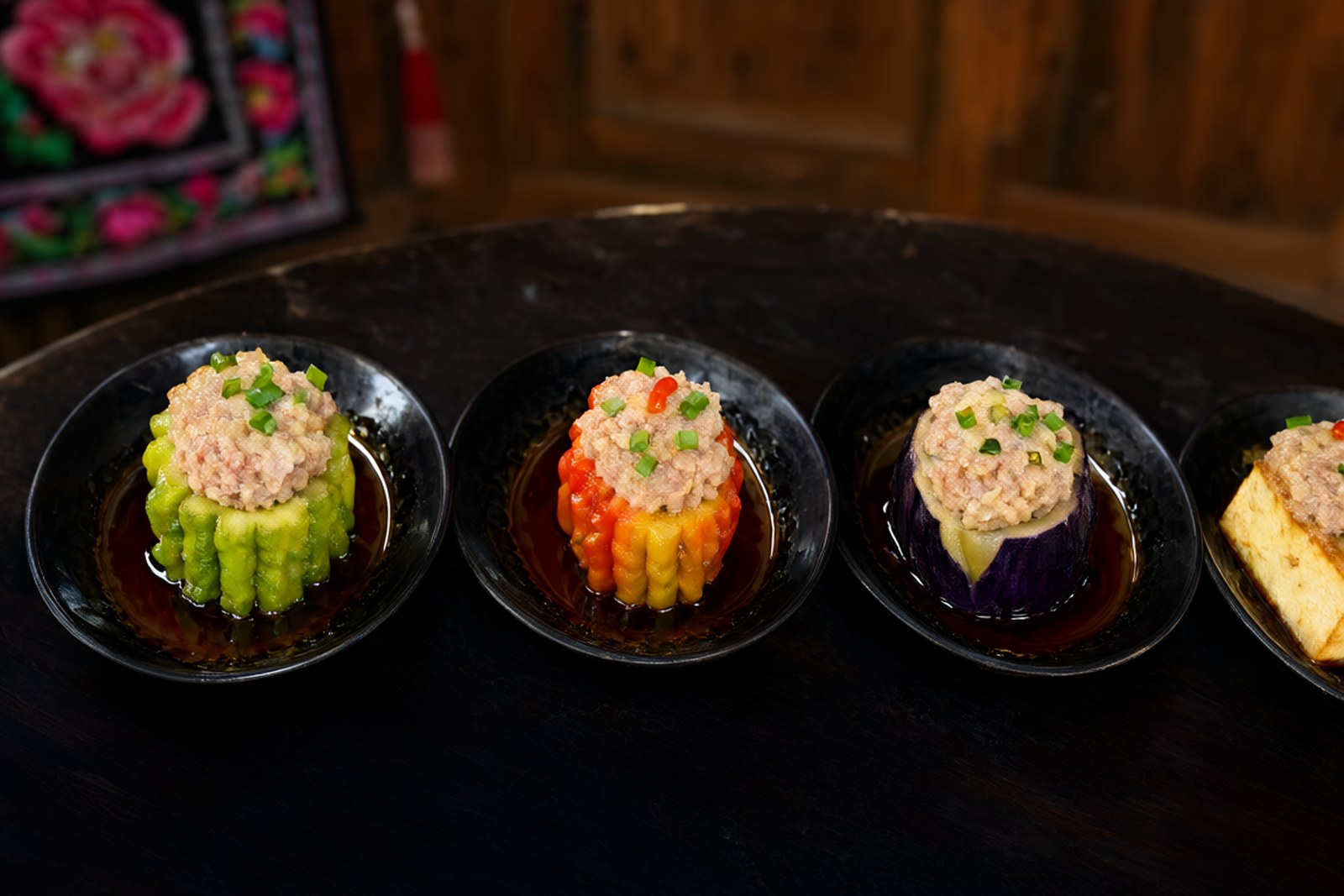
The dish began, like most great peasant food, as a solution to poverty. In the Yao villages of the 萌渚岭 Méngzhǔlǐng range, meat was scarce and guests were not, so the little meat there was got chopped fine, mixed with mountain bamboo shoots and dried mushroom, and stretched by pushing it into whatever the garden was producing. The claim that the eighteen correspond to eighteen branches of the Yao is a later piece of poetry; what is certainly true is that the number is not fixed, and that the local motto — 无菜不酿 wú cài bù niàng, nothing is not stuffed — is meant literally. In recent years the repertoire has grown past thirty, and there is a modern low-fat version made with purple rice and quinoa that has nothing to do with the mountains and everything to do with the gym.
The First Niang Is the Hardest
The canonical eighteen, as listed by the local heritage authorities, run: water tofu, chilli, bitter melon, snail, rice tofu, fried tofu, shiitake, garlic, konjac, bamboo shoot, aubergine, loofah, lotus root, winter melon, pumpkin flower, 牛耳菜, radish, and egg. The one that matters is the first. 水豆腐酿 shuǐdòufu niàng — stuffed soft tofu — is the test of a Yao cook, because soft tofu has no structural integrity and has to be split, hollowed with a chopstick, filled, and then moved to the pan without breaking.
The best of them is the 圣水豆腐酿 Shèngshuǐ dòufu niàng, made with tofu ground using water from 得仙岩 Déxiānyán, a spring at 竹园寨 Zhúyuánzhài in the county seat of 沱江镇 Tuójiāng Zhèn. The claim is that the mineral content of that particular water gives the curd a springiness ordinary water does not. The bean curd is filled with hand-chopped lean pork, spring onion, salt and monosodium glutamate and nothing else, then lowered into a pan whose base has been coated with hot oil, fried until the underside is gold, splashed with soy-thinned stock, and covered to steam through. At the end comes chilli powder, spring onion and a few drops of sesame oil. It is said to have reached the banquet tables of the Great Hall of the People, which for a village recipe is as far as the road goes.
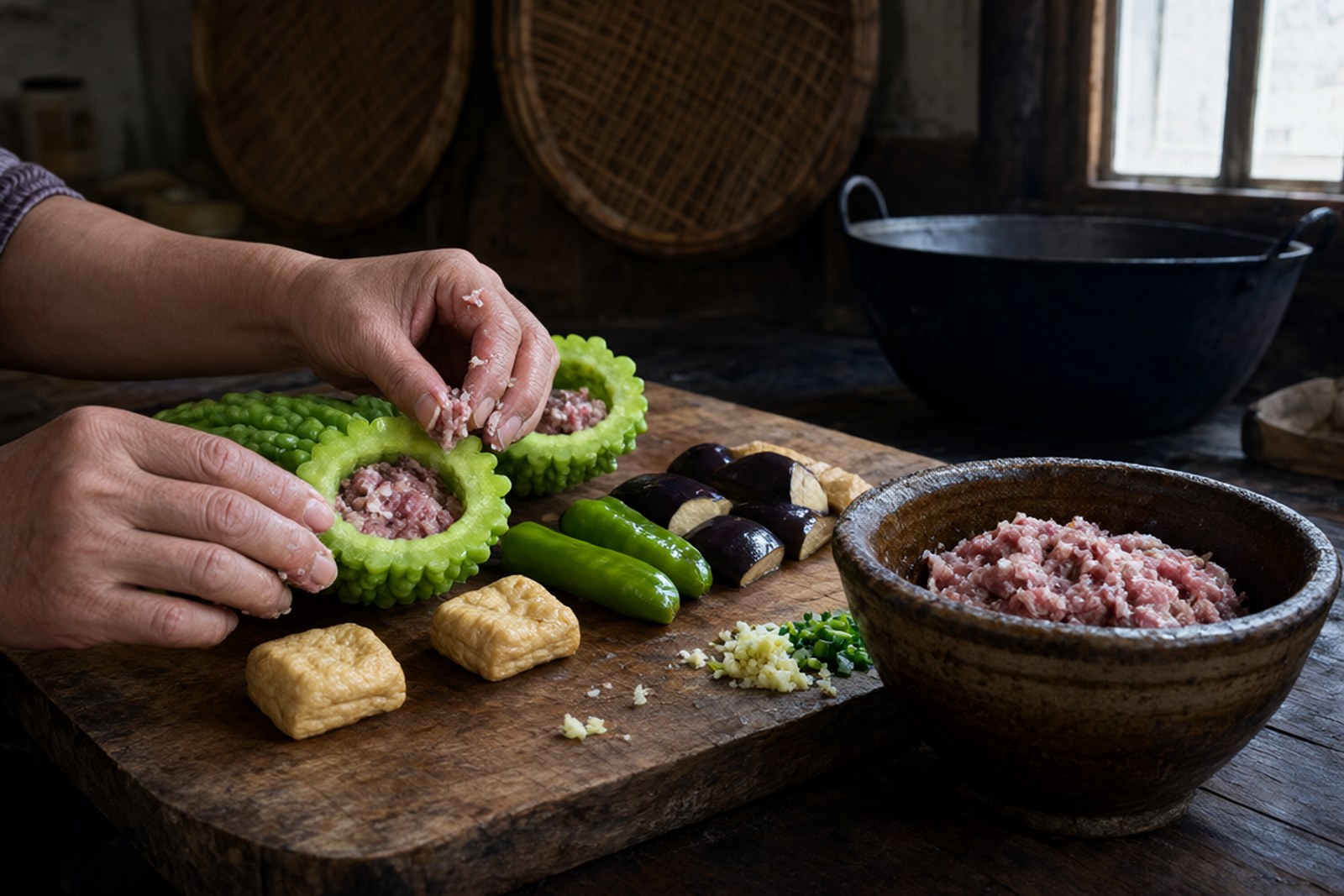
The general rules apply across the eighteen. The stuffing is 三分肥七分瘦 sān fēn féi qī fēn shòu — three parts fat to seven lean, usually pork belly or a mix — because all-lean filling comes out dry inside its wrapper. It is packed firmly but not forced, since a compressed filling cooks unevenly. And the cooking method is decided by the wrapper: the small round things — stuffed mushroom, stuffed fried tofu — are steamed; the long ones — bitter melon, bamboo shoot — are pan-fried so the exposed meat browns; and anything fragile, above all the water tofu, is braised with the heat low and the pan never shaken.
Words and Names
酿 niàng is the key word, and it is worth lingering on because it does more work in southern Chinese cooking than the translation suggests. Its ordinary meaning is to brew or to ferment; in the Yao and Hakka kitchens of Hunan, Guangxi and Guangdong it means to stuff one thing inside another, and by extension it carries the idea of something being made richer by being filled. The Yao phrase for the virtue behind it — 酿食如人品, 对人要实在, 酿食要饱满 niàng shí rú rénpǐn — says that a stingy stuffing is a character flaw: the food should be as full as the person is sincere.
江华 Jiānghuá is the county, and 沱江 Tuójiāng its seat. 瑶 Yáo is the ethnic group, the largest of the mountain peoples of south China, whose 盘王节 Pánwáng Jié, the festival of King Pan, is when the full eighteen are laid out and the drumming starts.
What the Locals Know
Ask for the set, not a dish. Ordering one niang is like ordering one dumpling. The point is the table full of them, and the restaurants in 沱江镇 Tuójiāng Zhèn that specialise will bring the traditional eighteen as a fixed menu.
Eat the seasonal ones. Spring brings 竹笋酿 zhúsǔn niàng, winter bamboo shoot stuffed with pork, and summer brings 南瓜花酿 nánguāhuā niàng, whole pumpkin flowers filled and steamed. If you are there in the right month, ask; if not, do not.
Try the 柚子皮酿 yòuzipí niàng. Pomelo peel, cured to take out the bitterness and then stuffed, is the one that surprises people — bitter, then sweet, then rich. It is the dish locals use to explain themselves to outsiders.
Say 搭赖 dālài. It is the Yao invitation to eat while it is hot, and using it will get you fed more than you wanted.
Where to Eat It
江华瑶族自治县 Jiānghuá Yáozú Zìzhìxiàn, in the restaurants around 沱江镇 Tuójiāng Zhèn, where a full eighteen-niang banquet for four people runs roughly ¥200–350, and individual plates are ¥20–40. Smaller versions are available all over Yongzhou city, but the tofu and the spring water that make the best of them do not travel far. Book a day ahead for the full set if you want the water tofu niang, which is made to order and does not sit.
flowcloud would say that the whole cuisine is a sentence about hospitality: that when you have very little meat, the way you show respect is not to serve more of it but to spend four hours making sure that every single vegetable on the table has some inside it, so that the guest never has to notice how little there was.
Where to find it: 瑶家十八酿 (Yáojiā shíbā niàng), 江华瑶族自治县 (Jiānghuá Yáozú Zìzhìxiàn), 永州市 (Yǒngzhōushì), 湖南 (Húnán). Best around 沱江镇 (Tuójiāng Zhèn). Full set for four ¥200–350, single plates ¥20–40. Ask for the 圣水豆腐酿 (Shèngshuǐ dòufu niàng) and any in-season niang, and expect the filling to be generous.