
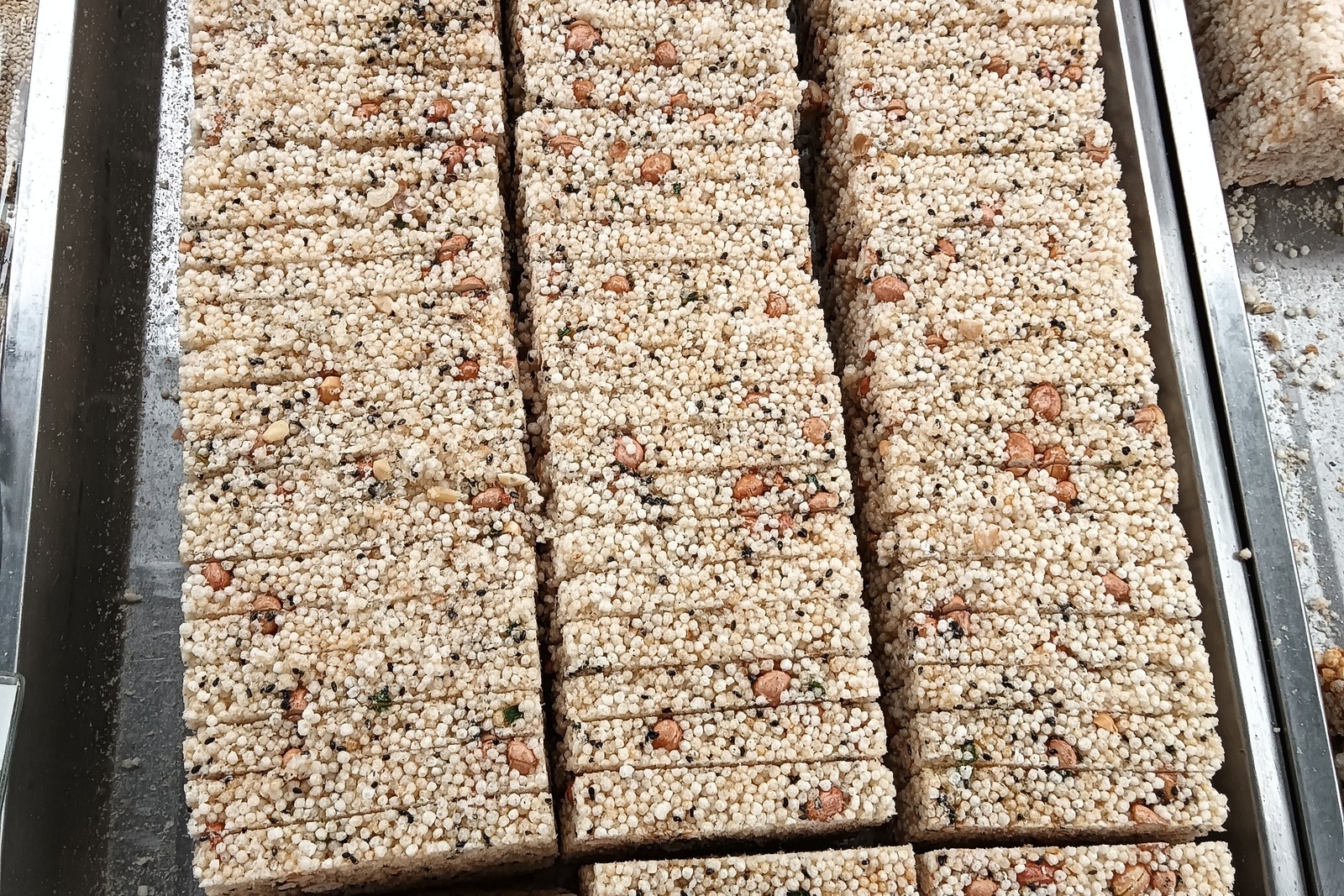
江津米花糖 Jiāngjīn mǐhuātáng, Jiangjin rice candy, is the district’s confection export and one of Chongqing’s oldest packaged sweets: puffed glutinous rice pressed into a white slab with malt syrup and peanuts, cut into bars, wrapped in wax paper. The trade formalised in the river-port town of 白沙 Báishā, Baisha, in the early twentieth century, where the candy houses took the farmhouse puffed-rice snack and industrialised it for the Yangtze steamer trade; the rose trademark that came to stand for the whole category dates from that era and still runs the largest lines. In Chongqing the candy is what the railway traveller bought and what the Spring Festival tin holds; in the district it is still a working industry.
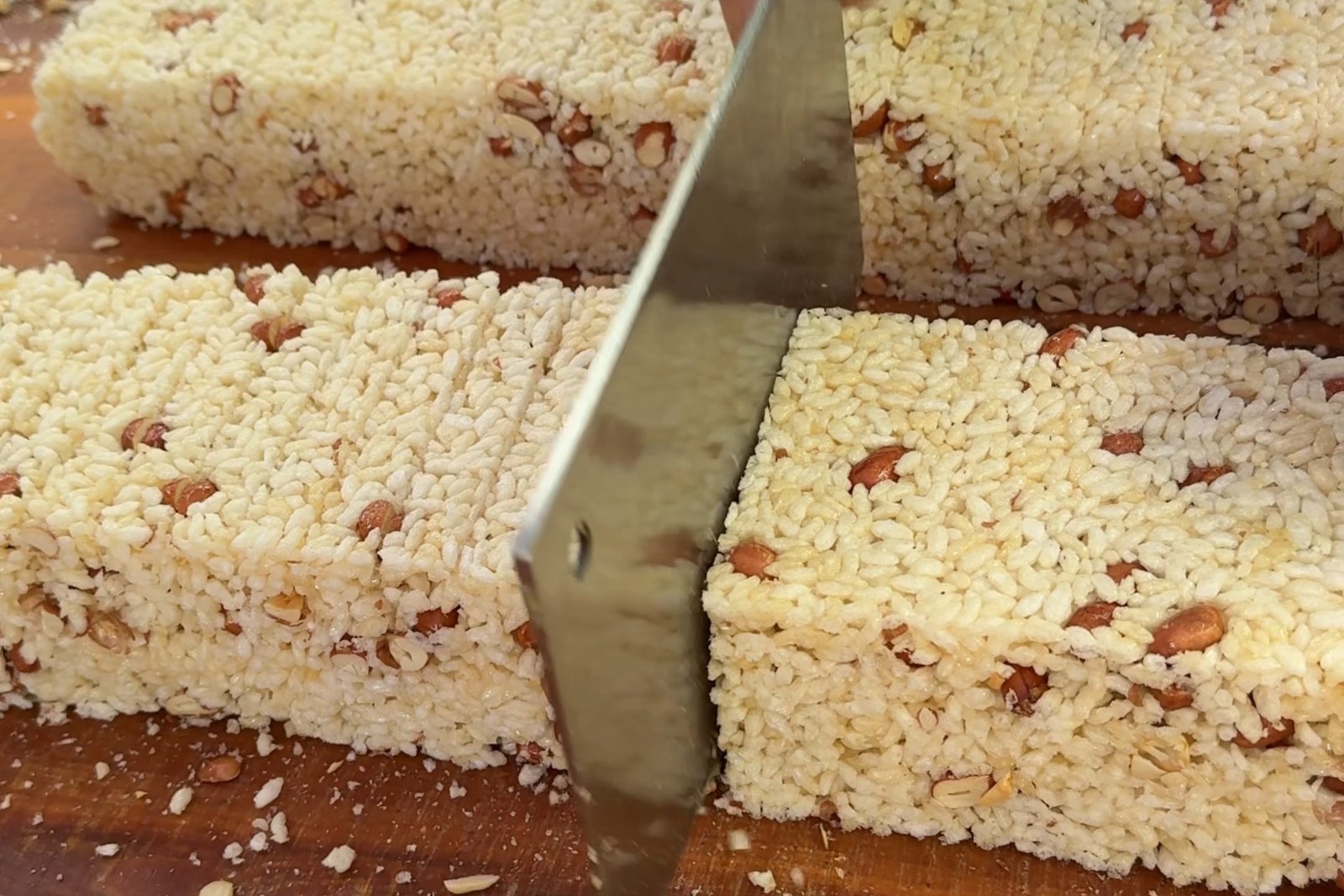
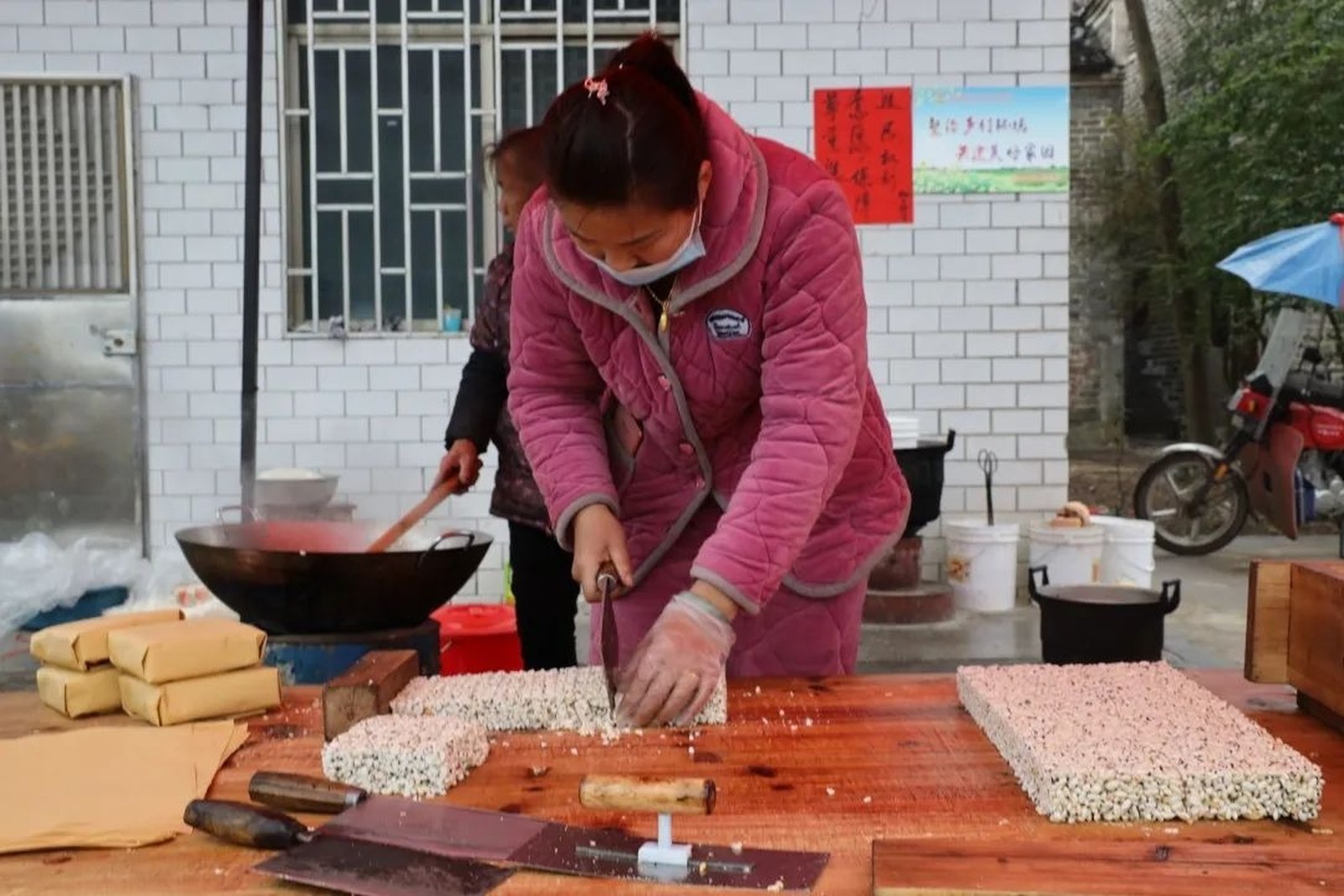
The port explains the industry. Baisha was one of the Yangtze’s working river ports, a town where steamer cargo, passenger trade and a long Qing-dynasty street of shops met on the same frontage, and a confection that pressed into slabs, wrapped in wax paper and stacked in crates was exactly the product such a port could ship. The farmhouse puffed-rice snack every Sichuan village knew became in the candy houses a standardised bar: puffed rice, malt syrup cooked to the stage that glues without hardening, peanuts folded through, pressed, cut and wrapped while warm. The rose trademark that outlived the era’s other houses is the survivor of what was plainly a crowded field.
The texture is the whole argument, and the recipe has resisted every temptation to modernise it. A proper bar shatters first – the grains separate clean under the tooth rather than bending – and then melts, because the malt syrup is only just holding the structure together and dissolves the moment it meets warmth. That balance is why the ingredient list has stayed short and why the bar stays fragile: a candy engineered to travel would need a harder glue, and a harder glue is a different, lesser sweet. The peanuts carry the salt note, the malt carries the low caramel tone, and the puffed grain itself is the trade’s point of pride.
What the record supports and what it does not is worth stating plainly, because a century-old sweet is exactly the kind of subject that collects invented detail. The record consulted names the Baisha port, the early-twentieth-century formalisation, the industrialising candy houses, the rose trademark of that era and the ongoing factory shops; it does not carry a founding year, a founding family or a documented first recipe, and none is invented here. The honest page dates the category to its era rather than to a year, treats the rose brand as the trade’s surviving standard-bearer rather than its sole origin.
What the visitor does is buy the day’s bars and eat the difference. The factory shops along the old streets sell over the counter what the festival tins ship to the cities, and the counter bar – snapped fresh, the shatter immediate – is the argument for buying at the source. The bars travel well within their wax paper, but the texture is a clock: the older the bar, the chewier the glue, which is why locals buy for the week and not the year. In Chongqing it is nostalgia by the slab; in the district it is simply the day’s output. All checked October 2026.
Words and Names
江津米花糖 Jiāngjīn mǐhuātáng, Jiangjin rice candy, the puffed-glutinous-rice slab of 江津区 Jiāngjīn Qū, Jiangjin District: puffed rice pressed with malt syrup and peanuts into wax-paper bars, formalised as a packaged trade in the early twentieth century at the river-port town of 白沙 Báishā, Baisha. The 玫瑰 rose trademark dates from that era and remains the category’s largest line; the texture is shatter then melt, with the syrup only just binding the grains. The trade runs as a working industry of factory-shop counters; no founding year, founding family or first recipe is on the public record consulted, and none is invented here.
What the Locals Know
The local knowledge is about freshness, not history. The bar is a texture with a shelf life – syrup-glued puffed rice picks up moisture and slides from shatter to chew within weeks – so the local buy is the counter bar in the plain wrapper rather than the gift tin, and the check is the snap: a bar that bends has waited. Locals serve it with hot tea, the malt and the tannin being the classic pairing. The second thing locals know is the geography: the candy houses were a Baisha port trade, and a visitor bound for the old town’s streets can pair the counter shops with the river frontage that shipped the crates. What the record does not carry is any shop ranking or price, and the page declines both – the queue at the counter is the review.
flowcloud would say that Jiangjin rice candy is the confection a river port built – puffed glutinous rice pressed with malt syrup and peanuts into wax-paper bars, formalised at 白沙 Baisha in the early twentieth century for the Yangtze steamer trade, the rose trademark of that era still the largest line, the shatter-then-melt texture no modernisation has bettered – and that the district still runs it as a working industry of factory-shop counters, with no founding year or family on the record and none invented. All checked October 2026.
Where to find it: the factory shops and counter trade are along the old streets of 江津区 Jiāngjīn Qū, Jiangjin District, with the trade’s port-era home at 白沙 Báishā, Baisha, whose old streets carry the shopfronts that shipped the category; no specific shop address, posted price or founding year is on the public record consulted and none is invented here. The bars are sold wrapped and travel well, but the fresh counter bar is the form the texture argues for. Pair this page with the Baisha ancient town page for the port that built the trade, and with the pepper chicken page for the district’s table in the same sitting.