
Seven in the morning at 黄桷坪 Huángjuépíng Huangjueping: the first kettle is already on in the passage, and by the time the door is unbarred the regulars are carrying their own lidded cups up the lane. 九龙坡区 Jiǔlóngpō Qū Jiulongpo is Chongqing Municipality’s south-west district on the Jialing’s south bank – the industrial city whose art college spent forty years in this quarter before moving west. This page sits down at 交通茶馆 Jiāotōng Cháguǎn the Jiaotong Teahouse at opening time. Its subject is a room that survived on one man’s stubbornness and one retired worker’s daily presence.
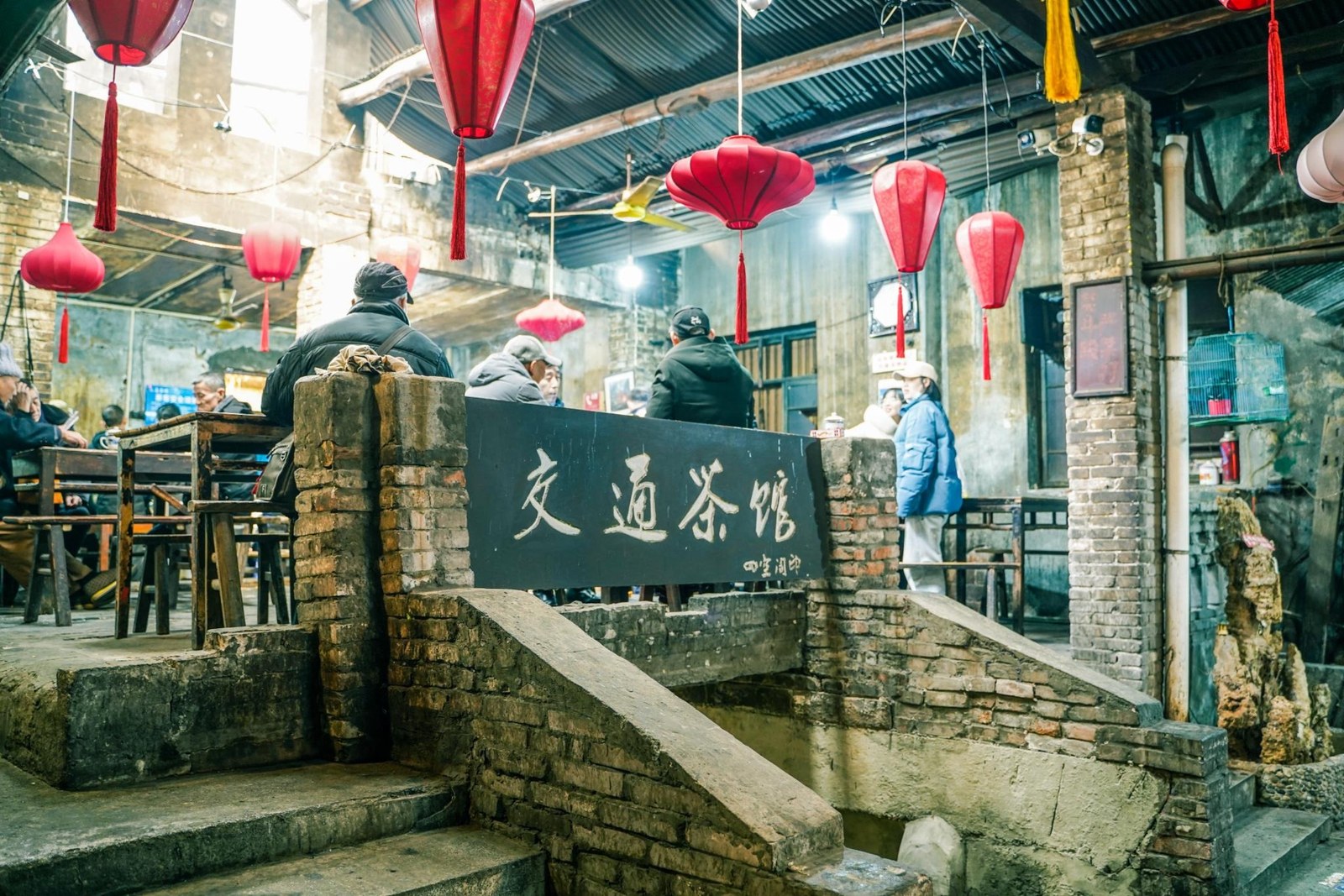
The room’s own record is short. The building is old brick and timber with a frame of uneven beams and grey-black tiles, patched through decades, and it stands on 黄桷坪正街 Huángjuépíng Zhèngjiē Huangjueping Main Street in the middle of what is now the graffiti quarter. It was not always a teahouse: it was the canteen and bathhouse of the district’s loading and transport company, the 黄桷坪装卸运输公司, and in 1987 – as the company’s own people and the city’s accounts agree – it was converted as the reforms let collective enterprises run more than one trade, the ground floor becoming a tea room named for the company and the upper floor a hostel. That conversion is the whole hinge: a canteen is a room built to feed shift workers quickly, and the people who inherited it turned it into a room where you could sit all morning.
What the room kept is the shape of the 1980s, and the city’s accounts agree on the claim: it is the city’s last teahouse still holding that decade’s form. It holds it partly by not being a business in the ordinary sense. Tea has never carried the rent. The prices have moved less than almost anything else in the neighbourhood – one account tracks a bowl of tuocha across a decade and finds it up by a few yuan while everything around it doubled and trebled – and old regulars may bring their own leaves and sit as long as they like, which is why the room is full by day and not by evening.
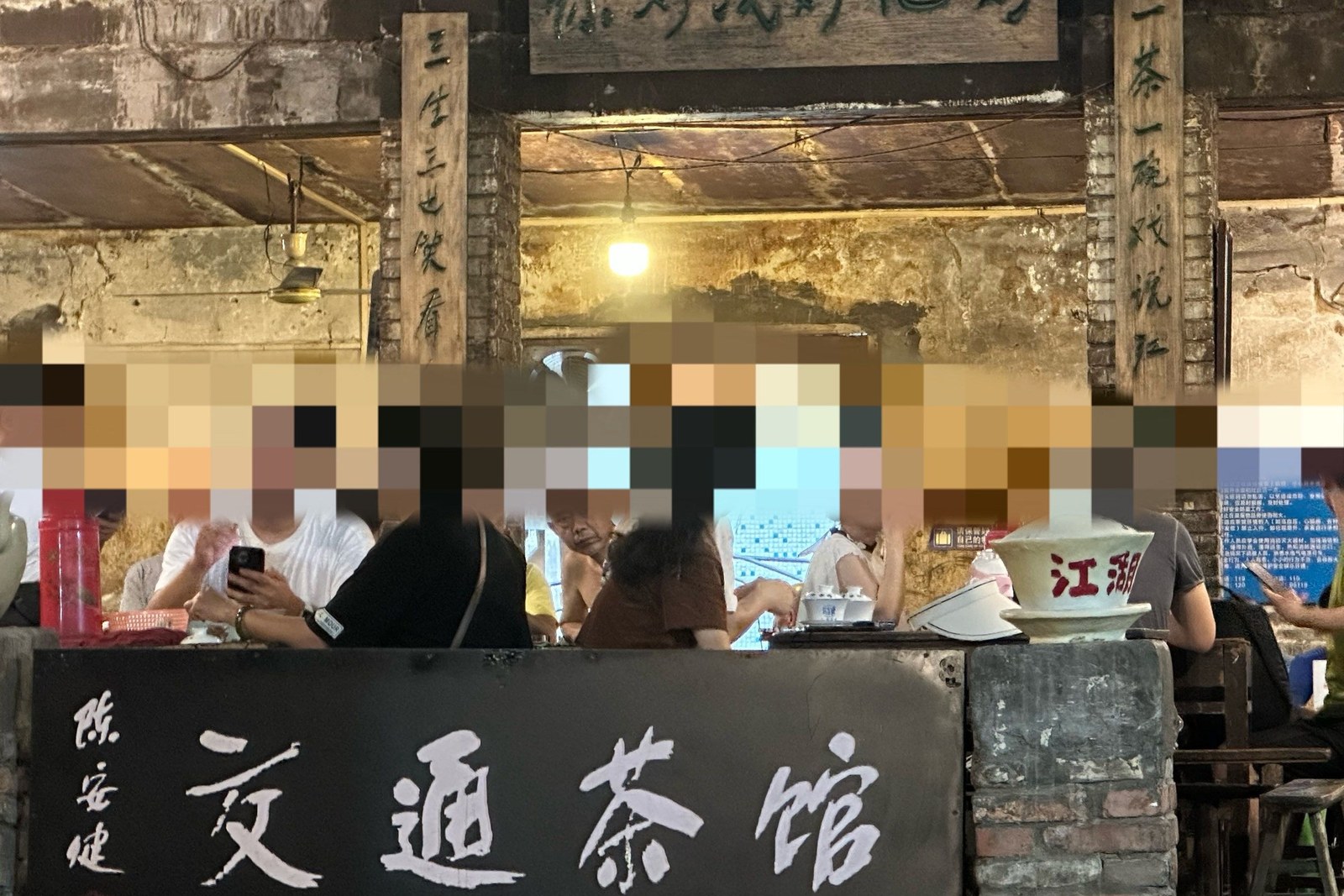
The room nearly closed once. Around 2005 the tea was losing money, the rent had gone up, and the transport company was willing to hand the lease to someone who wanted to open an internet cafe in the space – a proposal that would have paid better and changed the room’s volume, traffic and light entirely. A painting professor from the fine arts academy who had used the room as a studio for years, 陈安健 Chén Ānjiàn Chen Anjian, heard the plan and refused to let it go. He took the lease himself, went to the district government to write about the room, and for about ten years he and the teahouse carried the rent between them, on one condition he stated plainly and repeated: the building could be repaired, but its inside was not to be changed. He put 佘定明 Shè Dìngmíng She Dingming, a retired worker from the hostel next door, in charge, and she has been running it since.
The room’s second life was a film. In the mid-2000s a crew shot a comedy there whose director had spent a week in the room quietly drinking before he asked to film in it; the negotiation was reported at the time as a flat fee for a day’s shooting, the owner by her own account not learning until later what the film was called. It is now the most widely recognised image in the city, which has brought a camera-carrying crowd the room never asked for, and the room’s response is the only one available: nothing in the timber has been moved, the lighting stays dim, and the regulars keep their seats.
Words and Names
黄桷坪 Huángjuépíng Huangjueping, the Jialing-side quarter that held the fine arts academy’s campus for decades and now holds its 1.25-kilometre graffiti street; 交通茶馆 the Jiaotong Teahouse, named for the transport company that owned the building. 黄桷坪装卸运输公司 the district’s loading and transport company, whose canteen and bathhouse the room was; the conversion to a teahouse and hostel is dated 1987. 盖碗茶 gàiwǎn chá covered-bowl tea, in blue-and-white lidded bowls with unlimited refills. 沱茶 tuóchá tuocha, the dark compressed tea the house serves by default. 摆龙门阵 bǎi lóngménzhèn “putting the dragon array”, the long loud conversation that is the room’s real product. 陈安健 Chén Ānjiàn the academy professor who took the lease in 2005; 佘定明 Shè Dìngmíng the retired worker running it since.
What the Locals Know
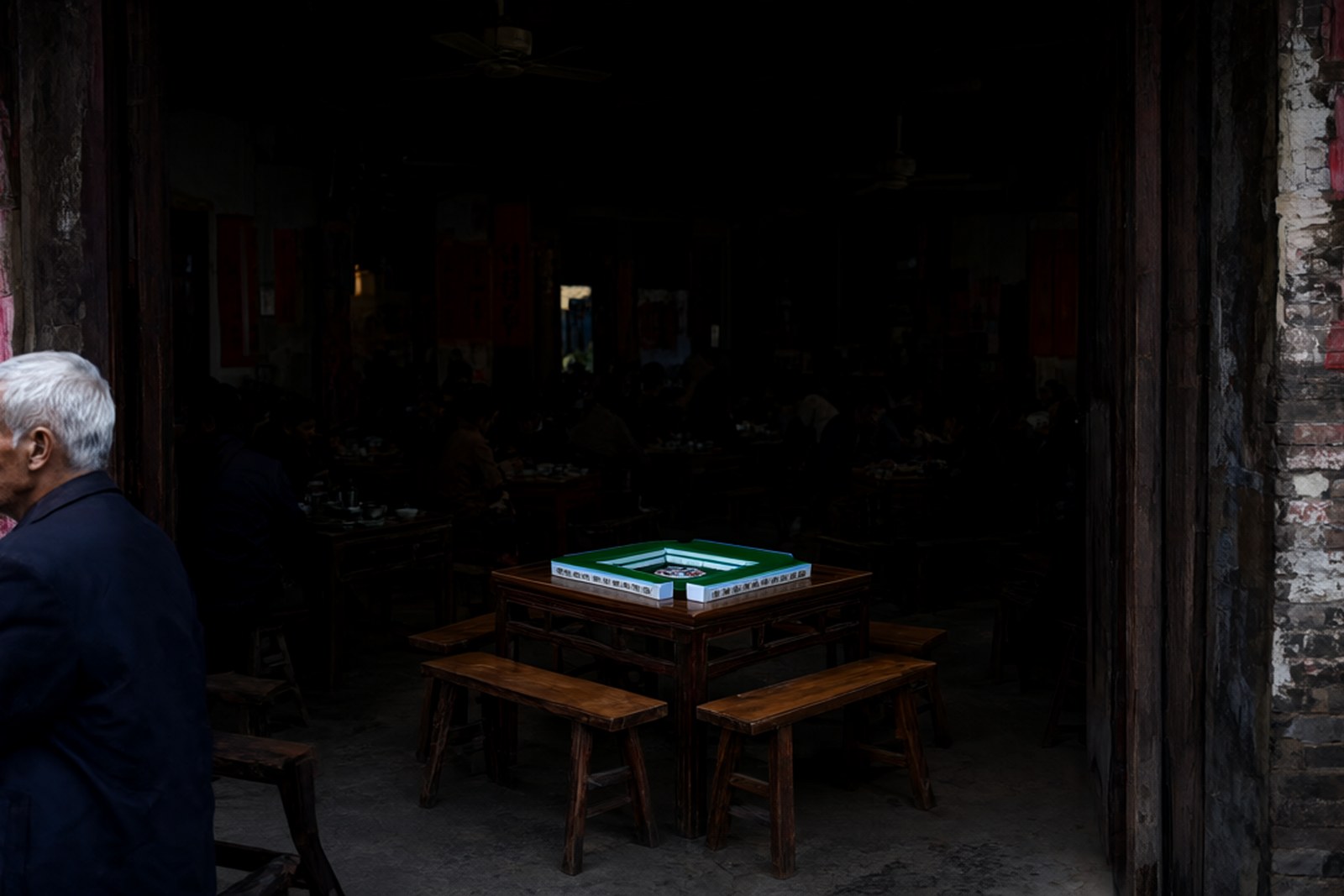
Regulars read the room the way other city regulars read a football terrace. There are seats that are informally held – the bench by the wall with the draught, the table nearest the light that goes first in winter – and an outsider who does not know the system will simply be moved, kindly, at the next table. The day has an order nobody discusses: the first water goes on early, the early tables are quiet, mid-morning fills with talk, lunch takes the whole floor, and the long afternoon is the mahjong hour. Tea is refilled continuously and nobody counts anything, and what regulars insist on is that the first hour is not for cameras.
And then there is the arithmetic of loyalty: people who moved out of Huangjueping years ago still get on a bus to come back, and several current regulars live across the river and travel in. The professor’s arrangement has kept the clientele the room was built for – the ones who came for the tea, not the ones who came for the film.
flowcloud would say that the Jiaotong Teahouse is the room the city lost everywhere except here – a 1987 conversion of a transport company’s staff canteen and bathhouse in Huangjueping, bare tables and a low stage, covered-bowl tea from seven in the morning at a price that barely moved while the neighbourhood doubled, and a 2005 rescue in which a fine arts academy professor, 陈安健, refused to let the lease go to an internet cafe, carried the rent himself for about a decade on the condition that nothing inside be changed, and put a retired canteen worker, 佘定明, in charge of the room that is still full at dusk.
Where to find it: 交通茶馆 the Jiaotong Teahouse, on 黄桷坪正街 Huángjuépíng Zhèngjiē Huangjueping Main Street, 黄桷坪街道 Huángjuépíng Jiēdào Huangjueping subdistrict, 九龙坡区 Jiǔlóngpō Qū Jiulongpo District, Chongqing Municipality – a low door at the far end of a narrow lane off the main street, easy to walk past. Light rail line 18 to Sichuan Fine Arts Institute station and a short walk, or buses to the Huangjueping Main Street stop. The room is open from early morning until the last table leaves, and to anyone who walks in and sits down. Several numberings are used for this door and they do not agree, so look for the lane rather than the number. No price is quoted here. The 1987 conversion, the 2005 rescue and the decade of the rent arrangement come from the owner’s and the professor’s own accounts as reported from 2014 to 2018.