
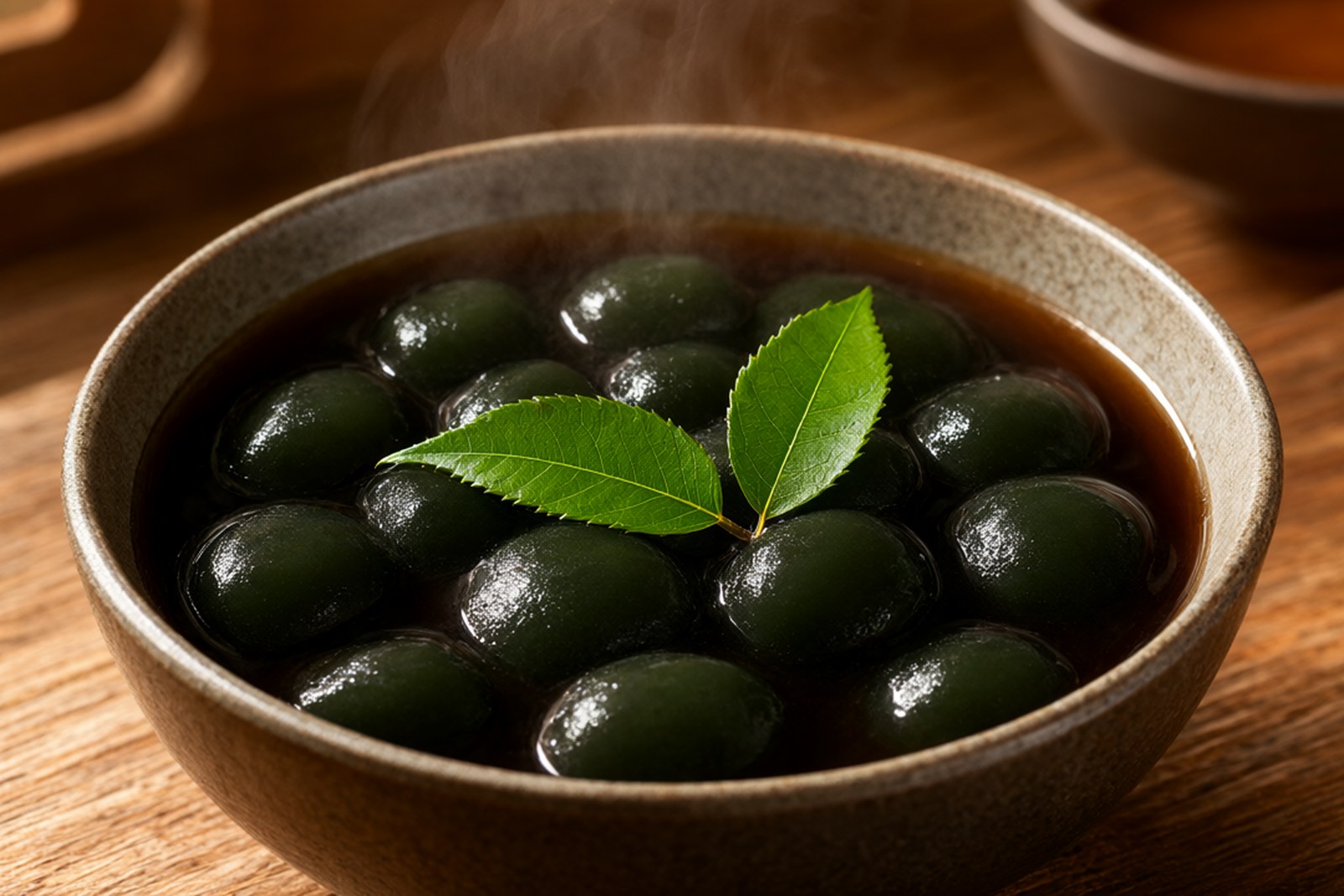
鸡屎藤粿仔 jī shǐ téng guǒ zǎi is the sweet soup of 琼海市 Qiónghǎi shì and it has the worst name in Chinese cooking. 鸡屎藤 jī shǐ téng, chicken-dropping vine, is 鸡矢藤, a climbing weed of the coffee family that grows over walls and hedges all over the island, and it is called that because a leaf crushed between the fingers smells rank – sulphurous, faintly faecal, exactly as advertised. 粿仔 guǒ zǎi are the little rice cakes it is made into. Cooked, the smell goes and something else comes up in its place: a green, slightly medicinal sweetness, closer to a herb infusion than to a dessert, and the colour it turns the dough, a deep grey-green, is the colour of the thing.
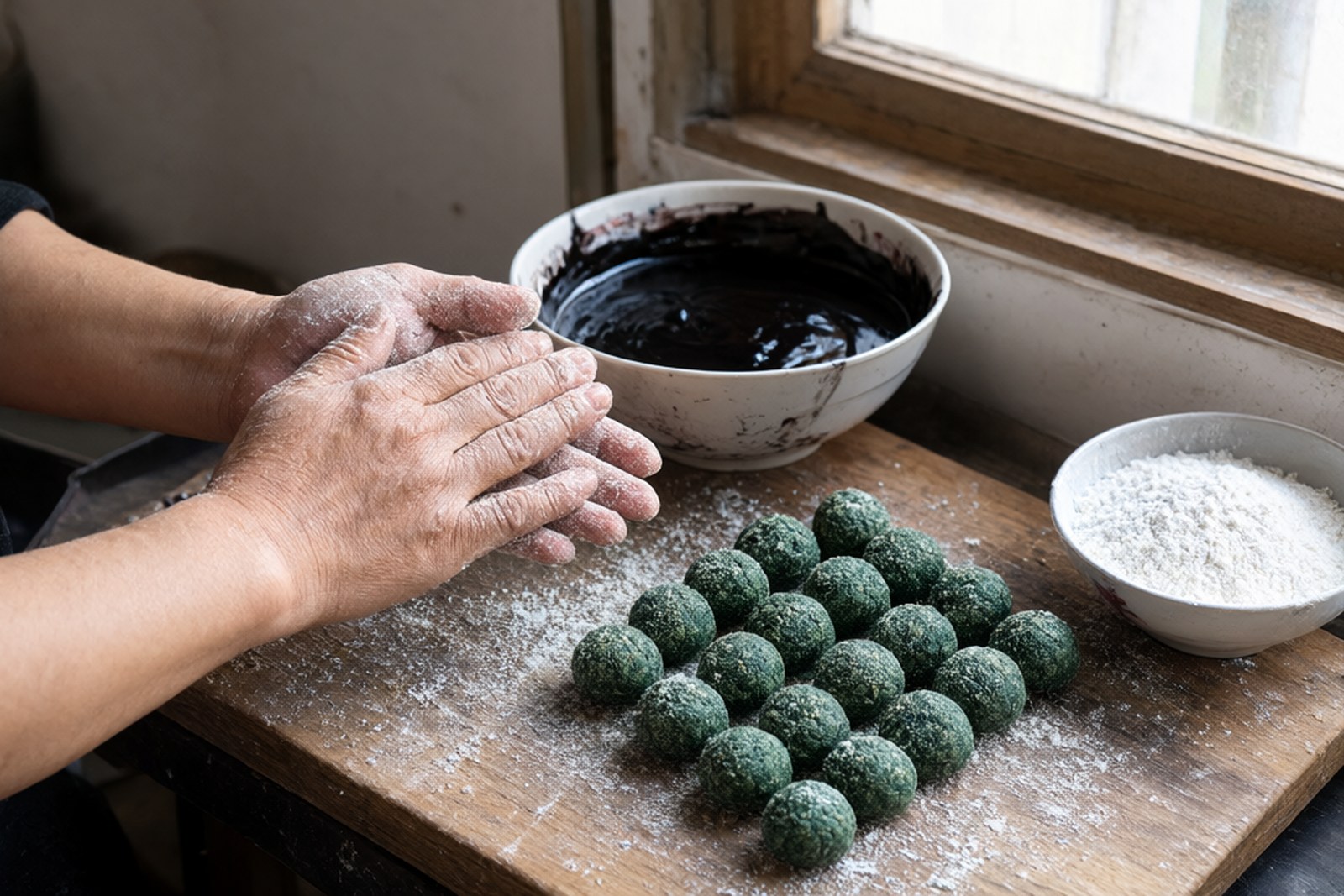
The making is cottage work and the measure of it is the dough. The leaves are picked young, washed and pounded or blended with a little water into a dark pulp; that pulp is worked into rice flour, usually a mix of glutinous and ordinary 粘米粉 zhān mǐ fěn so that the balls hold their shape without going gluey, with sugar and sometimes a spoon of lard or coconut oil to keep the dough supple. The dough is then rolled between the palms into small rounds the size of a broad bean, or into short cylinders, and dropped into boiling water until they float. That is the whole technique, and the difference between good and ordinary is entirely in the ratio: too much leaf and it is bitter, too little and it is a bowl of plain rice balls with a green tint.
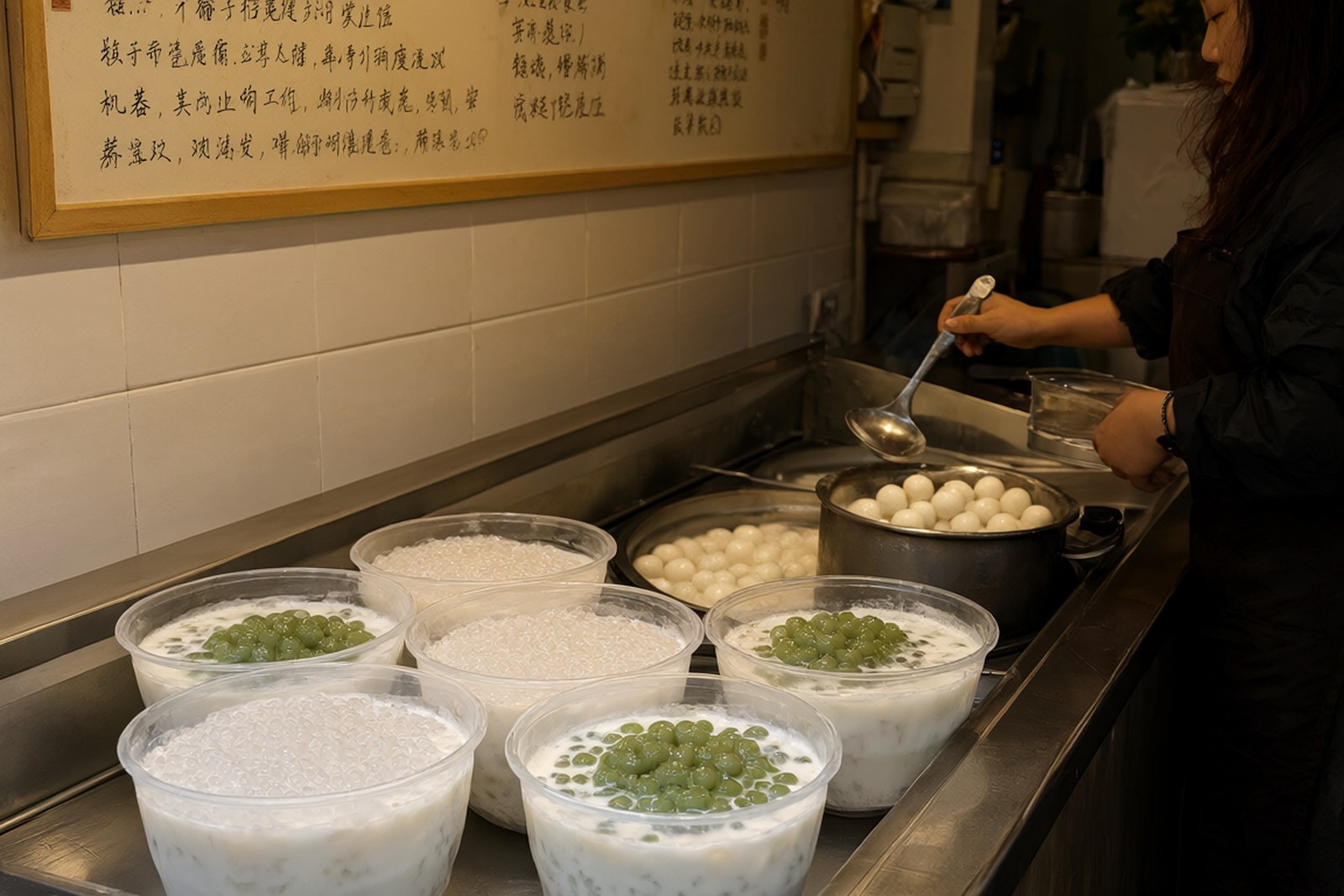
What the balls go into is where the county divides. The old version is a 姜汤 jiāng tāng, a thin syrup of brown sugar and ginger, hot, in which the balls are served with the poaching water; that is what a 琼海 household makes when somebody has eaten too much or has been out in the rain, and the plant is credited locally with cooling the system in summer and clearing damp, which is the ordinary folk claim for a bitter green in the tropics. The shop version is cold: the balls over ice in 椰奶 yē nǎi, coconut milk, with a spoon of sugar syrup, sometimes with 芋圆, taro balls, or red bean, and it is what the 杂粮 zá liáng houses of 嘉积 sell by the bowl through the afternoon and the evening. 琼海 is known on the island as the home of 杂粮 – literally mixed grains, in practice the whole repertory of sweet soups, rice cakes and steamed puddings that the Cantonese would call 糖水 and the island eats as its afternoon tea – and 鸡屎藤粿仔 is the one on every list.
The county’s sweets are a real tradition and the calendar runs on them: at 清明 the households make coloured 粿 for their children, red and green ones in shapes with a wish attached, and through the year there are 薏粑 yì bā, the sticky-rice cake with shredded coconut, peanut and sesame wrapped in a banana leaf and steamed, 高粱卷 gāo liang juǎn, rolls of glutinous dough with a sweet filling, and 清补凉 qīng bǔ liáng, the bowl of beans, jelly, fruit and coconut milk that the whole island eats after dark. 琼海’s contribution to that repertory is the one that most visitors have to be talked into and then cannot stop ordering, and the reason is simple: it tastes of nothing else in the country and it does not taste of what it is called.
Words and Names
鸡屎藤 jī shǐ téng is the vine, literally chicken-dropping vine, and 粿仔 guǒ zǎi are the small rice cakes made from it; the plant itself is 鸡矢藤 in the written form. 粘米粉 zhān mǐ fěn is ordinary rice flour and 糯米粉 nuò mǐ fěn the glutinous one, usually mixed. 姜汤 jiāng tāng is the hot ginger syrup version and 椰奶 yē nǎi the cold coconut milk one. 杂粮 zá liáng is the 琼海 word for the whole family of sweet soups and rice cakes, 薏粑 yì bā is the coconut sticky-rice cake in a leaf, and 清补凉 qīng bǔ liáng the island’s mixed sweet bowl.
What the Locals Know
Eat the hot ginger version first if you want to know what the plant tastes like and the cold coconut one afterwards if you want to enjoy it, because the coconut milk does most of the work and the ginger syrup does not. Look at the colour of the balls: a good bowl is a dark grey-green rather than a bright emerald, since the deep colour is the leaf and anything pastel has been thinned with flour. In a 杂粮 shop, ask for 鸡屎藤粿仔 and not for 鸡屎藤, which will get you the plant in another form; and if you are there in the rainy season, take the hot one and believe the locals about the damp, because there is no harm in it.
flowcloud would say that a county which found a weed that smells appalling, pounded it into rice flour, and then sold it for centuries on the strength of what it tastes like rather than what it smells like, has been running a very simple test of its customers that most of them pass on the second spoon.
Where to find it: the 杂粮 shops and sweet-soup stalls of 琼海市, with the streets around 金海路 Jīn hǎi lù and 银海南二横街 in 嘉积镇 Jiā jī zhèn holding most of the old ones, open from about eleven in the morning and staying open past ten at night. A bowl of 鸡屎藤粿仔 is ¥8 to ¥18 depending on whether it is the hot ginger version or the iced coconut one, a 薏粑 ¥4 to ¥8 and a 清补凉 ¥10 to ¥20. 琼海 is about an hour from 海口 on the 东环 high-speed line, with 琼海站 Qiónghǎi zhàn about ten minutes from the 嘉积 town centre by road.