
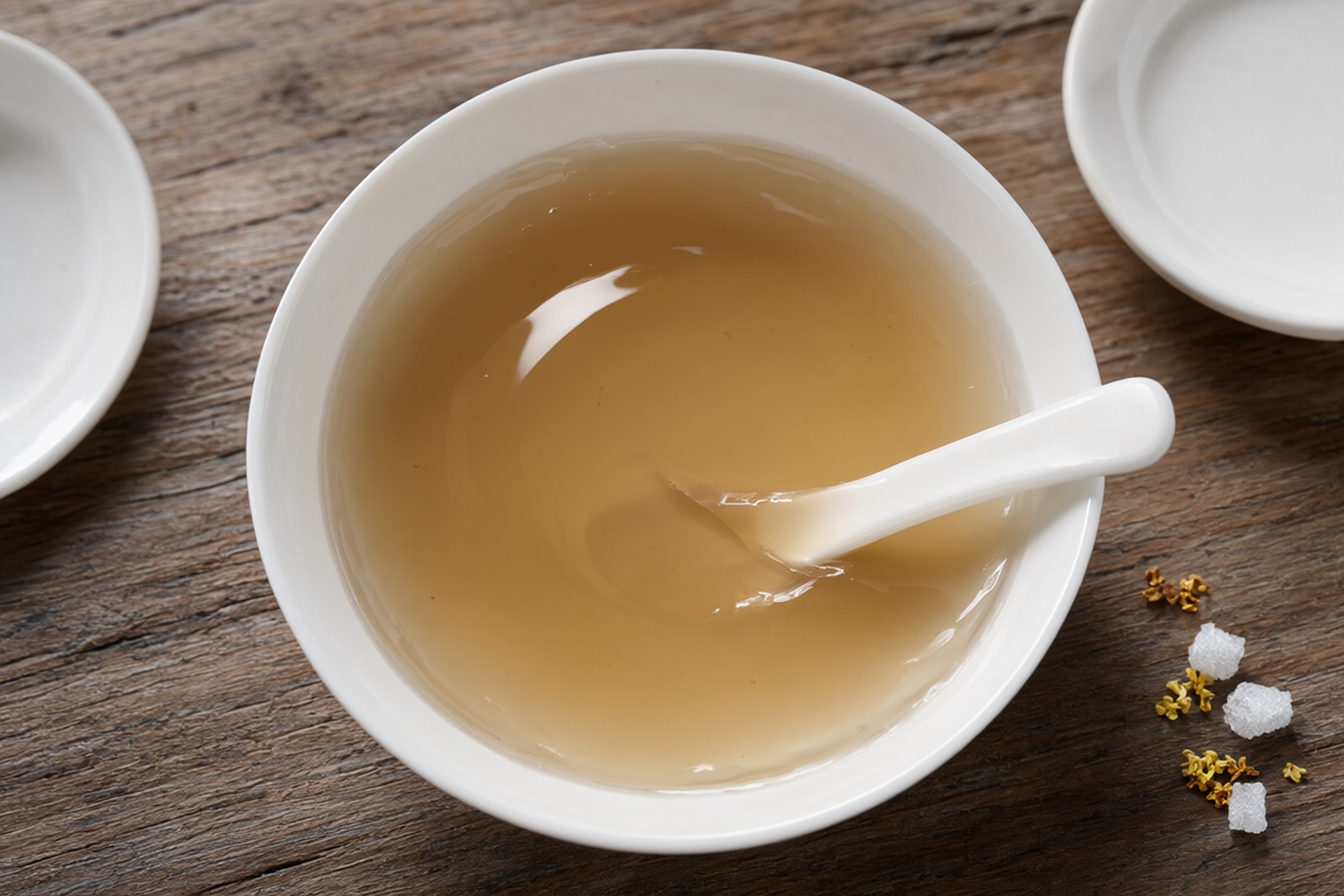
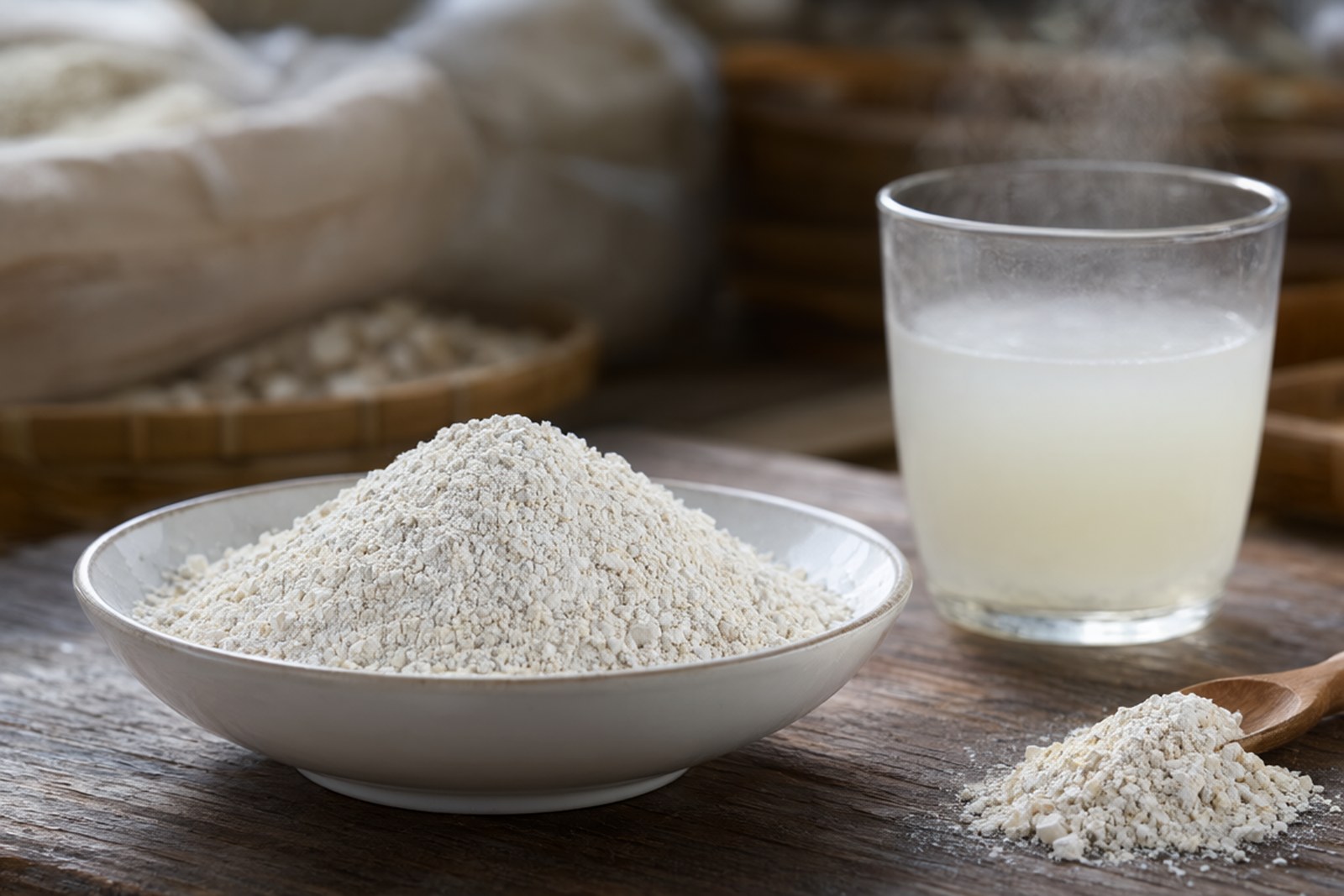
The powder sits in a bowl looking like nothing much — greyish white, a little lumpy, faintly gritty between the fingers. Then hot water goes in and you stir, and in about eight seconds it turns. First cloudy, then thickening, then suddenly translucent and glossy and holding its shape, a bowl of pale amber jelly that trembles when you move it. There is a smell of cut grass and earth. This is 葛根粉 gěgēnfěn, kudzu root starch, one of the three staple forest products of the 武陵 Wǔlíng mountains, and it is the single most useful thing to learn to make in 张家界 Zhāngjiājiè.
The Plant Under the Hill
葛 gě, kudzu, is the vine that ate the American South — a fast-growing legume with enormous tuberous roots that has become a devastating invasive species in the United States. In its native range in China it is a cultivated and wild-harvested resource with a three-thousand-year history in food and medicine, and the plant used here is specifically 柴葛 cháigě, the wild mountain kudzu of the 武陵 Wǔlíng ranges around 张家界 Zhāngjiājiè, in north-western 湖南 Húnán, rather than the agricultural variety.
The root is the point. A mature 柴葛 cháigě root is a woody, gnarled mass that can weigh many kilos and be more than two metres long, growing down into the hillside where the plant has been for years. To turn it into starch, the roots are dug, washed, pulped and repeatedly washed and sieved so that the starch settles out of the fibrous mash, and then the settled material is dried into the lumps and blocks sold in markets all over the region. Getting the starch out of one big root is a long day’s work, which is why the price is where it is and why the local verdict on cheap 葛根粉 gěgēnfěn is that it has been cut with something.
The nutritional claim that sells it is 葛根素 gěgēnsù, puerarin, an isoflavone that appears in the Chinese pharmacopoeia as the active principle, along with a spread of amino acids and minerals. 本草纲目 Běncǎo Gāngmù, the sixteenth-century materia medica, records kudzu root as a nourishing and restorative food, and the modern marketing in 张家界 Zhāngjiājiè follows that line closely: it is sold as 植物黄金 zhíwù huángjīn, plant gold, generally to people who want breakfast that is also a health decision. The honest version is that it is a starch with a pleasant flavour, no fat to speak of, and a very good texture, and that eating it is nice.
How to Make It
The technique is entirely about the order of operations, and it is the thing every visitor gets wrong once.
You take a couple of spoonfuls of the dry powder. You add a small quantity of cold or barely warm water — just enough to wet it — and stir it into a smooth paste with no lumps. This step is called 化开 huàkāi, dissolving it open, and if you skip it you will get a bowl of solid lumps and no way to recover. Then you pour boiling water in, in a steady stream, stirring hard and fast in one direction. The mixture clouds, thickens and turns translucent, and within a few seconds it has become a smooth, glossy, faintly amber gel. Sweeten with sugar or honey, or eat it plain.
Served that way it is a breakfast or an afternoon bowl, and it is what almost every household in the region does with it.
The kitchen use is more interesting. Because the gel sets firm when it cools, it can be cut into pieces and treated as an ingredient. 葛根粉炒腊肉 gěgēnfěn chǎo làròu, kudzu jelly stir-fried with cured pork, is the dish to order: cubes of the jelly, seared in a hot pan until the surfaces blister and crisp a little, tossed with slices of the local 腊肉 làròu and green garlic or chilli. The jelly takes on the fat and the smoke of the pork and holds its own against it. In the same manner you get 葛根粉煎蛋 gěgēnfěn jiāndàn, kudzu jelly fried with egg, and 葛根粥 gěgēnzhōu, kudzu stirred into a pot of rice congee, which is what you eat when somebody in the family is ill.
Words and Names
葛 gě is kudzu, and 葛根 gěgēn is its root; the two characters are so identified with the plant that Chinese medicine names the plant’s other parts after it — 葛花 gěhuā, kudzu flower, 葛藤 gěténg, kudzu vine. 粉 fěn means powder or starch, and it is the character you see on the front of every packet here, as in 米粉 mǐfěn, rice noodles, and 玉米粉 yùmǐfěn, cornflour.
柴葛 cháigě is the wild variety, and 柴 chái — firewood — is doing the work of marking it as woody, tough and unimproved, as against the cultivated forms grown for starch yield. 武陵 Wǔlíng is the old name for this mountain region, and the 武陵源 Wǔlíngyuán scenic area takes its name from it. 植物黄金 zhíwù huángjīn, plant gold, is a wholly modern marketing phrase and worth recognising as such. And 葛根素 gěgēnsù, puerarin, is the compound name — the 素 sù suffix being the standard way Chinese names an isolated substance, as in 维生素 wéishēngsù, vitamin.
What the Locals Know
Buy it white, and smell it. A good 葛根粉 gěgēnfěn is pure white or very pale cream, breaks with a clean chalky fracture, and smells faintly of raw grass or earth. Greyish or brownish powder has been badly dried; powder that smells of nothing has probably been extended with cassava or corn starch. One of the local selling points is 带草腥味, “with the grassy smell”, as a marker of the real thing.
Order the jelly dishes, not just the drink. Visitors overwhelmingly buy the powder and make the bowl at home, which is fine, but the region’s own cooking treats it as a starch to be set, sliced and fried, and that is the version worth trying before you decide what it is.
Ask for it 少油 shǎo yóu if you are having it stir-fried. The jelly is a sponge for oil, and a careless kitchen will produce something swimming in it. The good version is seared and dry-surfaced.
Do not eat it as a health regime and expect results. It is a pleasant starch with a good texture and a lot of folklore attached. Enjoy it on those terms.
Buy from a co-operative or a mill, not from the scenic-area stalls. The villages around the 武陵源 Wǔlíngyuán core, and the smaller markets, sell it in plain bags at a fraction of the price the tourist shops charge, and the provenance is much better.
Keep it dry. Kudzu powder absorbs moisture from the air and turns into a brick. A sealed jar, kept somewhere cool, will hold it for a year or more.
Where to Eat It
The savoury versions — 葛根粉炒腊肉 gěgēnfěn chǎo làròu above all — are on the menus of the farmhouse restaurants around 武陵源 Wǔlíngyuán and through 张家界 Zhāngjiājiè city, at about ¥30–50 a plate. The plain bowl, sweetened, is sold in markets and snack stalls for ¥8–15 and is the cheapest way to try it. To take some home, buy dry powder from a village mill or a farmers’ co-operative at roughly ¥60–150 a 斤 jīn depending on grade — the wild 柴葛 cháigě being dearer and noticeably better than the cultivated product sold in supermarkets — and ask them to show you the open bag before they weigh it.
flowcloud would say that the most sophisticated thing a mountain kitchen can do is make a vine root into something translucent, and that a food which changes state in eight seconds in front of you has a better claim on your attention than anything that comes out of a packet.
Where to find it: 葛根粉 (gěgēnfěn), 张家界 (Zhāngjiājiè) and 武陵源 (Wǔlíngyuán), north-western 湖南 (Húnán). The plain bowl is sold at markets and snack stalls from ¥8–15; 葛根粉炒腊肉 (gěgēnfěn chǎo làròu) is about ¥30–50 a plate in farmhouse restaurants around the 武陵源 (Wǔlíngyuán) core. Dry powder to take home runs ¥60–150 per 斤 (jīn), cheapest and best bought from a village mill or co-operative rather than a scenic-area shop. Ask for the 柴葛 (cháigě) grade, look for pure white powder with a grassy smell, and try the stir-fried version before you decide what kudzu tastes like.