
乐东芒果 Lèdōng mángguǒ, the Ledong mango, is the county’s other great winter-and-spring fruit, grown in 乐东黎族自治县 Lèdōng Lí Zú Zìzhì Xiàn, Ledong Li Autonomous County, on Hainan’s west coast, and it is the one that reaches the counter before almost anybody else’s. Three things hold this article up and nothing else does: a geographical-indication certification mark approved on 28 March 2020, the county’s own 富域乐东 Fùyù Lèdōng public brand, and a picking window the provincial marketing calendar lists for March to May. Hainan grows mango in several counties and this site already carries two of them, one on the dry west and one on the south-east; this page keeps to the county that registered its mark in 2020 and ships the fruit out under its own name.
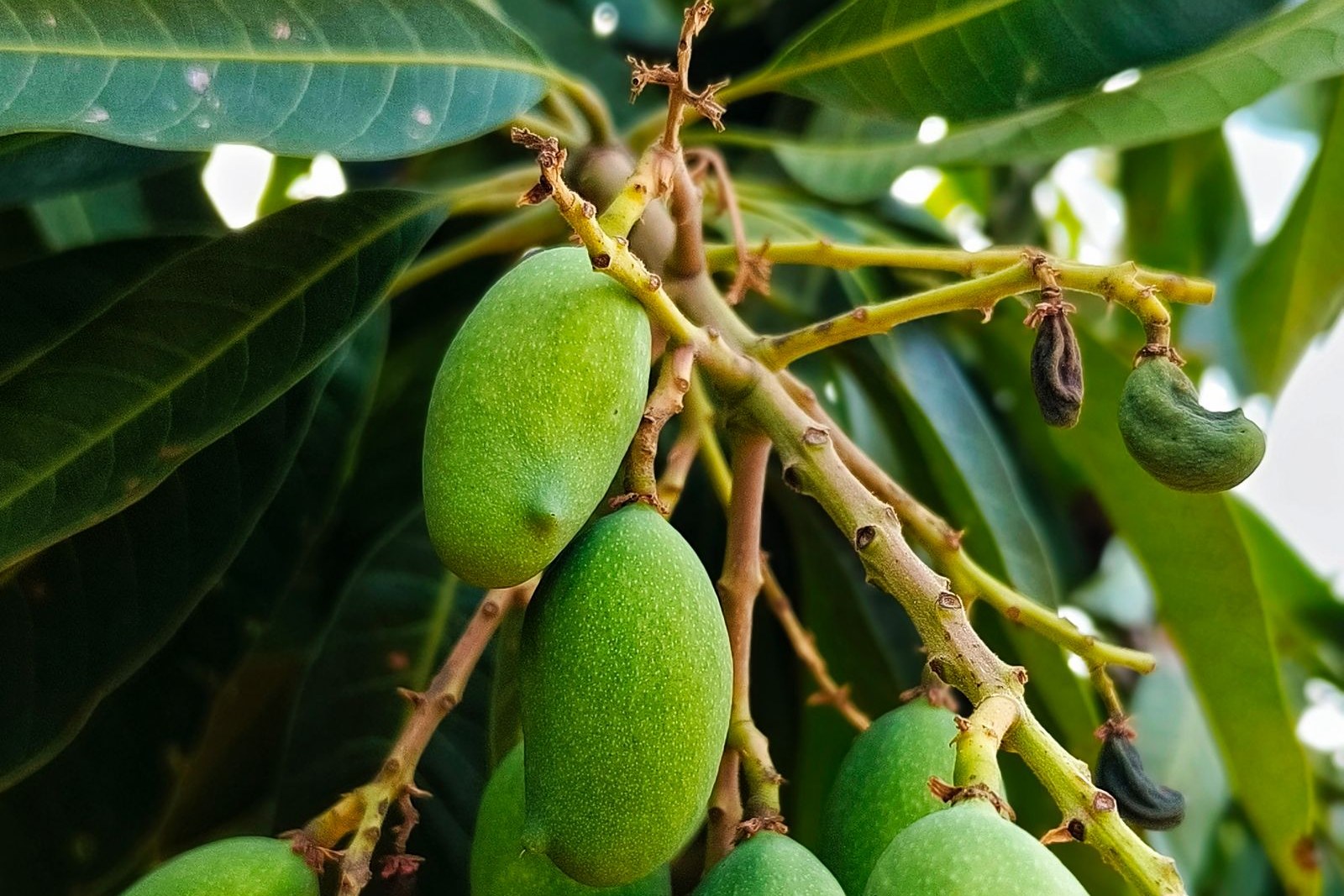
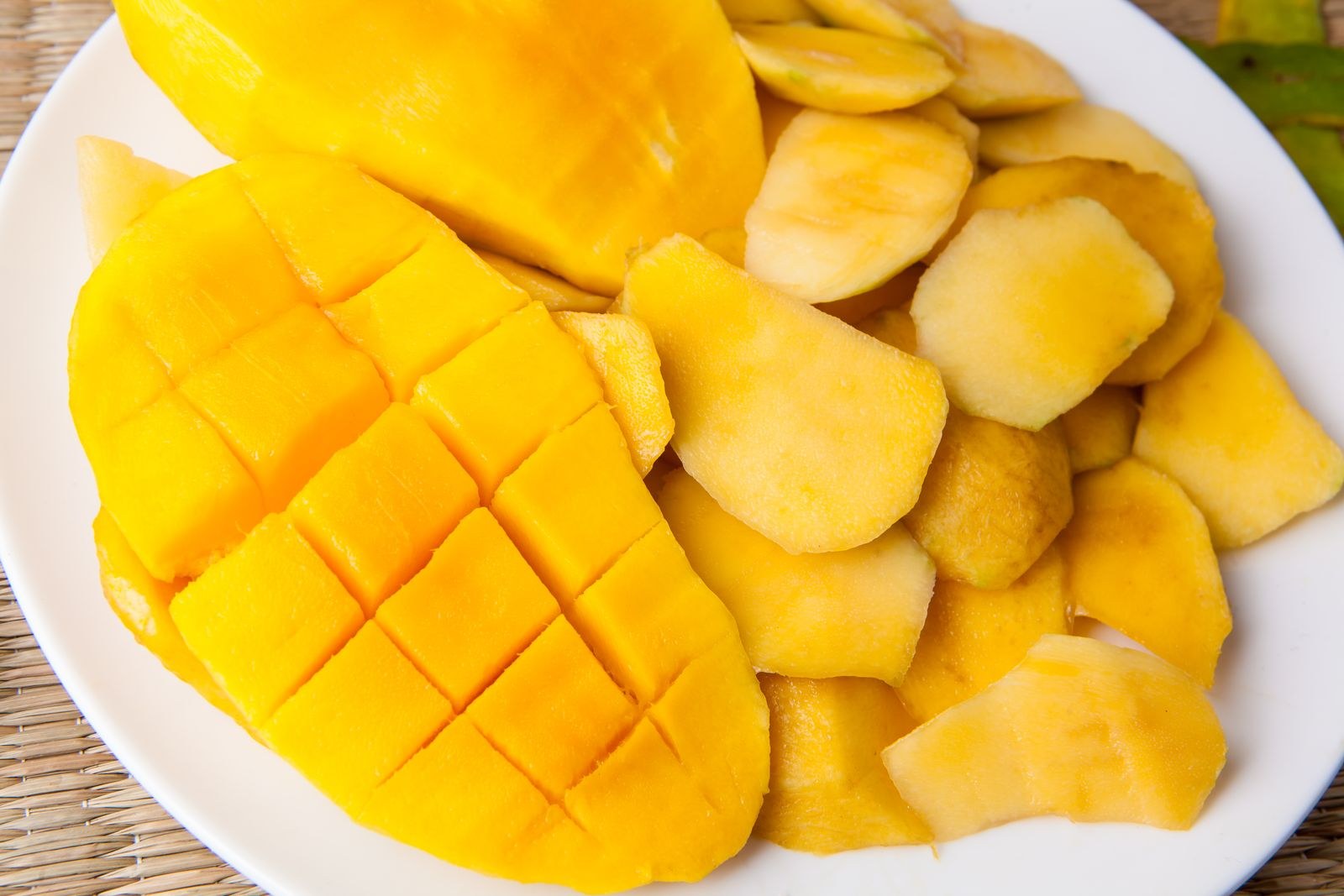
The register entry is the hardest fact here. 乐东芒果 is a geographical-indication certification mark, application number 35073402, approved on 28 March 2020 and registered to the county’s tropical crops office, as the provincial market regulator’s register lists it; it sits with the county’s nine other marks, the banana, the melon, the longan and the rest. Behind the seal is the county’s own public brand, launched in 2024, which carries a single-product name for the mango and a ring of enterprise marks around it, 福报千家 Fúbào Qiānjiā, 叶锐 Yè Ruì, 期望 Qīwàng, 乐阳 Lèyáng, 毛公 Máogōng and 永沐 Yǒngmù among them. The quality side rests on the county’s standardisation work: five of its mango operations hold national tropical-crop standardised-production demo status and twenty-four hold the provincial version, a register of orchards rather than a claim about taste. The register describes the fruit plainly, and this text prints it as the register’s own words: thin skin and a small stone, skin high in anthocyanins and therefore green or purple-red, smooth and nearly unblemished, flesh yellow to orange, firm, juicy, smooth and fragrant.
The mango came to Ledong late and rose fast. Planting began in the 1990s, mostly on the state farms, and the early orchards ran the varieties that were later dropped, 小青皮, 留香芒, 秋芒 and 吕宋芒, which cropped weakly and looked poor, and the county’s own account records that farmers took to calling the mango tree 穷人树 qióngrénshù, the poor man’s tree. The turn came with the cultivars that replaced them: 台农一号 Táinóng yī hào, the Tainong No.1; 贵妃 Guìfēi, the imperial-concubine mango; 红芒六号 Hóngmáng liù hào; and 金煌 Jīnhuáng. Two of those carry the county now, because Tainong and Guifei together are put at roughly eighty per cent of the Ledong crop. The county’s own sentence about the change is worth keeping, because it is the county’s: the same tree that was a poor man’s tree became the fruit that made people money.
The acreage is where care is needed, because two official counts sit a year apart and grow by ten wan mu. The county’s 2024 figures put plantings at 233,000 mu, of which 195,000 mu were bearing, for an output of 192,000 tonnes, work for more than 58,000 people and a per-capita disposable income of 12,300 yuan for the growers; its May 2025 figures then put plantings at 335,000 mu and output value at 1.43 billion yuan. The jump may be a change of definition, between planted and bearing land or between the county’s own count and one that takes in the state farms, and this text prints both with their years and does not merge them. The statistical bulletin, a separate office again, records 157,233 tonnes of mango for 2024, down 3.1 per cent, and that fall has a cause: the super typhoon that crossed Hainan in September 2024 cut some Ledong orchards from about a hundred jin a tree to sixty or seventy, and from more than three thousand jin a mu to roughly two thousand, with the farm gate at five to six yuan a jin that season, a 2024 snapshot and no guide to this year.
The window is the county’s real advantage and it is a scheduled one. The provincial mango marketing plan sets the Ledong season at March to May, with Tainong No.1 listed for March and April, Guifei for March and April, and Jinhuang for April and May, which puts Ledong fruit on the counter before the mainland crop is ripe; the county adds that its harvest comes one to three months earlier than elsewhere, a claim carried here as the county’s, and a newspaper line about fruit already on sale at the end of September belongs to a different year and is not reconciled with the plan. Export is the county’s newest chapter: one Ledong operation farms more than seven thousand mu for eight thousand tonnes a year, holds green-food and GAP certification and export registration, and shipped to Poland, Russia and Canada in 2023, with a peak price once reported at 168 yuan a kilogram, a headline high and not an average, and a mango base on the Shanrong state farm counts fifty-four mu and close to 350,000 jin a year. What the record refuses is a current wholesale price, which no authoritative source for 2025 or later gives, and any title of mango township, which this county does not hold the way it holds its banana and melon billings.
Words and Names
乐东芒果 Lèdōng mángguǒ is the fruit; 台农一号 Táinóng yī hào, the Tainong No.1, and 贵妃芒 Guìfēimáng, the imperial-concubine mango, are the two varieties that make up most of the crop, while 金煌 Jīnhuáng and 红芒六号 Hóngmáng liù hào are the other named kinds. 穷人树 qióngrénshù, the poor man’s tree, is the county’s old nickname for the mango before the new varieties arrived, and 富域乐东 Fùyù Lèdōng is the county brand the fruit now travels under. The site’s Changjiang and Lingshui mango pages keep their own counties, one the dry west and its double registration, the other the south-east and its county-name brand; this page keeps the 2020 mark and the March-to-May window.
What the Locals Know
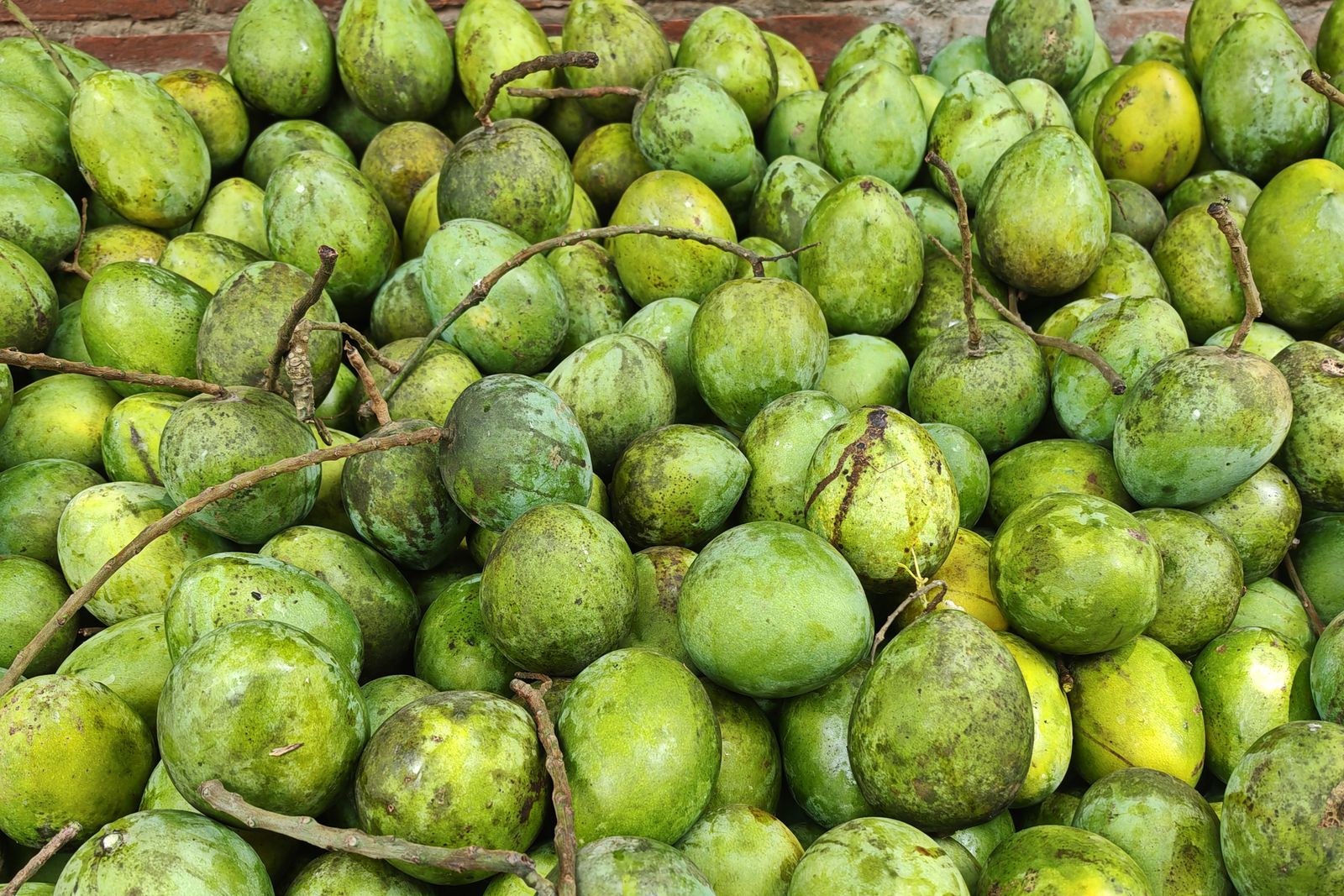
The mango is eaten two ways in the county, and the market frame on this page shows the first: green fruit, hard and sour, heaped at the stall and sold with a small bag of chilli and salt to dip it in, a market habit rather than a restaurant dish. The orchard side is the second. Visits are not a ticketed attraction: the county’s mango bases, at 九所镇 Jiǔsuǒ Zhèn Jiusuo around the state farm, at 千家镇 Qiānjiā Zhèn Qianjia, where the 2024 mango area is counted at 73,100 mu, and along the Longqi Bay side, are working farms, and the honest advice is that a grower will show a visitor round in the March-to-May season by arrangement rather than at a gate.
Come for the window and not for the fruit alone, because picking runs from March into May and outside it the trees are just trees. The county’s dry, sunny west-coast climate is what makes the early season work, and the same sun that ripens the mango also ripens the melon and the banana nearby, which is the shape of the county’s farm year. What the record refuses, once more and plainly: a single retail price for the fruit, which the sources do not fix; a county-wide export volume, of which only one company’s figures exist; and any ranking of Ledong mango above the island’s other mango counties, because no official comparison exists.
flowcloud would say that the Ledong mango is a west-coast fruit with a geographical-indication mark approved in March 2020 and the county’s own brand behind it, picked in a March-to-May window that beats the mainland crop to market, and grown from the varieties farmers once called poor man’s trees.
Where to find it: the mango country around 九所镇 Jiǔsuǒ Zhèn Jiusuo and the state farm, 千家镇 Qiānjiā Zhèn Qianjia and the Longqi Bay side, with the county markets of 抱由镇 Bàoyóu Zhèn Baoyou for the fruit itself, in 乐东黎族自治县 Lèdōng Lí Zú Zìzhì Xiàn Ledong Li Autonomous County, Hainan; orchard visits in the March-to-May window are arranged through cooperatives and farm-stays rather than at a ticket gate, and the day’s price is whatever the stall quotes.