
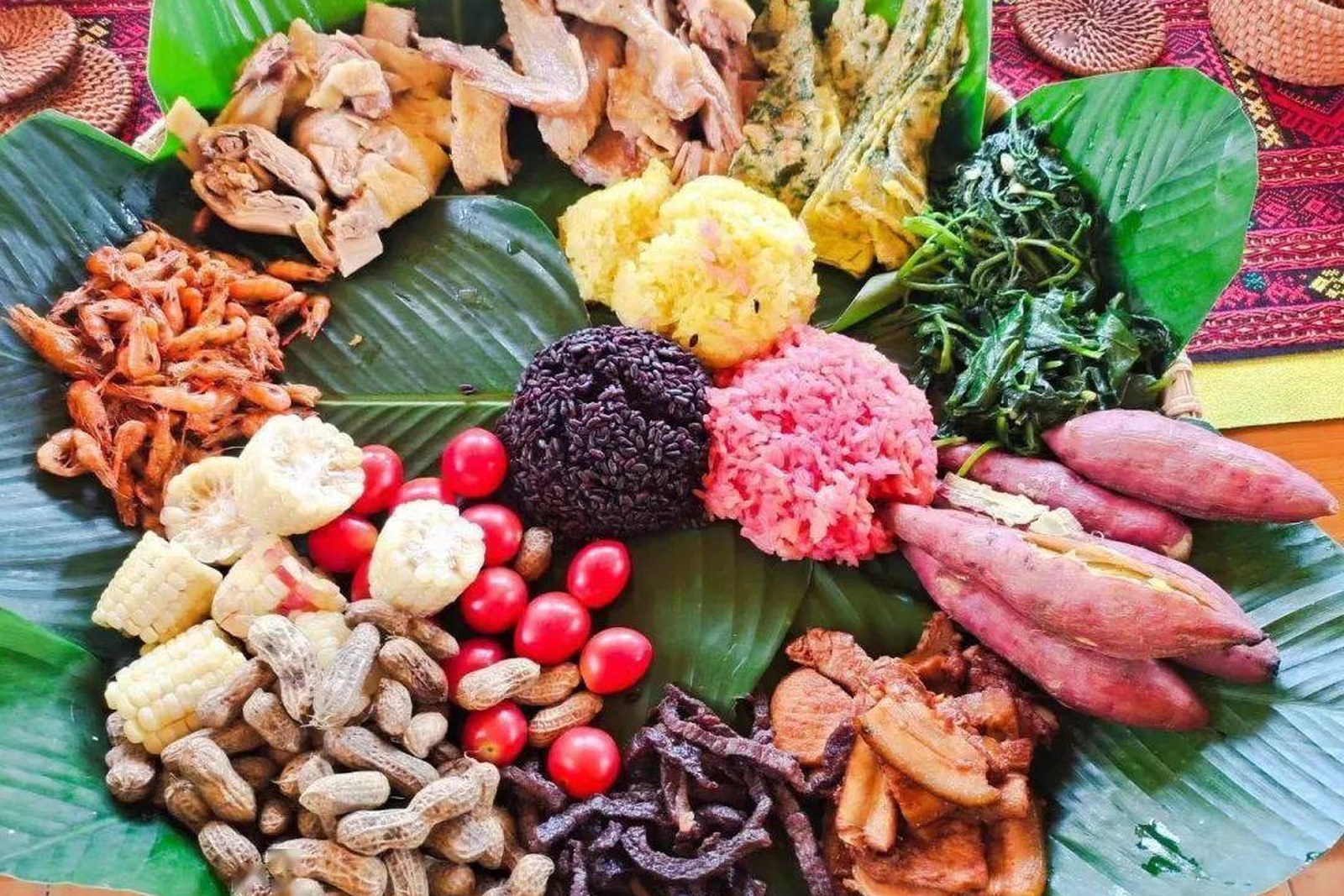
簸箕宴 bòjī yàn, the banana-leaf tray feast, is the Li and Miao answer to the banquet question – how do you serve a dozen dishes to a room of guests with no plates at all? The county’s own definition: cook everything first, then lay the dry, oil-free dishes directly on a woven winnowing tray lined with fresh banana leaves, and stand anything with soup in bowls on the tray. Tray and leaf are container and tablecloth at once, one shared spread. In Qiongzhong the format is also called the 长桌宴 chángzhuō yàn long-table feast, and the county calls it the highest and most solemn form of Li-Miao etiquette, a table with thousands of years behind it. The anchors: 什寒村 Shihan village up in 红毛镇 Hóngmáo Zhèn Hongmao Town’s clouds, 鸭坡村 Yāpō cūn Yapocun in 湾岭镇 Wānlǐng Zhèn Wanling Town, and the 百花廊桥 Bǎihuā Làngqiáo Baihua Corridor Bridge at the county seat 营根 Yínggēn Yinggen.

The two names travel together but are not the same object. Strictly, a boji yan serves the food on winnowing trays lined with leaves; a long-table feast lines rectangular tables end to end and covers them with banana leaves. Qiongzhong’s official pages use the two interchangeably – the tray feast is also called the long-table feast, in the county’s words – and this text follows the county’s usage while keeping the two shapes distinct. Neither has a heritage entry of its own: what the national list carries, from 20 May 2006, is the 三月三 Sān Yuè Sān festival itself, the Li-Miao third-month-third, the love festival, with the county cultural centre among its protecting units – the banquets are the festival’s table, not a listed item.
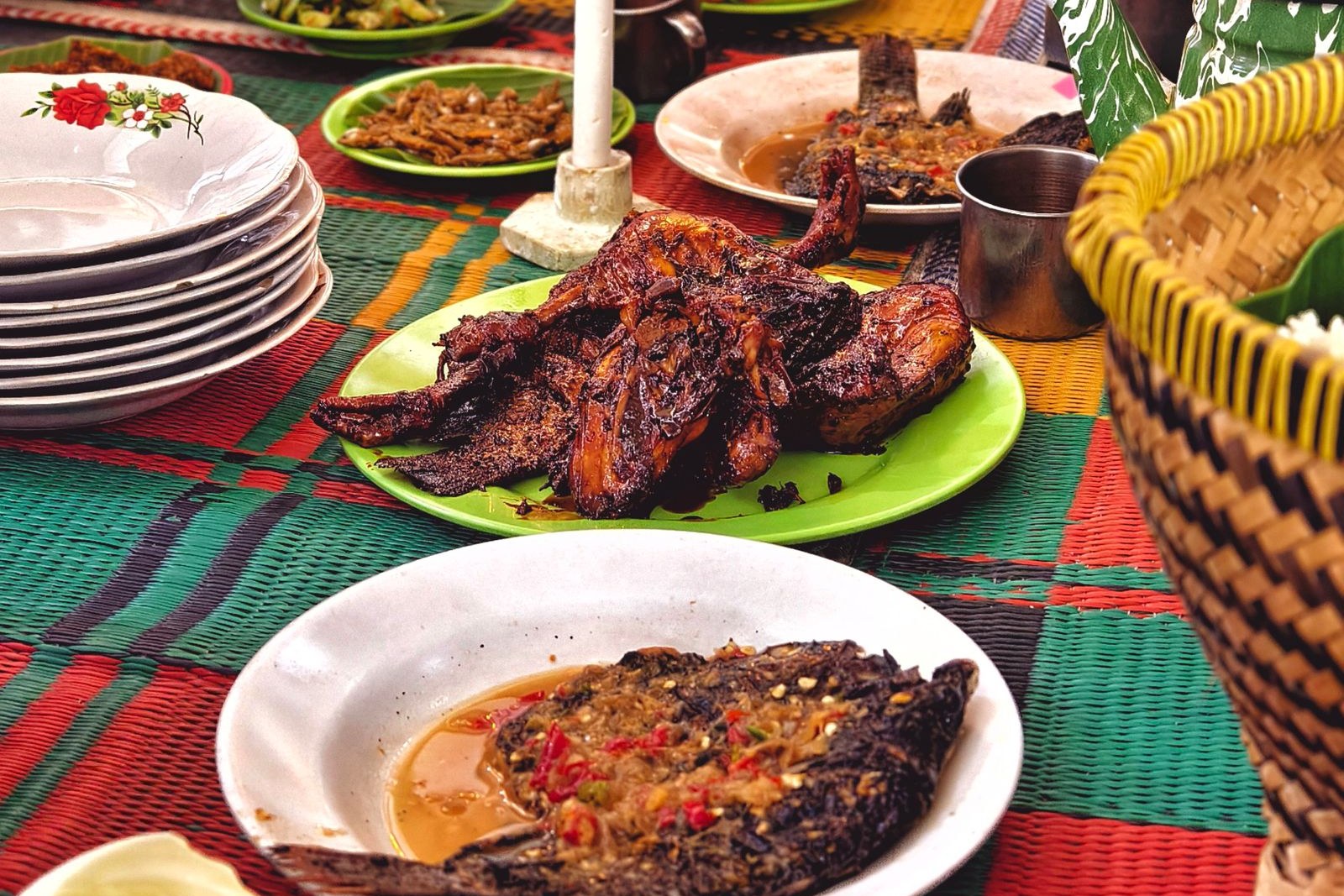
The menus the province’s own guide prints: at Yapocun’s 瓦屋家 Wawujia – pan-fried chicken, hairy-fig-root chicken soup, local black pork, fried beef, alkaline-water dumplings. At Shihan’s long tables – black-lingzhi chicken soup, five-toe pig, banana heart, centella salad, Miao sour-pickle vermicelli. At the third-month-third tables – three-colour rice, Shanlan glutinous wine, yellow beef, banana heart, river snails. The house menus move with the season and the village, and the county’s wider pantry brushes past the format – the five-toe pig, the three-colour rice, the bamboo-tube rice, the Shanlan wine and the fish tea each have pages of their own on this site, a name on the spread here, none expanded.
The format is half etiquette. Guests and hosts toast each other across the tray, trade drinking songs, and raise Shanlan wine – the songs are part of the service, not entertainment beside it. The county’s wedding-custom page prints the fullest version: a bridal procession fights through six checkpoints in the bride’s village, the matchmaker sings three songs to lower three of them, and the day ends at a long table of traded folk songs and toasts and Li-Miao dances. In April 2024 a hundred couples ran the sequence at Shihan and Baihua Ridge; in 2016 a matchmaking long table at Shihan ended with an Italian guest, 罗华 Luo Hua, toasting in the Li-Miao manner, a-biang.
The calendar gives the format a stage. For the 2025 golden week the county set corridor-bridge long tables under the 百花廊桥 at Yinggen, nightly six to nine in the evening, 1 to 6 October, beside a Qiongzhong-good-taste food week at the third-month-third square and heritage events up at Shihan; the county’s third-month-third ran fifteen activities in 2024 and fourteen in 2025. Behind it all sits 奔格内 Bengenei, the county’s rural-tourism brand named from the Li phrase for come here, twenty routes across a hundred and twenty villages with the tray feast as its table, and the Shanlan rice-culture market 琼中游好市 as its night-market sibling.
Words and Names
簸箕宴 bòjī yàn is the tray feast, 簸箕 bòjī the woven winnowing tray; 长桌宴 chángzhuō yàn is the long-table feast the county swaps it with. 三月三 Sān Yuè Sān is the third-month-third festival the tables serve; 山兰酒 shānlán jiǔ is the Shanlan glutinous wine in the toasts; 芭蕉心 bājiāo xīn is the banana heart on the tray; 雷公根 Léigōnggēn is the centella in the salad. 奔格内 Bengenei is the Li phrase for come here and the county’s rural-tourism brand.
What the Locals Know
Shihan is the format’s showcase village: a high basin at about 800 metres between Limu Mountain and Yinggeling, among Hainan’s highest villages – the 什 in its name reads zá locally – where the Li hamlet and the Miao hamlet face each other across one bridge. The village keeps 19 farm restaurants and 38 specialty shops, and 65 guesthouse rooms across five styles; banquets run on demand and climb into bonfires and bamboo-pole dances at festival time. The drive from Haikou is about two and a half hours on mountain road – fog and rockfall in the rains, no night driving – the rooms run 300 to 500 yuan a night as of the late-2026 snapshots, and the festival fortnights fill them; the village’s own advice is to stay the night, because the cloud sea and the stars, not the lunch, are the payoff.
Prices move by venue and menu, and the honest range as of late 2026 is 50 to 80 yuan a head – about 50 at Yapocun’s Wawujia, 70 to 80 at Shihan’s long tables and at the corridor bridge. Yapocun’s house is on the provincial guide; the corridor bridge is the county seat’s night version, festival-scheduled; Baihua Ridge has hosted the wedding format, its after-meal walk running to the Tianchi pool on the waterfall’s crown and the heavenly-zither strangler fig – no food street at the pool, the record carries none. The format has reached the resort towns – Sanya and Wanning tables serve it at resort prices – but the village table is the point; the leaf-lined tray tastes of the room it sits in.
What the record refuses: an official unified price for the banquet, a heritage entry under either name – the festival is the listed item – annual reception counts for Shihan, and any dating more precise than the county’s own thousands of years. The two names stay swapped the way the county swaps them, with the shapes kept straight.
flowcloud would say that 簸箕宴 is a banquet reduced to two materials – a woven tray and a banana leaf – carrying a dozen dishes at once, the songs between the toasts part of the recipe, and a county that borrows a bridge at golden week to lay the whole format out over the river.
Where to find it: the 19 farm tables of 什寒村 Shihan village in 红毛镇 Hóngmáo Zhèn Hongmao Town, any of them, best with a night’s stay for the cloud sea; 瓦屋家 Wawujia at 鸭坡村 Yāpō cūn Yapocun in 湾岭镇 Wānlǐng Zhèn, the provincial guide’s tray-feast address; and the 百花廊桥 Bǎihuā Làngqiáo Baihua Corridor Bridge at 营根 Yínggēn Yinggen on festival nights. Pair the noon rice-cooker chicken at Wanling with an evening tray feast and you have the province’s own day route; book the Shihan rooms two weeks ahead of the third-month-third.