
The name is the first trap and the taste is the second. 鱼茶 yúchá translates as fish tea, which leads visitors to expect something delicate and possibly hot. What arrives is a small bowl of grey-white rice with pieces of fish in it, faintly wet, smelling sharply of sour fermentation, and you do not eat it with a spoon. You pour water over it — cold water, or the light broth from the table — let it sit for a moment, drink that water, then eat the rice and fish with chopsticks. Drinking first and eating after, exactly the way a tea is drunk before its leaves are eaten, is where the name comes from; in the 黎语 Lí yǔ of the villages it is called something remembered in Chinese sources as nan dua, and it has nothing at all to do with 茶 chá, the plant. What it is, in fact, is a jar of fermented fish, one of the oldest preserved foods of the Hainan interior, and the single most divisive thing you can put on a table in 五指山 Wǔzhǐshān.
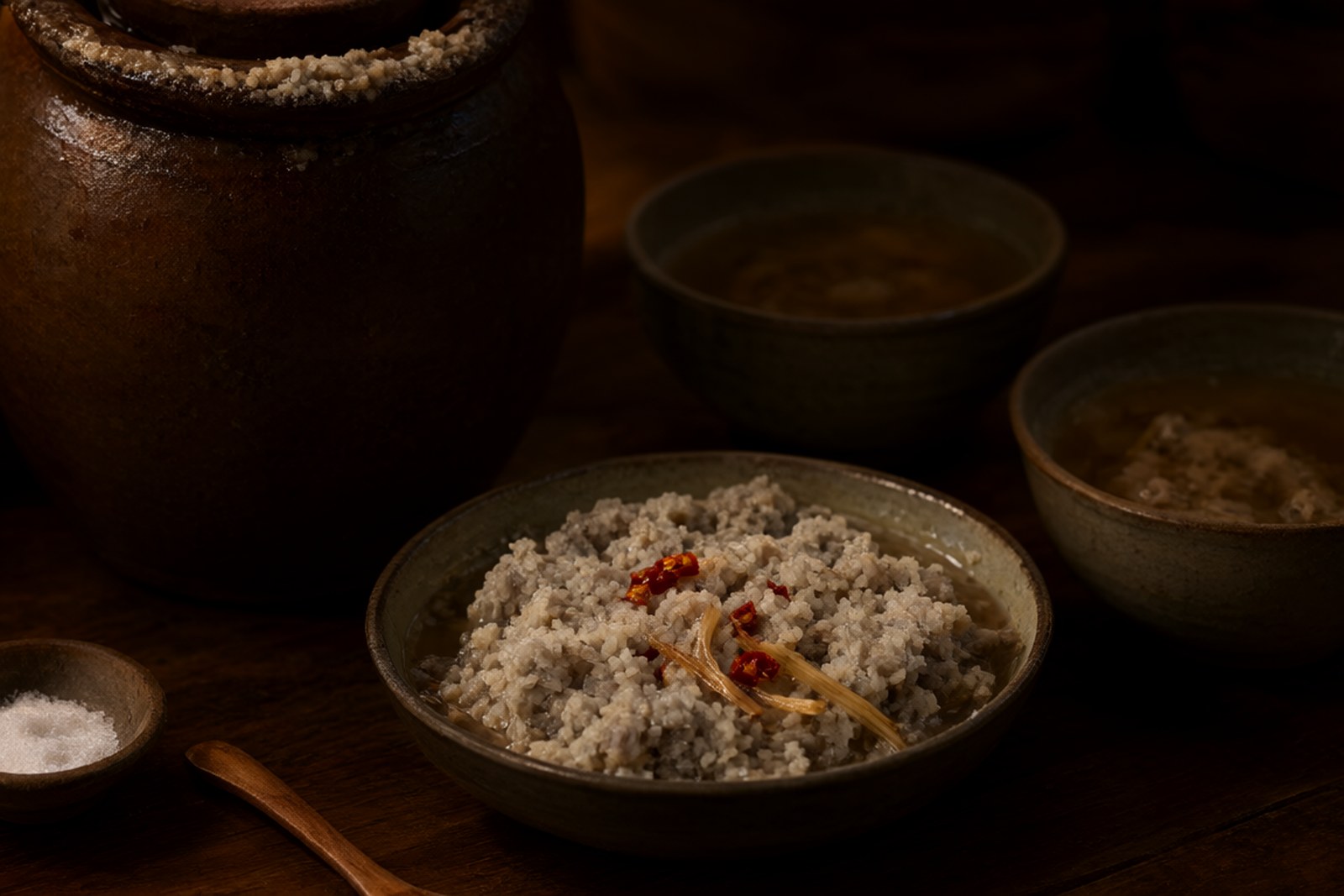
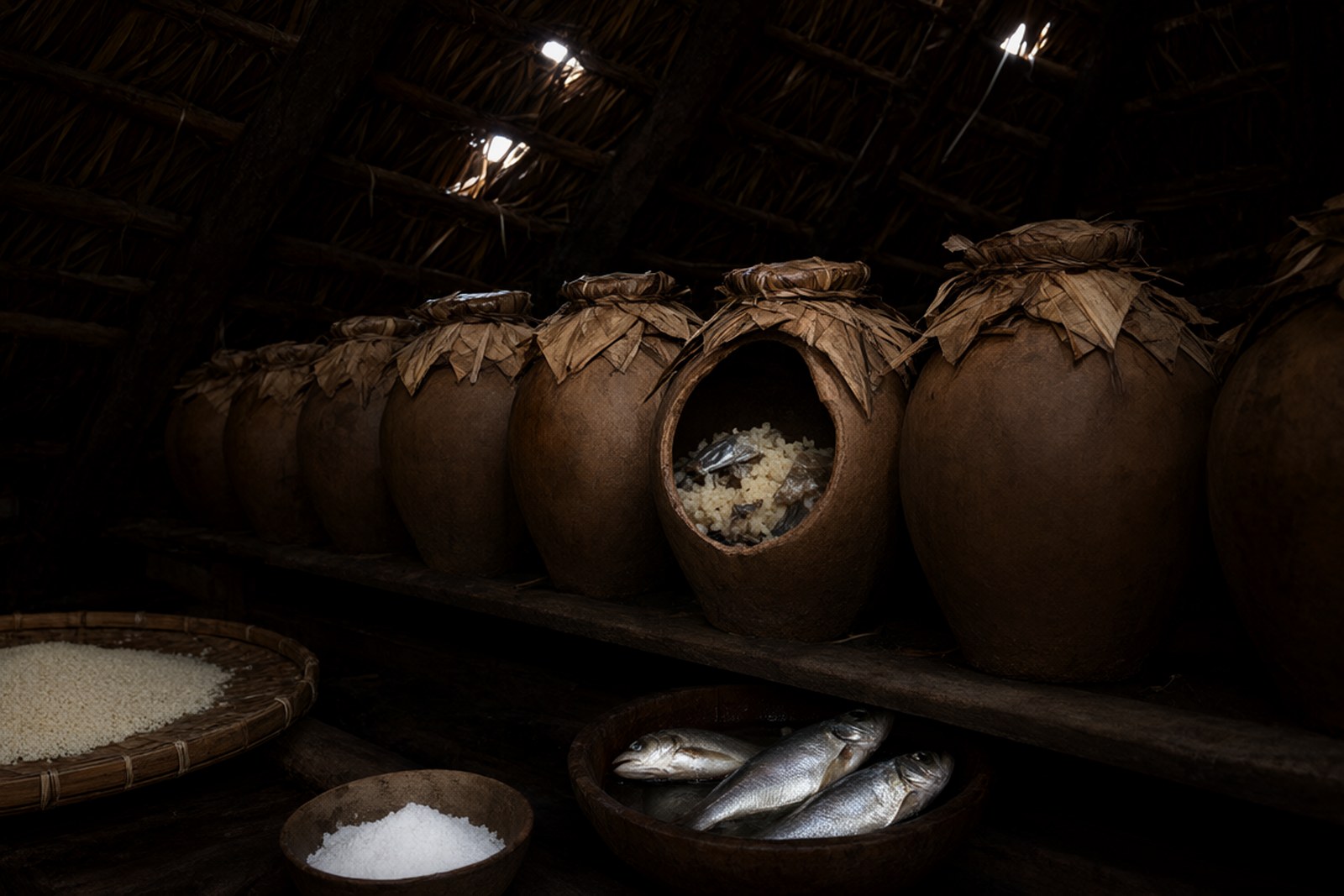
The method is the method of people who had no refrigeration and an abundance of river. Freshwater fish from the mountain streams are cleaned, boned where the fish allows it, and salted; the salt is left to draw water out for a day or so. Cooked 山兰米 shānlán mǐ, the local upland rice, is then mixed with the fish — sometimes dry, sometimes as a thin congee, depending on the family — and the whole mass is packed into an earthenware jar, pressed down, covered with banana leaves, and sealed. Twenty days later, in the heat of a Hainan spring, it is ready. Some households add chilli and ginger at the packing stage, some scatter them on at the table, and some add a little 酒糟 jiǔzāo, the lees from rice wine, which pushes the sourness in a boozier direction. The classic fish for it is 石鲮鱼 shílíngyú, the small stream fish locals call the fish that surfs because it holds station in the fastest water; its flesh is unusually firm, and firm flesh survives fermentation without turning to paste.
What Makes It Work
Fermentation here is doing three jobs at once, and understanding them is the only way to enjoy the dish. It preserves fish without cold, which was the original point. It breaks proteins down into amino acids, which is why the flavour is so much deeper and rounder than the smell suggests — the initial sourness of the jar gives way, in the mouth, to something closer to a strong cheese or a good anchovy. And it acidifies the rice, so what would otherwise be a bowl of starch becomes a carrier for a flavour that has nowhere else to sit. The water you pour over it is not a ritual either; it lifts the aromatics off the surface, cuts the intensity by half, and gives you something to sip while you decide how you feel. Locals will tell you that a good 鱼茶 should be sour but clean, with no ammonia at the back of the nose, and that the rice should still have a grain to it. If the rice has gone to slime, the jar has been kept too warm.
Words and Names
鱼茶 yúchá is the standard written name, used across 五指山、白沙、琼中 Wǔzhǐshān, Báishā, Qióngzhōng and the other Li and Miao counties of the centre; 黎语 Lí yǔ is the Li language, which has its own name for it. 腌鱼 yān yú, salted fish, and 酸鱼 suān yú, sour fish, are what outsiders call versions of the same thing. 石鲮鱼 shílíngyú is the stream fish of choice, 山兰米 shānlán mǐ is the rice that goes in with it, 瓦罐 wǎguàn is the earthenware jar, and 芭蕉叶 bājiāo yè is the banana leaf used as the seal. 发酵 fājiào is the word for ferment; 长桌宴 chángzhuō yàn, the long-table feast, is where it is most often served to guests, usually as one bowl among fifteen.
What the Locals Know
The locals know that guests either love this or cannot finish a spoonful, and they will watch to see which. They also know the dish is not for every day. 鱼茶 is made in batches in the cool months, when fermentation is slow enough to control, and eaten through the year as a side dish with plain rice, a little at a time, the way you would eat a strong pickle. There is a rule about who gets it first: at a long-table feast the bowl goes to the oldest person present, not because they like it most but because it is considered good for the stomach. And there is a practical warning that no one will give you unasked, which is that eating a large portion of fermented fish on a hot afternoon, then getting into a car to drive down the mountain, is a mistake that people make exactly once. Try it in the villages and not in a hotel, where it is usually pasteurised into something that tastes of salt and regret; a spoonful is a fair sample, and a bowl is a commitment.
flowcloud would say that any place which turns its most abundant fish into a sour jar rather than a fresh plate is telling you something about how long the wet season lasts.
Where to find it: 黎族 Lízú and 苗族 Miáozú family restaurants around 水满乡 Shuǐmǎn Xiāng and in the 五指山市 Wǔzhǐshān Shì old town, and at any long-table feast. Ask for it by name, ask whether it is 自家腌 zìjiā yān, home-pickled, and start with half a bowl. The words 慎重点 shènzhòng diǎn, order carefully, are the friendliest thing a waiter can say to you here, and they sometimes will.