
三色饭 sān sè fàn is the three-coloured rice of the 黎族 Lí zú, the Li people of central and southern 海南, and it is one of the few things the island’s indigenous culture has made into an everyday food that everyone, Li or not, will happily eat. The name is literal: three portions of glutinous rice, each dyed a different colour, cooked together until the colours hold and the grains stay separate. The three colours are the ones you will see in varying order across the island – red, yellow and black in most villages, though some do red, yellow and a blue or purple from a different leaf – and they are produced not with food colouring but with the juice of forest plants that the Li have used since long before anyone wrote a recipe down.
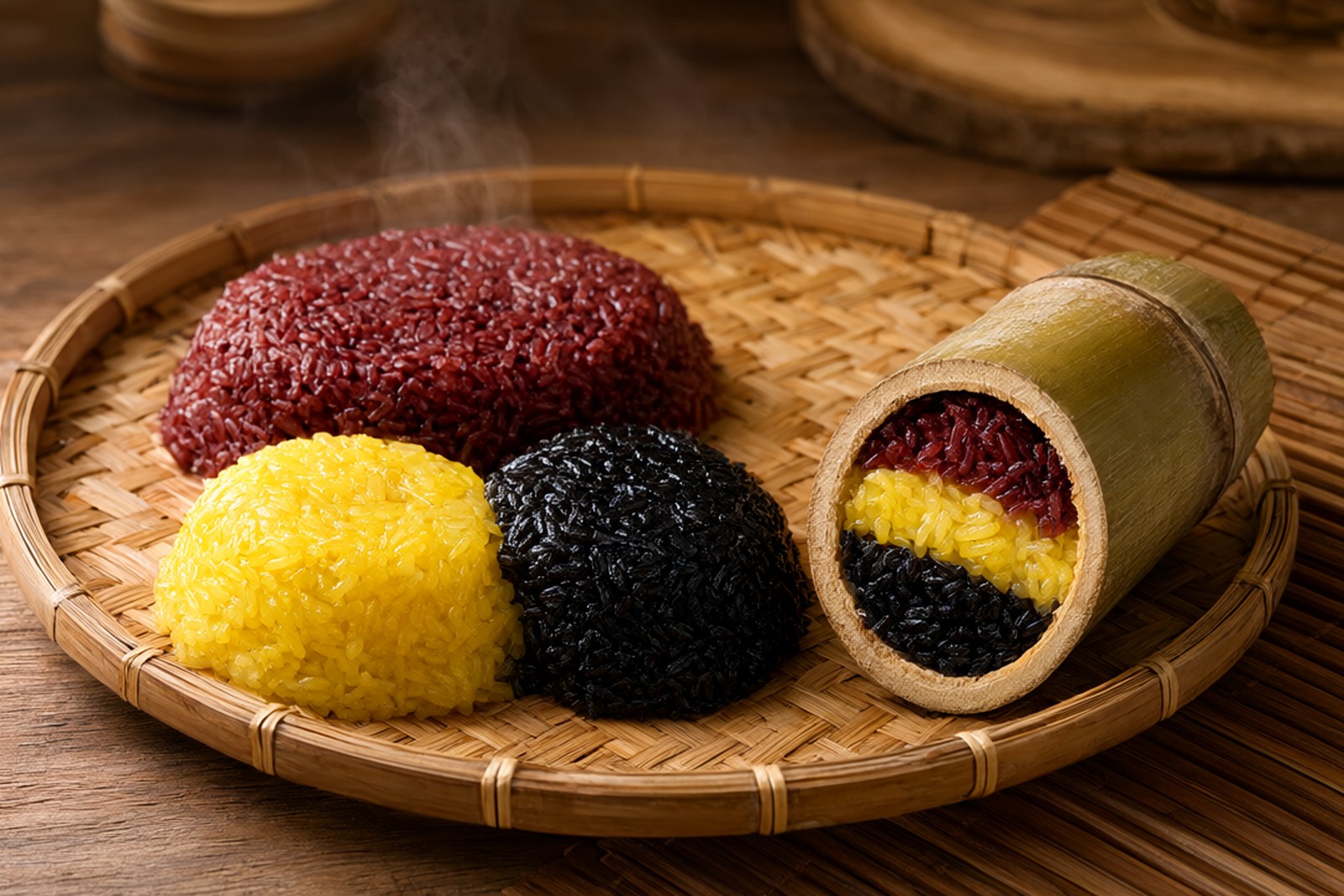
The dyes are the heart of the dish. The red comes from a plant the Li call 红蓝草 hóng lán cǎo, a herb whose leaves give a deep red-brown when steeped; the yellow comes from 黄姜 huáng jiāng, yellow ginger or turmeric root; and the black, the most striking and the one people ask about first, comes from the steamed leaves of a shrub that gives a dark, almost blue-black water. Each of these is steeped or simmered separately to make a coloured liquid. The glutinous rice, 糯米 nuò mǐ, is then soaked in the liquids, drained, and the three lots are either laid side by side on a steaming tray or layered in a 竹筒 zhú tǒng, a section of bamboo, and steamed until the grains are translucent, sticky, and each one held its colour.
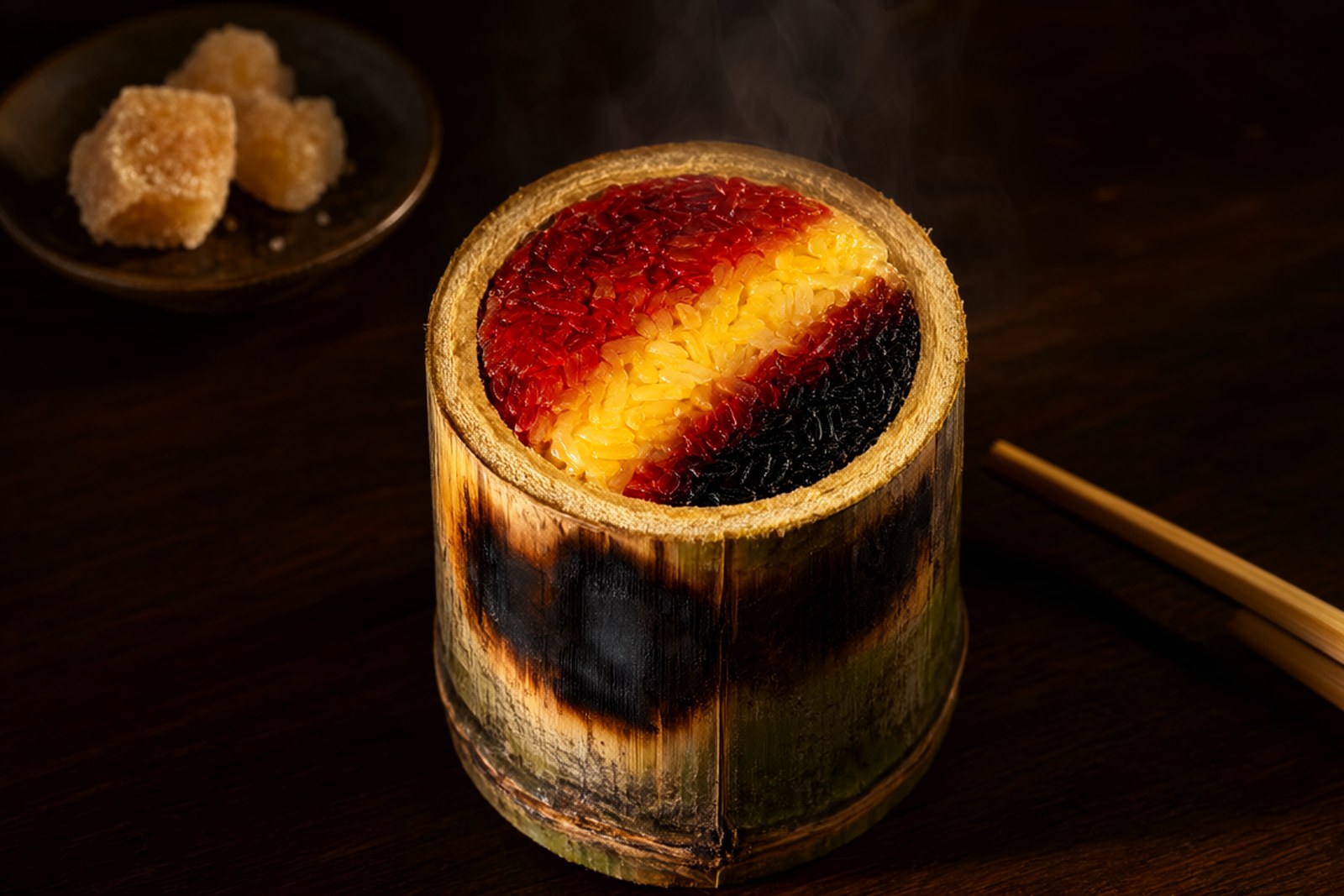
The rice is cooked for festival and for family. It is one of the foods that 黎族 households prepare for the 三月三 sān yuè sān, the third day of the third lunar month, the great Li festival of singing and courtship, and it is also made for New Year and for the visits of guests. The three colours carry meaning in the old cosmology – often read as red for the blood and fire of life, yellow for the sun and the harvest, black for the earth and the forest that gives the dye – and it is a dish that is as much about the gesture as the taste. It is eaten by hand, rolled into a ball, and it is faintly sweet, salty and smoky from the bamboo, with a chewiness that sets it apart from plain rice.
Words and Names
三色饭 sān sè fàn is the three-coloured rice and 黎族 Lí zú the Li people who make it. 糯米 nuò mǐ is glutinous rice, 竹筒 zhú tǒng the bamboo tube it is often steamed in, and 三月三 sān yuè sān the Li festival it appears at. 红蓝草 hóng lán cǎo is the herb for the red, 黄姜 huáng jiāng the yellow ginger for the yellow, and the black comes from a steamed shrub leaf.
What the Locals Know
It is an occasion food, so you will not find it on every menu; look for it at a Li village, at a festival, or at a restaurant that specialises in 黎家宴 Lí jiā yàn, the Li family feast. Ask which plants made the colours rather than assuming it is artificial, because the real versions are more subtle and more fragrant. The rice is best eaten warm and by hand, rolled into a ball and dipped in a little sugar or eaten plain. If you visit a Li village, offering to try the 三色饭 is a gesture of respect, and asking about the dyes is a good way to open a conversation. And do not mistake the dark grains for burnt rice; that is the bamboo-leaf dye, not scorching.
flowcloud would say that a people who drew their festive colours from the forest, and who could see red for the fire of life and black for the earth, knew a way of making a meal a statement about the world long before anyone thought of print.
Where to find it: the 黎家宴 restaurants of 陵水 and the surrounding county towns, the Li and Miao villages that welcome visitors along the east coast, and the home kitchens of the festival season. It is sold at some market stalls and breakfast shops on festival mornings, and by restaurants that do a set Li meal. A portion is ¥15 to ¥30. It is a dish to look out for rather than assume; if you cannot find it in town, ask at a village or book the Li feast meal in advance.