
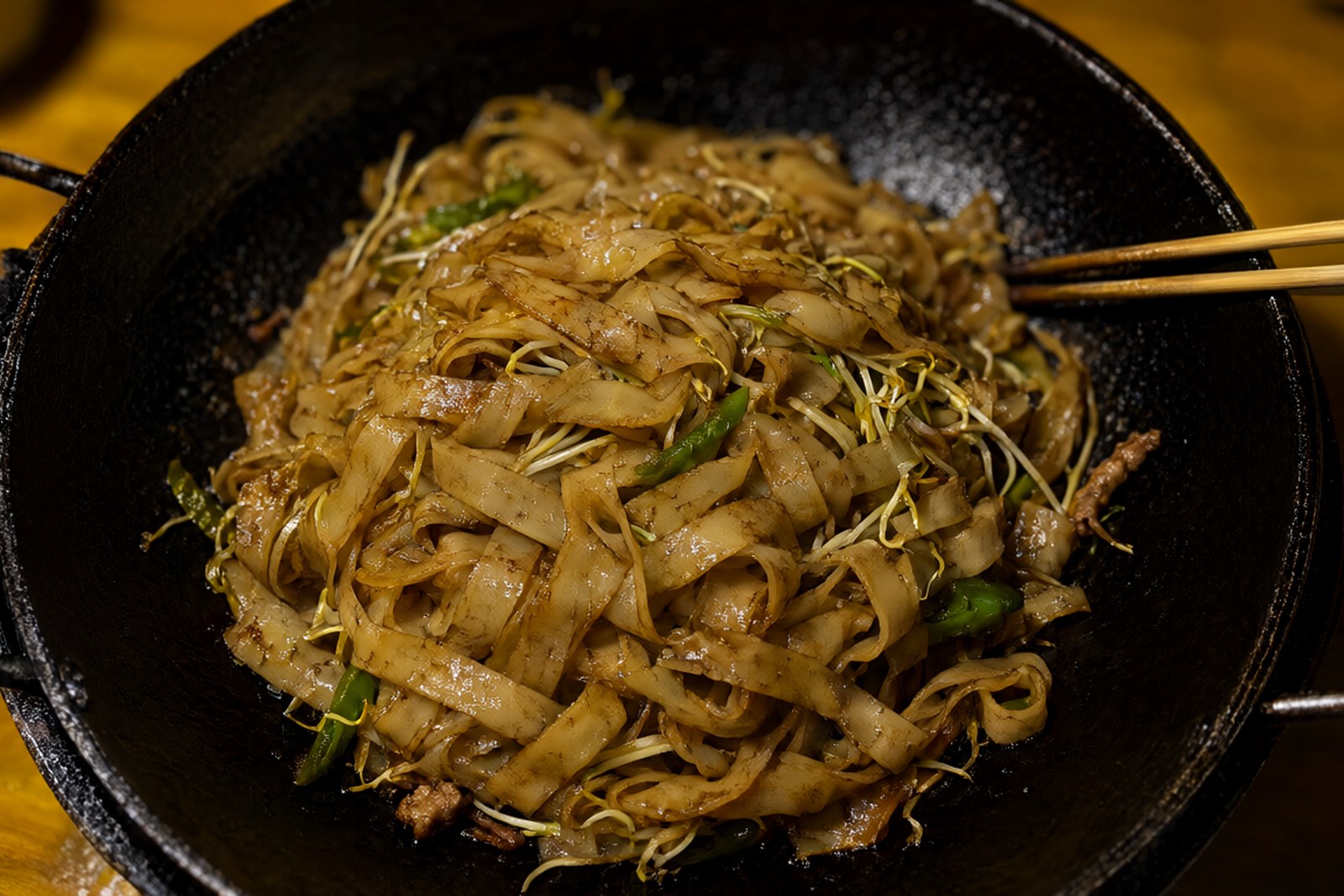
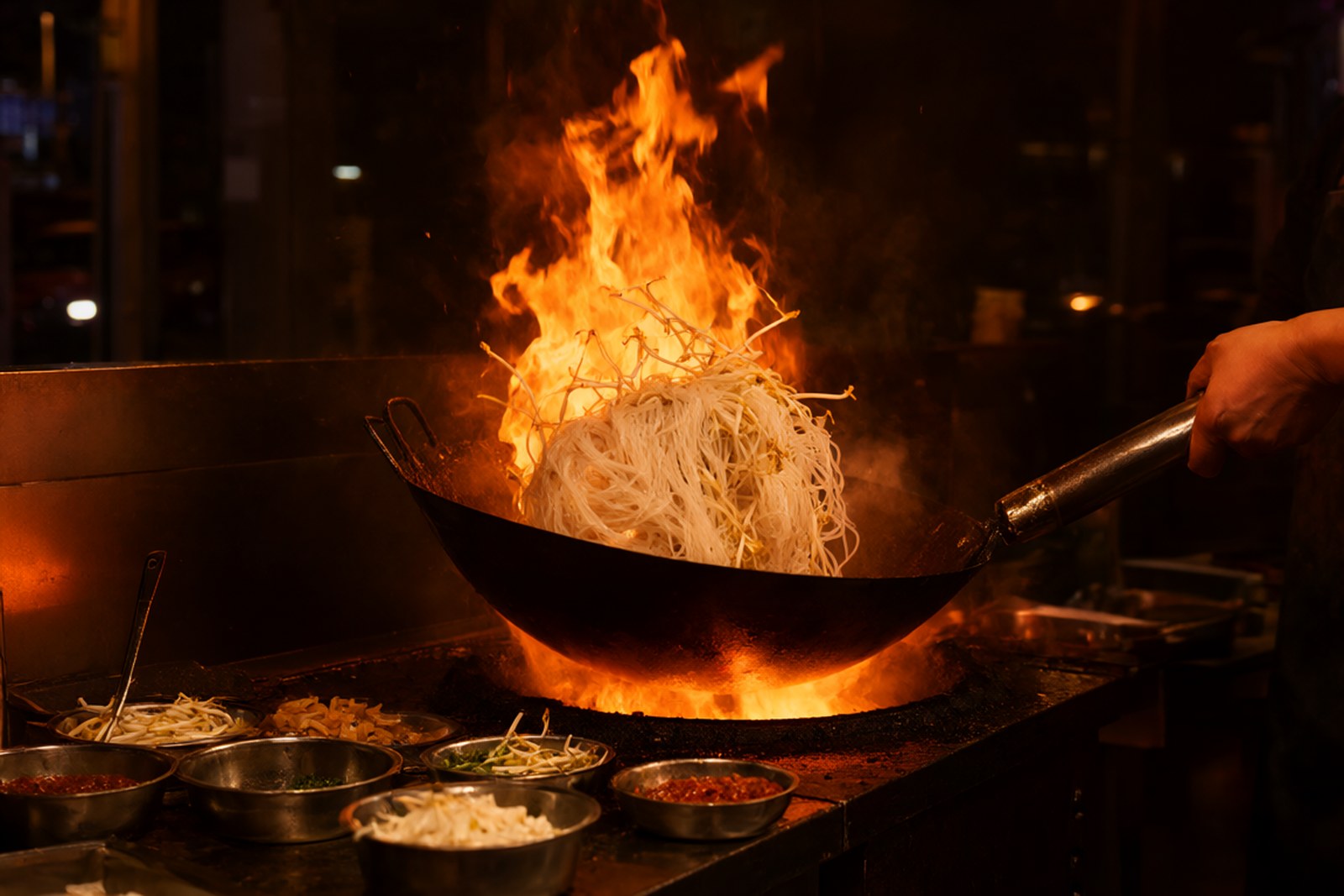
The wok goes up and the noodles come down and for two seconds there is fire in the middle of it, and what lands on the plate is a tangle of wide flat rice noodles with charred edges, bean sprouts still crisp, a few threads of pork, and a smell of hot iron and soy that is the entire reason street food exists. 醴陵炒粉 Lǐlíng chǎofěn is the working-class dish of a working-class town, eaten standing up at nine in the evening after a shift, and it is a textbook demonstration of 镬气 huò qì — wok breath, the flavour that only comes from a pan hot enough to burn and fast enough to not.
醴陵市 Lǐlíng shì is a county-level city in the east of 株洲市 Zhūzhōushì, and its real fame has nothing to do with food. It is one of the historic centres of Chinese ceramics, the place where 釉下五彩瓷 yòuxià wǔcǎi cí — underglaze five-colour porcelain — was developed at the beginning of the twentieth century, and where a vase won a gold medal at the Panama-Pacific Exposition in 1915. 醴陵瓷器 Lǐlíng cíqì is a nationally protected geographical product; the kiln sites at 沩山 Wéishān are a national heritage site; and the town still fires an enormous share of the country’s everyday dinnerware. The 瓷谷 cígǔ, the Porcelain Valley, is a complex of buildings shaped like vessels, and it has a food court, a museum and, inevitably, restaurants.
炒粉 is what people eat around all of that. The noodles are fresh 米粉 mǐfěn, the round kind pressed flat into ribbons roughly a centimetre and a half wide, and they must be cooked the day they are made or they break. The pan is a thin carbon-steel wok over a fierce flame; oil, then pork slivers and a little pickled chilli, then the noodles, which are tossed rather than stirred so that they scorch in patches instead of turning to paste. Bean sprouts go in at the end for crunch and moisture, spring onion last. A good plate has dark blistered spots on perhaps a fifth of the noodle surface, and the rest is glossy and pale. The seasoning is soy, salt and a little MSG; there is no sauce and there is nowhere to hide.
Almost every street corner in the town has a version, and the local argument is entirely about the wok rather than the recipe. The same cook on a domestic gas ring produces something entirely ordinary; the difference is heat, and the ability to keep the noodles moving for the ninety seconds before they burn. This is a dish that cannot be made slowly, and it is the reason the town’s late-night stalls are worth the trip.
Words and Names
炒粉 chǎofěn is fried rice noodles, and it is one of the most widespread dishes in south China, taking different forms from Guangdong to Jiangxi. The 醴陵 Lǐlíng version is distinguished by the flat 粉 fěn, the pickle, and the extreme heat. 镬气 huò qì — wok breath — is the Cantonese-derived term for the seared, faintly smoky quality that a very hot pan imparts; Hunan cooks use it too, and it is the thing being judged.
醴陵 Lǐlíng as a name means “sweet spring”, from the 醴泉 lǐquán — a spring whose water was supposed to taste of wine. The city’s other claim on the national imagination is that 渌江 Lùjiāng, the river running through it, is where 毛泽东 Máo Zédōng did his first rural investigation in 1927.
What the Locals Know
Eat it at the stall. This is not a dish that survives a plate, a journey or a photograph. It is at its best about forty seconds after it leaves the wok.
Order 加蛋 jiā dàn or 加肉 jiā ròu. Egg or extra pork, a few yuan, and it changes the balance of the plate for the better.
Ask for 少油 shǎo yóu if you are not used to Hunan oil levels. The default is generous, and it is not wrong, but it is a lot.
Go late. The best stalls in the town fire up around eight in the evening and run until two; the same cooks at midday are working too fast and the wok is not as hot.
Where to Eat It
The night stalls of 醴陵 Lǐlíng, particularly around the old town and near the 瓷谷 cígǔ, and in any 株洲 Zhūzhōu night market. A plate is ¥10–20 and with egg or meat ¥15–28. Look for the stall with the biggest flame and a queue of people in work clothes.
flowcloud would say that a town which makes porcelain for the whole country, and which eats its supper out of a wok at midnight with the noodles deliberately scorched, has a clearer sense of the relationship between craft and heat than almost anywhere I have eaten.
Where to find it: 醴陵炒粉 (Lǐlíng chǎofěn), 醴陵市 (Lǐlíng shì), 株洲市 (Zhūzhōushì), 湖南 (Húnán). Night stalls and small restaurants; plate ¥10–20, with egg or pork ¥15–28. Eat it standing, within a minute of the wok, and go after eight in the evening.