
临高韭菜饼 Lín gāo jiǔ cài bǐng is a fritter, not a pie and not a dumpling, and the single most useful thing to say about it is that it is made in a ladle. A shallow round ladle, made for the job and sold in the county’s markets as a 韭菜饼煎勺 jiǔ cài bǐng jiān sháo, is dipped in oil, filled with a batter of chopped chives and flour, and lowered into a wok of hot oil; ten or twenty seconds later the cook raps the handle of the ladle against the rim of the wok and the cake slides out and floats free, a disc the size of a saucer, gold at the edge and green under the surface. The Chinese name is a plain description, chive cake, and the favoured poetic alias is 翡翠玉饼 fěi cuì yù bǐng, jade biscuit, from the colour of the chives through the batter. It costs almost nothing. It is fried at the roadside in winter over a brazier, and it is eaten standing up with a dish of sour vinegar, and it belongs to the same family of food as a scallion pancake only in the sense that both are fried batter; the Chinese chive, 韭菜 jiǔ cài, is a strong, oniony, slightly sulphurous leaf rather than a scallion, and in 临高县 Lín gāo xiàn it is combined with a whole prawn often enough that the fritter has a second name and a second flavour, and the county’s food writers describe the result as 地道的海鲜味 dì dào de hǎi xiān wèi, an unmistakably seafood taste.
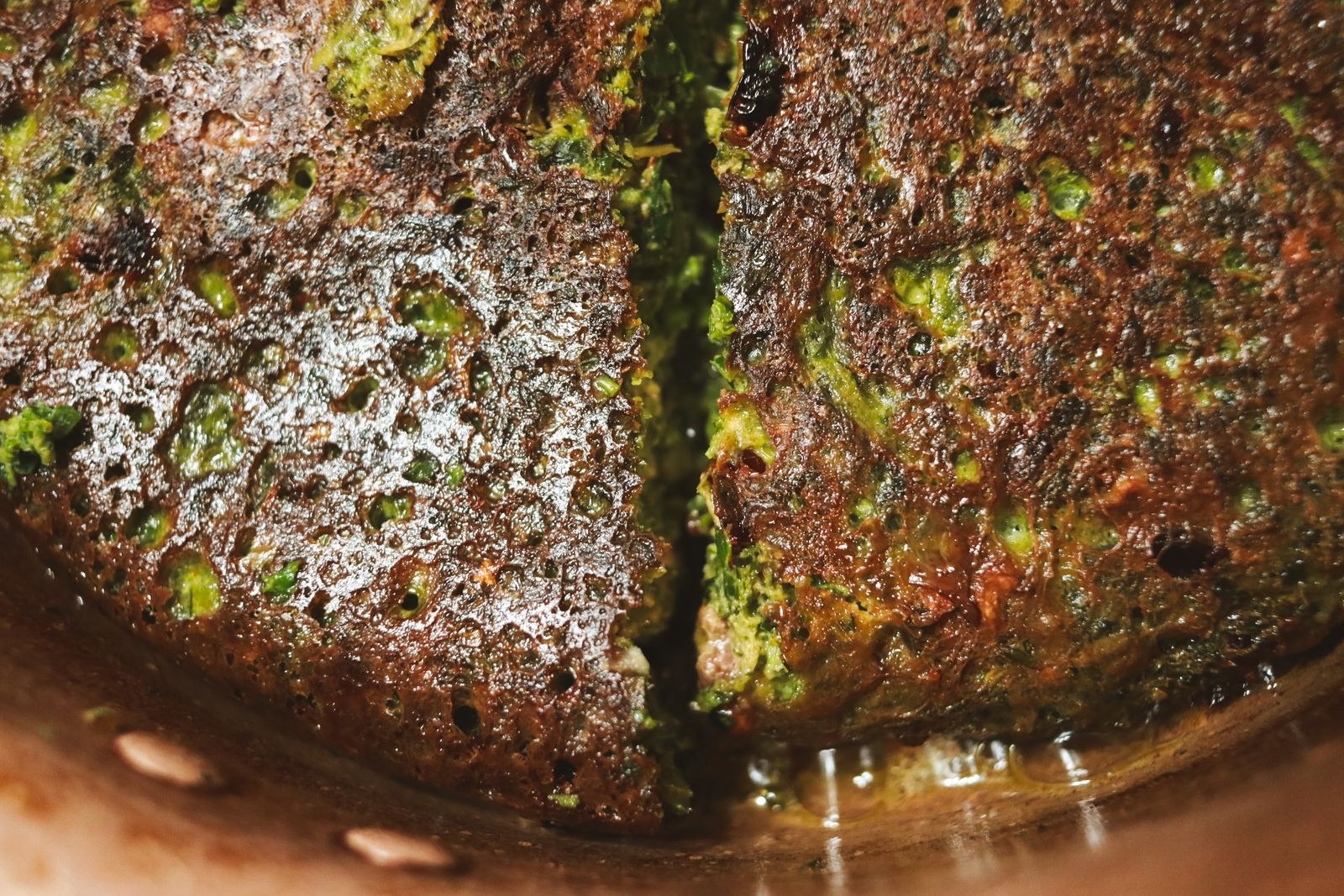
The names take a moment to sort out, because the fritter has been written down in several different ways and one of them is a record of a spoken language that has no standard spelling. 韭菜饼 is the neutral written name. In 临高话 Lín gāo huà, the county’s own speech, which is not Mandarin and not Cantonese and is not mutually intelligible with either, the snack has a name that reporters have rendered as 脖楞 bó lèng in one Hainan Daily piece and as 拔乱 bá luàn in an encyclopaedia entry, with travel writers offering a Latin-alphabet version that looks more like a sound than a word; 虾馍 xiā mó, prawn cake, is a further name, and it is the one that tells you what is inside, since a version of the fritter is made with an entire prawn laid across the top of the batter before it goes into the oil. The distinction between 虾馍 and 韭菜饼 is not a distinction between two dishes so much as between two orderings of the same one, and a stall that has prawns will have both names on the board. What the names share is that none of them has anything to do with a written tradition, and that turns out to be the honest state of the historical record as well. The encyclopaedia entry on the dish says in as many words that 其起源长久已无从考证 qí qǐ yuán cháng jiǔ yǐ wú cóng kǎo zhèng, its origins are lost to enquiry, and that is the position this article takes. There are produce-trade websites that assert the fritter has been sold in the county town’s markets since the Ming and Qing, and one or two that say it goes back several hundred years, but none of them cites a gazetteer, an inscription or a dated document, so the claim is not repeated here as fact. A fried batter cake is not the kind of thing that leaves an archaeological trace, and a county snack that has been made at home and sold from a barrow does not need an origin story to be worth eating.
The batter itself is simple enough to be written on a card, and one of the useful side effects of the dish having gone online is that home cooks have published weighed versions. The core is chives, flour and water with salt and nothing else; a few cooks add a little white pepper or monosodium glutamate, and some use rice flour instead of wheat flour or a mixture of the two, which gives a crisper, more brittle edge and is closer to the older county practice. One widely circulated home recipe sets the proportions at 500 grams of chives to 400 grams of flour, 80 grams of water and 10 grams of salt, with a dipping sauce of white vinegar, three cloves of garlic and sugar. A second, from a cook writing about the village version, keeps the batter as 面粉或米粉适量 miàn fěn huò mǐ fěn shì liàng, flour or rice flour as needed, and adds half a catty of pork, minced and marinated in soy sauce and oyster sauce, as an optional topping, with a dip of rice vinegar, sugar, garlic and cold boiled water. The chives are washed, drained properly, and cut into pieces of one to two centimetres – short enough that the batter holds them, long enough that you can still see what they are – and then folded through the flour and salted water until the mixture is a thick, spoonable sludge. The one judgement that matters is the consistency, and it is a narrow window. Too thin and the batter will not hold its shape in the ladle and the cake will break up in the oil; too thick and the finished fritter will be dense and hard rather than crisp. Cooks describe the target as 糊状 hú zhuàng, a paste, and the test is that a spoonful should sit on itself for a moment.
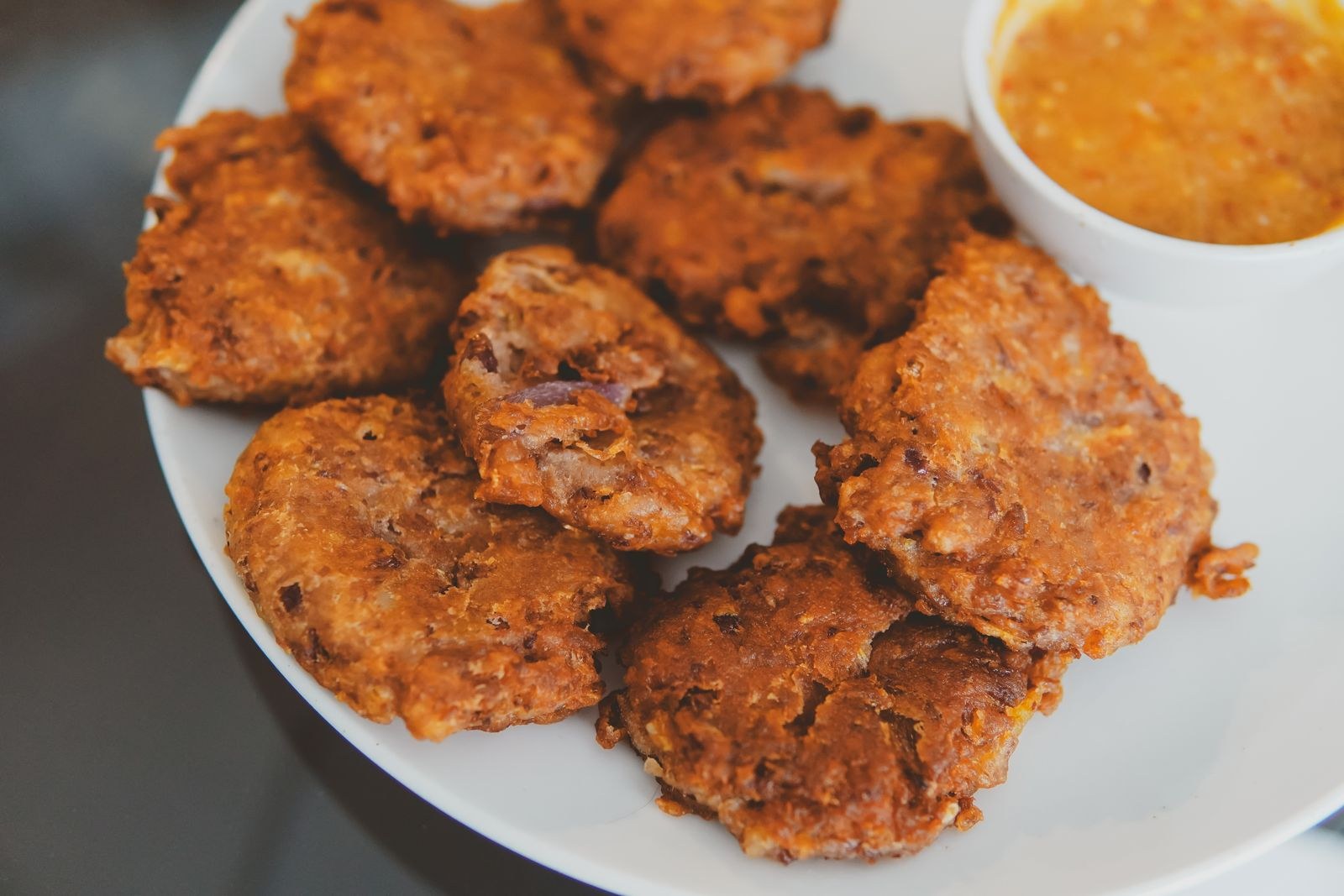
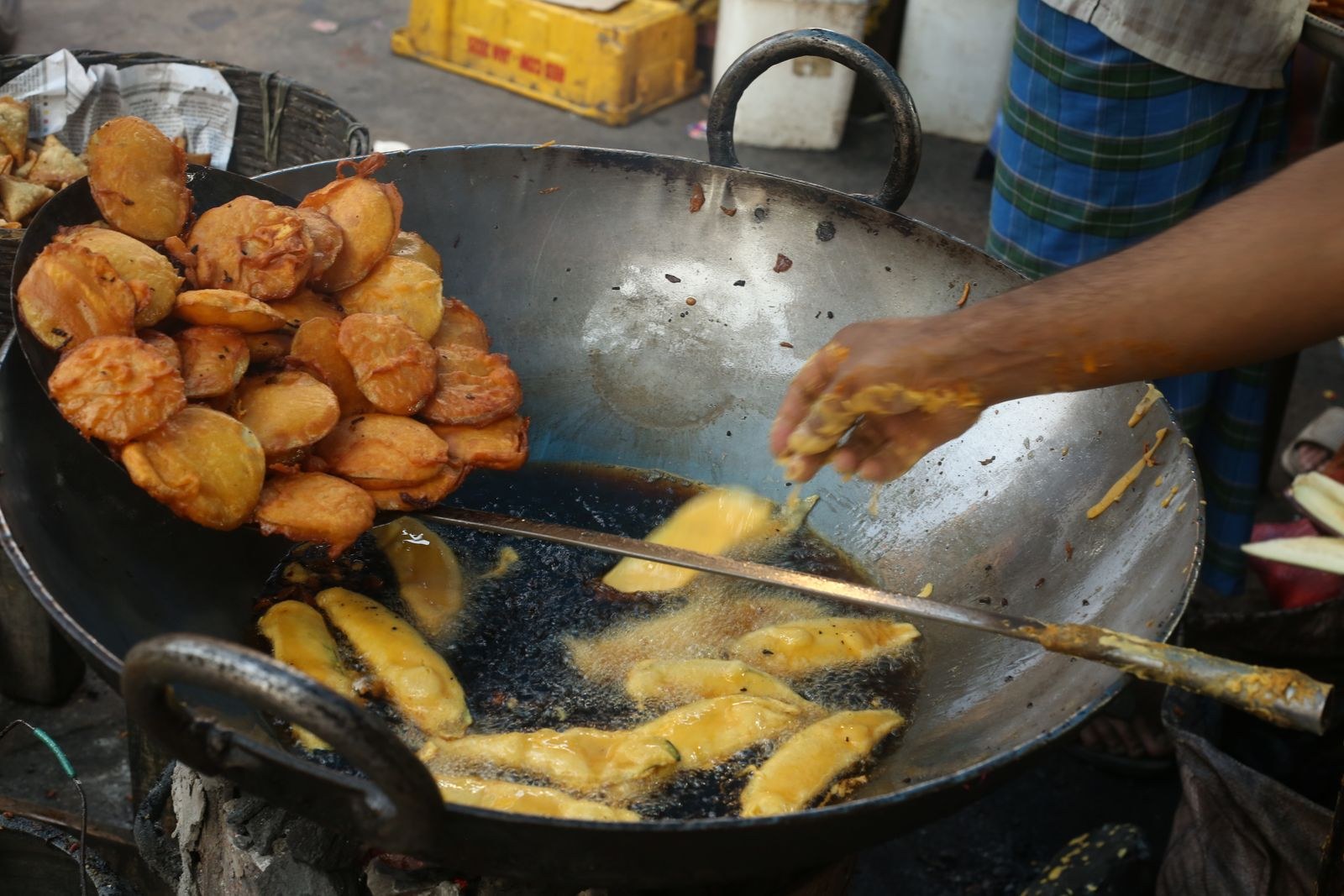
The fry is short and it is entirely a matter of timing, and the sequence a county cook follows is worth setting down because nothing in it is optional. The chives are chopped and the batter is mixed. The ladle is stood in the hot oil for a moment before it is filled, so that the batter does not stick. The batter goes in, and if the customer wants prawn or minced pork it is pressed onto the surface now, and not too much of it, because a thick fritter does not crisp. The ladle goes into the oil at a moderate heat and stays there for anything from about ten seconds to a minute, depending on how much batter it holds, while the cake sets and the batter puffs slightly around the chives. Then comes the move that identifies the dish: the cook lifts the ladle and knocks its handle against the side of the wok, and the whole fritter comes free and floats. It is left until the chives have gone a deep jade green and the rim has begun to colour, which is the moment to take it out, and anybody who wants it crisper asks for it to stay in a little longer and gets a darker, harder version. It is lifted out and drained, and it is eaten within a minute or two, because this is not a food that keeps. The whole operation takes a couple of minutes, and a skilled hand can have two or three ladles going at once, which is the reason a queue at a good stall moves faster than it looks. There is nothing to assemble afterwards and nothing to add except the dip. What you are buying is the contrast between a shatteringly crisp shell and the still-soft, still-pungent chive inside it, and that contrast is gone by the time the fritter has cooled.
The dip is not a garnish in the way a ketchup sachet is a garnish; it is the other half of the recipe. It is called 酸甜醋 suān tián cù, sour-sweet vinegar, and it is made from rice vinegar or white vinegar with minced garlic and sugar, sometimes with a spoonful of Hainanese chilli sauce, and sometimes loosened with cold boiled water so that it is a thin spoonable liquid rather than a syrup. The county’s food writing calls it 神仙伴侣 shén xiān bàn lǚ, the immortal’s companion, and the composition is not arbitrary: the vinegar cuts the oil, the sugar rounds the chive’s bite, and the garlic and chilli push it up. There is also a folk explanation that is worth reporting because it is a completely different way of thinking about fried food than the one an English reader will have met. In Chinese dietary logic, deep-fried food is 上火 shàng huǒ, it puts heat into the body, and a great deal of southern Chinese street eating is organised around balancing that; 降火 jiàng huǒ, bringing the heat down, is what the vinegar is for. Whether or not you believe in the physiology, the practice is good, because a mouthful of chive fritter dipped in sharp sweet vinegar is a much better mouthful than a plain one. The dip is served in a small shallow dish, one between two or three people, and if you ask for 辣椒 you will get a little chilli sauce added or a second dish of it. What you will not get is soy sauce.
Words and Names
韭菜 jiǔ cài is the Chinese chive, a flat-leaved allium with a strong sulphurous bite, and 饼 bǐng is a flat cake, so 韭菜饼 names the dish in the plainest possible way; 虾馍 xiā mó, prawn cake, is the version with a whole prawn in it, and 馍 mó here is a southern dialect word for a cooked patty rather than the northern steamed bun. 翡翠玉饼 fěi cuì yù bǐng is the poetic alias, jade biscuit, from the colour of the chives seen through the fried batter. 临高话 Lín gāo huà is the county’s own speech, and the dialect names that have been printed for this snack – 脖楞 bó lèng in one newspaper and 拔乱 bá luàn in one encyclopaedia – are two attempts to catch the same sound in characters, which is why they do not look alike. 煎勺 jiān sháo is the frying ladle, the shallow round mould the batter is set in; 酸甜醋 suān tián cù is the dipping vinegar and 蒜醋汤 suàn cù tāng, garlic vinegar broth, is another name for the same thing made thinner. 上火 shàng huǒ is the rising internal heat that fried food is said to bring on and 降火 jiàng huǒ is what the vinegar does about it. 中镇街 Zhōng zhèn jiē is the old shopping street in 临城镇 Lín chéng zhèn, the county town, where the evening snack stalls cluster. 炸炸 zhà zhà is the general Hainanese term for the fried-food stall where you choose items and they are dropped in batter and fried to order, which is a different operation from this one even though both sell fried food.
What the Locals Know
The scene the fritter belongs to is a winter evening, and this is the most useful thing to know before you go looking for it. The county’s own reporting describes it precisely: 冬季,在临高各乡镇的街巷中,常见路边火炉上架着油锅,食客们围聚在周围 dōng jì, zài Lín gāo gè xiāng zhèn de jiē xiàng zhōng, cháng jiàn lù biān huǒ lú shàng jià zhe yóu guō, shí kè men wéi jù zài zhōu wéi, in winter, in the lanes of the townships, you will commonly see an oil wok standing on a brazier at the roadside with customers gathered round it, and by evening the young people of the town do what young people do anywhere, which is arrive in groups and eat standing up. The brazier is doing two jobs at once, since it heats the oil and it heats the people standing around it, and a fritter eaten outdoors in a Hainan winter – which is mild, but damp and breezy enough to make a warm brazier pleasant – is a better version of the dish than one eaten indoors. The etiquette is casual and slightly self-policed: the cakes come out of the oil and go onto a rack, diners take them with chopsticks or fingers, and everyone keeps their own count and tells the stallholder at the end how many they have eaten. In some stalls the cooked fritters are left on an iron rack for people to help themselves, which sounds risky and works perfectly well because the queue is short and the turnover is fast. The county town street that most of the travel writing converges on is 中镇街 Zhōng zhèn jiē, a lane of small food businesses in 临城镇 that sells, in no particular order, fried snails, sweet soups, these fritters, pickled fruit, skewers and the roast suckling pig that the county is separately famous for. The lane is busiest after dark, when the stalls are all lit. Prices are the least stable thing about the dish and they need dating. A Hainan Daily report in 2015 gave it as 五毛钱两个 wǔ máo qián liǎng gè, five mao for two, with two or three yuan being enough to fill a person; an encyclopaedia entry records the price moving from one yuan for five to one yuan for three; writing from 2026 records five mao each at an ordinary stall, one yuan each on the third day of the Spring Festival, ten yuan for twelve in one place, and a tourist-facing stall asking three yuan for one. The honest summary is a few mao to a yuan or two apiece, with the outliers being festival pricing and locations that have discovered tourists.
There is one story about this snack that has been reported in detail, and it is a shop rather than a dish, but it is the best illustration of why a fritter this cheap is worth writing about. In 2005 a man surnamed 老钟 Lǎo Zhōng and his wife left 临高 for 海口 with the recipe, and set up a barrow in a lane in 盐灶 Yán zào, in the old part of the city. The worst day they had, in the account they later gave a newspaper, they sold eight fritters. Their answer to that was to spend more rather than less on the ingredients: they used whole fresh prawns where other stalls used dried shrimp, and they bought better flour. The barrow became a shop, the shop fried for eleven years, and it eventually moved to 龙昆上村 Lóng kūn shàng cūn, where it became one of the city’s well-known snack addresses, opening at two in the afternoon. The detail that says everything about the genre is what the woman does at five in the morning: she gets up to take delivery of the chives and scallions from the vegetable vendors and to go to the market for fresh prawns, and neither the oil nor the raw material is carried over from one day to the next. That shop sells its fritters under the name 韭菜虾饼 jiǔ cài xiā bǐng, the prawn version, and it is a reminder that this is a snack whose economics are extremely tight and whose reputation is made by the refusal to economise. Where the chives come from matters too. Hainan reports on the county describe households growing their own chives in the yard, without pesticide or chemical fertiliser, on organic manure, and harvesting repeatedly from the same clump, which is about as short a supply chain as a restaurant ingredient can have. Whether the fritter has any formal status is a short answer: nothing in the record shows that 临高韭菜饼 has been listed as intangible cultural heritage or granted a geographical indication, and it should not be described as either. What it does have is official recognition of a modest kind, since the county put it in the company of 临高粉, 猪血肠 and 艾草耙 ài cǎo pá, mugwort cakes, as one of the traditional snacks of the county at a food-culture promotion held in 海口 on 18 and 19 December 2020, where staff made the fritters in front of visitors.
Two things on the internet about this snack are worth flagging so that a visitor does not arrive with the wrong picture. The first is a description, on at least one travel site, of 韭菜饼 as a steamed roll of rice-milk skin wrapped around a chive and dried-shrimp filling, sometimes called 猪肠馍 zhū cháng mó. That is a real thing in Hainan, but it is not this dish and it contradicts every substantive account of 临高韭菜饼, which is a batter fried in a ladle, so ignore it. The second is the persistent attempt to give the fritter a Ming dynasty pedigree. The county’s own writing does not do this, the encyclopaedia says the origin is unrecorded, and the earliest actual dated mention anybody has produced is a newspaper feature from the 2010s, so the right posture is to enjoy the thing and leave its ancestry alone. What you should instead spend your attention on is the gear: a fritter is a thickness, a temperature and a count of seconds, and the difference between a good stall and a mediocre one is visible in whether the cakes are crisp to the rim and whether the chive inside is still sweet. Order one, watch it being knocked out of the ladle, eat it standing up, and ask for more vinegar than you think you need.
flowcloud would say that the pleasure of 临高韭菜饼 is that it is a recipe with almost nothing in it – a handful of chives, a spoonful of flour, salt, hot oil – which means that all the skill has been displaced into a single gesture, the knock of the ladle on the wok rim that decides whether the cake in your hand is a sodden disc or a crisp green shell.
Where to find it: the evening stalls of 中镇街 Zhōng zhèn jiē in 临城镇 Lín chéng zhèn, the county town, which is where the travel writing converges and which runs late; the market gates and old lanes of the other townships, where a brazier and a wok appear at dusk in winter and are gone by spring; and the food stalls of the fishing towns at 新盈镇 Xīn yíng zhèn and 调楼镇 Diào lóu zhèn on the coast, where the prawn version of the fritter is at its best because the prawns are hours out of the water. 临城镇 is the practical base, and the county’s own food promotions have featured the dish made to order, but the everyday place to eat it is a barrow rather than a restaurant; go after four in the afternoon and before the oil runs out, and expect to pay a few mao to a yuan or two for each one rather than a menu price.