
临高粉 Lín gāo fěn is a bowl of rice noodles that is defined less by the noodle than by what is poured over it, and in the county that gives it its name the defining property is liquid. The brine, which is called 腌汁 yān zhī when the bowl is dressed rather than souped, is deliberately thin, thin enough that it soaks through the entire bowl instead of sitting on top of it, and that one decision separates it from every other famous noodle bowl on Hainan Island. In 海口 Hǎi kǒu, the provincial capital two hours up the coast, the local 海南粉 Hǎi nán fěn is dressed in a gravy thick enough to cling, sweetish and sticky, and it is eaten with peanuts, pickled vegetables, shredded bamboo shoot, beef threads and fried dough flakes, with a bowl of clear soup afterwards to rinse the mouth. In 文昌 Wén chāng the 抱罗粉 Bào luó fěn is a slightly thicker, half-transparent noodle in a beef-and-pork bone broth. In 陵水 Líng shuǐ the 酸粉 suān fěn is a fine chewy noodle under a sour, sweet, chilli-hot dressing with dried squid, fish cake, beef jerky and sandworm, and yellow lantern chilli on the side. In 万宁 Wàn níng the 后安粉 Hòu ān fěn is a flat, nearly transparent noodle in a milky pork-and-offal broth. 临高粉 sits to one side of all of them. It is fine, smooth, soft and springy; the county’s own eaters describe it as 爽口不油腻 shuǎng kǒu bù yóu nì, refreshing in the mouth and not greasy, which is a claim about the dressing as much as the noodle; the base note is 酸咸 suān xián, sour and salted, rather than the sweet-salty axis of the Haikou bowl; and the bowl is finished with 脆香小酥肉 cuì xiāng xiǎo sū ròu, small pieces of crisp-fried pork, and 肉松 ròu sōng, pork floss, scattered over the top. If you have eaten rice noodles in Hainan and not in 临高县 Lín gāo xiàn, you have not eaten this.
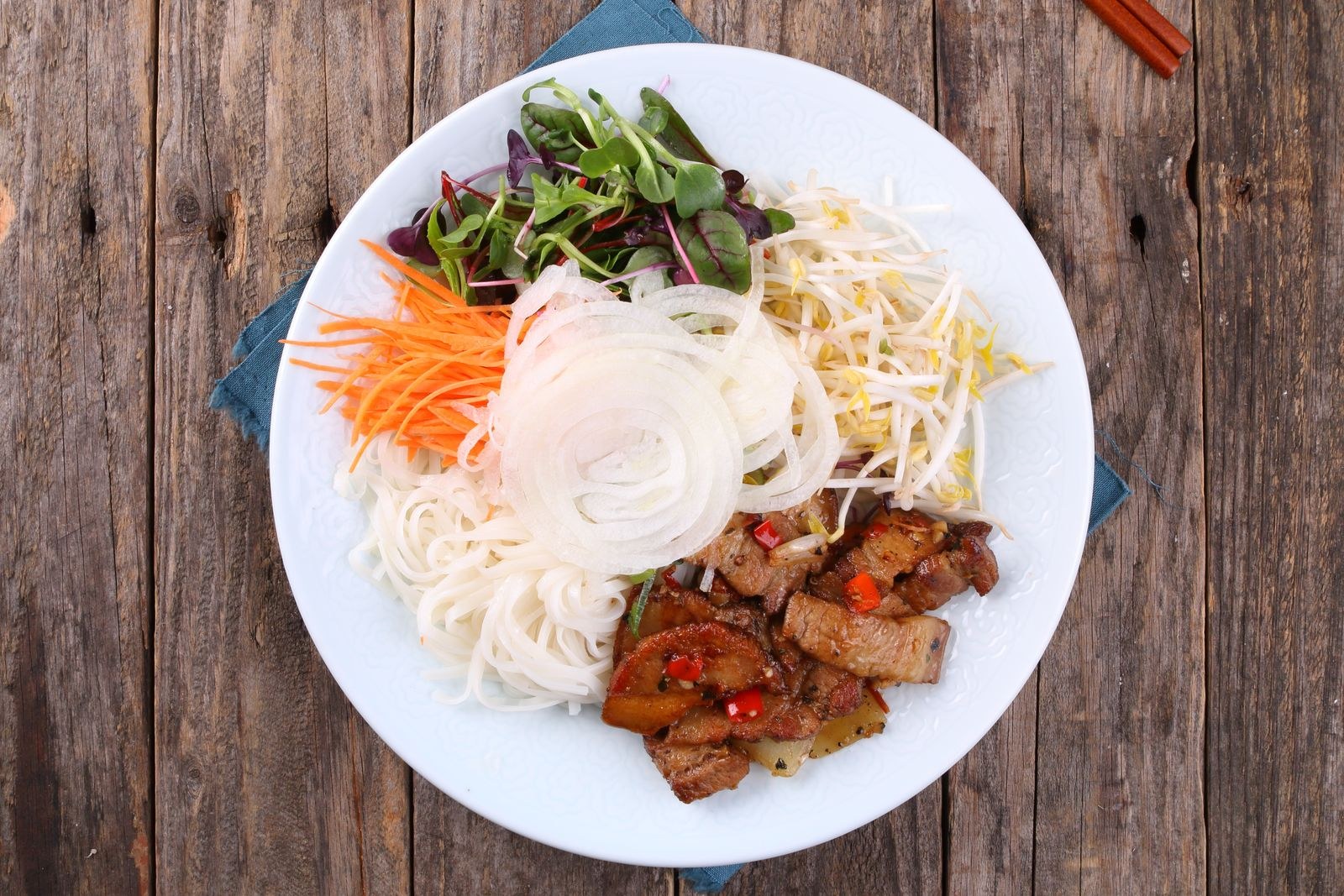
The second thing that defines the bowl is the number of things in it, and here the county is competitive in a way that is easy to verify at the counter. The usual count for a fully loaded 临高粉 is 10 多种佐料 shí duō zhǒng zuǒ liào, more than ten kinds of topping, and the list runs across beef jerky cut small, sliced pork, pickled mustard greens, fried peanuts, sliced pig intestine, shelled prawns, chilli and vinegar, plus 黄金蒜油 huáng jīn suàn yóu, golden garlic oil, dried squid, coriander and spring onion, with bean sprouts and garlic sprouts appearing in some versions. The garlic oil is the aroma switch: minced garlic lowered into cool oil and taken slowly to gold, and then spooned over the noodles, which is why a good bowl smells of toasted allium before it smells of anything else. The brine is the soul of it and the recipe is published, which is unusual and useful. It starts with a stock made from 筒骨 tǒng gǔ, pork marrow bones, about a catty of them with a few slices of ginger, simmered down; the flavour comes from two ingredients that are not in the other Hainan bowls, 美味香 měi wèi xiāng, a commercial seasoning powder, and 豆腐乳 dòu fu rǔ, fermented bean curd, one cube of it mashed and fried in garlic until it smells sweet; the stock goes in, comes to the boil, and is finished with soy sauce, oyster sauce and a small amount of starch water to give it body, and the result is an amber, glossy liquid. Here the sources disagree with each other and it is worth saying so plainly. The same encyclopaedia passage that describes this bowl as having a brine thin enough to soak the whole noodle also endorses an amber, thickened gravy, and a home recipe produces exactly that. The resolution is quantity rather than recipe. The gravy is a concentrate, and what goes on a bowl of 临高粉 is a spoonful of it loosened into the noodle, so that every strand is wet and the bottom of the bowl holds a shallow pool of sour-salted liquid rather than a sauce sitting on top. Read either way, the point stands: this is a wetter, lighter bowl than a Haikou 腌粉, and it is meant to be.
The county this bowl belongs to is worth a paragraph of its own, because 临高县 Lín gāo xiàn has a food canon and the noodle has a settled place in it. It is a county of eleven townships on the north-western coast, with a long shoreline, eleven harbours and four good natural ports at 金牌 Jīn pái, 新盈 Xīn yíng, 调楼 Diào lóu and 黄龙 Huáng lóng, and its own promotional language calls it 鱼米之乡 yú mǐ zhī xiāng, a land of fish and rice, which in a Hainanese context means both the sea and the paddy at once. When the county held its food-culture promotion in 海口 Hǎi kǒu in December 2020 it put six things in the window, and the noodle was one of them, alongside 临高乳猪 Lín gāo rǔ zhū, the roast suckling pig that is the county’s other famous dish, 土窑海鲜 tǔ yáo hǎi xiān, seafood baked in a clay pit, 多文空心菜 Duō wén kōng xīn cài, the chive fritters and the blood sausage. Of the six it is the noodle that is eaten every day and by nearly everybody, which is why it matters more than its price suggests: a bowl that costs three yuan and is sold from a shopfront with a glass counter is not a delicacy but a habit, and a habit is the hardest thing for a visitor to see in the time a visitor has. The county is also, by its own count, the largest marine-fishing county in the province, and its breakfast trade keeps the same hours as its harbours, which is to say early. There is one piece of background that helps a visitor make sense of the names: 临高话 Lín gāo huà, the county’s own speech, is a distinct language rather than a dialect of Mandarin or of Cantonese, so the local words for dishes are often written in characters chosen for their sound rather than their meaning. The food here is not a variation on Haikou cooking. It is a separate tradition that happens to share an island.
The noodle itself is a dry noodle until you order it. 临高粉 is made and sold as 临高干粉 Lín gāo gān fěn, dried strands that have to be cooked, and the proportions used in a home kitchen are a working guide to a street bowl: about 1.5 两 liǎng, seventy-five grams, for one person, dropped into boiling water for roughly five minutes until a strand can be pulled apart by hand, then taken off the heat and left to stand for three minutes, then drained and rinsed cold. Rinsing is what keeps the spring in the noodle; skip it and the strands go on cooking in their own heat and turn soft in the bowl. The county’s trade descriptions add that the noodles are made by hand, from a late-season 籼米 xiān mǐ, long-grain rice, soaked and ground to a slurry, boiled through, cooled to set the texture and cut into strands no thicker than 1.5 millimetres, and that this is why the noodle is finer and more delicate than the mass-produced article; that account comes from a produce-trade site rather than an official source and should be treated as the trade’s own description rather than a verified specification, though nothing in it is implausible. Either way, the manual element is real, since 临高粉 is one of the Hainanese bowls that is still commonly described as being made by hand rather than extruded. The last structural fact about the bowl is that it can be served two ways, and the choice is a choice about weather. 湿吃 shī chī, the wet way, takes the cooked noodles back through boiling water for a moment and then adds the pre-made soup and the toppings, so the bowl is hot, full of liquid, lightly seasoned and inclined to scald; it is what you order on a cold morning. 干吃 gān chī, the dry way, skips the second blanching and dresses the drained noodles directly in the sauce and toppings so that there is almost no liquid in the bowl at all, closer to a cold tossed salad; it is what you order when you are in a hurry or when the day is already too hot for soup. Both are 临高粉, and the same shop will make either without blinking.
Words and Names
粉 fěn is the word for a rice noodle, and the distinction between 粉 and 面 miàn, wheat noodles, is the first thing to get right in Hainan, where almost every local bowl is 粉. 临高粉 is therefore just Lingao noodles, and 临高米粉 Lín gāo mǐ fěn is the same bowl under a longer name. 腌粉 yān fěn is the dry-dressed style of Hainan rice noodle, where 腌 yān means to dress rather than to pickle, and 腌汁 yān zhī is the dressing; 湿吃 shī chī and 干吃 gān chī are the wet and dry ways of serving it. 佐料 zuǒ liào are the toppings, and on this bowl there are more than ten of them. 黄金蒜油 huáng jīn suàn yóu, golden garlic oil, is the toasted-garlic oil spooned on at the end, and 小酥肉 xiǎo sū ròu is the crisp-fried pork scattered over the top alongside 肉松 ròu sōng, pork floss. The two ingredients that make the brine this county’s own are 筒骨 tǒng gǔ, pork marrow bone, and 豆腐乳 dòu fu rǔ, fermented bean curd, with 美味香 měi wèi xiāng, a brand-name seasoning powder, doing the rest. 猪血肠 zhū xuè cháng is the pork-blood sausage that is the bowl’s standing companion, 黄金搭档 huáng jīn dā dàng, the golden partner; the county’s noodle bowls are compared with 海南粉 Hǎi nán fěn, 抱罗粉 Bào luó fěn, 陵水酸粉 Líng shuǐ suān fěn and 后安粉 Hòu ān fěn, which are the four Hainanese bowls a visitor is most likely to have met. 临城镇 Lín chéng zhèn is the county town where the breakfast trade is concentrated, and 蜜汁猪肠 mì zhī zhū cháng, honey-glazed pig intestine, is the extra that regulars add.
What the Locals Know
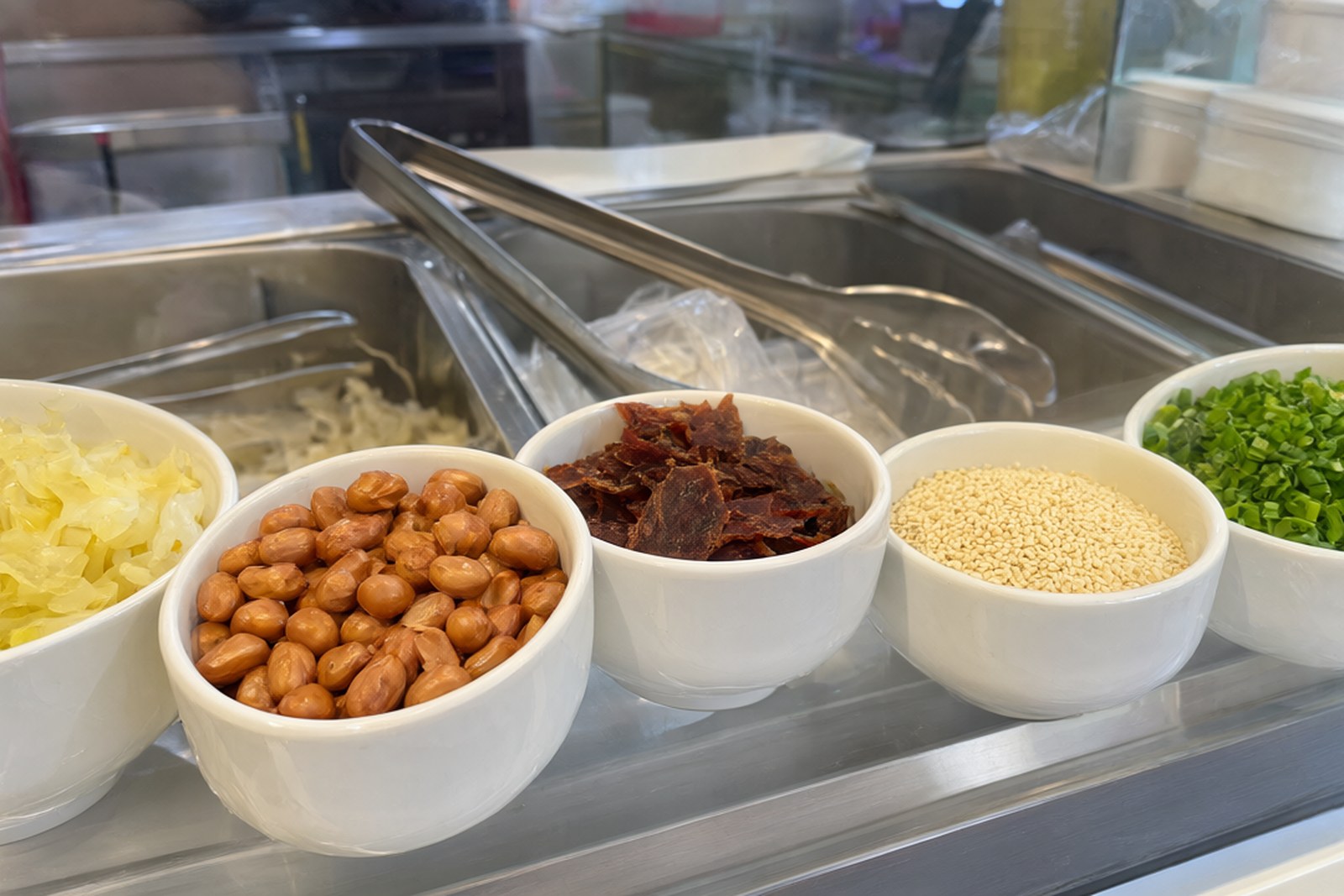
Breakfast is the meal this bowl belongs to, and in the county town the ritual is described in a way that is unusually exact. The local saying is 早餐吃好,午餐吃饱,晚餐吃少 zǎo cān chī hǎo, wǔ cān chī bǎo, wǎn cān chī shǎo, eat well at breakfast, eat your fill at lunch, eat little at dinner, and the first clause is the one that gets acted on: an unremarkable little shopfront in the old quarter of 临城镇 Lín chéng zhèn steams from early morning, and what it sells is this. The setup is worth picturing because it explains the dish. Behind the glass of the counter there is a row of iron bowls, each holding one 佐料 zuǒ liào and nothing else, pickled mustard greens, fried peanuts, dried beef, sesame, so that dressing a bowl becomes a short walk along a line of ingredients; beside them are baskets of the dry noodles. By seven the shop fills, and the order that carries across the room is 老板,要临高粉加肠 lǎo bǎn, yào Lín gāo fěn jiā cháng, boss, a Lingao noodle with sausage, which is the standard configuration and the one to order on a first visit. Food writing about the county says there are a great many noodle stalls in the town but only two that are genuinely famous, both on the main streets, and that any local will point you to them without hesitating; a bowl costs between three and five yuan depending on what is in it, and one bowl is a full breakfast for an adult. Prices need dating, since the same sources span a decade: the three-to-five-yuan figure comes from an encyclopaedia entry, while a 2026 account of the breakfast stalls on 解放路 Jiě fàng lù in the county town records a plain bowl with pickled greens and garlic-oil broth from three yuan, and five to eight yuan with pig offal, lean pork or sliced poached pork added. Either way this is one of the cheapest proper meals in Hainan, and the useful timing advice is to arrive between seven and half past ten in the morning, because a number of the stalls pack up by late morning and there is nothing to eat there at all in the afternoon. Some regulars add a portion of honey-glazed pig intestine on the side, which is a different pleasure from the sausage and worth knowing about.
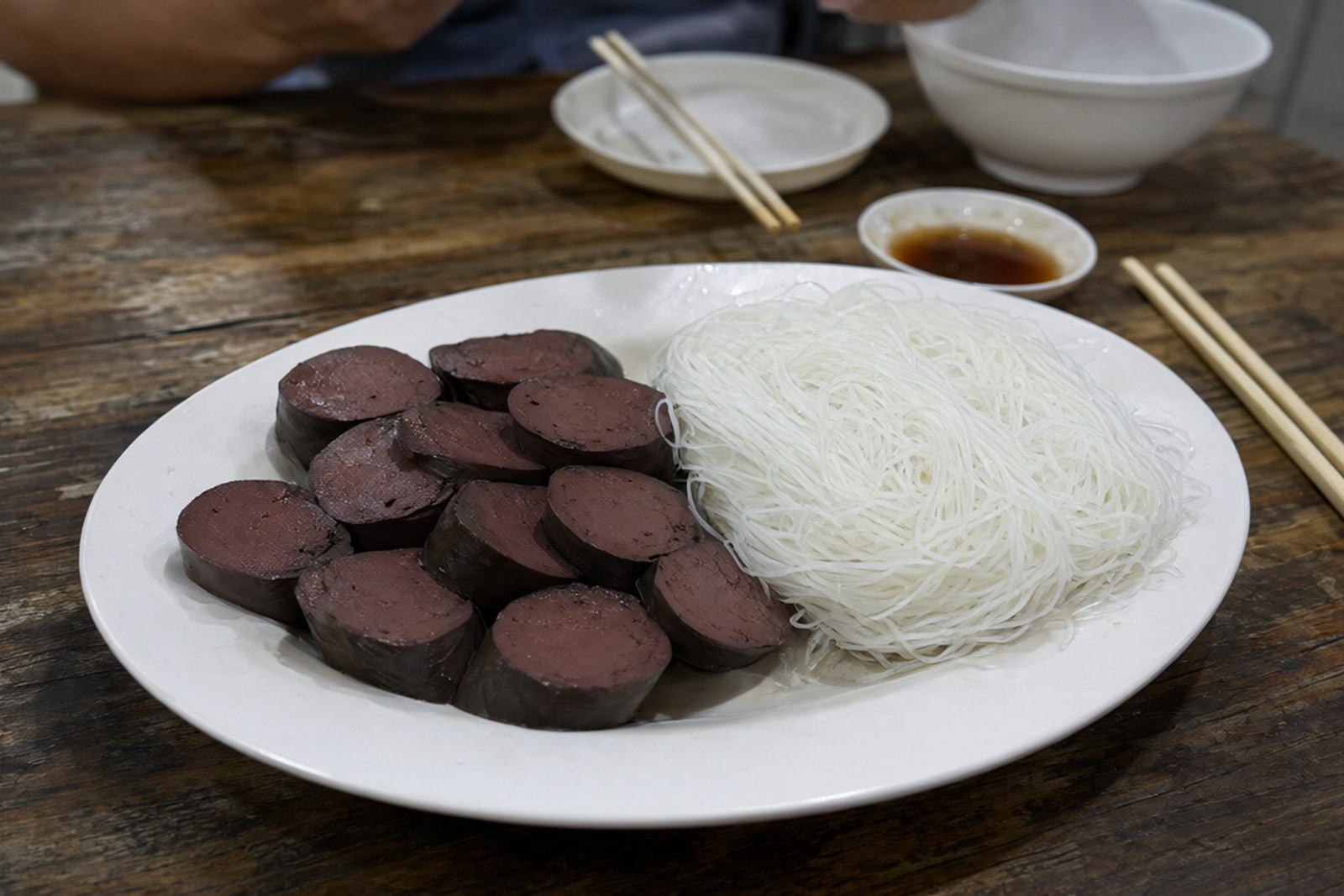
The companion that comes with this bowl has its own small history, and it is the part of the meal a visitor is most likely to remember. 猪血肠 zhū xuè cháng is made by seasoning pig’s blood, stuffing it into the intestine, tying both ends, pricking the casing to let the air out, and then boiling and steaming it, and it is served alongside the noodles as a matter of course rather than as an option. The explanation the county’s newspapers give for the pairing is functional and specific. Fishermen and labourers in the old county went out early to the boats or the fields and burned an enormous number of calories, and a bowl of rice noodles alone did not hold them until the next meal; most people were not rich; so cooks worked out ways to make cheap food that lasted, and blood sausage was one of them, because it is filling and it releases its energy slowly. That reading of the dish – cheap, and it keeps you going – is the one the official reporting leans on, and it is a better explanation of a local food habit than any story about flavour. The scene at the shop is memorable in its own right. A pot sits covered on a low stove with the sausages coiled under the lid, each one swollen tight with blood and faintly iron-smelling when you get close; the owner lifts one out and cuts it into pieces two or three centimetres thick straight into the bowl, and there are customers who come for the sausage alone and order it as a plate with no noodles at all. The hours involved are brutal on the shop’s side of the counter: breakfast stalls making their own sausage are reported to start at two in the morning to wash and stuff the casings. If you are offered it, say yes.
Two questions about this bowl have no good answer in the record, and it is better to say so than to invent one. The first is where 临高粉 comes from. There is no origin date, no named inventor and no early document; the Hainanese bowls that do have a pedigree have it in the form of reported tradition, since 抱罗粉 is said to go back to the Ming and 陵水酸粉 is dated to the late Qing, and 临高粉 has no equivalent. The second is status. Nothing in the record shows that 临高粉 has been registered as a geographical indication or listed as intangible cultural heritage, and it should not be described as either; the comparison that makes the gap visible is that 陵水酸粉 entered the third batch of Hainan’s provincial intangible cultural heritage list in 2011, and a mass-tasting event of it in 2012 was entered in the Guinness records, whereas 临高粉 has nothing comparable. A further conflict worth naming is the stock. The published home recipe simmers its pork bones for around three hours; a produce-trade page describes a broth boiled for more than twelve hours, and while a long boil is what a restaurant would do, that source is the weaker of the two and the shorter figure is the one printed here. The county does promote the bowl as one of the dishes it shows off, and 临高粉 appeared with the roast suckling pig, the clay-baked seafood, 多文空心菜, the chive fritters and the blood sausage at the food-culture event the county held in 海口 in December 2020. What it has is a reputation rather than a certificate, which is fine, because the thing you can verify is in the bowl, and the thing in the bowl is a texture.
flowcloud would say that 临高粉 is the one Hainanese noodle worth judging by its liquid rather than its solids, because the county’s whole contribution to the island’s noodle canon is a decision to water the dressing down until it can reach every strand in the bowl, which is a humble sort of genius and the reason a three-yuan breakfast can taste like it was thought about.
Where to find it: the breakfast shops of 临城镇 Lín chéng zhèn, the county town, and specifically the old quarter and the 解放路 Jiě fàng lù stretch where the stalls open before seven and close before eleven; the two long-standing noodle shops on the town’s main streets that locals will point out if you ask for 临高粉; the market-food lanes of the other townships, where a bowl is served the same way; and the harbour-side eating houses of 新盈镇 Xīn yíng zhèn and 调楼镇 Diào lóu zhèn, where the blood sausage that comes with the bowl has a fishing-town logic to it. Order it 加肠 jiā cháng, with sausage, ask for the dry dressing if it is a hot day and the wet one if it is not, and go early: the whole dish belongs to the first half of the morning, and by noon the pot and the counter are both shut.