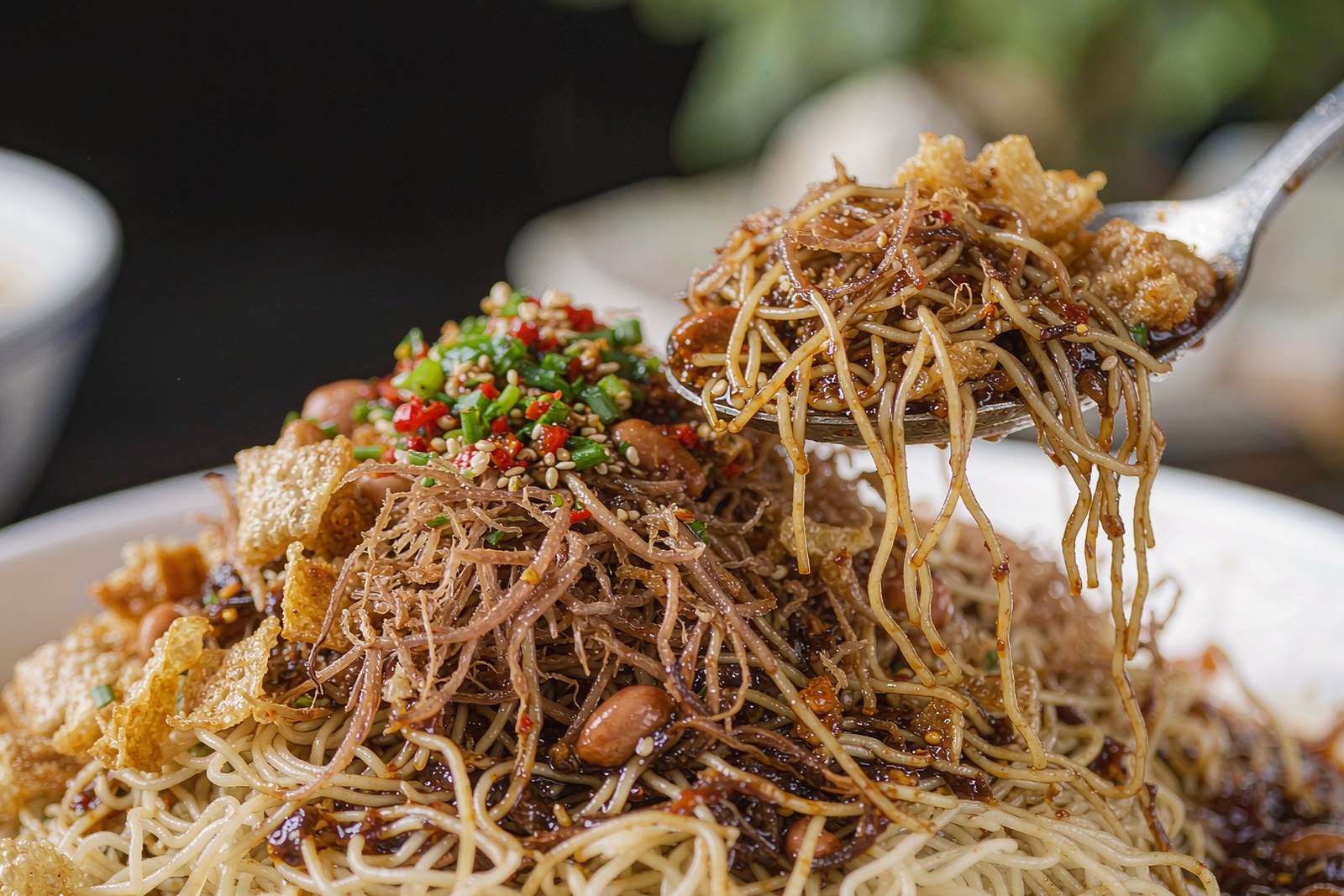
Lingshui Sour Noodles
The first thing you notice is the smell, and it is not what you were expecting. It is sour, and it is sharp, and it is carrying something underneath that is almost sweet, with a whiff of dried seafood and a heat that reaches you before the bowl does.
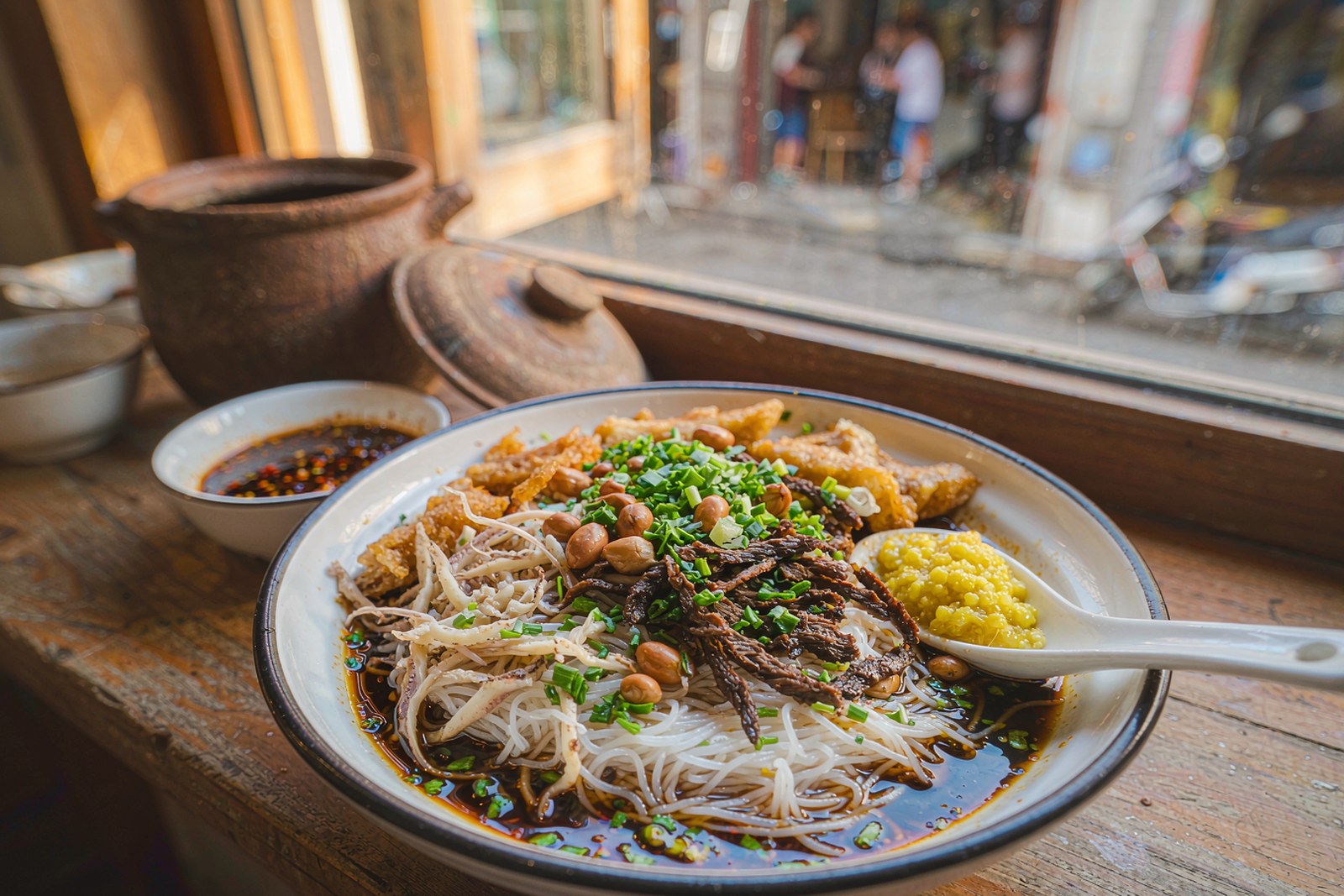
This is 陵水酸粉 (Língshuǐ suānfěn), Lingshui sour noodles, and it is the tartest, most confrontational of all Hainan’s great rice noodles. In a province that eats noodles for breakfast the way other places eat bread, this is the one locals argue about, and the one that divides Hainan into two kinds of people: those who can handle the sour, and those who cannot.
A Noodle Born in a Village by the Sea
Lingshui county sits on the south-east coast of Hainan, below Wanning and above Sanya, and its sour noodles come from a specific story that the county tells with some pride.
In the last years of the Qing dynasty, at 安马村 (Ānmǎ Cūn, Anma Village) in Lingshui, a family called 胡 (Hú) began making rice noodles in a way no one around them was doing. Where the rest of the island made sweet or savoury broths, the Hu family soured theirs — fermenting and dressing the thin noodles in a sharp, tangy sauce that woke the palate rather than soothed it. The village was close enough to the sea to have dried squid and fish, and close enough to the land to have the vegetables and herbs, and the dish that came out of that combination has been made in Lingshui ever since.
The family kept at it, and the recipe passed down through four generations. The fourth-generation inheritor, 胡仕光 (Hú Shìguāng), is the man whose name is on the version you will most often find today — sold in Lingshui and across the island under names like 光明酸粉 and 胡仕光陵水酸粉. In 2011, the making of 陵水酸粉 was added to the Hainan provincial list of intangible cultural heritage, which is the official version of what the county already knew: this is not a recipe, it is an inheritance.
What Is in the Bowl
The reason it is called sour is the sauce, and the reason the sauce is so memorable is that it is not simply vinegar. It is a dark, thin, reddish-brown dressing built from a fermented and seasoned base — sour, then sweet, then salty, then hot — and it is what coats every strand of the noodles. The noodles themselves are fine, thinner than almost any other Hainan noodle, made from rice and cut so fine they are almost like threads.
Then the toppings, which are the part that makes a bowl of this a meal and not a snack. In Lingshui you get a generous handful of all of these:
- 沙虫干 — the dried sea worm, 沙虫 (shāchóng), which sounds far more alarming than it tastes. It is a slender sand-burrowing marine worm from the mudflats, dried and crisped, and it contributes a deep umami that is the backbone of the whole thing.
- 鱿鱼干 and 牛肉干 — shredded dried squid and strips of dried beef, chewy and savoury.
- 鱼饼 — little slices of fried fish cake.
- 花生米 — peanuts, for crunch.
- 韭菜 and 空心菜 — the greens, chopped, adding freshness against the sour.
- 黄灯笼椒 — the fierce little yellow lantern chilli, added to taste, which is how you turn it from sour to sour-and-burning.
How You Eat It
There is a rhythm to eating 陵水酸粉 that locals follow without thinking, and it matters more than you would expect.
You do not slurp it like a soup, because it is not a soup. The noodles come out dressed — 腌 (yān, “pickled” or “dressed”) — coated in the sauce with the toppings piled on, and you mix it with your chopsticks the way you would a cold noodle salad, folding the toppings through until every strand is coated.
Then you eat it in small bites, balancing the sour against the crunch of the peanut and the chew of the dried squid. The heat creeps in slowly — the yellow chilli is genuinely hot, and it gets hotter the longer the bowl sits. When you reach the bottom, the good move is what the locals do: add a spoon of the chilli paste and work the last of the sauce up with the remaining toppings, because that last few mouthfuls, with the chilli fully bloomed, are the whole point of the dish.
A bowl is modest — in Lingshui, where it is cheapest and best, you will pay around ¥4–5; in Haikou and Sanya it runs closer to ¥10–15 depending on the toppings. It is one of the most inexpensive ways to eat very well on this island.
What It Refuses to Be
This is a dish with fixed boundaries, and the boundaries are worth knowing so you do not order the wrong thing by accident.
It is not a broth noodle. If you order a “soup” version expecting a clear, gentle broth, you will be surprised — the classic 陵水酸粉 is a dressed, dry-mix noodle, and the “soup” is the sauce that is already on it. It is not sweet. The big contrast to 海南粉 is exactly here: where 海南粉 leans sweet and dark, 酸粉 leans sour and hot, and the two are the island’s great opposites. And it does not do gentle. It is a bold, assertive breakfast, and it is not for a delicate morning.
Where to Eat It
The best bowl is in Lingshui itself, where the county’s shops make it to the original standard. Across the island it travels well, though it changes with the distance — Haikou and Sanya both have branches of the well-known 陵水酸粉 houses, and the one you want is the one that still makes the noodles fine and the sauce properly sharp.
In Haikou, two of the most reliable are 梅姐陵水酸粉 on 龙舌坡, and 阿川陵水酸粉 on 海甸岛; in Sanya you will find the same names scattered through the city. If you want the reference version, go to Lingshui 安马村 and ask for 胡仕光’s.
What the Locals Know
- Order it 腌, not as a soup. The dressed version is the real one; a brothy bowl is a different and lesser thing.
- Go easy on the chilli at first. The 黄灯笼椒 creeps up. You can always add more; you cannot remove it.
- Drink something clean with it. The sour and the heat demand a drink, and a glass of plain water or a 清补凉 is the right companion.
- The dried 沙虫 is the point. It looks like nothing you have eaten before, but it is the umami centre of the bowl.
- Eat it where it was made if you can. Lingshui is an hour and a half from Sanya by car, and the bowl is cheaper and better in the county itself.
The Name
陵水 (Língshuǐ) is the county’s name — literally “ling water,” from the 陵 (líng) in the place’s older name and the 水 (shuǐ) for water. 酸 (suān) is “sour,” and 粉 (fěn) is “noodles.” Put together it describes exactly what is in front of you: Lingshui’s sour rice noodles. The name is so direct that nobody in the county ever has to ask what you are ordering.
flowcloud would say that a place that learned to make its food sour did so because the coast was hot and the palate needed waking up — and that a bowl of something this sharp, this cheap, and this honest is the best argument for getting off the resort and going inland.
Where to find it: In Lingshui, head to 安马村 (Anma Village) for the original 胡仕光 (Hu Shiguang) 陵水酸粉; on the island, look for 梅姐陵水酸粉 on 龙舌坡 in Haikou or 阿川陵水酸粉 on 海甸岛. Thin dressed rice noodles in a sour-sweet-savoury sauce with dried sea worm (沙虫), dried squid, beef jerky, fish cake, peanut, greens and yellow lantern chilli. About ¥4–5 a bowl in Lingshui, ¥10–15 in Haikou and Sanya. Best eaten as a morning bowl or a late-afternoon pick-me-up; go easy on the chilli at first.