
The duck that gives this dish its name is a strange-looking bird. It is narrow, upright and unbothered about being photographed, with a hooked beak, thick flat feet, and a body that never seems to put on weight: after seventy or eighty days of careful feeding it weighs about two and a half jin, or a little over a kilogram, which by commercial poultry standards is a scandal. Raise it faster, feed it pellets, keep it in a shed, and it will taste of nothing in particular. Raise it slowly along the 武水河 Wǔshuǐ Hé in 临武县 Línwǔ Xiàn, let it swim and grub in river margins for two and a half months, and you get meat that is dense and slightly sweet, with a thin layer of fat under the skin that renders into something close to a sauce. 临武鸭 Línwǔ yā — Linwu duck — has been counted among the eight great ducks of China for a long time, and was sent to the imperial court as tribute, which is the sort of fact that a county will keep repeating for six hundred years.
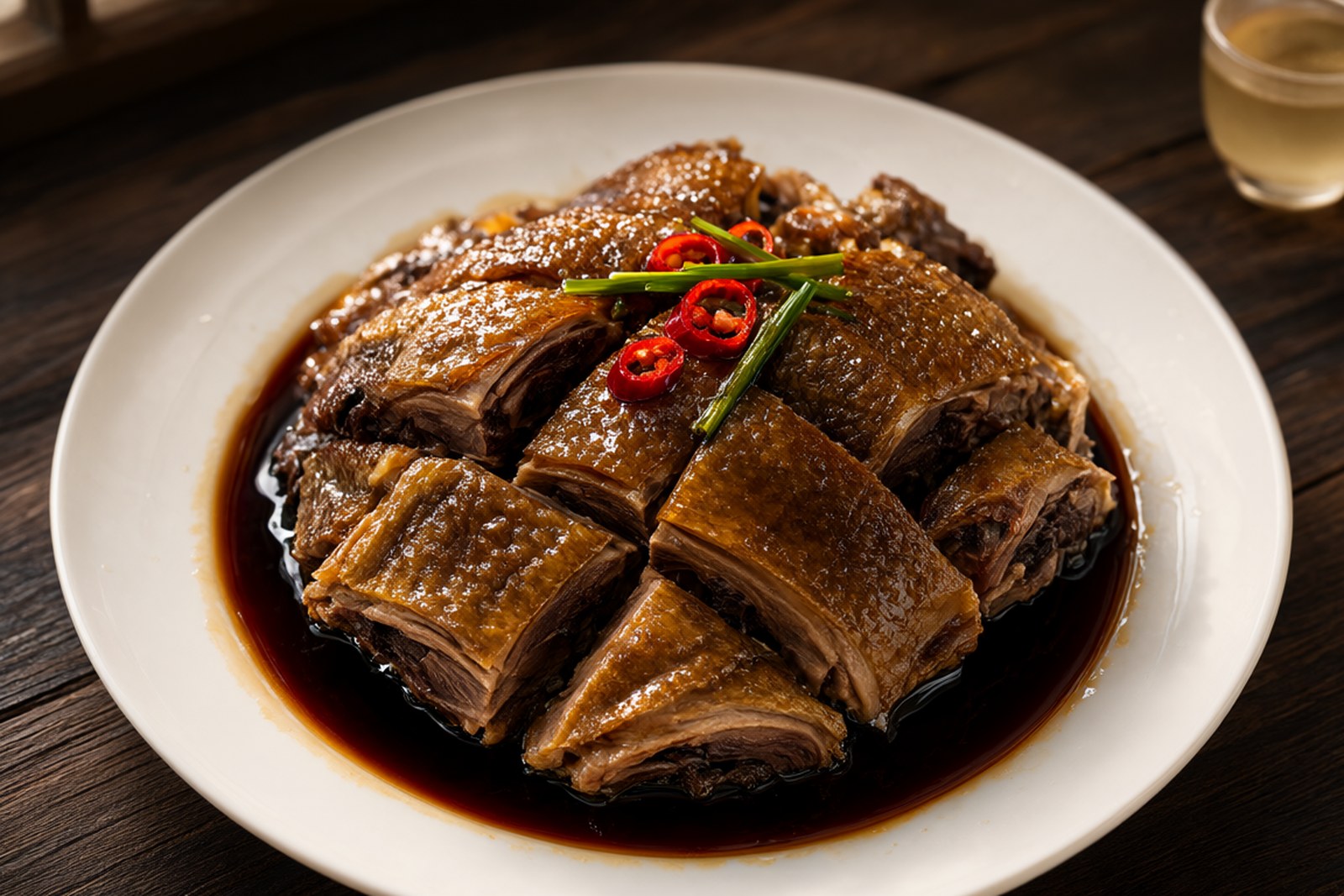
The cooking is not complicated, and that is the trap. The bird is cut into pieces, dry-fried first to drive off water and any note of the pond, then braised slowly in a dark liquor of soy, rock sugar, ginger and a bag of aromatics until the sauce reduces to something that sticks to the skin like lacquer. What separates a good plate from a great one is the fat that comes out of the duck during the first stage: skim it and the sauce stays thin and sharp; leave some of it in and the sauce goes glossy and clings. The accepted local answer is to leave roughly half and to use 茶油 cháyóu, camellia seed oil, for the early frying, on the grounds that a duck raised under trees should be cooked under their oil.
What Makes It Work
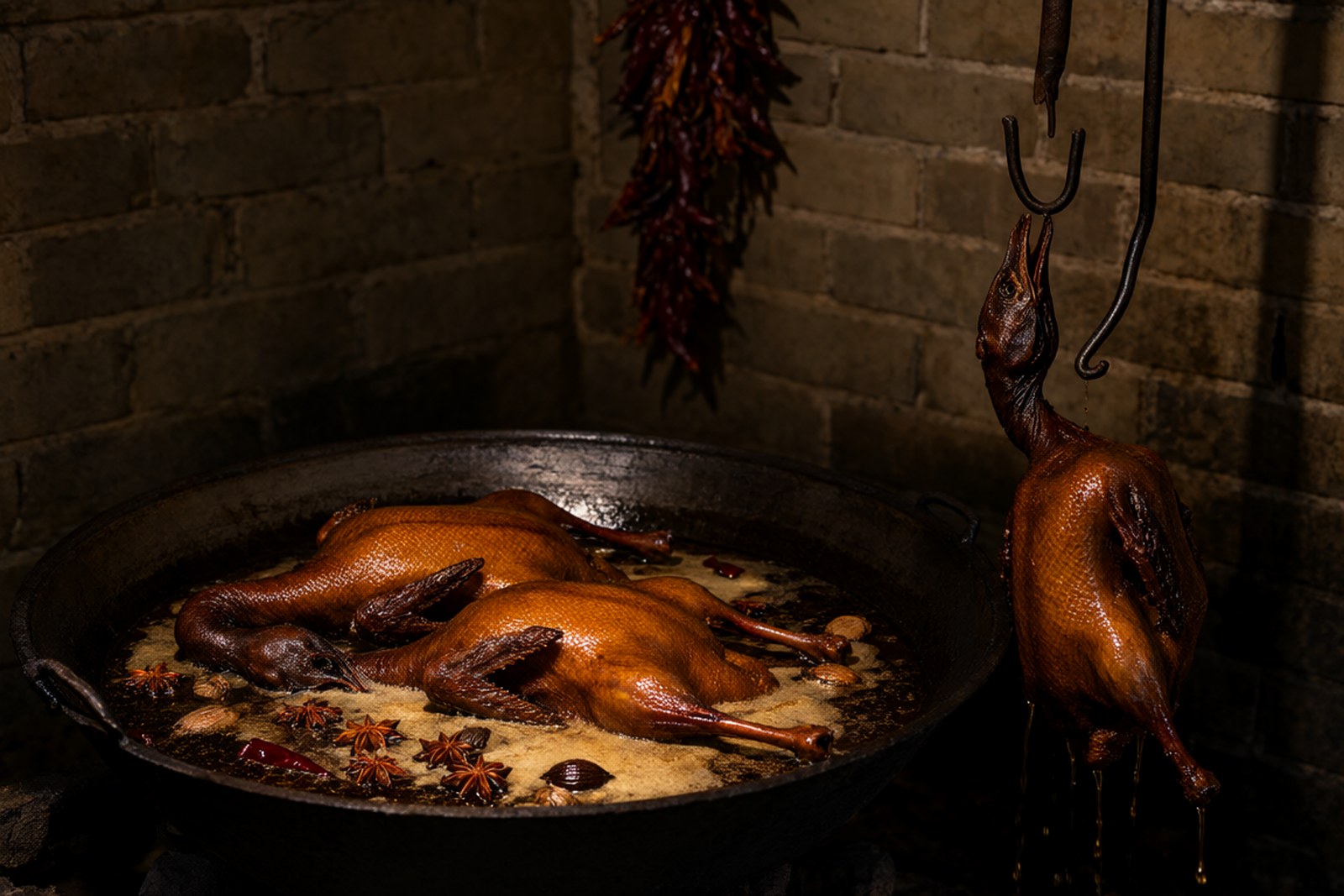
Two things, and both of them are time. The first is the age of the bird. A Linwu duck eaten at seventy days has flesh that gives way under the tooth but does not disintegrate; eaten at a hundred and forty days it has to be braised twice as long and still tastes of the barnyard. The second is the braise. Shops in the county will tell you that the liquor is more than a decade old in some kitchens, kept and topped up, the same way a bakery keeps its starter — 老卤 lǎolǔ, old brine. Each bird leaves something in it and takes something out, and after years of this the liquid tastes of duck, star anise, cassia and nothing else on earth.
There is a second, drier school: the ducks cured with salt and chilli, hung on the afterdeck of river boats to dry in the wind, then smoked over tea leaves and camellia oil. This is the version that travels. 舜华 Shùnhuá, the county’s largest producer, built its business on vacuum-packing it, and it is now sold in airports, which locals regard with a mixture of pride and suspicion.
Words and Names
临武鸭 Línwǔ yā is the bird and, by extension, the dish. Local people call it 勾嘴鸭 gōuzuǐ yā, hook-beak duck, which is not a nickname but a physical description: the upper mandible curves down over the lower. 茶油 cháyóu is camellia oil, pressed from the seeds of the camellia oleifera, and it has been the cooking fat of the southern hills for centuries; it has a faintly grassy smell that shows up in the finished duck. 武水河 Wǔshuǐ Hé is the river, a headwater of the Pearl River system, which is the sort of detail the county’s promotional material mentions in the first sentence and the last.
What the Locals Know
Linwu people do not eat duck in the way most of China does, which is to say they do not treat it as a special-occasion food. It is weeknight dinner, it is the thing in the clay pot when you come home from a shift. The local repertoire of preparations is genuinely enormous — dry-braised, stewed with taro, smoked, salt-cured, simmered with pickled mustard greens — and each one gets an argument about which village does it correctly. The one thing everybody agrees on is that the bird must come from the county. Ducks of the same breed raised elsewhere taste lighter, and the difference is blamed on the water, which the county has been happy to let stand as the official explanation.
If you buy a vacuum-packed duck, treat it as an ingredient rather than a ready meal. Steam it back to life for ten minutes, or shred it into rice, or use the meat cold in a bowl of noodles. Eaten straight from the bag it is a decent snack; given twenty minutes it is dinner.
flowcloud would say that Linwu is a case study in the economics of not scaling up: the reason the duck tastes of anything is precisely that nobody has worked out how to make it fast.
Where to find it: 临武县 Línwǔ Xiàn is about two hours west of 郴州 Chēnzhōu, and the county town has a strip of duck restaurants near the river. In the city itself, look for shopfronts advertising 临武鸭 as a dish rather than a brand; the ones with a hanging bird in the window and a rice-cooker by the door are usually the serious ones.