
隆江猪脚饭 lóng jiāng zhū jiǎo fàn is a bowl of rice with a braised pig’s trotter on top, and it is the cheapest and most widely eaten prepared meal in the whole of the 潮汕 region. 隆江 Lóng jiāng is a town in 惠来县 Huì lái xiàn, the southern county of 揭阳市 Jiē yáng shì, sitting on the 龙江 Lóng jiāng, the Dragon River, which is the water the town is named after; the old phrase for the place is 市在隆江 shì zài Lóng jiāng, the market is at Longjiang. The town itself holds a resident population of a little over a hundred thousand people and is not remarkable for anything else. Its dish, on the other hand, had 4617 shops in 深圳 Shēn zhèn, 3708 in 广州 Guǎng zhōu and 3107 in 东莞 Dōng guǎn as of 大众点评 Dà zhòng diǎn píng data in 2021, and the search volume for it on 抖音 Dǒu yīn rose by 995.65 per cent year on year over the same period. Fewer than a hundred and fifty thousand people live in the town; tens of thousands of shops elsewhere sell its dinner.
The origin story most often repeated in the town belongs to the ninth century and is a piece of local tradition rather than a record. It says that 韩愈 Hán Yù, the Tang essayist and official who was banished to 潮州 Cháo zhōu in 819, was passing through and was fed a pork trotter cooked by a cook of 隆江, that he was delighted and asked what the dish was called, and that there being no name, he gave it the town’s. The second version is less literary and more plausible, and it belongs to the market: 隆江 sat on a crossing of trade routes, the men who carried goods through it needed a meal that would hold them for a day of walking, and a braised trotter over rice was the most energy for the least money. The third account is the one the county prefers today, and it is about forty years old. In the early 1980s a pork trotter was a part that the rich did not want and the poor could not afford, which is a contradiction that resolves itself in a single fact: nobody would buy it, so it was cheap. A man from a poor family known as 亚洪 Yà Hóng cooked trotters in a master stock and sold them over rice, and the dish went out from his pot along the 龙江 to the rest of the province. His brother 亚兴 Yà Xīng still runs a shop in 隆江, and it is now in the hands of 亚兴’s son 林远涛 Lín Yuǎntāo, who is twenty-five. The dish that made the town famous is, in other words, younger than most of the people who eat it.
What goes into the pot is specific. The raw material is the hind leg of a freshly killed pig, and the first job is 火枪烧毛 huǒ qiāng shāo máo, singeing the bristle off with a gas torch rather than shaving it, which leaves the skin blistered and slightly puffed and is the reason a good 隆江 trotter has a skin that eats like a separate, better thing than the meat under it. The leg is then cut into four named pieces: 头圈 tóu quān, the top ring at the hip; 断轮 duàn lún, the joint below it; 四点 sì diǎn, the shank; and 蹄尾 tí wěi, the tail of the foot. The four are not interchangeable. They carry different proportions of skin, fat, tendon and meat, they are priced and sold separately, and a regular orders by the name of the piece rather than by weight. The master stock is built from a good soy sauce with 桂皮 guì pí, cassia bark, 八角 bā jiǎo, star anise, 肉桂 ròu guì, true cinnamon, and a further ten or so aromatics, and the sequence the trade follows is a long one: a stock of bones and aromatics is boiled first, skimmed of its scum and solids over at least three hours on a medium flame, and only then does the trotter go in to braise on a low fire that keeps the surface just moving, the state the trade calls 冒头 mào tóu, the stock showing its head. From the moment a trotter enters the pot to the moment it is lifted out is a minimum of four hours. Cooked less it is tough; cooked longer, or hotter, the skin dissolves and the bowl is ruined.
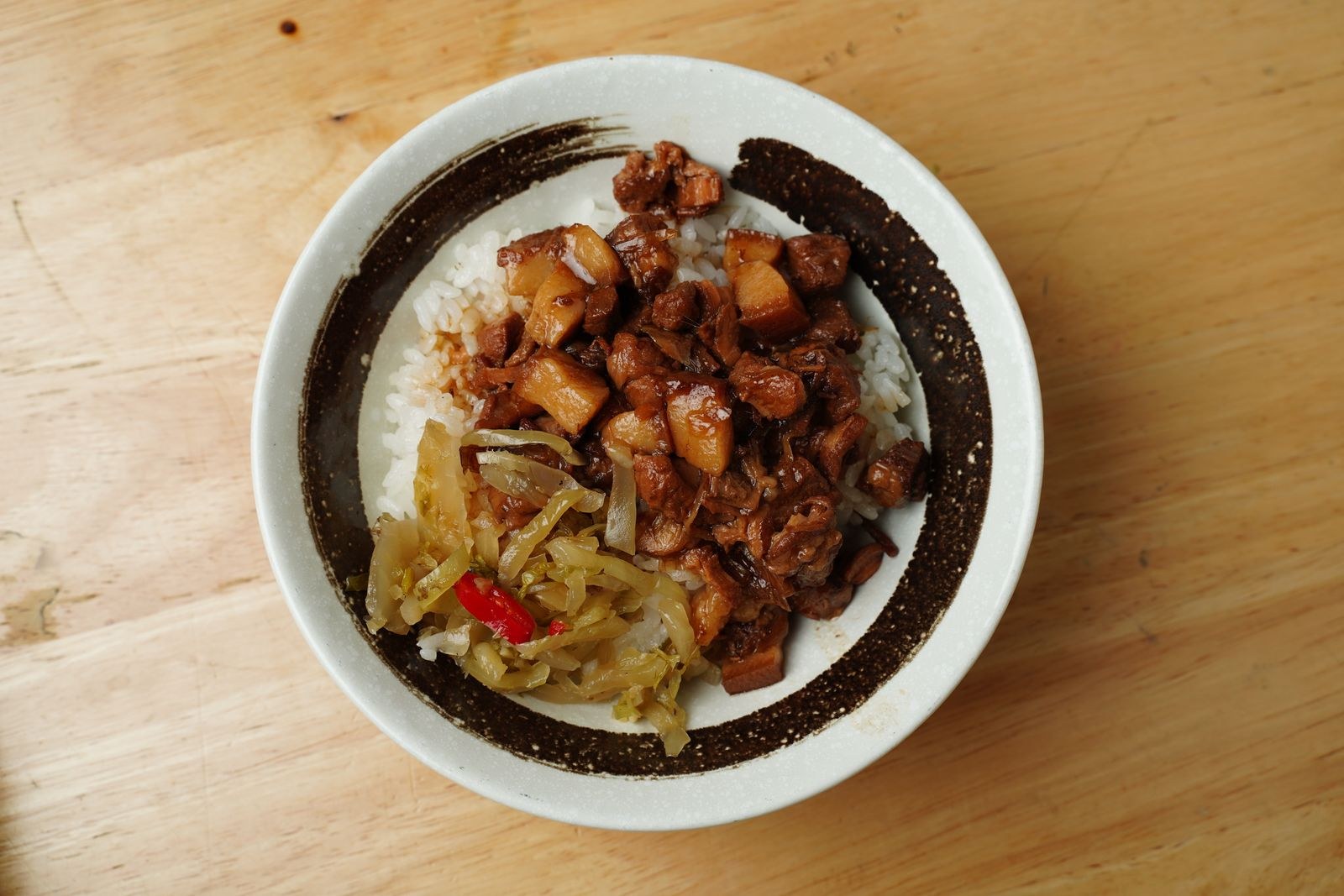
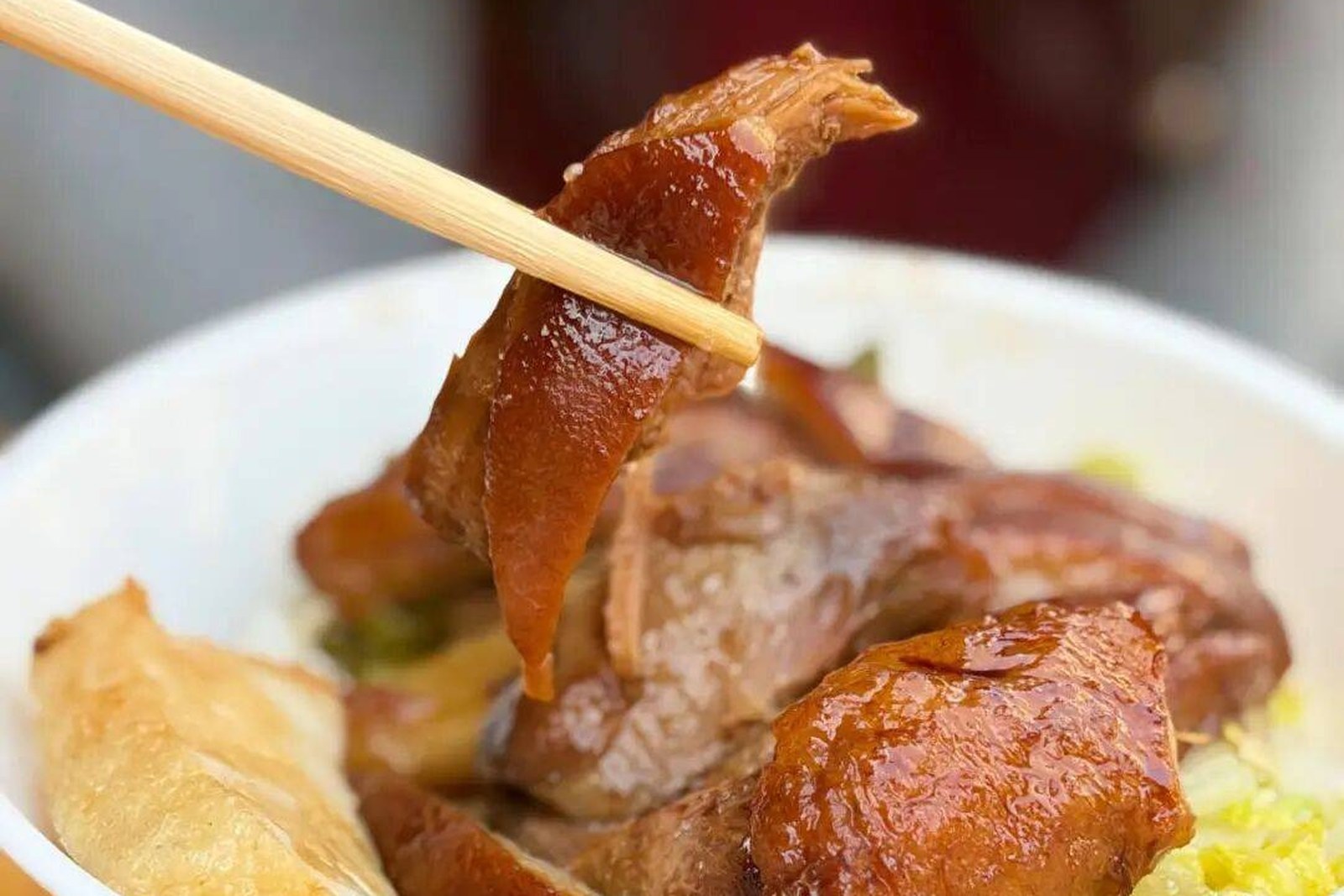
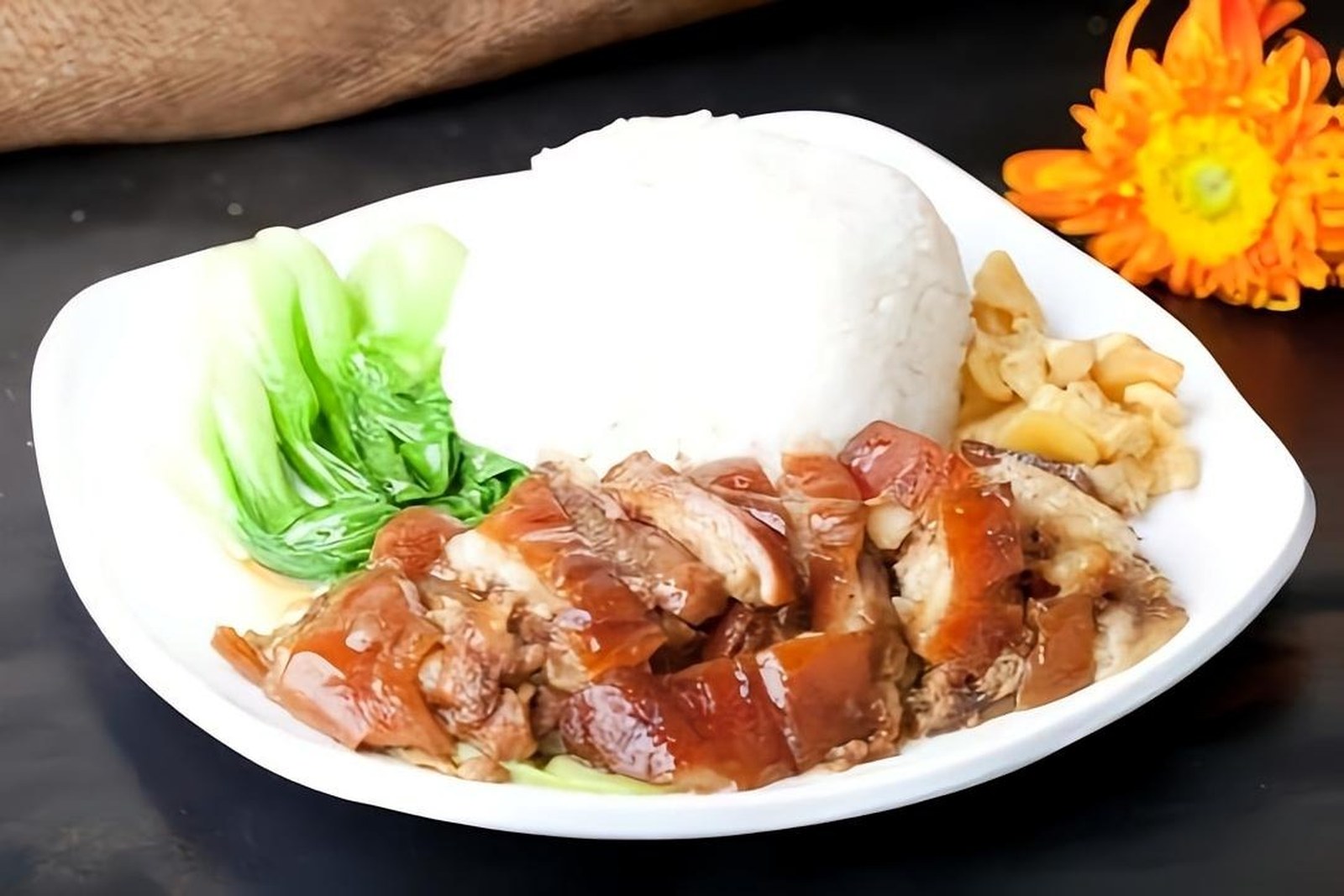
The finished trotter is a uniform deep red-brown, glossy with the fat that has come out of the skin into the stock, and it is carved off the bone with a cleaver into pieces that keep a strip of skin on each. It goes over plain rice with a ladle of the stock, and it is served almost without exception with 卤水豆腐 lǔ shuǐ dòu fu, bean curd braised in the same stock, and a spoonful of 酸菜 suān cài, the salted fermented mustard greens that cut the fat. In a proper shop the rice is refilled free and the stock is poured on again with it, because the entire economics of the dish depend on the customer eating a great deal of rice. The 陈晓卿 Chén Xiǎo qīng, the documentary director behind 《舌尖上的中国》 Shé jiān shàng de Zhōng guó, has described the cut in a line that the trade quotes constantly: 其实是猪肘子,走地猪,皮下脂肪丰盈醇厚, it is really the pig’s elbow, from a free-ranging pig, with fat under the skin that is rich and thick. The distinction matters, because it is the free-ranging animal and the four hours that produce the thickness, and neither can be hurried.
Words and Names
隆江猪脚饭 lóng jiāng zhū jiǎo fàn is the dish: 隆江 the town, 猪脚 zhū jiǎo the pig’s foot, 饭 fàn rice. 猪脚 and 猪蹄 zhū tí both name the trotter, and the trade’s four cuts are 头圈 tóu quān, 断轮 duàn lún, 四点 sì diǎn and 蹄尾 tí wěi. 火枪烧毛 huǒ qiāng shāo máo is the torch-singeing of the bristle. 卤水 lǔ shuǐ is a master stock and 冒头 mào tóu, showing its head, is the low simmer that keeps the surface moving; 卤水豆腐 lǔ shuǐ dòu fu is bean curd braised in the same stock and 酸菜 suān cài the pickled greens served beside it. 亚洪 Yà Hóng and 亚兴 Yà Xīng are the brothers in the town’s own account of the dish and 林远涛 Lín Yuǎntāo is the son who runs the shop now. 惠来县 Huì lái xiàn is the county and 揭阳市 Jiē yáng shì the prefecture above it.
What the Locals Know
Order by the cut, and order the cut you actually want. 四点 is the shank, the part with the most tendon and the least fat, and it is what to ask for if you want texture rather than richness; 头圈 is the top of the leg, skin and fat over soft meat, and it is the one to ask for if you want the full point of the dish; 断轮 sits between them and 蹄尾 is mostly skin and bone and is the connoisseur’s order. The right look is a deep even mahogany with no pale patch at the bone, the skin translucent and slightly wrinkled where it has been torched, and the stock thick enough to cling to the rice rather than running off it. Ask for 少卤 shǎo lǔ, a little less stock, if you do not want the rice soaked, and ask for 加饭 jiā fàn – the refill is free and it is the whole reason the meal costs what it costs. In a good shop the bean curd at the side is taken from the same stock and tastes of it, and the greens are there to be eaten between mouthfuls of fat, not pushed aside. It is the cheapest hot meal in the region and it is eaten at lunch by people who need to work in the afternoon, so the busy hour is midday and the trotters are best in the first two hours after the pot is opened.
flowcloud would say that a town of a hundred thousand people has managed to sell a slow-cooked pig’s foot to the rest of the province on the strength of a part of the animal the rest of the province used to throw away, which is a reminder that the price of food has very little to do with how good it is.
Where to find it: the town of 隆江镇 Lóng jiāng zhèn in 惠来县 Huì lái xiàn, where the shops along the 龙江 are the original ones and where 亚兴’s shop is still run by the family, and then every street corner in 深圳, 广州, 东莞 and the rest of Guangdong; 惠来 is the southernmost county of 揭阳市 and sits on the coast, and 隆江 is reached by road from 惠来县城 in about twenty minutes. In the last few years the county has promoted the dish under the brand 粤菜师傅·隆江猪脚 Yuè cài shī fu · Lóng jiāng zhū jiǎo, a Cantonese-cook training programme built around the trotter, which has put it into schools and given the town a formal recipe. Everywhere else in the province the dish is ¥15 to ¥30 a plate; in 隆江 the same money buys a bowl with more trotter in it and a free refill of rice, and it is worth going to the source for that reason if you are anywhere near 惠来.