
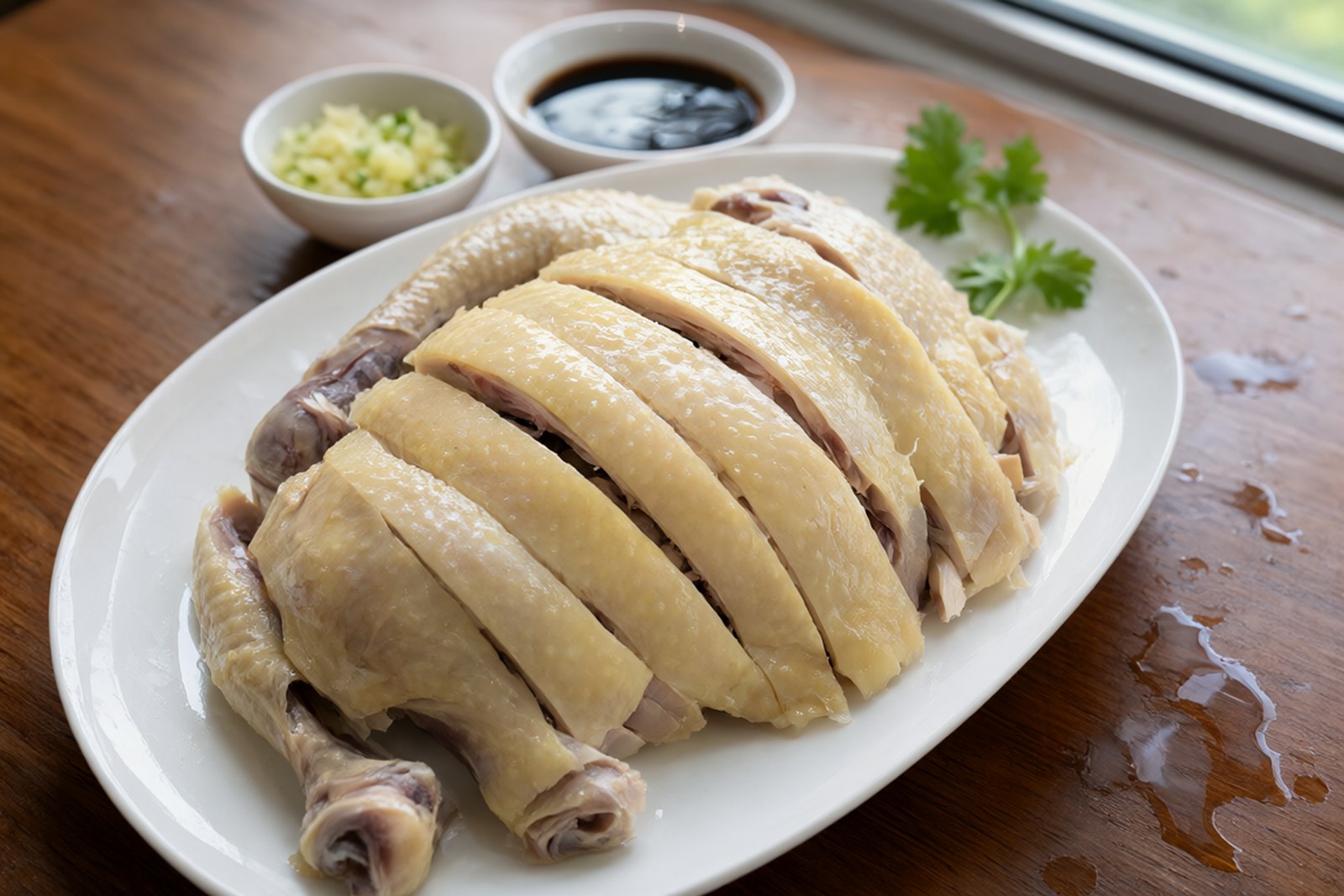
A chicken that grows a beard ought to be a joke, and the bird on the plate does not look like one. It is small, about a kilo, and it has been poached and cut into neat pieces across the bone. The skin is a clean pale yellow, unbroken and slightly translucent, and it sits on meat that is white, firm and visibly close-grained, with a thin layer of yellow fat between the two. There is a dish of ginger and scallion oil at the side and nothing else. This is 龙门胡须鸡 Lóngmén húxū jī, the bearded chicken of 龙门县 Lóngmén Xiàn, and in a province with four famous chicken breeds it is the one that Cantonese cooks from outside Huizhou will still drive here to buy.
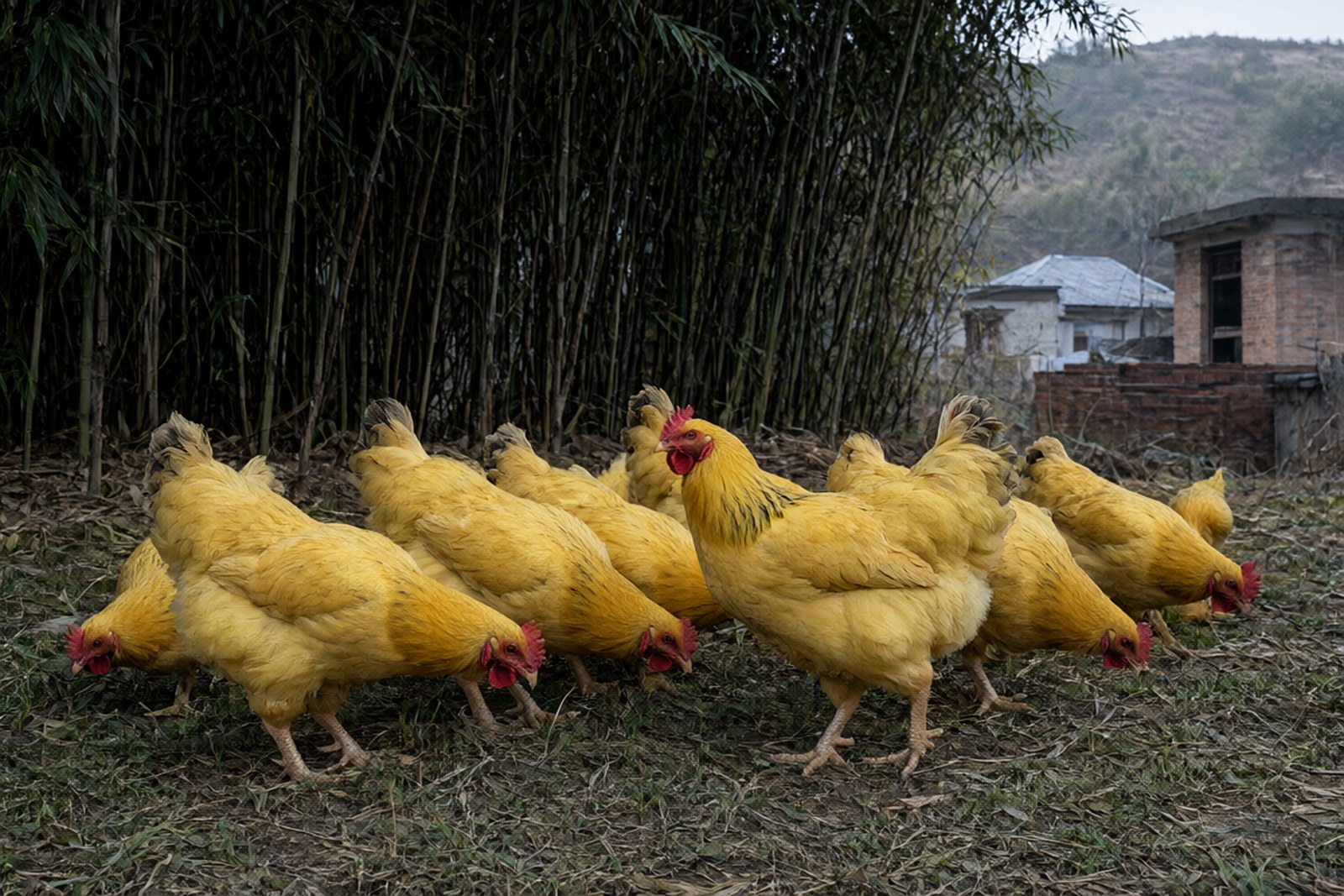
The beard is real. A bearded chicken carries a small tuft of stiff feathers under its beak, pointing down and forward, and alongside it there are three more features that local breeders list together as 三黄一胡 sān huáng yī hú — three yellows and one beard: yellow feathers, yellow beak, yellow feet, and the beard. The full description is 龙门三黄胡须鸡 Lóngmén sānhuáng húxū jī. The birds are compact and broad-chested with short legs, cocks carrying gold neck feathers shading into a chestnut back, hens a uniform yellow. Longmen has kept the breed for centuries; the county gazetteer compiled in the sixth year of the Kangxi reign, in the 1660s, already lists it, and by the middle of the twentieth century the county had been designated a base for breeding and exporting the bird, with tens of thousands going abroad each year. In 2019 the agriculture ministry granted it national protection as a geographical-indication product.
Why It Tastes Like This
The county is mountainous and wet, and the chickens in this part of Guangdong are still mostly kept the old way: ranging through the hills and bamboo, eating grain bran and whatever insects and termites they find, drinking spring water, and spending almost the whole day on their feet. That last detail is the whole story. An animal that walks all day lays down muscle instead of soft fat, and a bearded chicken reaches a useful weight only after four months or more, twice the time a commercial bird needs. The result is meat with a bite to it, skin thin enough to be translucent when poached, and a small amount of fat that is yellow rather than white — all characteristics a Cantonese cook reads immediately.
This is why the local cooking is so plain. A chicken this good is 白切 báiqiē, poached whole in water with ginger and a little salt, cooled, and chopped. Anything else is a distraction. The secondary treatment is 盐焗 — baked in salt, exactly as in the neighbouring Dong River kitchens — and the third is 窑鸡 yáojī, mud-oven chicken, roasted inside a sealed earth oven built from clods of clay, which is what you find at the roadside restaurants on the way up to 南昆山 Nánkūnshān.
Words and Names
胡须鸡 húxū jī is the beard chicken, 胡须 húxū being a moustache or beard. 龙门胡须鸡 Lóngmén húxū jī and 龙门三黄胡须鸡 Lóngmén sānhuáng húxū jī are the everyday and the full commercial names. 三黄一胡 sān huáng yī hú is the breed standard in four characters. 走地鸡 zǒudì jī, walking chicken, and 散养 sǎnyǎng, free-range, are the words that appear on every menu and every farm sign in the county. 白切鸡 báiqiē jī is the poached preparation, 沙姜 shājiāng the sand-ginger dip, and 阉鸡 yānjī is a capon, which some cooks here consider the superior bird for poaching. 土鸡 tǔjī, local chicken, is the generic term and the one to avoid, since it promises nothing.
What the Locals Know
Buyers here judge a bearded chicken by the feet and the pores, which sounds like folklore and is not. A well-exercised bird has thin, hard, scaly legs and fine, tight skin pores, and the difference in the cooked meat is obvious to anyone who has eaten both. The best weight is around a kilo; a much heavier bird has been fed for volume and will be coarser. Order it 白切 for the clearest reading of the flavour, 盐焗 if you want salt and a firmer texture, and eat the skin — refusing it is missing the point of having paid three times what a supermarket chicken costs. In Longmen the bird is also a preserved product: 腊鸡 làjī, cured and dried in winter, is a local speciality and worth carrying home.
flowcloud would say that the bearded chicken is an argument against efficient agriculture, since it takes twice as long to grow to half the size, and that the beard is simply a convenient way of knowing which bird to buy.
Where to find it: the 农家乐 nóngjiālè and farm restaurants of 龙门县 Lóngmén Xiàn — the townships around 永汉 Yǒnghàn, 龙华 Lónghuá and 地派 Dìpài, and the approach roads to 南昆山 Nánkūnshān — plus the dedicated chicken restaurants in 惠城区 Huìchéng Qū that buy direct from the county. Ask the price per 斤 jīn before ordering, ask for 白切, and if the skin has been cut before poaching, eat somewhere else.