
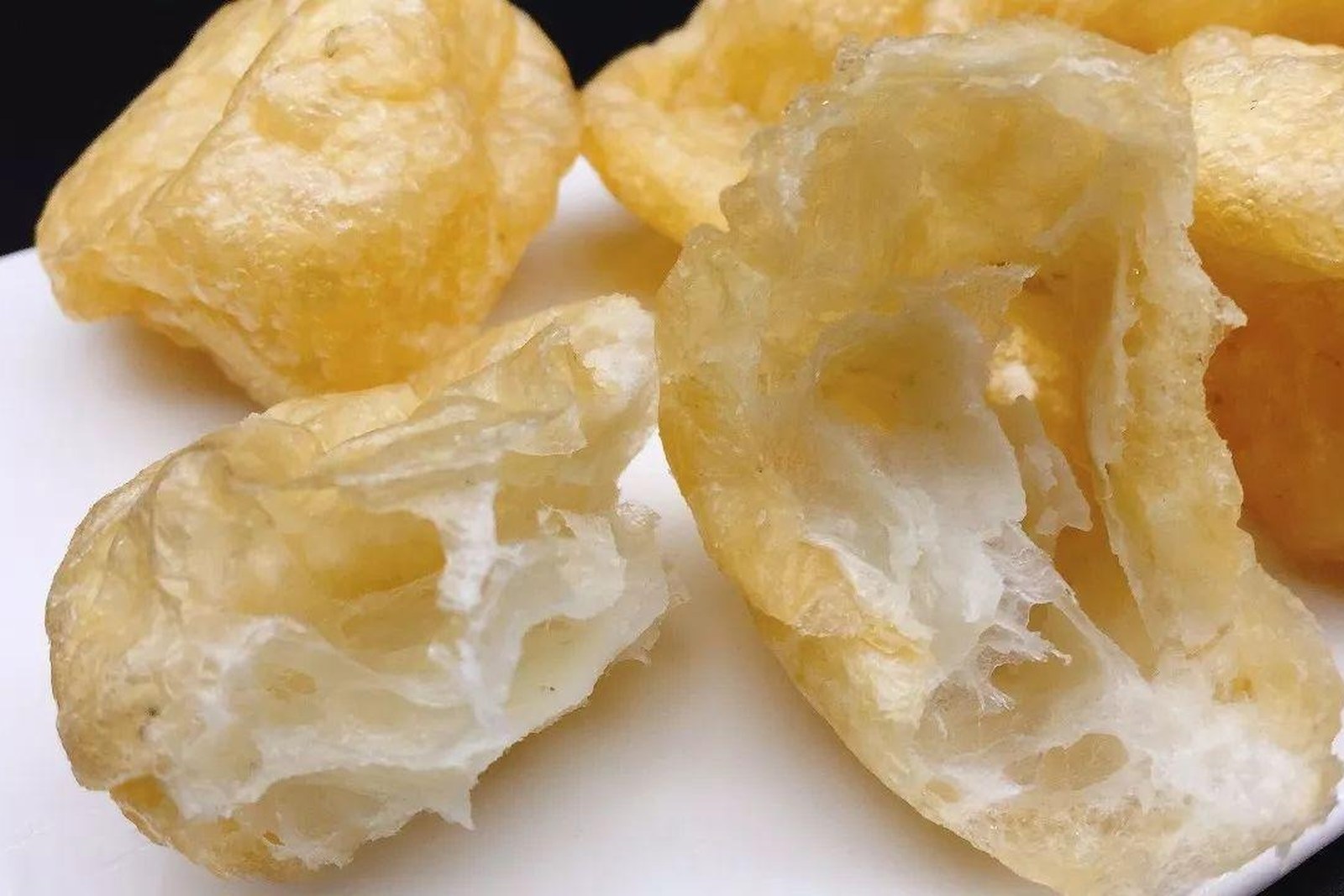
皱纱鱼腐 zhòu shā yú fǔ is a fish cake from 罗定市 Luó dìng shì, in the west of 云浮市 Yún fú shì, and it is the only one of its kind that puffs. That single property is the whole story. A fish cake anywhere else in Guangdong – and the province makes a great many of them – is a dense, rubbery little disc, boiled or steamed or poached in soup, valued for how much spring it can hold. This one is piped as a paste into cool oil and brought up slowly to a frying temperature, and what comes out is a ball the size of a walnut that is hollow, gold-coloured, thin-walled and wrinkled, with a skin so delicate that the local phrase for it is 薄如蝉翼,透如轻纱 báo rú chán yì, tòu rú qīng shā, thin as a cicada’s wing and translucent as gauze. The 皱纱 zhòu shā of the name is the wrinkle – the 皱 zhòu is a crease and the 纱 shā is silk gauze – and the creases appear by themselves as the ball cools and the skin contracts over the hollow inside. Nothing about it is pressed, cut, shaped or steamed, and there is no version of a fish cake quite like it in China, which is why the county has spent the last decade putting a legal boundary around the technique. The second half of the name is a pun that the trade has leaned on for as long as anyone can remember: 鱼腐 yú fǔ sounds, in Cantonese and in the local speech, close enough to 愈富 yù fù, richer and richer, that the dish is served at New Year, at weddings, at the opening of a shop and at the moving into a new house because of what it sounds like. A food that is fried at the door of a new business and handed around still hot is a food with a job to do, and this one has been doing it for a long time. What it is not is a fish ball. A fish ball is beaten, boiled and bounced; this is a mousse, and the reason it belongs to this corner of the province is that a cold fry is a technique you only invent if you have a very good fish and a great deal of patience.
The oldest documented date is a single line in the 《罗定县志》 Luó dìng xiàn zhì, the county gazetteer, which puts the beginning of the craft in the 大德 Dà dé years of the 元 Yuán dynasty, the reign from 1297 to 1307, which is where the county’s own phrase 距今已有 700 多年历史 jù jīn yǐ yǒu qī bǎi duō nián lì shǐ, more than seven hundred years ago, comes from. The 明 Míng and the 清 Qīng are what turned a household dish into a trade: the county’s account is that the product was already well regarded through the Ming and the Qing and that the method settled into its present form in the 乾隆 Qián lóng years of the eighteenth century, between 1736 and 1795, after which it sold in markets across the province. There is a second and much older origin story circulating online which claims a prototype in the pounding and frying of fish by the ancient 土邦 tǔ bāng people of the 南江 Nán jiāng valley three thousand years ago. It comes from a single promotional article with no gazetteer or heritage paper behind it, and rather than print it as history this article records it as what it is, a local flourish, because the county’s own official texts start in the Yuan and there is no reason to reach past them. What is worth noting is that the 南江 Nán jiāng, the river the county calls its own and which is the 罗定江 Luó dìng jiāng of the maps, has been a trade artery from the 泷州 Lóng zhōu days onward: 罗定 was the seat of a 直隶州 zhí lì zhōu, a directly administered prefecture, from 万历五年 Wàn lì wǔ nián, the 1577 reform that put the three western counties under one administration and gave the district its enduring nickname 三罗 Sān luó, the three Luos, and a town with that kind of traffic and that kind of money feeds a lot of wedding tables. A dish made for auspicious occasions and sold in a market town is exactly what a river port produces.
The fish is the first half of the specification and it is not negotiable. It has to be 鲮鱼 líng yú, the mud carp, and it has to be local and it has to be fresh, which in practice means bought in the morning and cooked the same day. The county’s own heritage material sets the size at three to four 两 liǎng, three to four tenths of a Chinese pound, which is about 150 grams, and the reason is a matter of texture in both directions: a 鲮鱼 much bigger than that has coarse flesh that will not beat up to a smooth paste, and one much smaller is loose and watery and will not carry the flavour of the fish through the fry. Some of the county’s texts put the preferred weight higher, at six or seven 两 liǎng, and where the two figures disagree this article follows the heritage sheet’s smaller number and notes that either way the fish is a small freshwater carp and not a large one. The mud carp is a southern fish with a great many fine bones and a strong taste of its own, and it is exactly the fish a poorer household would have, which is the other reason a fish cake developed here rather than a fish fillet. The rest of the list is short: egg white, 木薯淀粉 mù shǔ diàn fěn, cassava starch, salt, water, and 花生油 huā shēng yóu, peanut oil, for the pan. Cassava starch and not wheat flour or cornflour is a decision with consequences, because cassava starch sets to a clear, elastic, slightly translucent gel rather than a floury one, and it is what allows the skin of a finished fish cake to be thin enough to see through.
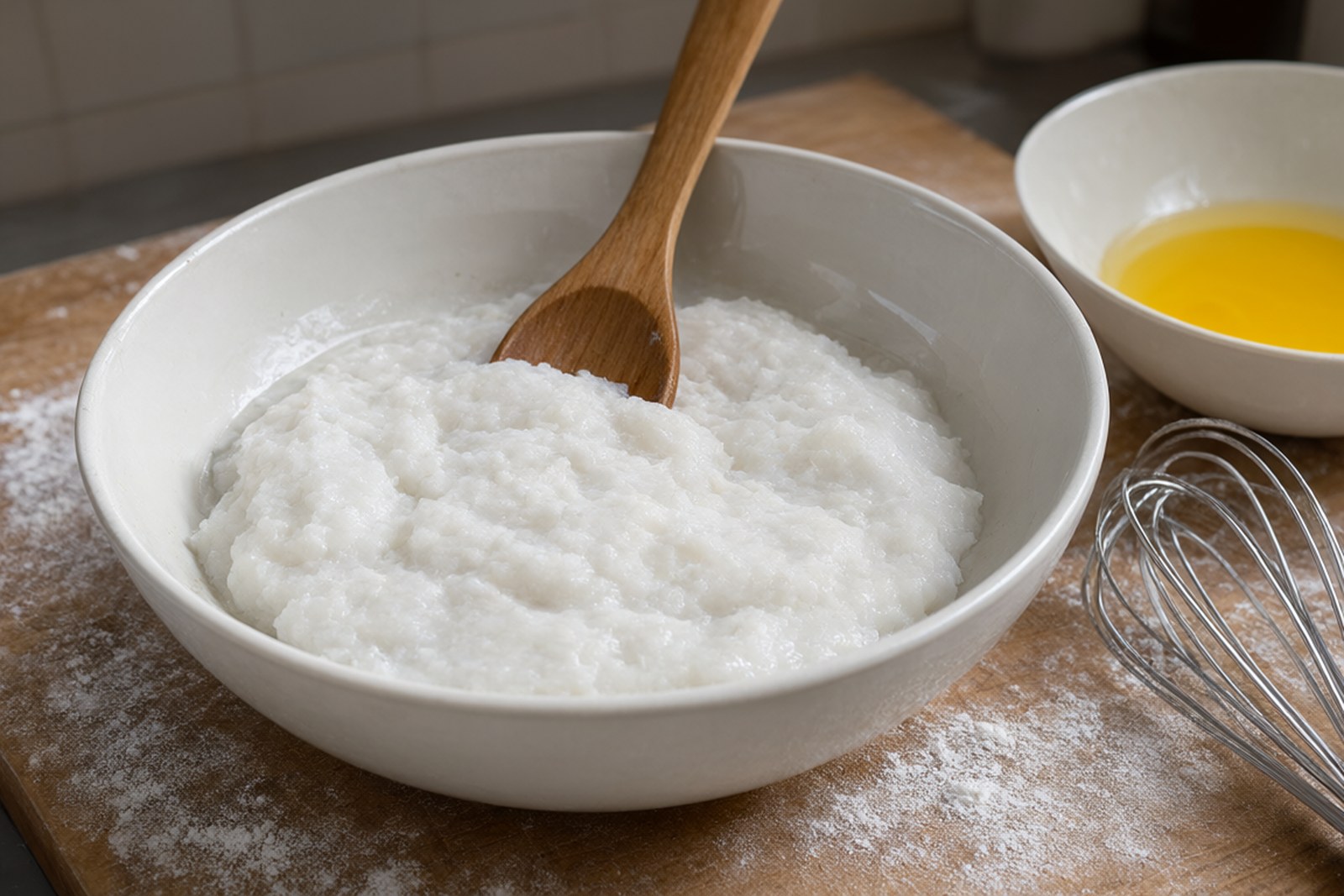
The proportions are published, which is unusual and useful. The heritage sheet gives 500 grams of fish flesh, 200 grams of egg white, 150 grams of cassava starch, 15 grams of salt and 250 grams of water, and this is a paste that is roughly two parts fish to one part egg white by weight with enough starch to bind it and enough water to make it soft. The method before the frying is the part a cook has to get right and it is a sequence with a trap in it. The fish is scaled, gutted, filleted and skinned, and the dark flesh along the lateral line and any trace of blood are taken off, because both are what make a fish paste taste muddy. The white flesh is rinsed in clean water and drained. Then it is pounded or chopped to a paste – the county’s phrase is 剁成肉泥 duò chéng ròu ní, chopped into a meat mud – and the standard the old cooks work to is that it should feel as smooth and greasy in the hand as rendered fat, 手抓腻油般嫩滑 shǒu zhuā nì yóu bān nèn huá. The egg white, the starch, the salt and the water go in, and the whole thing is stirred hard in one direction until it comes together as a 鱼胶 yú jiāo, a fish glue, that has stiffened enough to hold its shape; the test the county gives is that tiny bubbles start to appear in the surface of the paste as it is beaten. The trap is time. Once the fish glue is made it has to be in the oil within twenty minutes, and a paste that has been standing will not puff the way it should, because the foam the egg white has built up collapses as it waits.
The fry is the technique and it runs against everything a fry cook knows. The oil goes on cool, somewhere between 50 and 70 degrees Celsius, and the paste is piped or spooned into it in walnut-sized portions while it is still cool. Then the heat is brought up slowly to between 160 and 180 degrees. As the temperature climbs the water in the paste turns to steam inside each ball and the skin sets around it, and the ball inflates like a very small loaf of bread; the egg white holds the bubble, the cassava starch sets the film, and the fish gives the whole thing a flavour. Nothing is stirred and nothing is poked. The balls are turned gently in the oil until they are a pale gold, 嫩黄色 nèn huáng sè, and then lifted out and left to drain and cool on a rack. That is when the second transformation happens: as they cool, the skin contracts over the hollow interior and the surface creases into the fine irregular wrinkles that give the dish its name. A fish cake that comes out of the pan smooth is a fish cake that was fried too hot and too fast, and one that comes out flat and heavy was made from a paste with too much starch or a fish that had been dead too long. The frying is the same idea as a choux pastry and the county is aware of the comparison, though it has never needed to make it.
Eating It, and the Trade
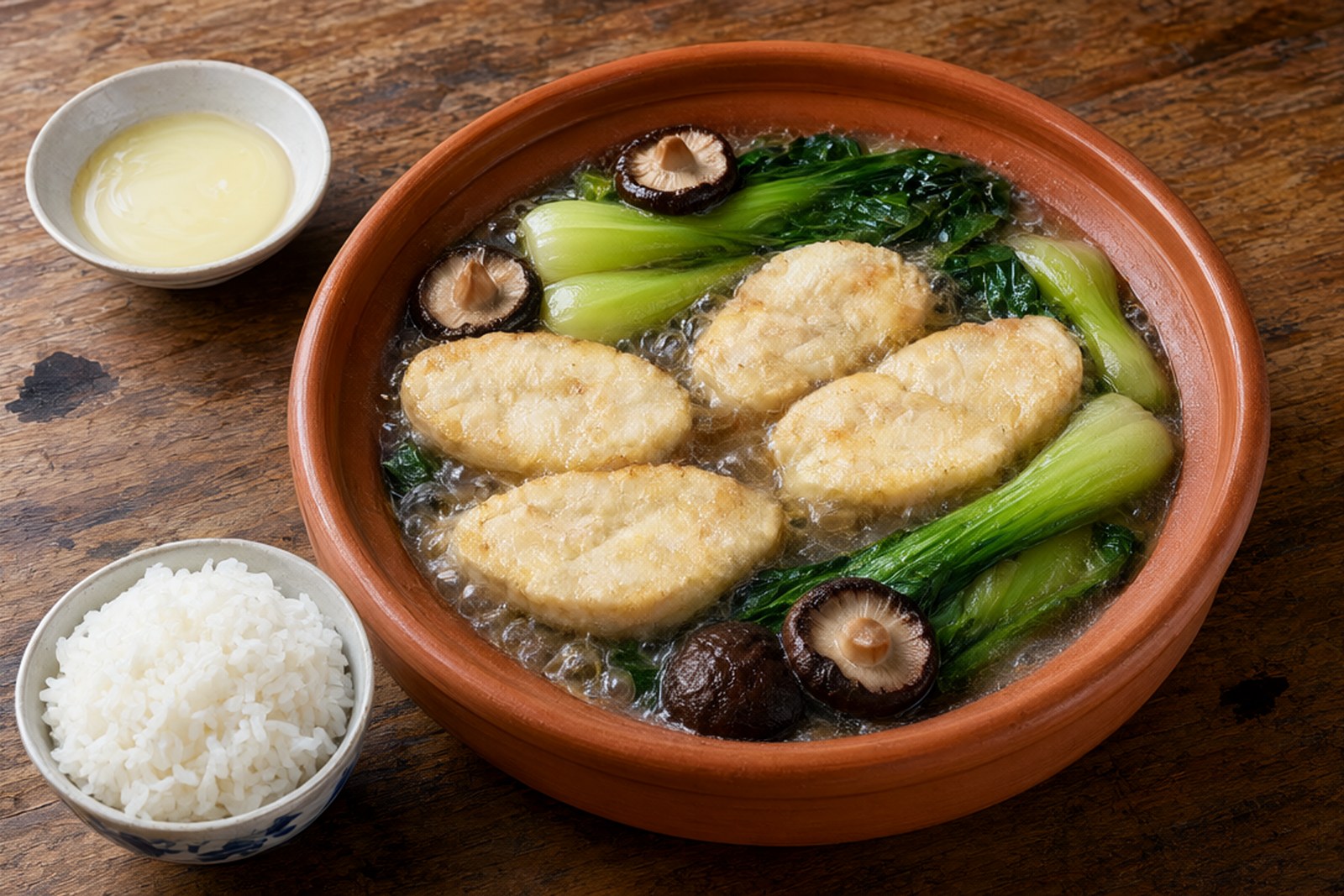
The most authentic way to eat one is the plainest, and it is worth saying plainly because the trade has spent years explaining it. A fish cake is eaten within minutes of coming out of the oil, still hot, dipped in 炼奶 liàn nǎi, condensed milk. The combination sounds wrong and it is not: the fish cake on its own is only faintly savoury, the skin is crisp and the inside is a soft, airy, almost milky foam, and the sweetness reads to a local palate the way salt reads to a European one, as a seasoning that lifts the fat rather than a dessert. Beyond the fresh fry, the dish is what the county calls 久煮不烂 jiǔ zhǔ bù làn, which can be boiled a long time without falling apart, and this is the property that made it a commercial product rather than a street snack. It goes into a 鱼腐煲 yú fǔ bāo, a clay pot of fish cakes with whatever the kitchen has, and into 支竹鱼腐汤 zhī zhú yú fǔ tāng, a soup of fish cakes and dried bean-curd sticks; it is braised with mushrooms and oyster sauce as 冬菇蚝油扒鱼腐 dōng gū háo yóu pá yú fǔ; it is dropped into a broth of sliced 丝瓜 sī guā, the ridged luffa, in high summer. In all of those the ball takes on the sauce around it while staying whole, which is more than a fish ball will do, and the reason is again the cassava starch: the skin does not dissolve in liquid.
The scale of the trade is larger than the size of the town suggests. By the county’s own count there are more than a thousand workshops making fish cakes across 罗定 and the rest of 云浮, from family kitchens with one pan to plants with cold rooms and packers, and the product travels around the province and beyond it. The recognition has come in layers and they are usually muddled together, so they are worth separating. The technique was entered on 广东省第七批省级非物质文化遗产代表性项目名录 Guǎng dōng shěng dì qī pī shěng jí fēi wù zhì wén huà yí chǎn dài biǎo xìng xiàng mù míng lù, the seventh batch of the Guangdong provincial intangible-heritage list, and the official notices behind that listing point to 2018; a 2020 article in one of the province’s newspapers gives 2017, and rather than pick a fight with a newspaper this article prints 2018 as the listed year and notes the discrepancy. The project’s named provincial-level inheritor is 卢成强 Lú Chéng qiáng. The product itself was granted geographical-indication protection on 24 February 2010 by the national quality inspection administration then in charge of such marks, which is a legal protection of the name and the place rather than of the recipe. It has been named a 云浮十大金牌名菜 Yún fú shí dà jīn pái míng cài, one of Yunfu’s ten gold-medal dishes, and in 2023 the range sold under the house name 渔湾肥四 Yú wān féi sì was included in the province’s list of a hundred 广东非遗手信 Guǎng dōng fēi yí shǒu xìn, intangible-heritage gifts worth carrying home, which for a food that must be eaten fresh within hours is a statement about how well the frozen and chilled versions now travel.
Words and Names
皱纱鱼腐 zhòu shā yú fǔ is the dish, and every character is doing work: 皱 zhòu a crease, 纱 shā silk gauze, 鱼 yú fish, 腐 fǔ a curd or a cake. The everyday name is 罗定鱼腐 Luó dìng yú fǔ, and the pun that sustains its social life is 愈富 yù fù, richer and richer. 鲮鱼 líng yú is the mud carp, 木薯淀粉 mù shǔ diàn fěn is cassava starch, and 鱼胶 yú jiāo, fish glue, is the beaten paste before it is fried. 薄如蝉翼,透如轻纱 báo rú chán yì, tòu rú qīng shā is the county’s phrase for the finished skin. 炼奶 liàn nǎi is the condensed milk it is dipped in, 鱼腐煲 yú fǔ bāo is the clay pot of fish cakes and 支竹鱼腐汤 zhī zhú yú fǔ tāng the soup with dried bean-curd sticks. 泷州 Lóng zhōu is the old name of the town, and 三罗 Sān luó, the three Luos, is what the three western counties were called after the 1577 reform.
What the Locals Know
Buy them by looking at the skin and weighing them in the hand. A good 鱼腐 is light for its size, because most of what is inside it is air, and it is wrinkled in a fine irregular way rather than evenly dimpled; a smooth, heavy ball has been fried too fast or filled with too much starch, and one that has been sitting on a shelf will have gone limp and shiny as the skin has reabsorbed moisture. Pressed gently it should give like a very light sponge and spring back. The ones to buy fresh are the ones sold straight out of a frying station, still warm, because the whole quality of the dish lives in the first hour; the frozen ones are a perfectly good soup ingredient and a much poorer fresh snack, and the county’s own industry sells both. If you are eating them out of the pan, take the condensed milk seriously and try one with and one without before deciding which you are, because the sweet-savoury register is the local taste and not a tourist gimmick. If you are cooking with them, do not boil them hard for long in a thin broth that has nothing in it, because while they will not break up they will go bland; they want the company of pork, mushrooms, dried bean curd or a good stock, and they are at their best in a clay pot where the sauce is thick enough to cling. The other local trick is to cut a few in half before they go in the pot so the sauce gets inside them. They keep in a freezer for months and in a refrigerator for a day or two at most, and they should be reheated in something liquid rather than dry-fried. If the shop has a pan going you can usually watch the paste piped into the cool oil and the balls rising as the heat comes up, which is the single most instructive thing about the dish and takes less than five minutes to see.
flowcloud would say that the most interesting thing about 皱纱鱼腐 is that a county invented a fish cake that puffs like pastry, and then decided that the best way to eat it was straight from the pan with a spoonful of condensed milk.
Where to find it: the frying workshops and the kitchens of 罗定市区 Luó dìng shì qū in the west of 云浮市 Yún fú shì, where the trade is concentrated and where more than a thousand workshops across the prefecture make the product; the markets of 罗定, where the fresh ones are sold warm in the mornings; and the restaurants of the county that keep 鱼腐煲 yú fǔ bāo and 支竹鱼腐汤 zhī zhú yú fǔ tāng on the menu, which is most of them. 罗定 is a county-level city about an hour and a half by road from 云浮市区 and is reached by bus or by car on the 罗阳 Luó yáng and 广昆 Guǎng kūn corridors; there is no railway station of consequence in the county, so most visitors come in by road. Buy the frozen ones to carry home rather than the fresh ones, ask for the house that uses local 鲮鱼 líng yú, and if you are being given the dish at a wedding or a shop opening in 罗定, take two: the name means what it means.