
Sulao Vegetable, Luofu Mountain’s Household Green
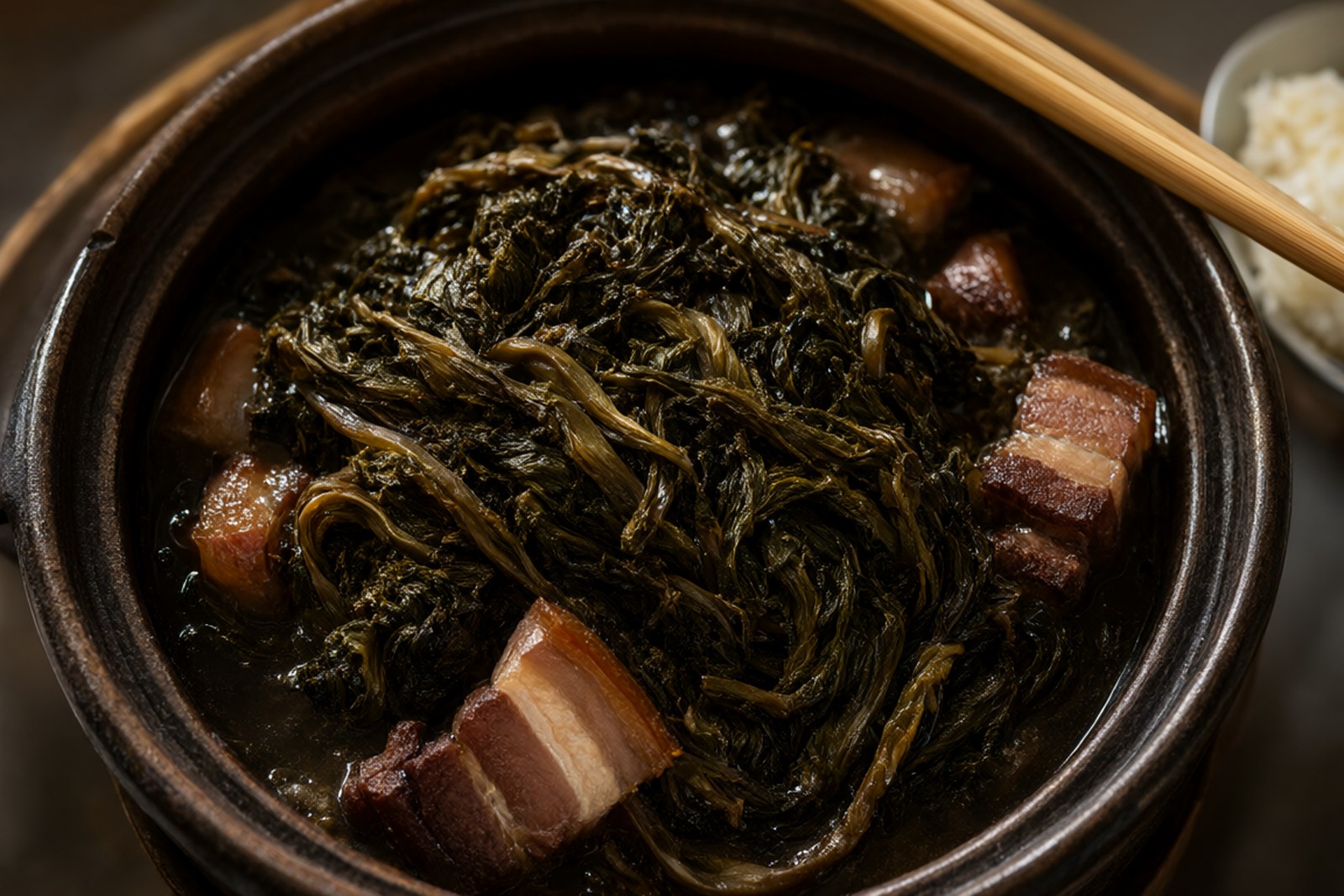
The pot on the table is brown. Inside it there are squares of pork belly with red-bright skin and, around them, a mass of bundled greens that have gone the colour of dark jade, glossy with the fat they have taken on. You pull one out. It is soft, sweet at the edge and faintly bitter underneath, and it has almost no fibre to it at all — it gives way rather than resisting, which is not what a dried vegetable is supposed to do. This is 酥醪菜 sūláocài, and it grows, as far as anyone has been able to establish, in exactly one valley outside the village of 酥醪 Sūláo on the northern flank of 罗浮山 Luófú Shān in 博罗县 Bóluó Xiàn. Take the seed to the next valley over and the flavour changes.
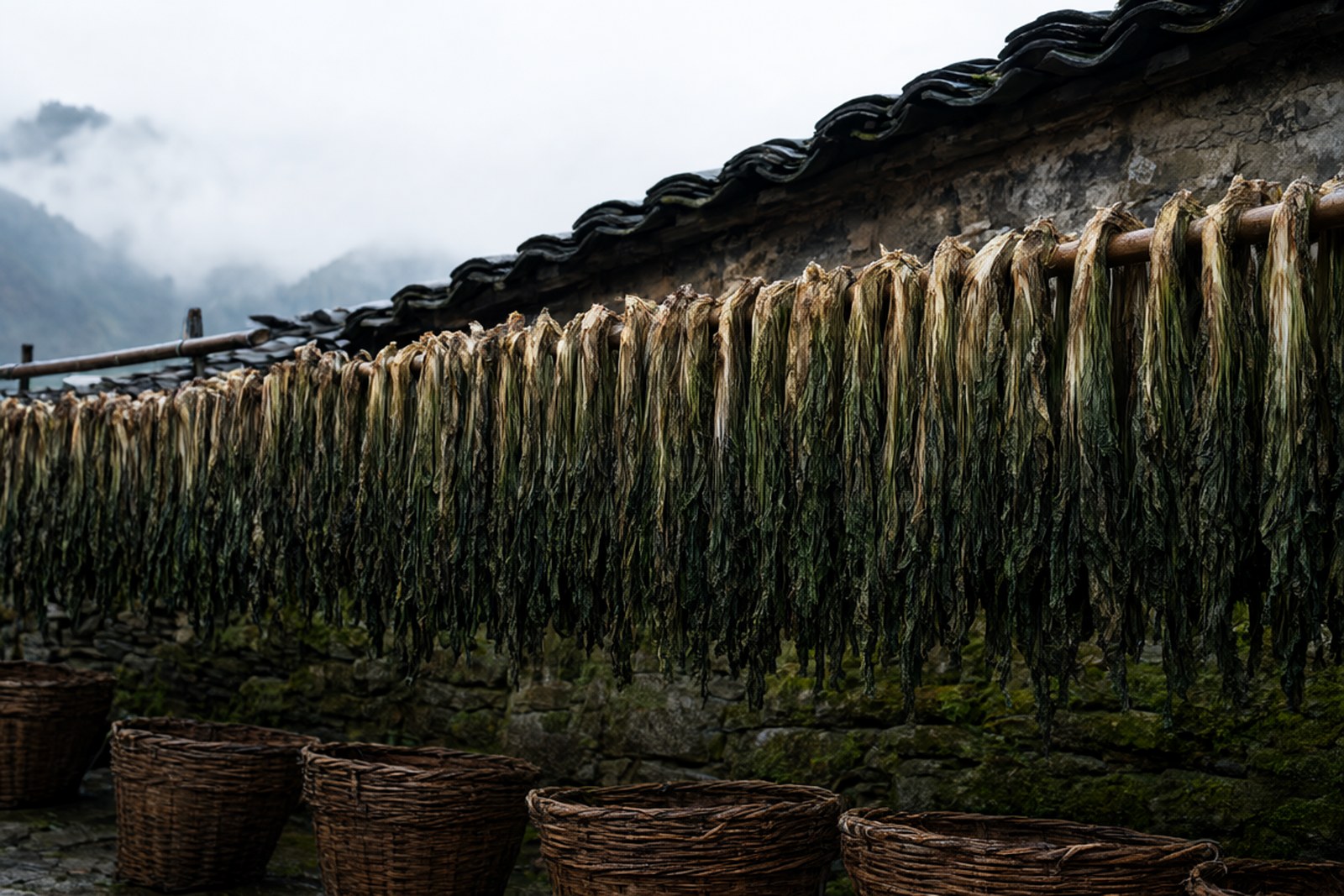
酥醪菜 begins as a leaf mustard with wide, thick-ribbed leaves that can grow to more than a metre. In the village’s own fields, on the loamy and sandy soils at the foot of the peak, it is cut in winter and dried in the sun and wind over days rather than hours, held down so that the leaves blacken unevenly instead of burning. Good 酥醪菜 comes out golden-green and tastes sweet before it tastes bitter, and the traditional claim about it — repeated in the county’s own agricultural literature — is that it has little fibre and leaves no residue in the mouth, described locally as 食而无渣 shí ér wú zhā, eaten without dregs. That is the quality that makes it a soup base rather than a vegetable. It goes into 酥醪菜干炖坑螺汤 sūláocài gān dùn kēngluó tāng, a clear soup of dried greens and river snails that is the signature dish of the village, and into pork, chicken and congee.
A Name with Two Legends Attached
The village’s name comes from 酥醪观 Sūláo Guān, a Taoist temple on the mountainside. 酥醪 means something close to mellowed wine dregs, and the legend attached to it concerns the Immortal 安期生 Ān Qīshēng, who is said to have drunk with a goddess on this mountain and breathed out a mist that turned everything it touched into 酥醪 sūláo; the plants of the valley got the name, and the greens got the flavour. The temple itself is far older than the story, built on the site associated with 葛洪 Gě Hóng, the fourth-century alchemist who worked on this mountain, and reconstructed in the Tang and Song; its main hall holds images of the Yellow Emperor, 吕洞宾 Lǚ Dòngbīn and 葛洪, and two camellia trees in its courtyard are said to be three centuries old.
The second claim is more recent and easier to verify. In December 2002, 20 grams of seed from four Boluo crops — among them 酥醪菜 — were sent into orbit aboard the Shenzhou IV spacecraft, and returned in February 2003 for cultivation. The space-flown strain proved hardier and, by the county’s account, sweeter and crisper than the parent plant. Boluo was the first county-level authority in China to run such an experiment, and the village has never stopped mentioning it. In 2025 the local technique for making the dried vegetable was entered on the county’s list of intangible cultural heritage.
Words and Names
酥醪菜 sūláocài is the vegetable; 仙人菜 xiānrén cài, immortal’s vegetable, is the old poetic name, and both appear on packaging. 菜干 càigān is any dried green, and 酥醪菜干 sūláocài gān is specifically the dried form. 酥醪观 Sūláo Guān is the temple that named the village. 罗浮山 Luófú Shān is the mountain, 博罗县 Bóluó Xiàn the county, and 长宁镇 Chángníng Zhèn the township it now administers the village under. 煲汤 bāotāng, to simmer soup, is what the vegetable is for, and 清热润肺 qīngrè rùnfèi, clearing heat and moistening the lung, is the property it is bought for.
What the Locals Know
Locals buy 酥醪菜 by smell and by colour, and they are unimpressed by most of what is sold as it in the cities. Real 酥醪菜 is golden-green rather than black, smells sweet and slightly smoky, and is pliable rather than brittle; a bundle that snaps in half is either old or was dried badly. It must be soaked and rinsed several times before cooking, because it is salted, and the water it gives up is used in the pot rather than thrown away. The consequence of coming out to buy it directly is that a kilogram from the village costs a fraction of what the same vegetable fetches in Guangzhou or Hong Kong, where it has been a recognised delicacy for generations — it took a bronze medal at the 1999 Kunming international horticultural exposition, and Cantonese home cooks still order it in by post. Officially it is one of Huizhou’s named quality agricultural products; in practice it is a village trade, and the best place to eat it is a farm table in the village that dries it.
flowcloud would say that 酥醪菜 is the rarest kind of local speciality, one whose distinctiveness cannot be borrowed, since the seed will grow elsewhere but the flavour will not follow it, and that this is the most convincing proof a place can offer that its terroir is real.
Where to find it: the village of 酥醪 Sūláo and the restaurants around 酥醪观 Sūláo Guān on the northern side of 罗浮山 Luófú Shān in 博罗县 Bóluó Xiàn, reached via 长宁镇 Chángníng Zhèn; in town, the 客家菜馆 Kèjiā càiguǎn of 惠城区 Huìchéng Qū that serve 酥醪菜干炖坑螺汤. Buy the dried vegetable loose rather than in a sealed gift box, and ask for 当年的 dāngnián de, this year’s crop.