
Put a spoonful of 洛碛 Luòqí Luozhi water-board tofu pudding into a bowl of cold seasoned water and it does not sink and it does not rise. It hangs. That is the whole local joke and the whole local skill: the pudding is set fine enough to hold its place in the liquid, half-sunk and half-floating, which is why the dish is called 水上漂 Shuǐshàng Piāo, drifting on the water, and why you cannot scoop it the way you would eat tofu anywhere else in Chongqing. Luozhi is a former town of 渝北区 Yùbèi Qū Yubei District, abolished on 7 November 2025 and folded with 江北区 Jiangbei into 两江新区 Liangjiang New Area; it sits on the Yangtze at the foot of 明月山 Míngyuè Shān Mingyue Mountain, and it is the hometown of the Song scholar 冯时行 Féng Shíxíng Feng Shixing. This page eats both halves of a two-town plate: the floating pudding on the Yangtze bank, and the dried tofu pressed in sheets in 龙兴 Lóng Xīng Longxing, up the same road.
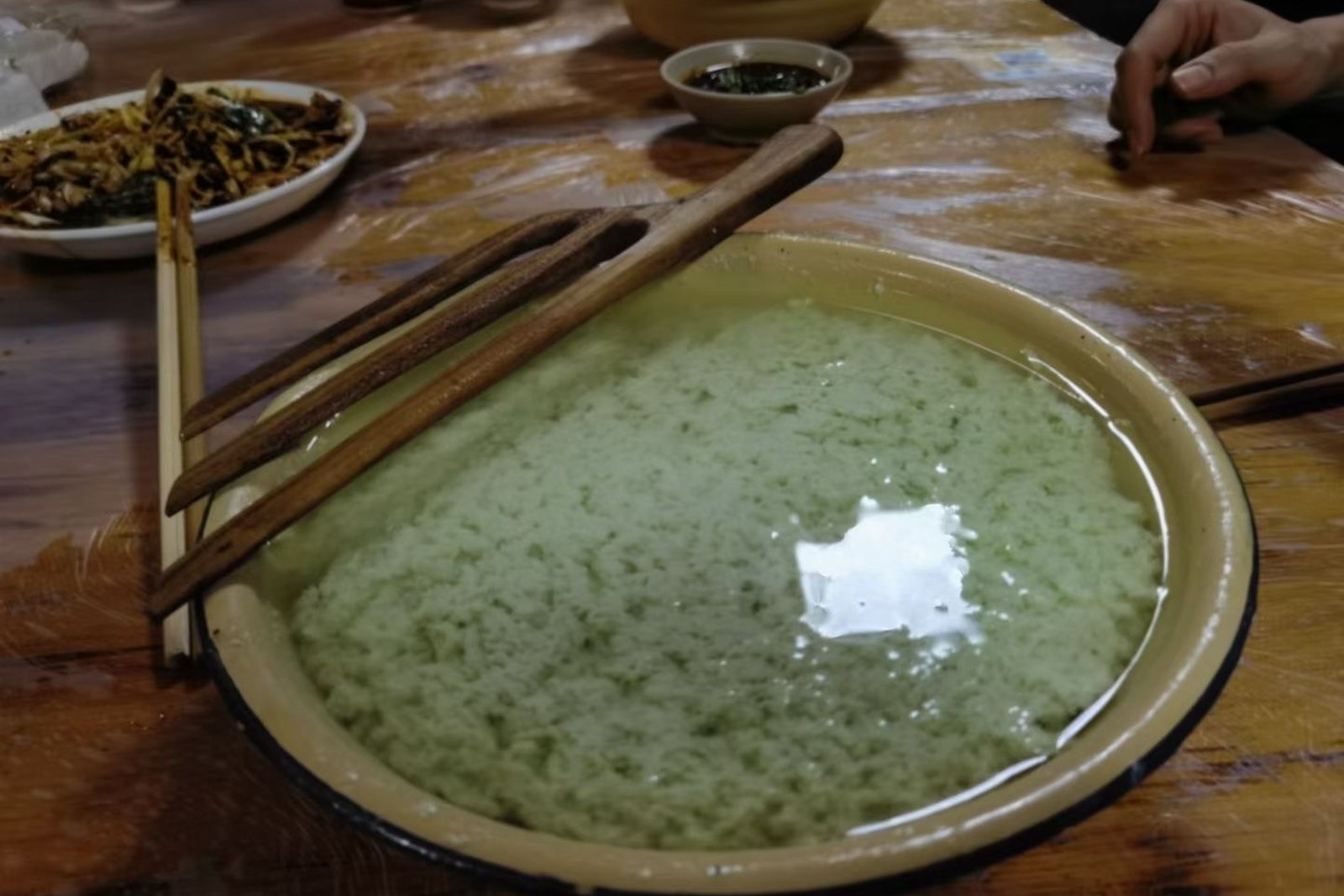
The town explains the pudding. Luozhi was a thousand-year water landing on the Yangtze, a place where river traffic stopped and cargo changed hands, and a landing has no reason to invent a dish that requires a pot to be carried to the river. Instead it refined the thing it already had: soy, salt, water and the patience to let a very dilute set hold together. The bean curd is set in the serving bowl itself rather than turned out of a mould, and it is poured there in front of you, which is why a bowl takes a minute to arrive and why the pudding can still be moving slightly when it is set down. The shop keeps its own seasoning on the table, and the bowl is not finished until the customer has made it agree with the jar.
On the same road, Longxing has the opposite end of the same ingredient. 龙筋豆干 Lóngjīn Dòugān long-jin dried tofu is pressed into flat sheets and dried, one of the town’s twelve intangible-heritage crafts, listed alongside Longxing brown sugar, yinmi, palm weaving, Li’s sugar painting and Tan’s dough modelling. One is made not to be lifted. The other is made to be carried for a month, and the two are eaten in the same sitting more often than a visitor expects.
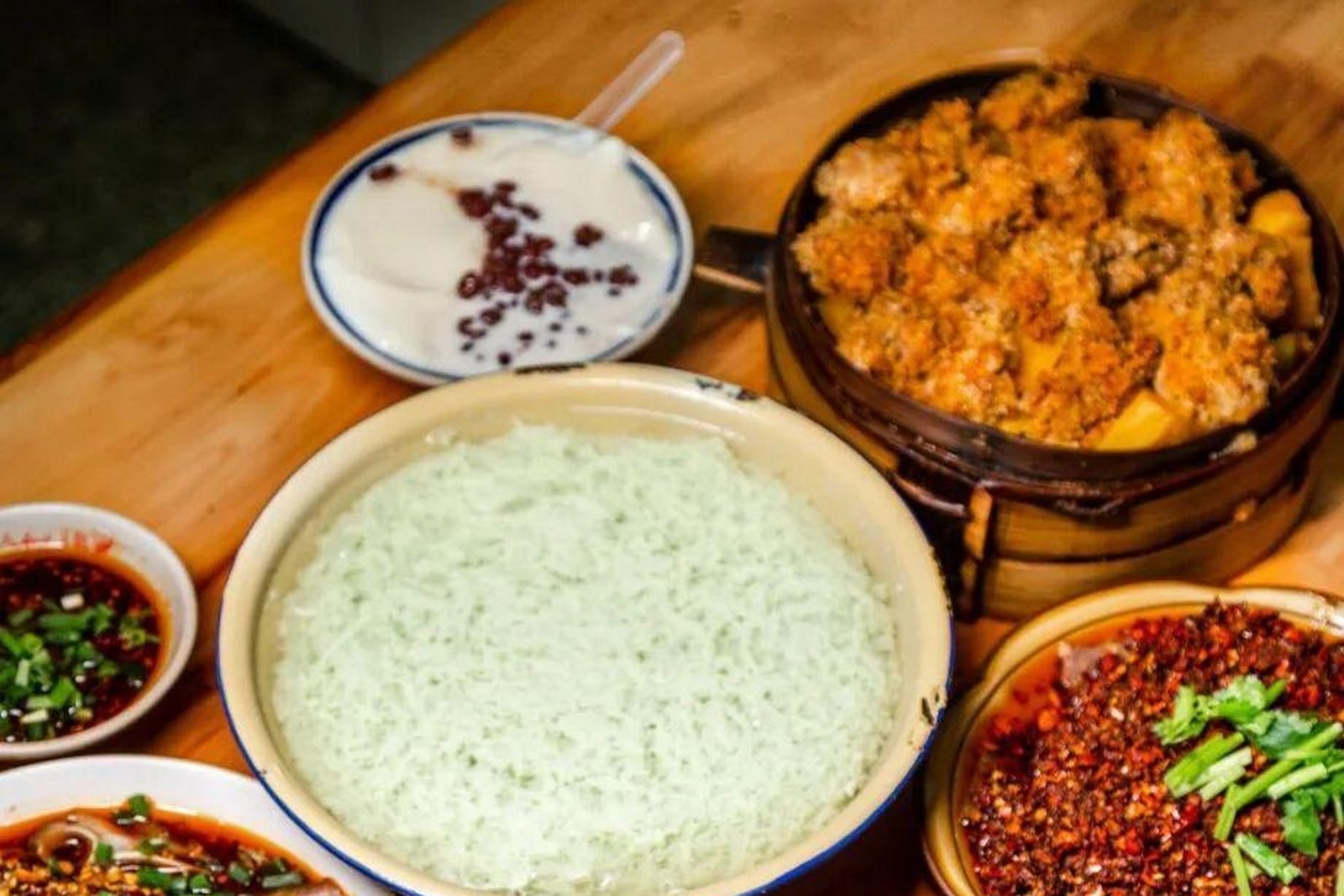
The Longxing half is a bowl as much as a sheet, and the shop that has fed travellers on it for 38 years is the one the town’s own publicity calls the old riverside douhua shop, on the lane near Canglong Street in the protected old town. The order is the plainest possible combination: 豆花饭 Dòuhuā Fàn douhua rice, the pudding set over rice with the shop’s own seasoning, finished with three plates of cooked meat – 烧白 Shāobái steamed pork belly, 红烧肥肠 hóngshāo féicháng braised pork intestine, and 粉蒸肉 Fěnzhēng Ròu pork steamed with rice flour. Yinmi, the steamed-then-sunned glutinous rice of the same town, is the other thing on the counters along the way; Chen’s yinmi is a separate thing again, a carved craft rather than a food, and the two names collide in translation more often than in life.
Words and Names
洛碛 Luòqí Luozhi, the former town on the Yangtze at the foot of Mingyue Mountain, hometown of the Song scholar 冯时行 Féng Shíxíng Feng Shixing, and the home of 水上漂 drifting tofu pudding; it was one of the eleven towns the former 渝北区 Yubei District governed before the 7 November 2025 reorganisation and is now inside Liangjiang New Area. 水上漂 Shuǐshàng Piāo “drifting on the water”, tofu pudding set fine enough to hang suspended, poured into the earthenware bowl it is eaten from. 豆花饭 Dòuhuā Fàn douhua rice; 烧白 steamed pork belly, 红烧肥肠 braised pork intestine, 粉蒸肉 pork steamed with rice flour. 龙兴 Lóng Xīng Longxing, the 600-year-old river town 36 km from the city centre on Highway 210, a national historical and cultural town since 2005. 龙筋豆干 Lóngjīn Dòugān long-jin dried tofu, one of Longxing’s twelve intangible-heritage crafts. 阴米 Yīnmǐ yinmi, steamed-then-sunned glutinous rice; 陈氏阴米 is a carving craft of the same name, not a food.
What the Locals Know
The knowing here is entirely about texture, and it is the sort that takes a bowl to acquire. On the floating pudding: the disc should be one piece and not a broken edge, its surface should still have the faint tremble of a set that is not fully cold, and the water it hangs in should be seasoned rather than plain, so that the last mouthful is not a mouthful of soy water. Locals drink that last mouthful. They also decide whether a bowl is good before they touch it, by tipping it slightly in the hand and watching whether the disc drifts, and a bowl that has been over-set will not drift at all – it will sit on the bottom like any other tofu, and the regulars will say nothing about it and simply not finish the water. On the Longxing side, the dried tofu is judged on the break: a good sheet snaps rather than bends, the fibres run visibly across the cut, and it is chewy rather than leathery, which is the difference between tofu that has been pressed and tofu that has been pressed twice and dried in the sun.
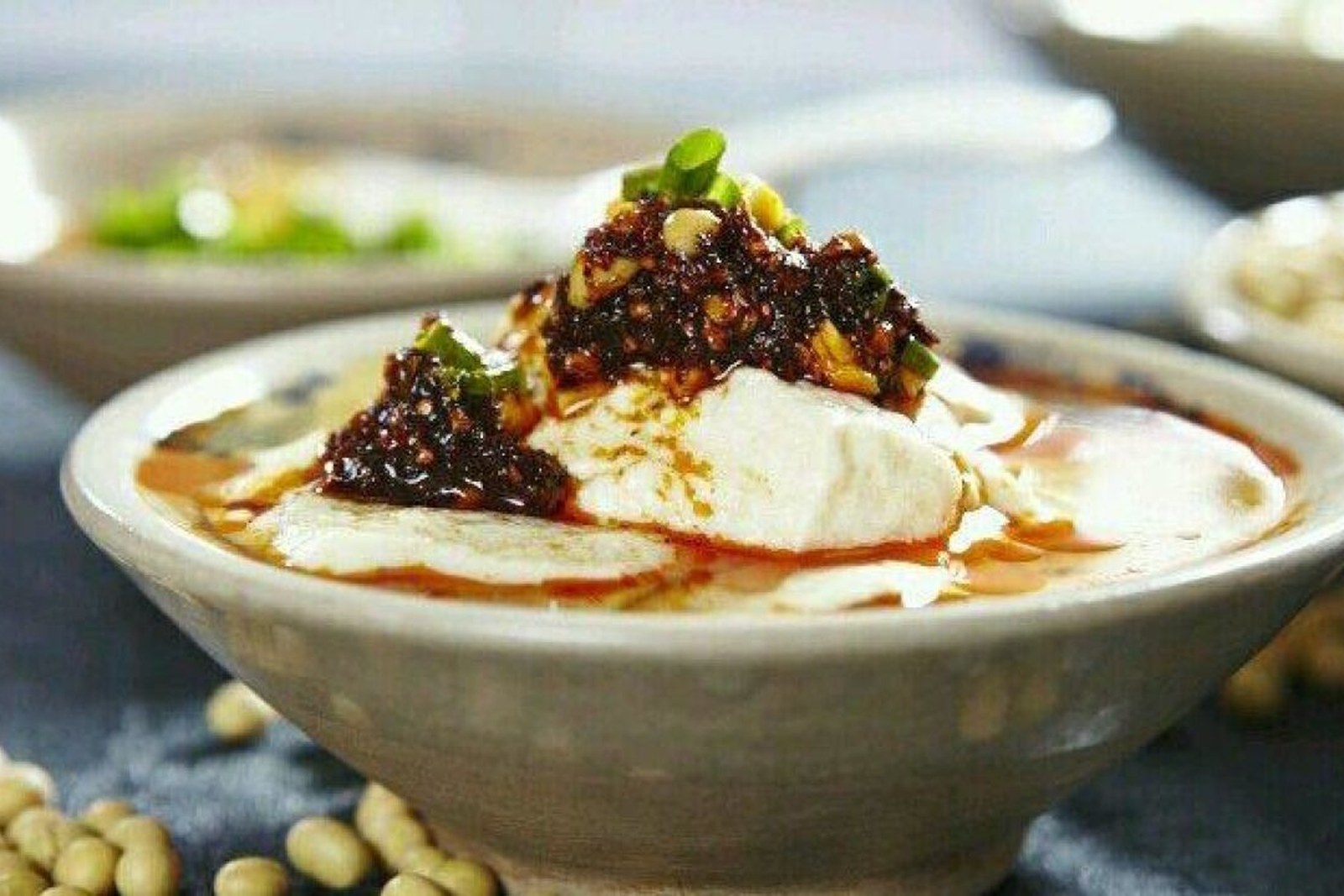
flowcloud would say that Luozhi’s 水上漂 tofu pudding and Longxing’s 龙筋豆干 dried tofu are the two halves of one river-town plate – a set curd fine enough to hang suspended in its bowl, poured in front of you into the earthenware bowl you eat it from, named for a thousand-year Yangtze water landing that is also the hometown of the Song scholar Feng Shixing, and the pressed, sun-dried sheet that Longxing, 36 km up Highway 210 and a national historical town since 2005, has been carrying for a market since before the war. The Luozhi bowl is finished with steamed pork belly, braised pork intestine and rice-flour steamed pork, and the riverside shop that serves the pudding has traded for 38 years. Since 7 November 2025 both towns are inside Liangjiang New Area.
Where to find it: the riverside douhua shops around 洛碛 Luòqí Luozhi town, and the dried-tofu and douhua counters inside 龙兴 Lóng Xīng Longxing Ancient Town’s protected old streets, both in the part of the former 渝北区 Yubei District that is now Liangjiang New Area. Longxing sits 36 km from the city centre on Highway 210 and is reached by the 984 bus to the cultural-square stop followed by a short walk; the town is free to enter and the streets are still lived in, so the craft counters are shops rather than a museum. Luozhi is the harder of the two, a riverside landing reached by road and best on a market morning. Both are counter-service, and no prices are quoted.