
The village of 马冈 Mǎgāng is in the south-west of 开平 Kāipíng, on the far side of the river from the watchtowers that brought the district its fame, and it is famous for two entirely unrelated things: a breed of goose that carries its name, and a hand-printed ledger paper, the 马冈木版画 and the 马冈纸 that travelling merchants once used for their accounts. The goose is the reason restaurants across the delta print 马冈鹅 on their menus. It is a heavy grey bird with a black beak and a knob at the top of it, raised slowly over ninety to a hundred and twenty days rather than the sixty of a commercial farm, and fed on grass, paddy, and whatever the ponds provide. A mature bird weighs three and a half to five kilograms and its meat is darker and denser than a duck’s, which is why it is roasted and braised here and eaten in slices rather than pulled apart.
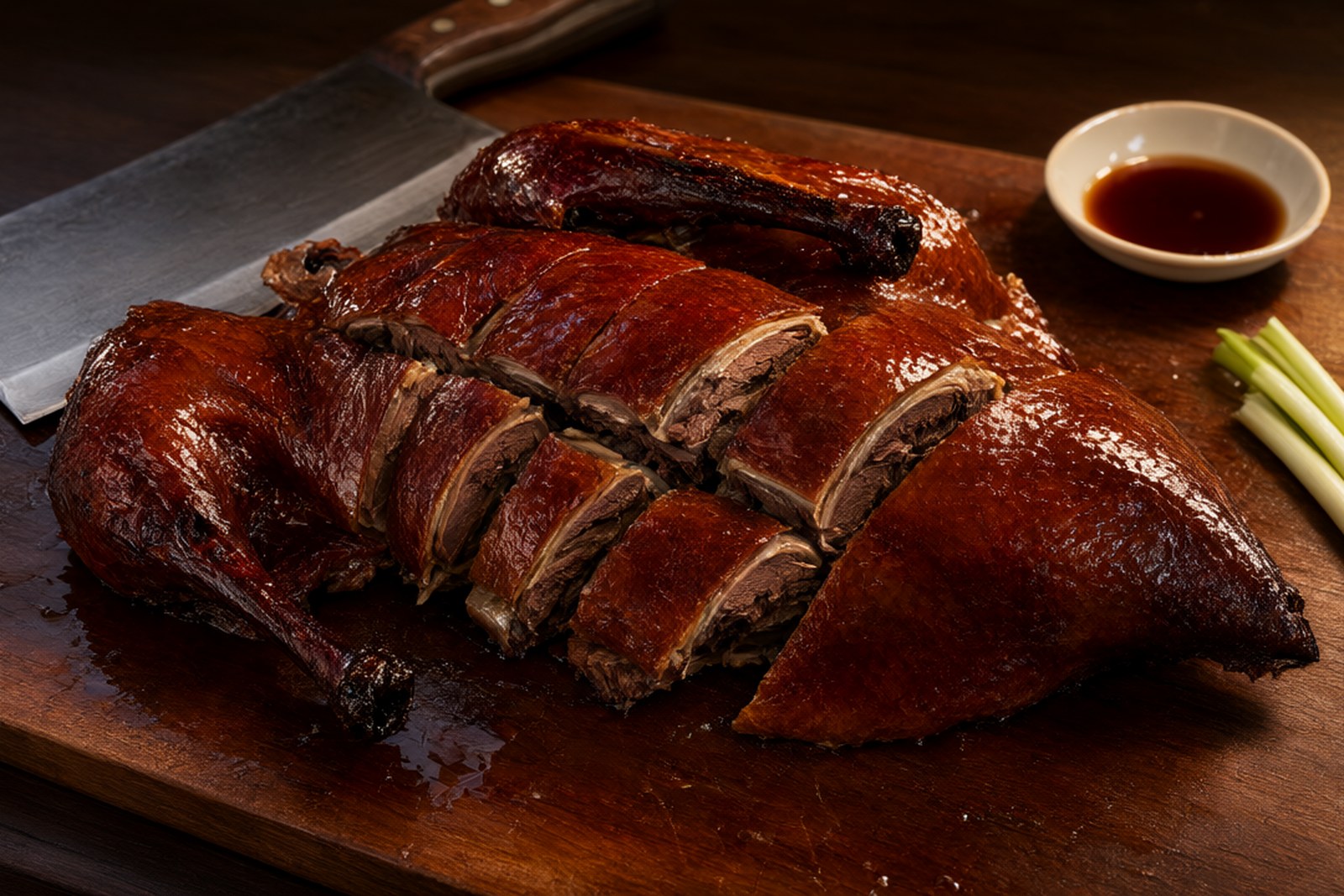
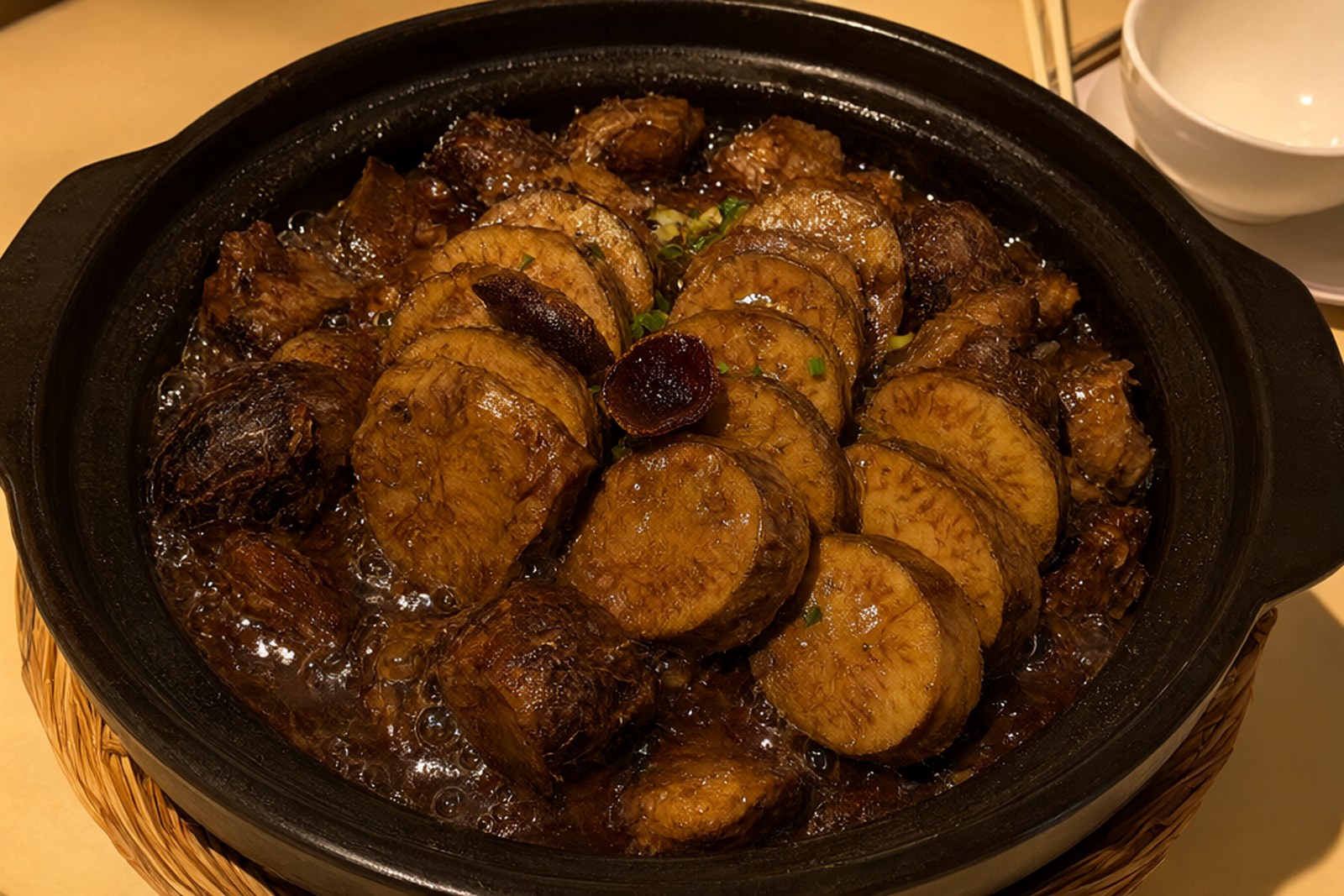
The default way to eat it, and the one to order first, is 烧鹅 shāo é, roast goose. The bird is rubbed inside with a paste of 五香粉 wǔ xiāng fěn, five spice, and 盐, given an air-dried skin, and then hung in a charcoal-fired 挂炉 guà lú and roasted until the skin goes a deep mahogany and the meat is still faintly pink near the bone. It is carved across the bone into thick pieces, laid over a plate with the fat running out, and eaten with a bowl of 酸梅酱 suān méi jiàng, a plum sauce that cuts the richness. The Ma gang bird differs from the 烧鹅 of Guangzhou in that it is bigger and the meat is firmer, so it is cut thicker and the pieces are heavier; the same order costs more and goes further. 豉油鹅 chǐ yóu é, goose simmered in a pot of soy, sugar, star anise and 陈皮 chén pí, is the other standard, cooked in a covered claypot and served with the reduced sauce poured over, and it is what families take away for festivals. 芋头焖鹅 yù tou mèn é, goose braised down with taro so that the taro drinks the fat, is the winter version.
What is sold around the goose is worth knowing about. The 鹅血 é xuè, the blood, is set into a curd and added to soup or fried with chives. The 鹅肠 é cháng, the intestines, are cleaned and blanched briefly and served as a chewy side dish with a soy dip, and they are better than they sound. The fat skimmed off a roast, 鹅油 é yóu, is kept in pots and used to cook rice and greens for weeks. And the feet and the neck, which nobody wants at a restaurant, go into the home pot with 腐竹 fǔ zhú, dried bean curd sticks, and a long simmer, which is the version of the dish that tastes most of the village it came from. Order the roast and the soy-braised together and compare them; the argument between the two is the one 开平 people actually have.
Words and Names
鹅 é is goose and 马冈 Mǎgāng is the village, so 马冈鹅 is simply the Magang goose. 烧鹅 shāo é is roast goose and 豉油鹅 chǐ yóu é goose braised in soy; 芋头焖鹅 yù tou mèn é is the taro braise and 五香粉 wǔ xiāng fěn the five-spice rub. 酸梅酱 suān méi jiàng is the plum dipping sauce, 鹅油 é yóu is rendered goose fat and 腐竹 fǔ zhú the dried bean-curd sticks. 开平 Kāipíng is the district and 陈皮 chén pí the dried tangerine peel that goes into the braise.
What the Locals Know
Ask whether the bird is 马冈 by breed or merely from 马冈 by place, because the question is a real one and the price differs; a proper 马冈鹅 has a shorter, thicker neck and a black knob on the beak. Buy roast goose in the morning for lunch and never in the evening, because the skin loses its crispness within two hours of leaving the oven and a re-heated bird is a different dish. When ordering 豉油鹅, ask for a bowl of the braising sauce and a plate of rice rather than bread; the sauce is the point and it is mostly soy, rock sugar and goose fat. And if you see 鹅肠 on the menu, order it, because a kitchen that sells intestines is a kitchen that kills its own birds.
flowcloud would say that a district known for watchtowers built with money earned abroad is also, and more quietly, known for a bird raised slowly by people who never left, and that the two together describe the delta better than either does alone.
Where to find it: the 烧腊 shops and 鹅 restaurants of 马冈镇 Mǎgāng zhèn in the south-west of 开平, and the goose stalls of the 赤坎 Chìkǎn and 开平城区 markets. A whole roast goose runs ¥200 to ¥350; a plate of 豉油鹅 with rice is ¥30 to ¥50. 开平 is about an hour by bus from 江门, and the 江湛 line stops at 开平南站 Kāipíng Nán zhàn. Order a plate of roast, a claypot of the taro braise, and a bowl of 鹅血汤 é xuè tāng, the blood-curd soup, which is the local way to start the meal.