
梅岭鹅王 méi lǐng é wáng, the goose king of Meiling, is the hottest dish in Guangdong and it is served at a mountain pass. The pass is 梅关 Méi guān, on the border between 南雄市 Nán xióng shì in the far north of Guangdong and 大余县 Dà yú xiàn in Jiangxi, and the 梅关古道 Méi guān gǔ dào, the flagged road over it, has been the main land crossing between the two provinces since the Tang. The goose is not a banquet dish that was later carried to a road: it is a road dish that grew into a banquet, and the road is the reason it tastes the way it does. The pass is not merely a border crossing. For most of the last thousand years the 梅关 was the only practical land route between the Yangtze basin and the Canton delta for anyone on foot, on a mule or in a sedan chair, and everything that moved south by land came through this one cut in the ridge – salt, tea, silk, iron, officers on their way to exile and their baggage behind them, and the monks, merchants and migrants who between them account for most of the surnames in the delta today. A road with that much traffic through it feeds a lot of people, and the villages below the pass cooked for them. The dish they cooked was built to be eaten by people who had been walking uphill since dawn and would be walking downhill again afterwards, which is to say it was built to be strong, salty, hot and served in quantity, and none of those properties has changed. The other thing the road did was bring the chilli. Guangdong’s own cooking has almost no heat in it, and the reason the far north of the province is the exception is not the climate but the company it keeps: on the other side of the pass and beyond the next ridge are Hunan and Jiangxi, and the peppers that came through the pass with the porters took root on this side of it. The goose itself is the other half of the local argument, because a goose is not a chicken: it is a bird that grazes, that can be turned out onto stubble and grass, and that a farming household in a poor hill county can raise without buying feed. Today the stretch of national highway below the pass carries more than a hundred and sixty restaurants, hotels and farmhouse kitchens, and every one of them cooks the goose.
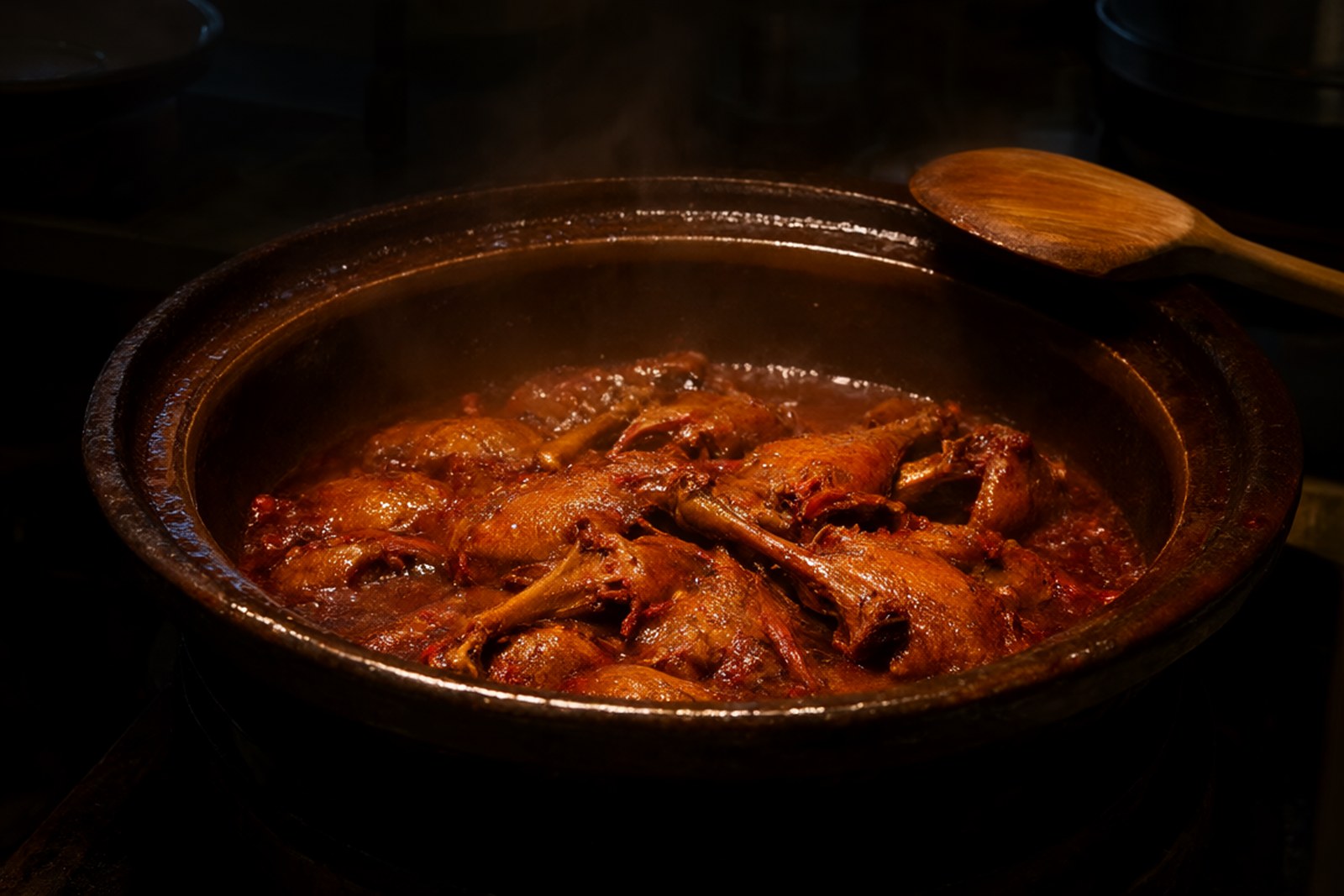
The first thing to be said about it is that this is genuinely a chilli dish in a province that does not eat chilli. Guangdong’s own cooking runs on freshness, sweetness and a controlled bitterness, and a Cantonese palate will send back a dish that burns. The north of the province is the exception, and 南雄 is the far end of the exception, because it sits on the 南岭 Nán lǐng where Guangdong, Jiangxi and Hunan meet and where for centuries the traffic up and down the pass came from Hunan as much as from Canton. The chilli that gives the dish its name is grown locally and is called 指天辣 zhǐ tiān là, pointing-at-the-sky chilli, or by its local nickname 霸王辣 bà wáng là, the overlord chilli; it is small, thin-skinned and finishes hot rather than merely hot at the tip, and the county’s own description of the dish’s register is 辣香、味浓 là xiāng, wèi nóng, hot and fragrant, thick in the mouth. It is described locally, with some pride, as being as hot as anything in Chongqing, and the pride is real: people here know they are the odd one out.
What the goose is, before the chilli, is a 仔鹅 zǎi é, a young goose. The specification the trade keeps is eighty to ninety days old and seven to eight 斤 jīn in weight, which is roughly three and a half to four kilos, and it must be a farm goose raised on grass – the local black-brown breed is what most kitchens buy, and the smallholders who supply it are not a side business. The county’s own figures put the number of geese raised for the trade at about two hundred thousand birds a year, which is worth in excess of sixteen million yuan to the farms alone. A goose younger than eighty days has not enough fat under the skin to make the sauce, and one older than ninety days is too firm to come off the bone the way the dish needs; the window is narrow enough that kitchens buy on the day.
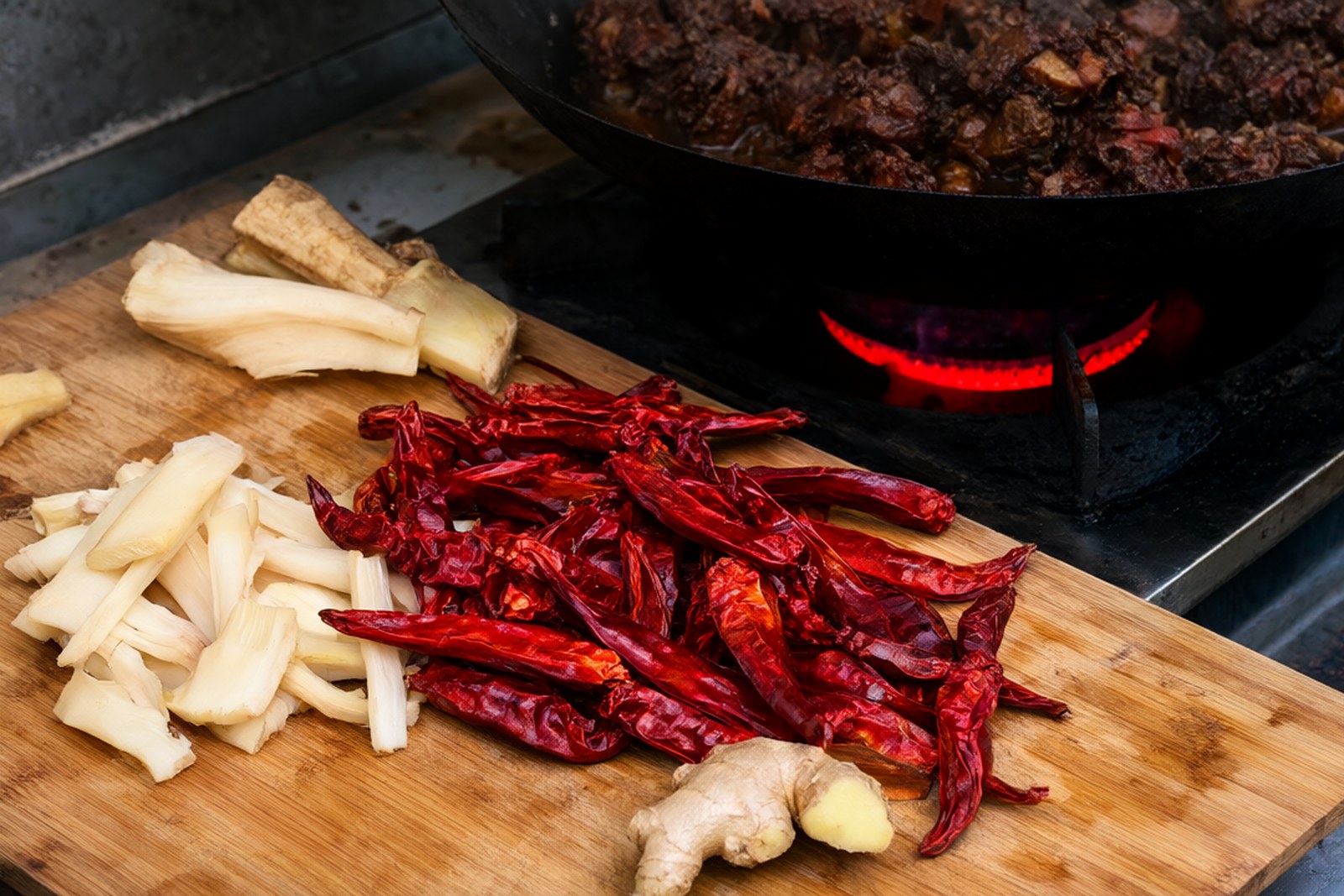
The method is a sequence of steps and it is not a stew. The bird is killed and cut into pieces rather than jointed neatly, then blanched briefly in water to lift blood and scum out of the meat. The next step is the one that is not obvious and that the county records as 大火炒白锅 dà huǒ chǎo bái guō, frying in a dry wok over a fierce flame – the pieces go into a hot empty pan and are turned until the fat under the skin gives up its oil and the surface of the meat tightens and colours. That oil is poured off. It is why a finished 鹅王 does not taste greasy, and any kitchen that skips it is producing something else. Then the pan is fired again with oil and the aromatics go in: 酸笋 suān sǔn, fermented bamboo shoots, which are the southern ingredient in an otherwise northern dish, 姜 jiāng, 蒜 suàn, a heavy weight of 指天辣, and behind them the dry spices – 砂姜 shā jiāng, 八角 bā jiǎo, 草果 cǎo guǒ, 小茄 xiǎo qié, 陈皮 chén pí and 甘草 gān cǎo. Then the liquid, which is the other local thing: 梅关家酿黄酒 Méi guān jiā niàng huáng jiǔ, the rice wine the households under the pass make themselves, with soy sauce and water.
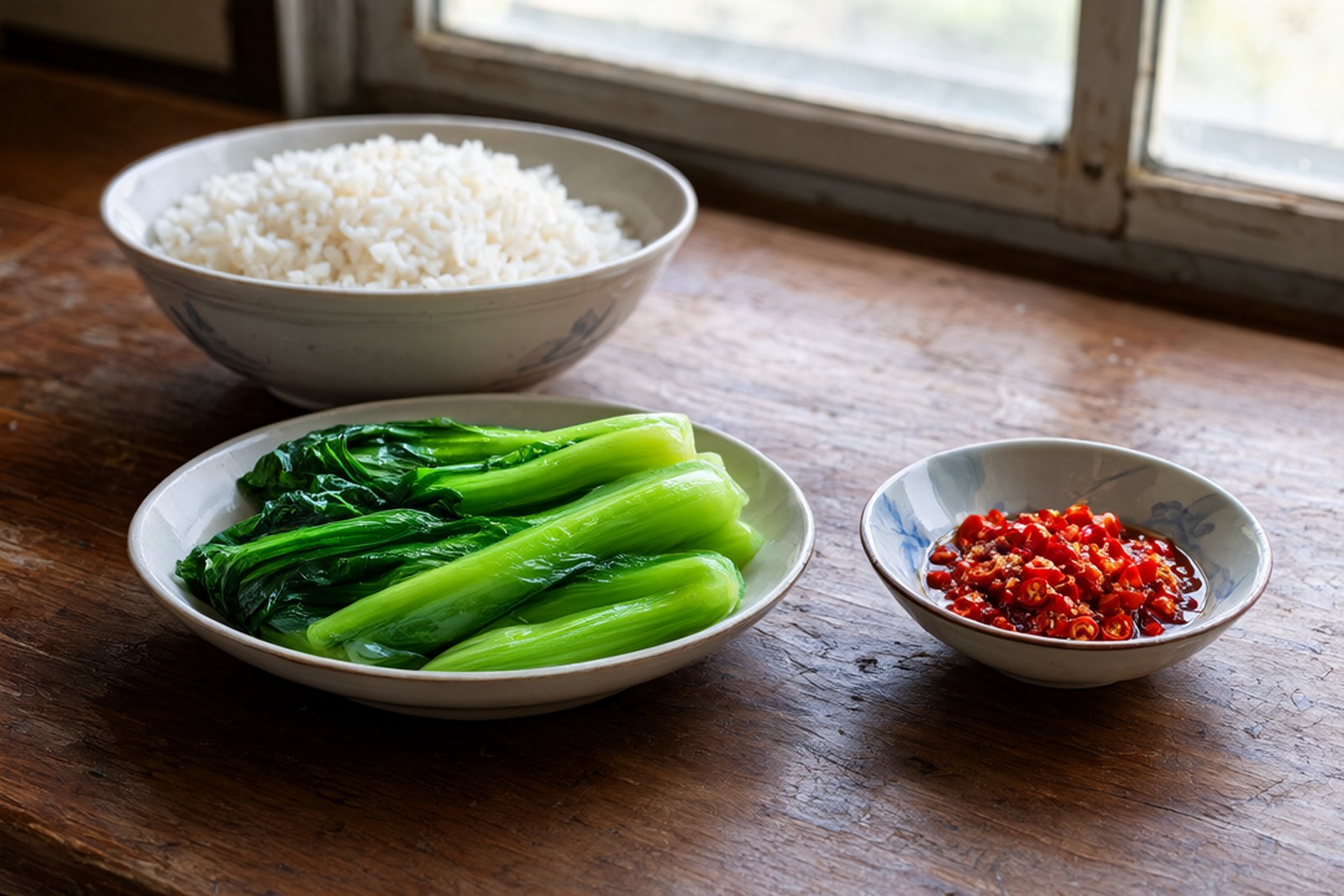
Then it sits. The braise is covered and held low for somewhere between sixty and seventy minutes, and the county’s accounts differ on the number without disagreeing on the point: the goose has to be taken past firm and stopped before it falls apart, because the dish is eaten with the fingers of a chopstick and a piece that has gone to shreds cannot be picked up. What is left in the pot at the end is a sauce almost black with chilli and reduced wine, with a slick of red oil on the surface, and it is eaten with rice and with plain blanched greens. Nothing about the dish is subtle and nothing about it is meant to be. The name the locals use for the whole register is 辣香 là xiāng, and the two halves of that phrase are not in competition: the chilli is there to carry the smell of the goose forward, not to hide a bird that was badly raised.
The Dish Under the Name
The goose did not start as a restaurant dish. What was cooked at 梅关村 Méi guān cūn, the village under the pass, was 酸笋鹅肉 suān sǔn é ròu, goose with fermented bamboo shoots, made for festivals and for the great family occasions and not on ordinary days, because a goose was a serious animal to kill. The chilli was the change. It was stuffed in alongside the bamboo shoots and the dish became a different thing – sharper, hotter and much more memorable – and it was sold. The date the county gives for that is exact: in 1996 a man from 梅岭村 Méi lǐng cūn called 肖祥华 Xiāo Xiáng huá opened the first restaurant to put 梅岭鹅王 on a signboard. Everything since is the growth of a trade around one man’s decision to sell a farmhouse dish on a road where people were hungry.
The official record has followed the trade and not the other way round. The technique was entered on the county-level intangible-heritage register of 南雄市 Nán xióng shì in 2023, and in December 2025 it went onto the tenth batch of the 韶关市 Sháo guān shì municipal intangible-heritage list. In 2022 the kitchens and the farms formed the 梅岭鹅王餐饮文化协会 Méi lǐng é wáng cān yǐn wén huà xié huì, the Meiling Goose King catering culture association, and what the association exists to do is hold a line: a standard raw bird, a standard list of aromatics, a standard braise. The chilli has become a crop in its own right too. The upriver growing of small yellow ginger and chilli for the pot runs to about thirty thousand tonnes a year, and the kitchens have pushed out products built on the braise itself, of which 鹅王酱 é wáng jiàng, goose king sauce, is the one sold in jars. The trade is worth in excess of five hundred million yuan a year by the county’s own reckoning and gives work to more than two thousand people, and in 2025 the dish was served at the welcome lunch of the fifth World Cantonese Kinship Convention, which is the sort of occasion a village dish is taken to when a county has decided it is a brand.
Two versions of the origin circulate and it is worth separating them. The one the signboards tell is a piece of local tradition rather than a record: it says that when 张九龄 Zhāng Jiǔ líng, the Tang chancellor and the most famous man 韶关 has produced, was cutting the road over the pass in the eighth century, the villagers fed the work gangs on braised goose and the chancellor asked what it was. The county prints the story and does not date it. The version with dates is the 1996 restaurant, and the interesting thing about the modern dish is that it is only about thirty years old. What is old is the road, the goose, the bamboo shoots and the household rice wine.
Words and Names
梅岭鹅王 méi lǐng é wáng is the dish: 梅岭 the Meiling ridge, 鹅 goose, 王 king, so the goose king of Meiling. 梅关 Méi guān is the pass itself and 梅关古道 Méi guān gǔ dào the flagged road over it. 指天辣 zhǐ tiān là, pointing-at-the-sky chilli, is the local pepper, also called 霸王辣 bà wáng là, the overlord chilli. 仔鹅 zǎi é is a young goose and 酸笋 suān sǔn is the fermented bamboo shoot that was in the dish before the chilli was. 梅关家酿黄酒 Méi guān jiā niàng huáng jiǔ is the household rice wine of Meiling, 大火炒白锅 dà huǒ chǎo bái guō is the dry-wok frying that takes the subcutaneous fat out, and 鹅王酱 é wáng jiàng is the sauce made from the braise for sale in jars. 肖祥华 Xiāo Xiáng huá opened the first restaurant under the name in 1996 and 梅关村 Méi guān cūn is the village it all came from.
What the Locals Know
Order it and order rice with it, because the sauce is the point as much as the meat and there is no version of this dish that is manageable without a bowl of plain rice underneath. The pot arrives at the table still hot and it is better after ten minutes than after two, when the chilli has had time to settle into the oil. Pick a piece with skin on it: the dry-wok step left that skin blistered and slightly tough in a way that holds sauce, and the meat nearest the bone is the sweetest. If the sauce is thin and red rather than dark and clinging, the braise was rushed; if the goose tastes of nothing but chilli, the bird was not worth cooking and the chilli is being used as a cover. Ask for 微辣 wēi là if you want it mild and be aware that this means less chilli and not no chilli – a 鹅王 with the heat taken out is a different dish and the kitchen will tell you so. The fermented bamboo shoot gives the sauce a sourness that is either the best or the worst thing about it depending on the eater, and it is the ingredient that marks the dish as belonging to this corner of Guangdong rather than to Hunan next door. In 南雄 the dish is a lunch and a dinner and it is also the thing the county feeds visiting officials, so on a weekend the roadside kitchens from the highway junction up to the pass car park are full from about eleven; the ones further up the hill, past the last of the tour coaches, cook the same recipes with more room.
flowcloud would say that the most interesting thing about the goose king of Meiling is that the dish gets its character from a road rather than from a kitchen, and that Guangdong’s only serious chilli dish is the one cooked by people who live where the province stops.
Where to find it: the roadside kitchens along the 323 national highway between 南雄市区 Nán xióng shì qū and the 梅关古道 Méi guān gǔ dào scenic area, above all in 梅岭村 Méi lǐng cūn and 梅关村 Méi guān cūn in 珠玑镇 Zhū jī zhèn, where more than a hundred and sixty places cook it and where the trade began with 肖祥华’s restaurant in 1996; the county’s own nickname for the strip is 梅岭鹅王一条街 Méi lǐng é wáng yī tiáo jiē, Meiling Goose King Street. 南雄 is in the far north-east of 韶关市, about thirty kilometres from the pass, and is reached by road from 韶关市区 in a little over an hour or by rail at 南雄站 on the 赣韶 line; there is no high-speed station in the county, so most visitors come by bus or by car from 韶关 station. A whole goose is sold by weight and feeds four or five people, the kitchens will portion it for two, and the chilli is grown locally rather than bought in, so the dish is not cheaper anywhere else and is not as good anywhere else either. A jar of 鹅王酱 é wáng jiàng is the one thing worth carrying home from the row of kitchens, because the braise keeps and the goose does not. If you are coming from 韶关市区, the pass road is worth the trip on its own: the flagged stone of the 梅关古道 Méi guān gǔ dào is still there above the restaurants, and walking up it after lunch is the standard way to finish the meal.