
The smell of a zongzi kitchen is steam and leaf. Green bamboo leaves, softened in hot water, give off something faintly grassy; underneath it there is the heavier smell of glutinous rice soaking in a bucket and, in one corner of the room, a bowl of pork belly already marinated in soy and rice wine. 汨罗 Mǐluó is a small city on a river, and for a few weeks each spring almost every household in it turns into a small factory: leaves on the floor, string on the wrist, a pot on the stove that will not come off the heat for five hours. The finished object is a pyramid of rice wrapped in leaf and tied with cotton, and it is the single food most closely attached to a place in all of China, because this is the river into which 屈原 Qū Yuán is said to have walked in 278 BC.
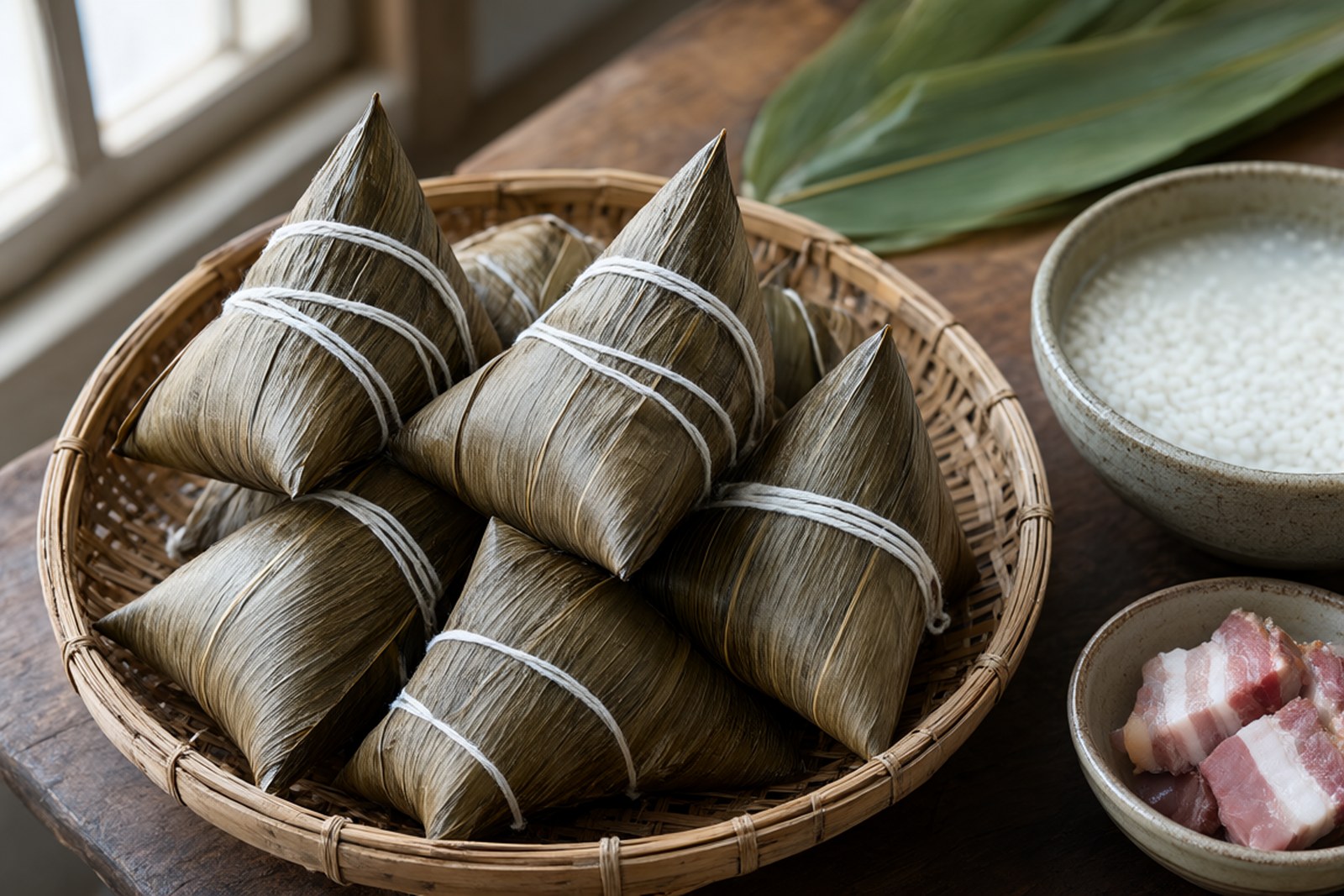
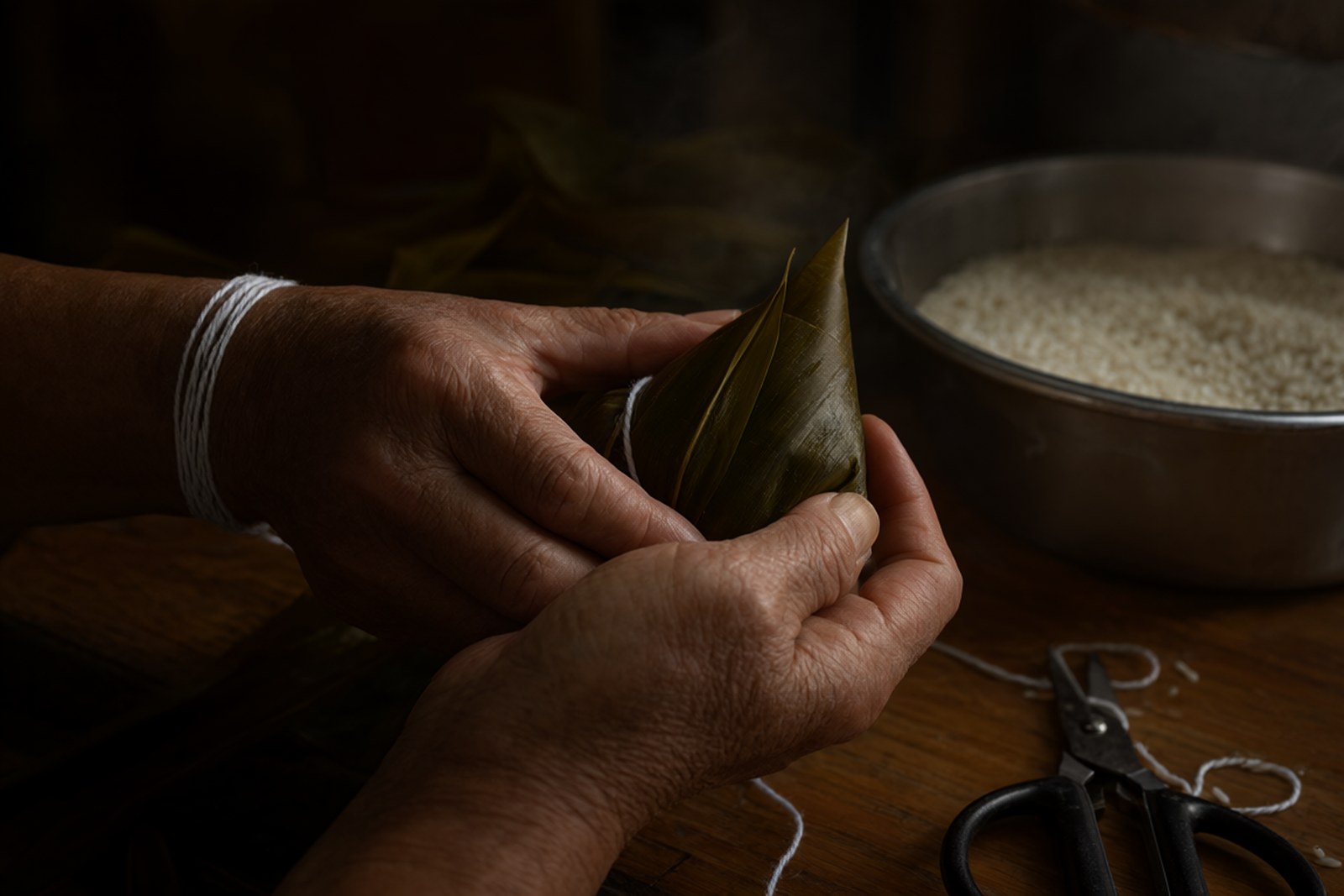
The making is a sequence of small skills, and each of them is a place where a bad zongzi announces itself. Two leaves are laid overlapping, glossy side up. The rice goes in, and it must go in loosely — a zongzi packed tight feels reassuring in the hand and turns into a solid brick after boiling. If there is a filling, it lies in a hollow in the middle of the rice: a piece of belly pork, or a salted egg yolk, or a spoon of sweet red bean. Then the leaves fold: the near edge lifted over, the sides pressed in, the far edge brought down, and the whole thing rotated so that the shape closes into a four-sided point. The string is wound three or four times and knotted, not too tight. A first-timer’s zongzi leaks rice into the water and comes out hollow; a grandmother’s comes out compact, the grains fused, the leaf having left its scent through the whole interior.
Two Rivers of Flavour
Hunan zongzi split into two families, and Miluo makes both. The 碱水粽 jiǎnshuǐ zòng, the alkaline one, uses water that has been poured over burnt plant ash or, these days, a pinch of food-grade lye. The rice turns pale gold and slightly translucent while it cooks, the texture becomes springy and almost jelly-like, and the flavour is faintly savoury even though nothing savoury was added. It is eaten plain, dipped in sugar, or with a spoon of honey, and it is the version that tastes most like what the leaves smell of. The 肉粽 ròuzòng, the pork one, is the opposite: dark soy, five-spice, a strip of pork belly with a good layer of fat, sometimes a chestnut, sometimes a salted yolk. Boiled long enough, the fat renders into the rice and the whole pyramid becomes glossy and heavy.
The boiling takes hours, and it is not a step to hurry. The pot is filled so the zongzi float, weighted with a plate so they stay under, and kept at a low rolling simmer. Green leaves give up their chlorophyll and go khaki. The rice inside goes from white to ivory to glass. A zongzi lifted out too early is chalky in the centre; a zongzi boiled through is dense and clean and comes off the leaf without sticking. Families cook a hundred at a time because the work is all in the folding, and because a cooled zongzi is still good — steamed again, or sliced and fried until the outside crisps.
Words and Names
粽 zòng on its own means the object; 粽子 zòngzi is the everyday name, and 角黍 jiǎoshǔ, millet horn, is the older literary one, because the earliest versions were millet rather than rice. 碱水粽 jiǎnshuǐ zòng is the alkaline version, 肉粽 ròuzòng the pork one, 蛋黄肉粽 dànhuáng ròuzòng the one with a salted yolk, and 白粽 báizòng a plain rice zongzi with nothing inside. 糯米 nuòmǐ is glutinous rice, the only rice that works, since ordinary rice will not bind. 箬叶 ruòyè are the broad bamboo leaves used here, as opposed to the reed leaves of the north. 端午 Duānwǔ is the Dragon Boat Festival, held on the fifth day of the fifth lunar month, and 龙舟 lóngzhōu are the boats raced on the river at the same time. 汨罗江 Mǐluó Jiāng is the Miluo River itself, the place-name and the story in one.
What the Locals Know
Miluo people judge a zongzi by the leaf, not the filling. A good one comes off the rice cleanly and leaves the outside of the pyramid faintly green-brown; if the rice has stuck to the leaf, the leaves were too dry or the boiling too short. The string should be cotton, not plastic, because plastic melts into the leaf. Ask for 碱水粽 if you want to understand the local taste, and eat it with sugar rather than with soy — the point of the alkaline version is that it is subtle and slightly sweet in a way that has nothing to do with added sugar. Buy from a household operation rather than a supermarket, and buy in the weeks before the festival when the leaves are fresh; a zongzi made with stored dried leaves tastes of nothing. Prices are low — a plain one for two or three yuan, a pork one for six to ten, and a big yolk-and-pork one for around fifteen in the better shops near the river.
flowcloud would say that a zongzi is a story that has been eaten for two thousand years without anyone agreeing on the ending, since the rice goes in loose and comes out solid, and the river keeps taking the credit for the flavour.
Where to find it: the streets around 屈子祠 Qūzǐ Cí, the Qu Yuan temple on the north bank of the river, and the market area of 汨罗市区 Mǐluó shìqū. Look for the shops with stacks of leaves in the doorway and a pot visible through the back, ask for 碱水粽 first and 蛋黄肉粽 if you want the heavy one, and go in the fortnight before 端午 when everyone is making them at once.