
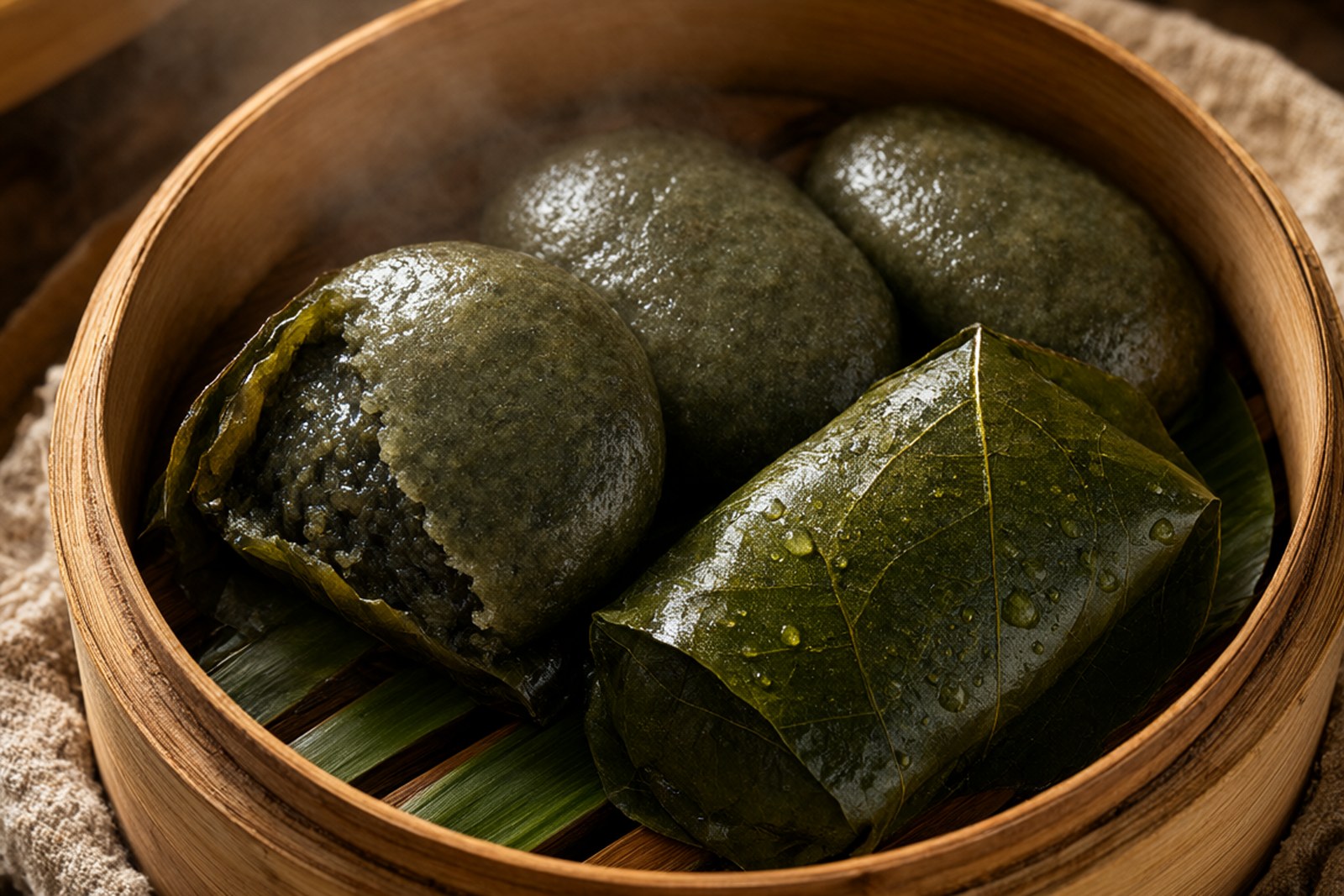
The cakes come out of the steamer still wrapped in their leaf, and when you peel it back the thing inside is the green of wet moss, glossy, faintly translucent at the edges, and it does not smell of pudding at all — it smells of a meadow after rain, green and slightly bitter and clean. Bite it and the sticky rice dough stretches, and then you reach the filling: sweet ground soybean and sesame and dark brown sugar, or, in the other version, cured pork and garlic chive, hot and salty and running with fat. 蒿子粑粑 hāozi bābā is the spring food of 张家界 Zhāngjiājiè, and it is one of the few dishes in China with an origin story about snakes.
A Cake Against Snakes
The third day of the third lunar month, in April, is the day. Every household in the villages around 张家界 Zhāngjiājiè, in north-western 湖南 Húnán, makes 蒿子粑粑 hāozi bābā, and the reason given is written into a saying that every child here knows: 三月三,蛇出山,蒿子粑粑扎蛇眼 — on the third of the third month the snakes come out of the hills, and the mugwort cake blinds the snake’s eye.
The explanation behind the rhyme is a piece of practical folk history. The mountains here were, and to a degree still are, thick with venomous snakes, and the arrival of warm weather brought them out of the caves and down towards the villages. The recorded account is that people took the local 艾蒿 àihāo, mugwort, a strongly aromatic herb used in medicine against damp and cold, and combined it with sweet-smelling food as bait, laying it at cave mouths; the snakes ate it, were made ill or killed by it, and stopped coming out. The name for the practice is 扎蛇眼 zhā shéyǎn, blinding the snake’s eye. A second and gentler version of the same belief is that eating the cake yourself protects you: 三月三吃蒿子粑,粑粑把住魂 — eat the mugwort cake on the third of the third month and the cake holds your soul in. Either way the dish arrives with a small piece of field medicine attached, which is more than most desserts can claim.
The Green Stuff
蒿子 hāozi is not one plant in the way a supermarket ingredient is one plant; it is a name for the young mugwort and related artemisias that come up in the fields and along the paths in early spring. The one the cooks look for is called 白蒿 báihāo, white mugwort, whose leaves are green above and pale, almost white-felted underneath, with a strong bitter-resinous smell. You pick the tenderest tips and shoots, because older leaves are woody and harshly bitter.
The treatment of the leaves is the step that separates a good cake from a bad one, and it is done differently by two schools of local cooking.
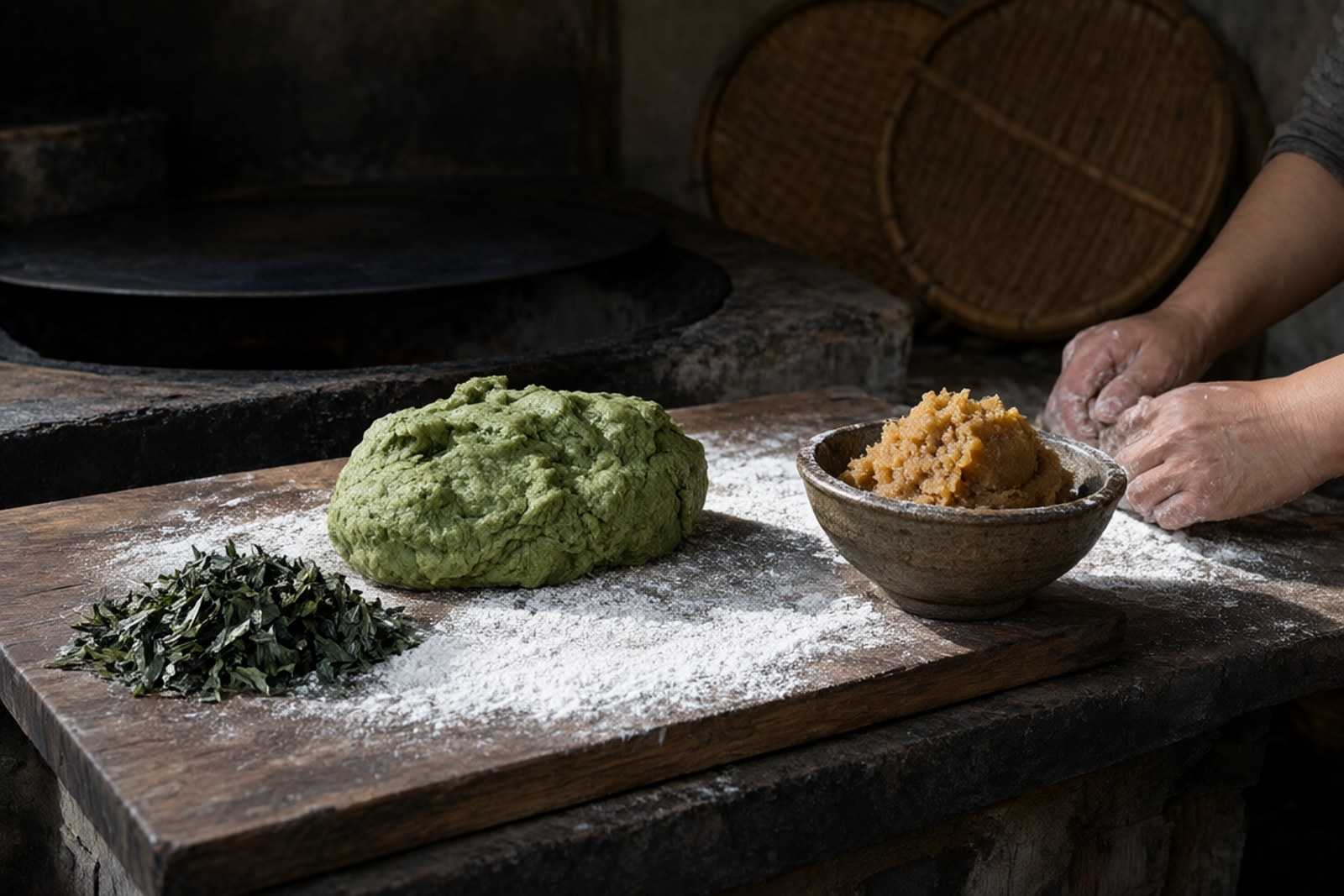
The common method, the one used for what local cooks call the coarse style, is to wash the leaves, pound them in a stone mortar to break down the fibres, then rinse and squeeze them repeatedly to drive out the dark green juice and the fine hairs that make the leaf unpleasant to chew. What is left is a chopped, milder green mash which is folded into glutinous rice flour with warm water and kneaded into a dough.
The other method, the finer style, skips the pounding: the fresh leaves go into the stone mill together with the rice, and the two are ground into a single flour already green through. The cake comes out darker, more intensely flavoured and smoother, and the people who prefer it will tell you the first method wastes most of what makes mugwort worth eating.
The proportion that is usually quoted is ten parts glutinous rice to three parts ordinary rice. The plain rice is essential: all-glutinous dough is too soft to hold a filling and too sticky to eat more than one of.
Then the filling. The sweet version is ground soybean and sesame with dark brown sugar, and the local insistence is on real brown sugar from the market, which has a molasses-and-cane-juice note that refined white sugar does not. The savoury version is chopped cured pork — the local 腊肉 làròu, smoked over the household fire — fried with garlic, chilli and Sichuan pepper. Both are traditional and nobody here considers one the proper one.
The cakes are formed flat and round, laid on a leaf, folded over, and steamed for thirty minutes. The leaf is usually 柚子叶 yòuzi yè, pomelo leaf, or 柑子叶 gānzi yè, citrus leaf, and it does two jobs: it keeps the sticky dough from welding itself to the steamer, and it perfumes the cake with citrus oil as it cooks. Eating one straight out of the steamer, still too hot, with the leaf peeled back and the brown sugar running, is one of the better food experiences available in Hunan.
Words and Names
蒿 hāo is the character for the whole artemisia and mugwort group, and it appears in a great many plant names; 蒿子 hāozi with the 子 zi suffix is the colloquial, affectionate form, and 蒿子粑粑 means, flatly, mugwort cake. 粑粑 bābā is a word that runs across the whole south-west of China — Yunnan, Guizhou, Sichuan, Hunan — for any cake or dumpling made of pounded or kneaded starch, and its meaning shifts from province to province: a rice cake here, a filled bun there, a flatbread somewhere else. 艾蒿 àihāo is the medicinal name, and the same plant is burned as 艾条 àitiáo, moxa, in Chinese medicine.
白蒿 báihāo, white mugwort, describes the colour of the leaf’s underside. 扎蛇眼 zhā shéyǎn uses 扎 zhā, to pierce or stab, and 蛇眼 shéyǎn, snake’s eye — the phrase describes the effect, not the method. And 柚子叶 yòuzi yè, pomelo leaf, is the leaf you will find wrapped around rice cakes all over southern China, for the same reason.
What the Locals Know
Eat them hot, and eat them the day they are made. The dough is glutinous rice and it goes hard and rubbery overnight; reheating in a steamer brings back most of it but not all. A cold 蒿子粑粑 hāozi bābā from a display case is a disappointment waiting to happen.
Ask which filling before you buy. Sweet and savoury look identical from the outside — both are green rounds in a leaf. The savoury one with cured pork is more interesting; the sweet one with brown sugar and sesame is more comforting. Get one of each and eat the savoury first.
Try the coarse and the fine versions if you can. Some stalls sell only one. If you are buying at the spring market in April, ask whether the flour was milled with the leaves in it — 磨的 mó de — and take that one, because the flavour is stronger.
Buy them in spring if that is what you are here for. The genuine article is a seasonal food tied to the new growth of mugwort in March and April, and around the third of the third month there are stalls and markets full of them. Out of season they are made with frozen or dried leaf and are a paler version of the thing.
A note on bitterness. Good 蒿子粑粑 hāozi bābā has a faint bitter edge; that is the plant, and it is what keeps the sweet filling from being cloying. A cake with no bitterness at all has very little mugwort in it.
Where to Eat It
The best place to eat them is where they are made: the market streets of 张家界 Zhāngjiājiè and the villages around 武陵源 Wǔlíngyuán in spring, and in particular the snack stalls of 溪布街 Xībù Jiē in 武陵源, where several families steam them to order. They cost ¥3–8 each depending on size and filling, and are usually sold three or five at a time. Around the third day of the third lunar month, in April, the season peaks and the cakes are everywhere. In winter, look for the ones being steamed behind the counter rather than sitting in a tray.
flowcloud would say that a food invented to keep snakes out of the village and then kept for four hundred years because it tastes good is a very honest kind of recipe, and that the correct quantity of mugwort cake is one more than you think, eaten standing up, with the leaf still warm in your hand.
Where to find it: 蒿子粑粑 (hāozi bābā), 张家界 (Zhāngjiājiè) and 武陵源 (Wǔlíngyuán), north-western 湖南 (Húnán). Best at market and street stalls, especially along 溪布街 (Xībù Jiē) in 武陵源 (Wǔlíngyuán) and in the old town of 张家界 (Zhāngjiājiè); ¥3–8 each. Peak season is the run-up to the third day of the third lunar month, in April, when the new mugwort comes up and every village steams them. Buy one sweet and one with cured pork, eat them hot out of the steamer, and check that the cake still has a faint bitterness in it.