
Blue hour on 南滨路 Nánbīn Lù Nanbin Road, the south bank’s riverside drive, arrives in layers: the water goes to pewter, the villas of the old treaty quarter switch on their veranda lamps, and the first dinner tables fill under arcades that began as warehouses. Chongqing is a municipality of southwest China, and 南岸区 Nán’àn Qū Nan’an is the district that holds this bank – the frontage where the city’s modern history has its first page. This page is that page eaten from: not a list of restaurants – Danzishi’s old street to the east keeps its own table – but dinner on top of the harbour’s origin story, the buildings telling it, the night market kept for the last course.
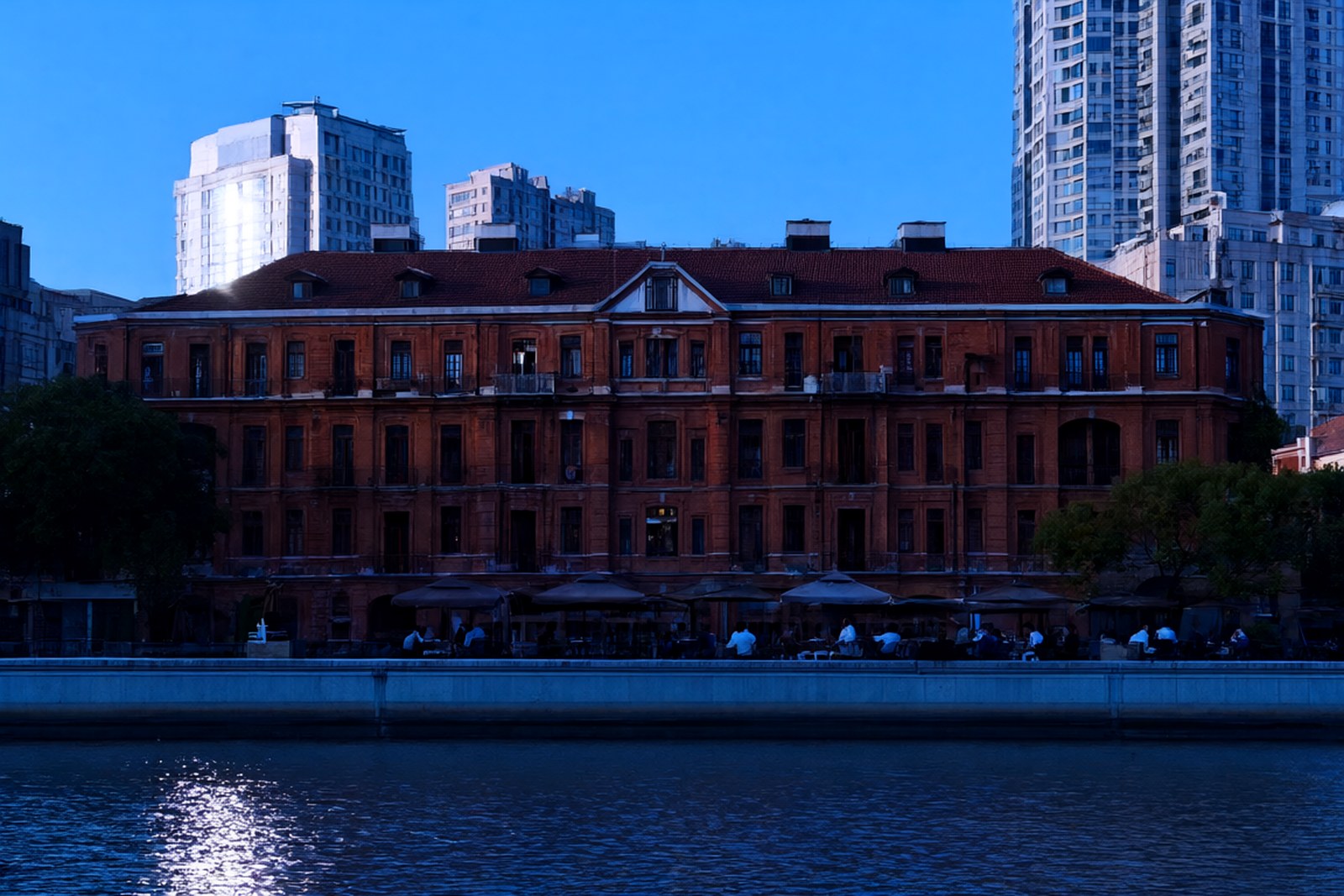
The key date is 1891, when Chongqing opened as a treaty port – and, by the city’s official histories, the bank that opened first was this one. A customs house began work here in March 1891, by most accounts, and the foreign firms followed: of the fifty-odd foreign houses of the treaty era, gazetteer material credits the south bank with half. 龙门浩 Lóngménhào Longmenhao, the cove at the road’s western end, ranks among the earliest inland treaty harbours of western China, its hillside later carrying wartime embassies; consulates, barracks and warehouses made this the city’s window on the world – then, for most of a century, closed.
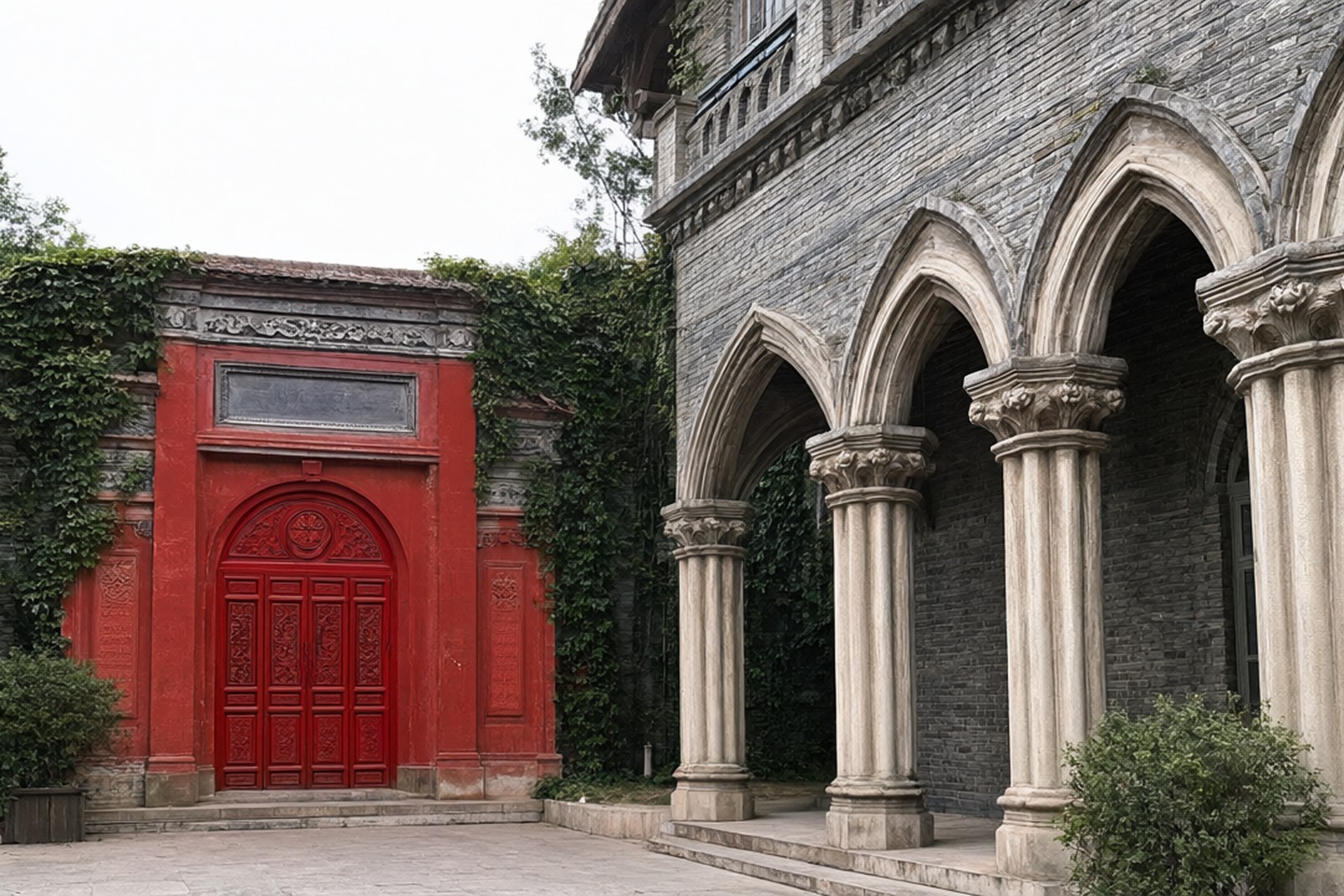
The flagship survivor is the French marine barracks, 法国水师兵营 Fǎguó shuǐshī bīngyíng, built in 1902-03 on ground that had held a Qing naval office – quarters, stores and a Yangtze control station for the French fleet, known locally as 奥当军营 Àodāng jūnyíng. The architecture is the era’s footprint: a Chinese memorial gateway with vermilion posts guards a European castle of Gothic arcades, one walled compound of main, side and annex blocks. The city protected it as a municipal heritage site in 2000, raised to national rank in 2013; on 28 December 2018 it reopened free, its halls re-armed with a bookshop, exhibition rooms and a port-opening display. Later it served for a time as premises of the French consular presence, by the chronicles’ account – not the simplified “embassy site” the internet sometimes prints, which this page declines.
Two doors down, the record turns from gunboats to art. 安达森洋行 Āndásēn yángháng, the Andasson warehouse, was built in 1891 for a Swedish trading house – eight buildings of stone base and rammed-earth wall, cable-rails to the river. In May 1938, during the wartime relocation of the Palace Museum’s collections, 3,694 crates of them were stored in four of its warehouses; the story told at the memorial has the Swedish flag spread out when bombers circled, and by museum accounts nearly all the crates survived. In 1947 the treasures left the south bank from the 海棠溪 Hǎitángxī Haitang Creek landing for Nanjing. In January 2021 the warehouses reopened as the Palace Museum Relocation Memorial, rebuilt under the architect 张永和 Zhāng Yǒnghé Zhang Yonghe, a bookshop and a café among the vaults. The restoration runs in episodes along the road: the red villa of the British merchant 立德乐 Lìdélè Archibald Little, whose 1898 steamship broke the upper river’s isolation, now anchors a port-opening heritage park, and the lanes of 下浩里 Xiàhàolǐ Xiahaoli pour coffee from old trading-house quarters.
Words and Names
南滨路 Nánbīn Lù is Nanbin Road, where Chongqing’s treaty-port era began; 开埠 kāibù the opening of a treaty port – Chongqing’s came in 1891, the south bank first. 法国水师兵营 Fǎguó shuǐshī bīngyíng the French marine barracks of 1902-03; 奥当军营 Àodāng jūnyíng its original local name. 安达森洋行 Āndásēn yángháng the Swedish warehouse that held 3,694 crates of the Palace Museum collections in 1938; 故宫文物南迁 Gùgōng wénwù nánqiān their southward relocation; 海棠溪 Hǎitángxī Haitang Creek, the landing for the 1947 shipment home; 立德乐 Lìdélè Archibald John Little, the merchant of the 1898 steamship run. 龙门浩 Lóngménhào the earliest treaty-era cove; 下浩里 Xiàhàolǐ the restored lane quarter beside the road; 黄金四小时 huángjīn sì xiǎoshí the “golden four hours”, six to ten at night, the official phrase for the evening spending peak.
What the Locals Know
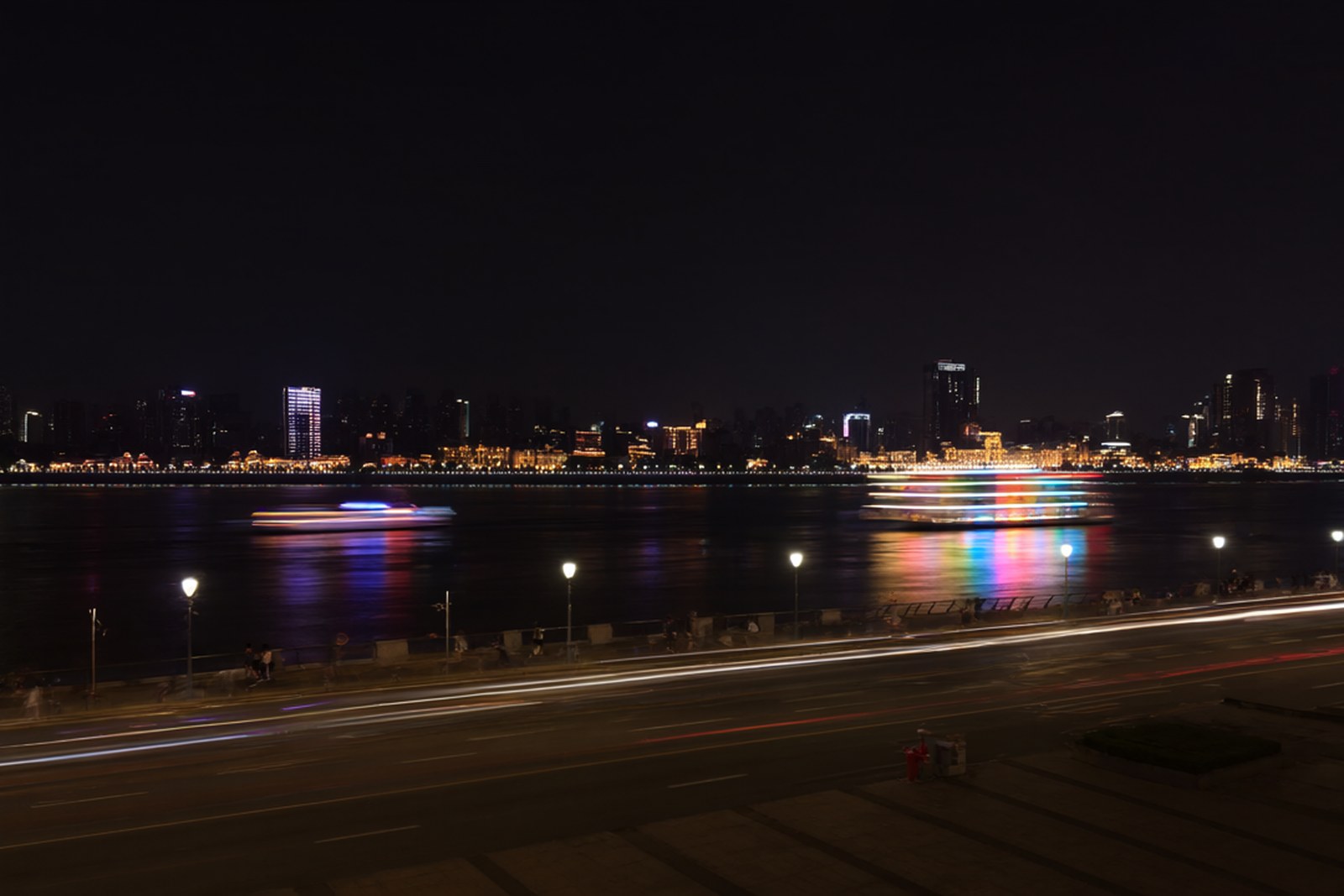
Old Nan’an residents periodise the road themselves: first the foreigners’ wharf, then vegetable plots and old factories, only then the dinner tables – dining, they note, is the youngest layer here. The old buildings are not scenery; plenty remember when the barracks stood locked with grass in its courtyard, and it was neighbours who came the day it reopened. The local walk times itself to the golden four hours: eat early, then take the half hour after dinner on foot toward Danzishi, cruise decks passing on the water – the cableway overhead keeps its story with the old peninsula’s pages. The night market’s sugar-painting and craft stalls are entertainment laid on for guests; what residents carry home is fried pepper and hotpot-base gift boxes, named here and left unopened. The quiet window: weekday tables before six, the half hour before the golden hours start.
flowcloud would say that Nanbin Road is dinner on top of chapter one – the bank where Chongqing’s treaty port opened in 1891, still wearing its buildings: the 1903 French marine barracks with its Chinese gateway and Gothic arcades, reopened in 2018, and the 1891 Swedish warehouse that held 3,694 crates of the Palace Museum collections through the war, reopened in 2021 as their memorial. After a century of sleep the buildings pour coffee, hold tables and light a night market, and the golden four hours from six to ten carry about sixty per cent of evening spending by the 2024 accounting.
Where to find it: the treaty-port belt of 南滨路 Nánbīn Lù Nanbin Road, 南岸区 Nán’àn Qū Nan’an District, Chongqing Municipality – the French marine barracks at 谦泰巷 Qiāntài Xiàng Qiantai Lane 142, Danzishi, through the port-opening heritage park and the Xiahaoli lanes to the Andasson warehouse and its Palace Museum Relocation Memorial by the 字水霄灯 Zìshuǐ Xiāodēng bus stop. Metro line 6 to Shangxinjie and a bus along the river, or any taxi that answers to Nanbin Road. The barracks and the memorial are free to enter on the last public notices – check current official announcements before going. The night-economy figures come from 2024 public reporting, checked October 2026, and drift; no restaurant is ranked here, and no foreign-city nickname is used for a riverbank that argues its own case.