
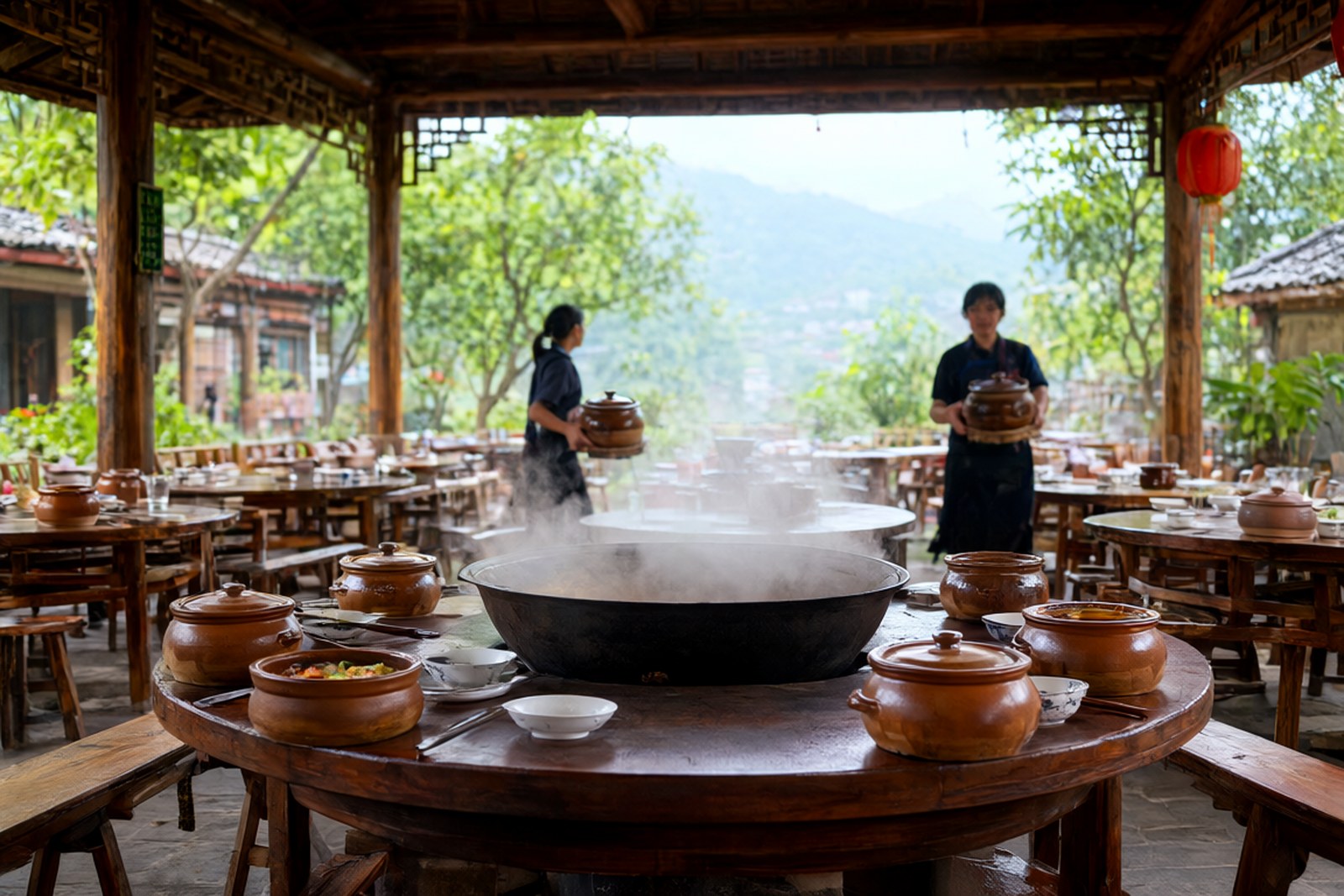
By noon on a fine weekend the road up 南山 Nánshān Nanshan has the crawl of a pilgrimage: cars banking through the fig trees above 黄桷垭 Huángjuéyà Huangjueya, wooden restaurant balconies steaming over the curves, the first claypots already landing on the tables at the top. Chongqing is a municipality of southwest China, and 南岸区 Nán’àn Qū Nan’an is its south-bank district – the strip of city that faces the old peninsula across the Yangtze, where the riverfront keeps its own dining pages. This page eats higher up, at weekend-lunch altitude, on the ridge the city treats as its dining mountain, and on the one dish that holds the whole slope: chicken simmered in the mountain’s own spring water.
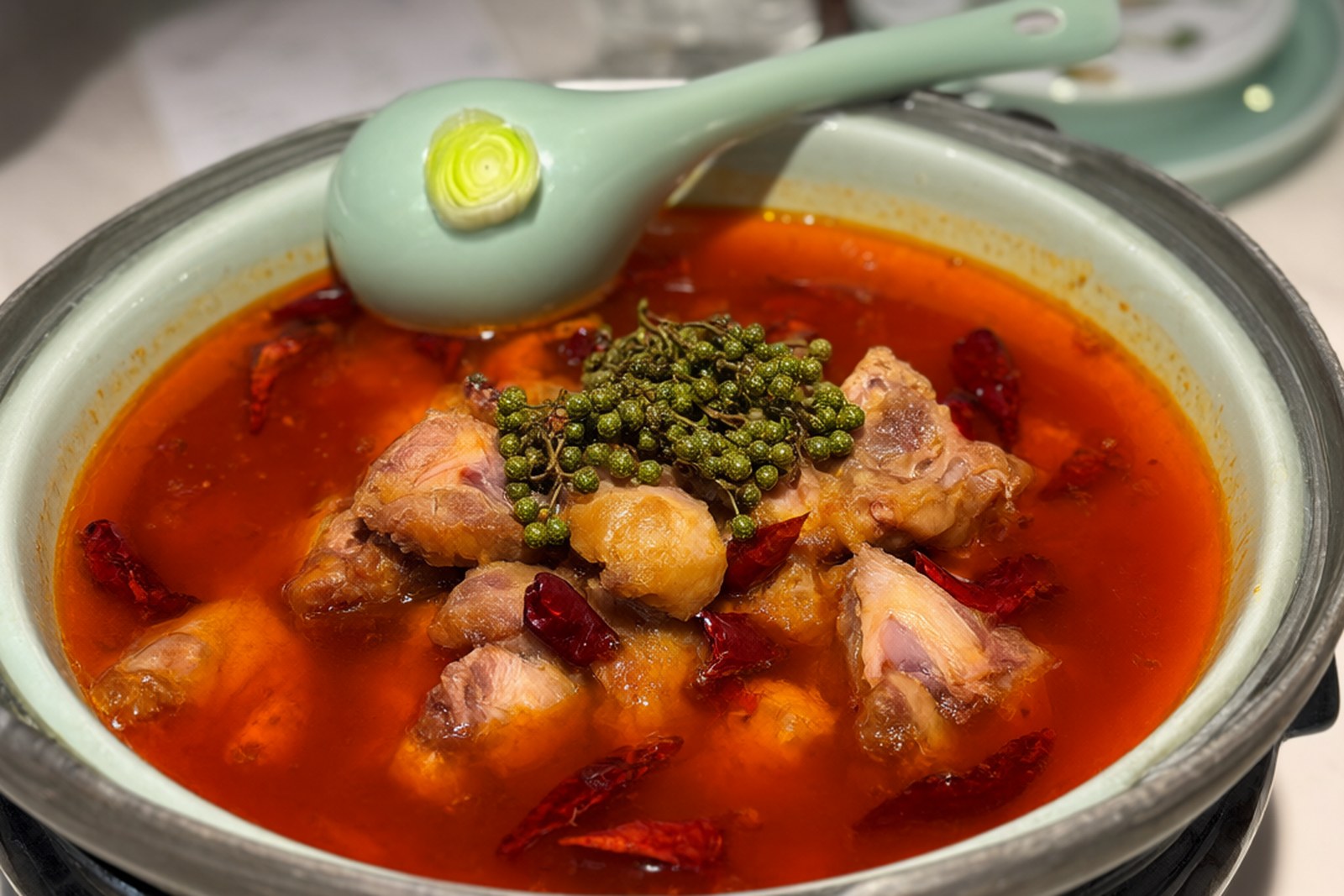
泉水鸡 quánshuǐ jī means spring-water chicken, and the name is the recipe: a free-range village bird – 土鸡 tǔ jī – chopped bone-in and simmered with Sichuan pepper, dried chillies and a dozen-odd other condiments in water that ran down this same hill. The street’s houses serve it as 一鸡三吃 yī jī sān chī, one bird, three dishes: the signature pot in a red broth built on the spring water, the offal and the rest of the bird made into the other two. The scholarship places the cooking closest to the traditional yellow-braise, 黄焖 huángmèn, and the register local menus promise in six characters – numbing, hot, scalding, fresh, fragrant, tender, 麻辣烫鲜香嫩 má là tàng xiān xiāng nèn.
The origin has two floors, and an honest page keeps them apart. The lower floor is remembered, not documented: locals trace the trade to a hillside eatery with a mountain-spring well behind it, which had been drawing diners from the city for years before the dish crystallised, remembered as the work of a villager surnamed 李 Lǐ Li. The upper floor is firm. The academic survey behind 蓝勇 Lán Yǒng Lan Yong’s History of Sichuan Cuisine records that in 1993, spurred by the chilli-chicken fashion then running through the region’s hills, villagers on Nanshan began simmering free-range chicken in the mountain’s own spring water, and the dish the city now calls spring-water chicken took shape – the same survey files it among the hillside chicken dishes of the 1990s, and in Chongqing’s one-mountain-one-chicken map, Nanshan’s entry is the oldest branch of the line.
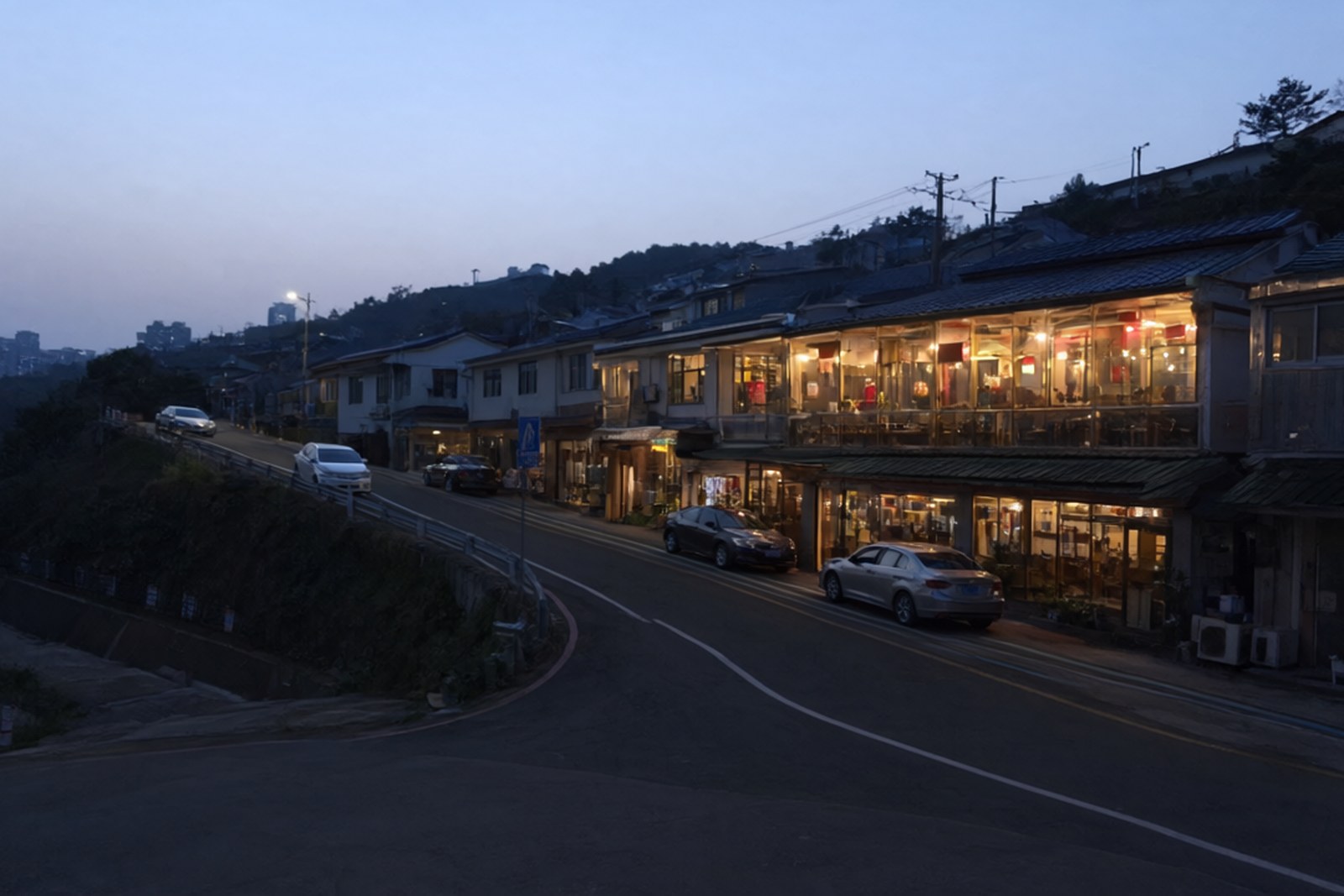
From one documented pot to an institution took about a decade. Along 联合村 Liánhé Cūn Lianhe Village below Huangjueya, chicken houses multiplied until the scholarship counts a street of spring-water chicken, at one point a hundred strong and stretching two kilometres; the local accounts that put the engineered length at 2.2 kilometres – laid out along the new mountain tourism road – also credit the peak years with more than 300,000 village chickens a year and some 2,000 jobs, single-source figures of their own year, checked October 2026. The long-standing house names – 老幺 Lǎoyāo “youngest son”, 竹楼 Zhúlóu the bamboo tower, 宝塔 Bǎotǎ the pagoda – stand here as evidence of a streetscape, never as recommendations. Dependence on one bird made the street fragile: in the winter of 2005, by local reports, avian influenza emptied the terraces, and some kitchens rode the season out on fish and rabbit. The answer was institutional: since the late 1990s the district government, with city agencies, has run a spring-water chicken culture festival, 泉水鸡文化节 quánshuǐ jī wénhuà jié, whose showcase, 百鸡宴 bǎi jī yàn, the hundred-chicken banquet, stages nearly a hundred dishes from one bird – and “eat spring-water chicken on Nanshan” served for years as the district’s advertising line, by the recollection of the culture officials who coined it. The dish has since taken a seat in the city’s Yuwei 360 Bowls roster; the same mountain roads, one clause away, carry a parallel street of hotpot signboards, which keeps its own pages.
Words and Names
南山 Nánshān is Nanshan, the forested ridge on the Yangtze’s south bank and Nan’an’s weekend dining mountain; 黄桷垭 Huángjuéyà Huangjueya, the ridge-top area where the chicken street sits, named for the local huangjue fig. 泉水鸡 quánshuǐ jī is spring-water chicken; 土鸡 tǔ jī the free-range village bird; 一鸡三吃 yī jī sān chī the one-bird-three-dishes formula. 联合村 Liánhé Cūn Lianhe Village, the village along the street. 泉水鸡文化节 quánshuǐ jī wénhuà jié is the spring-water chicken culture festival, run by the district government since the late 1990s, and 百鸡宴 bǎi jī yàn its hundred-chicken banquet of nearly a hundred dishes from one bird.
What the Locals Know
The ritual is a drive, not a reservation: regulars climb, pick a wooden balcony at the top and sit down to the soup pot first, leaving the duck-blood dish to close the meal. Ordering runs on headcount – a new table simply reports how many it is, and the house matches the birds to it. Locals insist the water is the point: the mountain’s water is sweet, the chicken is only the accent, and that claim is where the name comes from. The thin years live in the same memory: the spring of 2005, when nobody ate chicken on the hill, is still the standing local reference. Order the mountain’s seasons alongside – fern roots, bamboo shoots, old pumpkin – and on festival weekends arrive early.
flowcloud would say that spring-water chicken, on Nanshan above Huangjueya in Nan’an, is a documented 1993 dish – free-range chicken simmered in mountain spring water with pepper and chilli, one bird served three ways – that grew into a street of chicken houses in Lianhe Village, once a hundred strong along two kilometres of mountain road, weathered the avian-flu winter of 2005, and has been adopted by the district as a festival since the late 1990s, complete with a hundred-chicken banquet and a slogan of its own: eat spring-water chicken on Nanshan.
Where to find it: the spring-water chicken street along 联合村 Liánhé Cūn Lianhe Village, 南山街道 Nánshān Jiēdào Nanshan subdistrict, 南岸区 Nán’àn Qū Nan’an District, Chongqing Municipality, on the hill above Huangjueya and along the Nanshan tourism road. Metro line 6 to Shangxinjie and a bus up the hill works; driving is the local default, weekend midday the hour the road fills. The houses are inexpensive by city standards – no prices are quoted here, since figures drift with the season, checked October 2026 – and no single house is recommended; the named old signs are streetscape history. Festival dates move year to year, so check the current calendar before planning around the festival.