
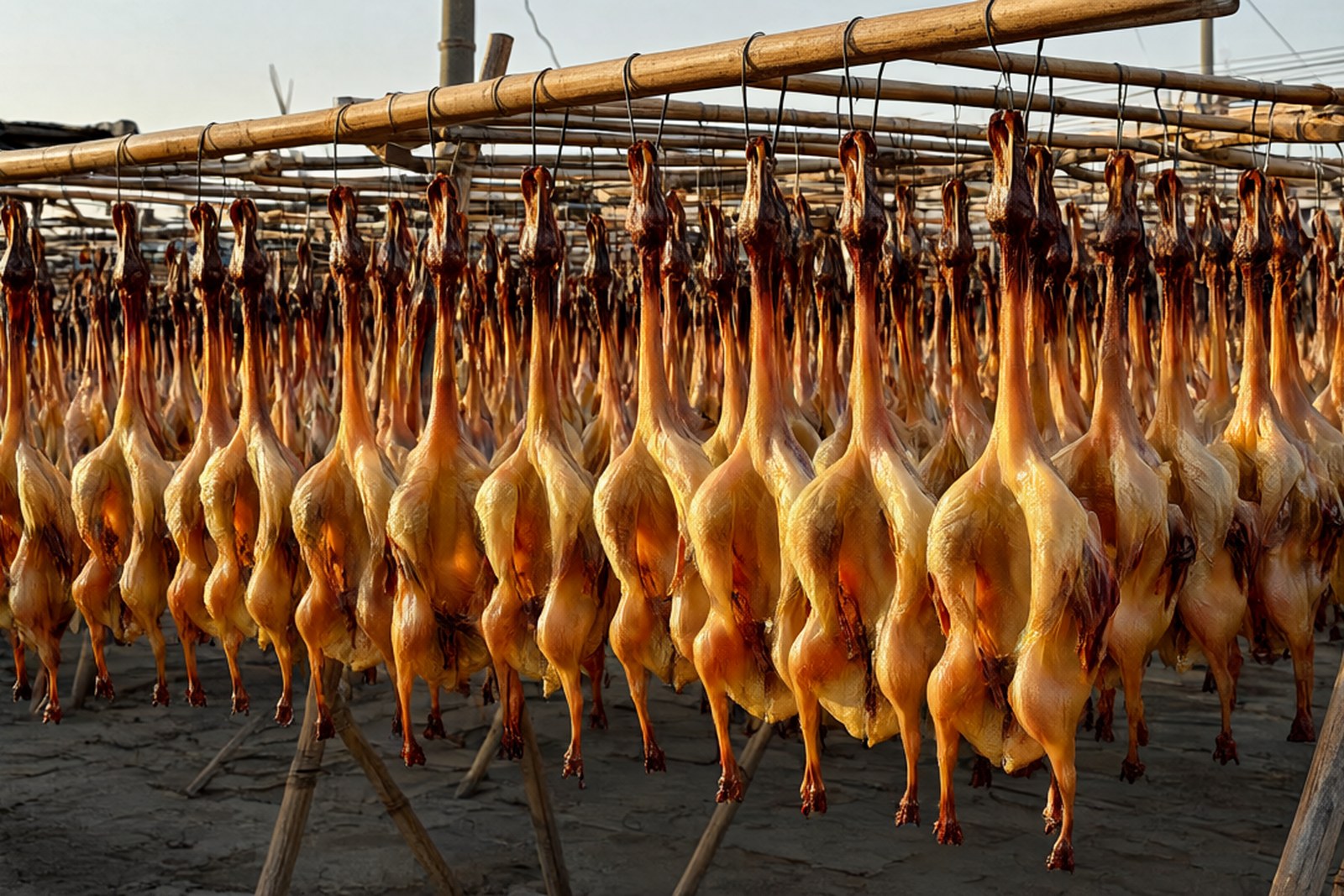
南雄板鸭 nán xióng bǎn yā is a duck that has been salted, flattened and dried in the wind, and it is made only in winter. 板 bǎn means board, and the name is a description of the shape: the bird is split down the back, pressed flat under a weight, and then hung up folded into what the trade calls a 琵琶形 pí pá xíng, a pipa shape, or a 桃园形 táo yuán xíng, a peach-orchard shape. What comes off the string is a flat, amber, semi-transparent object with the bones running through it, and it is one of the few Chinese cured meats with a geographical indication, a provincial intangible-heritage listing and a seven-hundred-year-old sentence in its own gazetteer. It is also the food that taught this corner of Guangdong how to keep a pig through the winter, and the county’s cured-meat trade is old enough to have been taxed by a Republican government and documented by a Qing prefect. What those documents describe is a craft that has changed less than the county’s promotional language suggests: the salt is still weighed, the pressing still uses a board, and the ducks still go out into the frost at night. The 板鸭 is also, in the way it is eaten, a completely different food from the goose down the road. There is no chilli anywhere near it. It is salt and smoke and time, it is served in thin red pieces over rice, and it is one of the handful of Guangdong foods that people outside the province recognise on sight. What it has in common with the goose is only the place: 南雄 is a county of about thirty-two hundred square kilometres at the top of the province, cold enough in winter for frost and warm enough in summer for rice, with enough standing water to raise a great many ducks, and both dishes exist because the county has always had more birds than it could eat fresh. A 板鸭 is also cheap by the standards of cured meat, at anything from eighteen to thirty yuan a kilo, which is the other half of why it travelled: it was a protein that a poor household could hang up and eat from all winter, and the county’s own Republican-era tax records suggest it was sold in very large numbers long before anyone thought to call it a delicacy.
The oldest thing written about it is the best thing written about it, and it is a single line in the 清 Qīng gazetteer 直隶南雄州志 Zhí lì Nán xióng zhōu zhì, the prefecture’s own record, in juan nine, the section on local products: 雄鸭,以雄得名,鸭嫩而肥,腌之,渍以茶油,日久鲜红味美,广城甚贵之 xióng yā, yǐ xióng dé míng, yā nèn ér féi, yān zhī, zì yǐ chá yóu, rì jiǔ xiān hóng wèi měi, Guǎng chéng shèn guì zhī – the Nanxiong duck takes its name from the place, the duck is tender and fat, it is salted, it is dressed with camellia oil, and after a long time it is a fresh red and good to eat, and the city of Canton held it dear. Everything the modern trade does is in that sentence: the bird, the salt, the oil, the wait, and the fact that the buyers are a long way away.
The county’s account of the craft is that it is very old and that it industrialised in the Ming. The 南雄麻鸭 Nán xióng má yā, the local speckled duck, has been cured here for something on a thousand years, and by the 万历 Wàn lì years of the sixteenth century, five hundred-odd years ago, there was a production trade rather than a household habit. The early method was what the countryside still calls 泡腌 pào yān, soak-cured: the bird was packed in coarse salt, taken out, and dried in the sun with nothing holding it flat, so it came out plump and irregular. The change to 绷板 bēng bǎn, bracing it against a board, is what made the flat bird and what made the name; the pressing was done with a door plank or a millstone at first, and the folding of the legs and the shaping into the pipa came later. From that point a cured duck stopped being a duck and became a 板鸭, a board duck.
The season is not a preference, it is a condition. The county’s own window for the whole trade is 寒露 Hán lù, around the eighth of October, to 立春 Lì chūn in early February, and the reason is the weather and not the calendar: what makes a 南雄板鸭 what it is, in the county’s own explanation, is that the local winter has a wide swing between day and night and frost on the ground at dawn. The duck goes out into the sun by day and stands in the cold by night, and the local phrase for the second half of that is 打霜 dǎ shuāng, taking the frost – the birds are left out overnight on purpose. The county has a saying for when the season opens, 北风起,腊鸭香 běi fēng qǐ, là yā xiāng, when the north wind gets up the cured duck smells good, and the ducks are made in the north of the county at 黄坑镇 Huáng kēng zhèn, 全安镇 Quán ān zhèn and 乌迳镇 Wū jìng zhèn, where the ponds are.
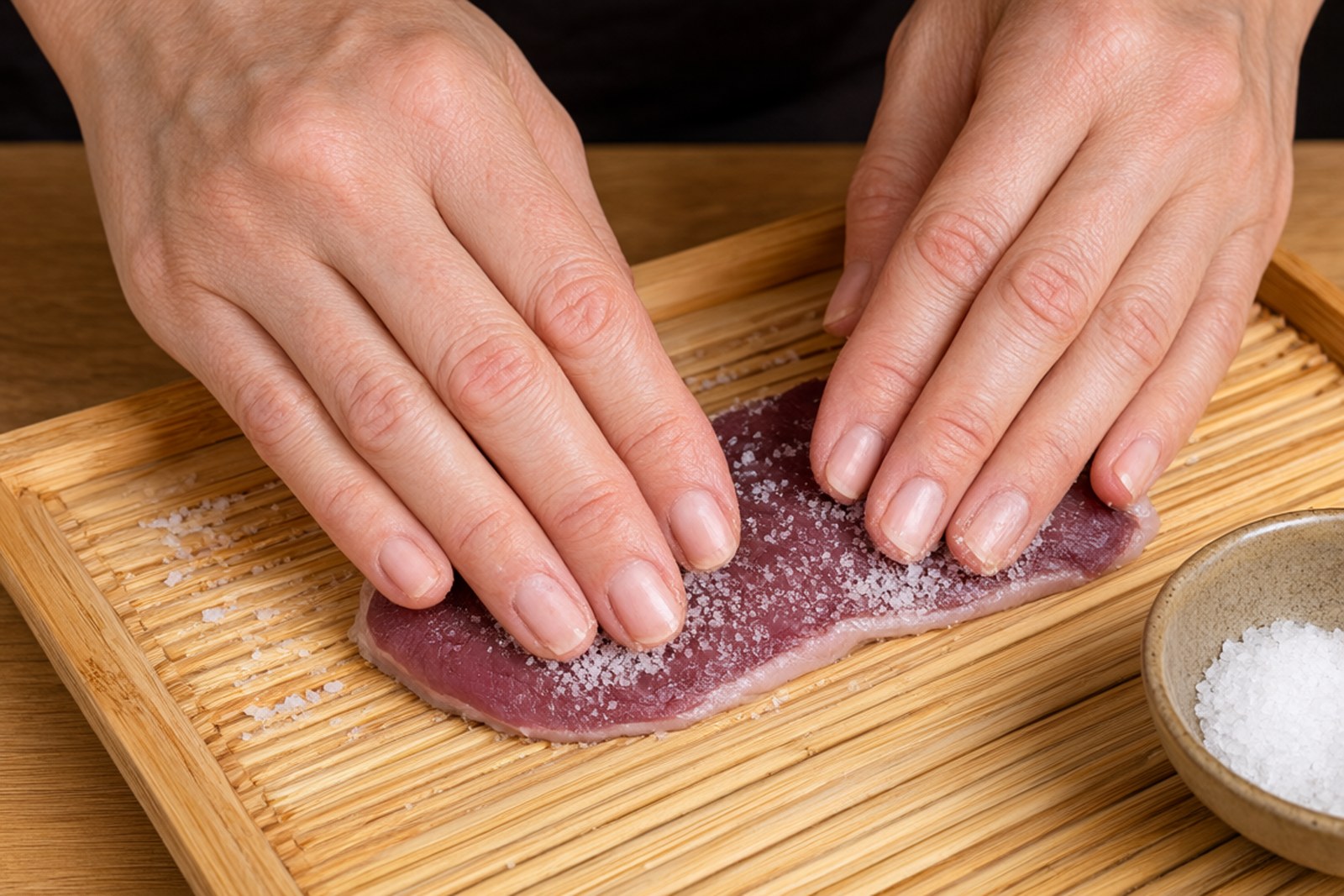
The method is seven steps and the numbers attached to them are unusually precise, which is what makes it possible to say what a good one is. The bird is a 麻鸭, and the trade will not take a duck that has laid eggs or has already moulted through to new plumage; the chosen age is ninety to a hundred days, after a twenty-eight day fattening period, and the weight band is 1.25 to 1.75 kilos for a drake and 1.5 to 2 kilos for a duck. It is hung upside down and bled thoroughly, plucked, opened and eviscerated, and then hung in a draught for an hour to drip. Then the back ribs and the breastbone are chopped through so the carcass will lie flat – 砍断背部肋骨及胸骨使平整 – and the salt goes on: fine salt, fried dry in a pan and left to go cold first, rubbed by hand, at a hundred to a hundred and twenty-five grams to the bird. It stands in a crock in that salt for six to eight hours and no longer. It is spread on a bamboo 挞 tà, pressed under a weight to shape it, wiped down with a clean cloth, and painted with 头酒 tóu jiǔ, the first-run rice wine the county distils, which is there to add aroma and to hold the surface. Then the drying: sun by day, frost by night, and finally a hanging under the eaves until the skin goes a translucent gold. The finish the trade is looking for is listed as 表皮呈金黄半透明 biǎo pí chéng jīn huáng bàn tòu míng, skin golden and half-transparent, and the whole bird should be 皮薄肉嫩、肉红味鲜、骨脆可嚼 pí báo ròu nèn, ròu hóng wèi xiān, gǔ cuì kě jiáo – thin-skinned and tender, red-fleshed and savoury, with bones brittle enough to chew. A flute that will not snap is an under-dried one.
The Trade and the Lane
The place to see it made and sold is 珠玑巷 Zhū jī xiàng, the lane outside 南雄 that is the starting point of a great many Cantonese family histories, and within the lane the 腊巷 là xiàng, the cured-meat lane, which is the trade’s own street of workshops. The lane sold about two million ducks in 2015 at eighteen to thirty yuan a kilo, which is a great deal of duck for a county of this size, and the buyers are no longer only local: every year merchants come up from 广州 Guǎng zhōu, from the cities of the Pearl River Delta and from Hong Kong and Macau to place orders. The ducks travel better than almost any other Cantonese cured meat because they are flat, dry and hard, and that is not an accident of the recipe – a bird pressed flat packs and ships in a way a round one does not, which is probably why the board was introduced in the first place.
The official recognition has come in three layers and they are often confused with one another, so they are worth separating. The 原国家质检总局 Yuán guó jiā zhì jiǎn zǒng jú, the former national quality inspection administration, granted geographical-indication protection on 26 May 2009. The craft went onto the eighth batch of the Guangdong provincial intangible-heritage list in May 2022, filed under 腊味制作技艺 là wèi zhì zuò jì yì, cured-meat making technique, as one of sixteen traditional techniques taken from the whole province in that batch. In December 2019 the duck went onto the fourth national list of famous, special and excellent new agricultural products. None of these is a national-level intangible-heritage listing, and the county does not claim one. What the county does claim, and can show, is that the trade was large enough in the Republican period to be worth taxing on its own: the 民国 Mín guó government levied a specific duty called 腊鸭税 là yā shuì, the cured-duck tax, which is not a thing a county invents about a business that is not there.
Words and Names
南雄板鸭 nán xióng bǎn yā is the duck: 南雄 the county, 板 bǎn a board, 鸭 yā a duck, so the duck pressed flat on a board. The everyday names are 腊鸭 là yā, cured duck, and 曝腌 pù yān, sun-cured, and the old technique before the pressing was 泡腌 pào yān, soak-cured. 麻鸭 má yā is the local speckled duck the trade insists on. 绷板 bēng bǎn is the bracing that gives the bird its shape, 打霜 dǎ shuāng is the overnight frost the ducks are deliberately left out in, 头酒 tóu jiǔ is the first-run rice wine they are painted with and 腊巷 là xiàng, the cured-meat lane, is the row of workshops inside 珠玑巷. 寒露 Hán lù and 立春 Lì chūn are the solar terms that open and close the season.
What the Locals Know
Buy it flat and buy it hard. A good 南雄板鸭 has a skin the colour of thin amber held against a window, a dry matte surface with no tackiness anywhere, and a smell of salt, wood and cured fat with nothing sour at the edge. Press the breast: it should feel like a board with a little give under it, not like meat. A duck that is still soft in the middle has not had its nights outside, and a duck that is stiff as a plank throughout has been dried too fast and will eat like leather. Look at the bones through the thin parts of the meat – a good bird is red-fleshed, not grey. At home it is usually cut into pieces and steamed over rice with a little ginger, or chopped and stir-fried with garlic shoots and chilli, and the whole point of either is the fat that comes out of the skin into whatever is under it, so put something under it. It does not need to be soaked unless the salt was heavy, in which case fifteen minutes in warm water and a wipe-down is enough, and it will not need salt of its own. The season matters for eating and not only for making: in summer what is on sale has been held over, and held-over cured duck is a flatter, saltier thing than the bird that came off the winter wind in January. The county’s own advice is to buy between the first north wind and the spring, and the reason there is a lane of workshops selling ducks is that a household with a winter north-facing balcony is already halfway to being able to make one.
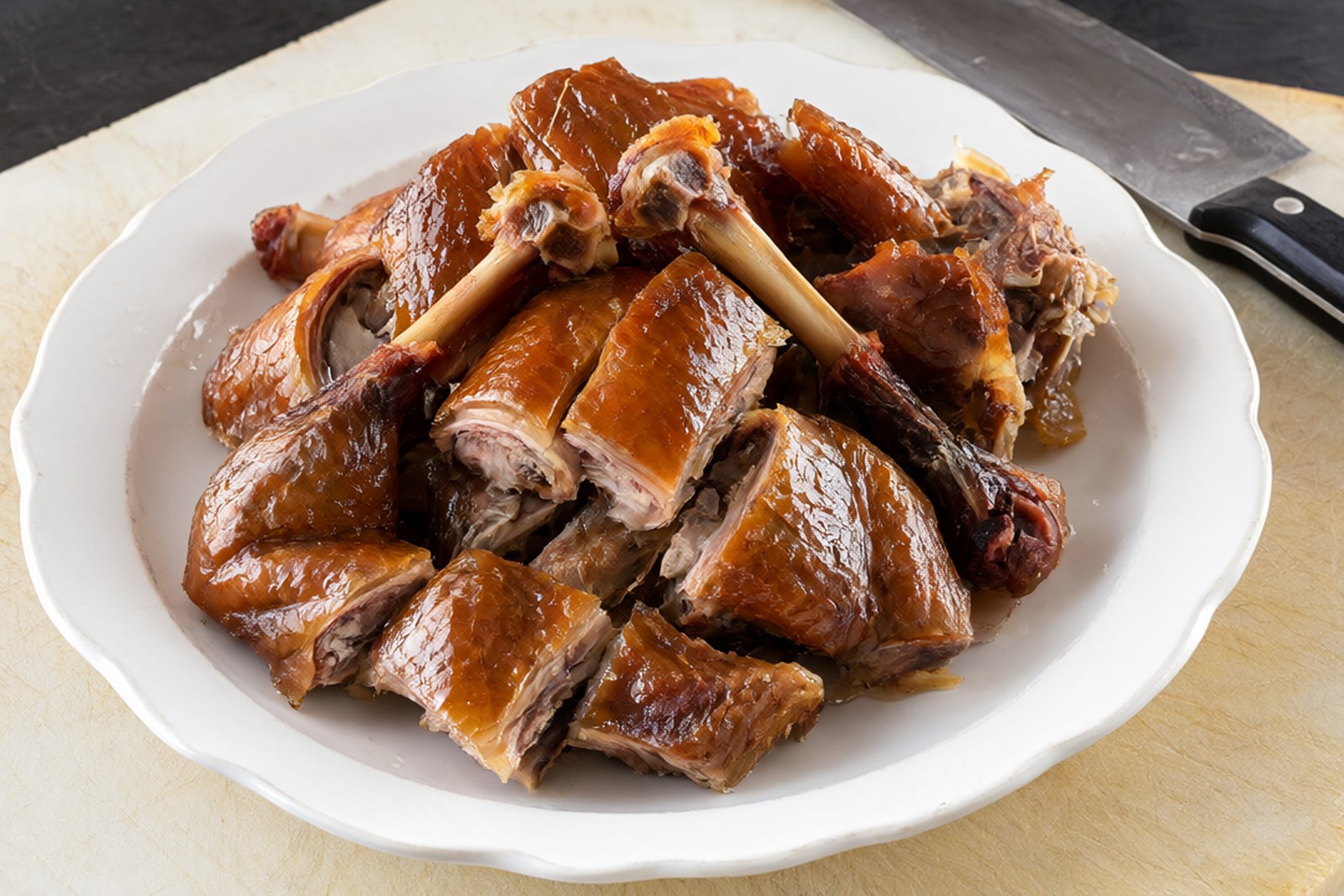
flowcloud would say that the most sophisticated thing about 南雄板鸭 is that a county worked out centuries ago that flattening a food is a way of making it travel, and that the board press under the eaves has done more for the local duck trade than any recipe ever did.
Where to find it: the 腊巷 là xiàng, the cured-meat lane inside 珠玑巷 Zhū jī xiàng, the old lane about nine kilometres from 南雄市区 Nán xióng shì qū, where the workshops press and hang their own birds and where you can watch the whole sequence in season; the market stalls of 南雄市区 itself; and the producing townships of 黄坑镇 Huáng kēng zhèn, 全安镇 Quán ān zhèn and 乌迳镇 Wū jìng zhèn, which hold most of the county’s duck ponds. 南雄 is about an hour and a half by road from 韶关市区 in the far north-east of the prefecture and is served by trains at 南雄站 on the 赣韶 line. Buy in the window between 寒露 and 立春, ask what date a bird was hung, and if the seller cannot tell you, buy somewhere else. Whole birds are sold wrapped flat like a book, which makes them the easiest gift in the prefecture to carry home.