
You sit down expecting a penance and are served a banquet. There is a plate of sliced 素鸡 sùjī, vegetarian chicken, layered and taut like the real thing; a braised 素扣肉 sùkòuròu, vegetarian pork belly, where the fat is made of konjac and the skin of bean curd; small dishes of 竹笋 zhúsǔn, bamboo shoot, and mountain fern; a clear soup of 香菇 xiānggū mushrooms that tastes like it has been simmering for hours; and a bowl of noodles so plain they seem ascetic until you notice the depth underneath them. There is no meat anywhere, no garlic, no onion, no leek, no chives, nothing from the 五辛 wǔxīn list of pungent plants, and yet nothing tastes like it is missing. This is 南岳素食 Nányuè sùshí, the vegetarian cooking of 南岳 Nányuè, the mountain town at the foot of 衡山 Héng Shān, and it is one of the more interesting kitchens in central China.
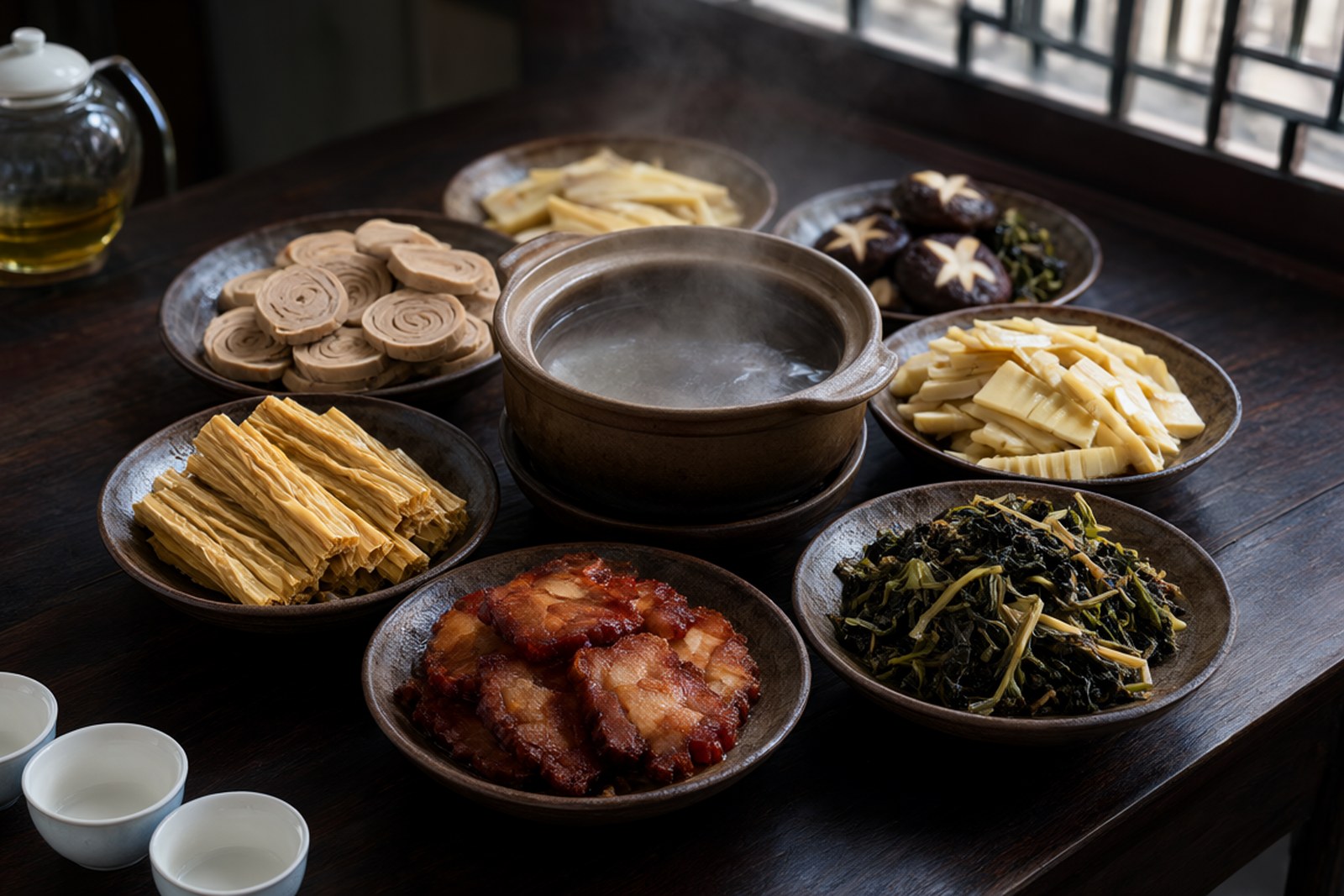
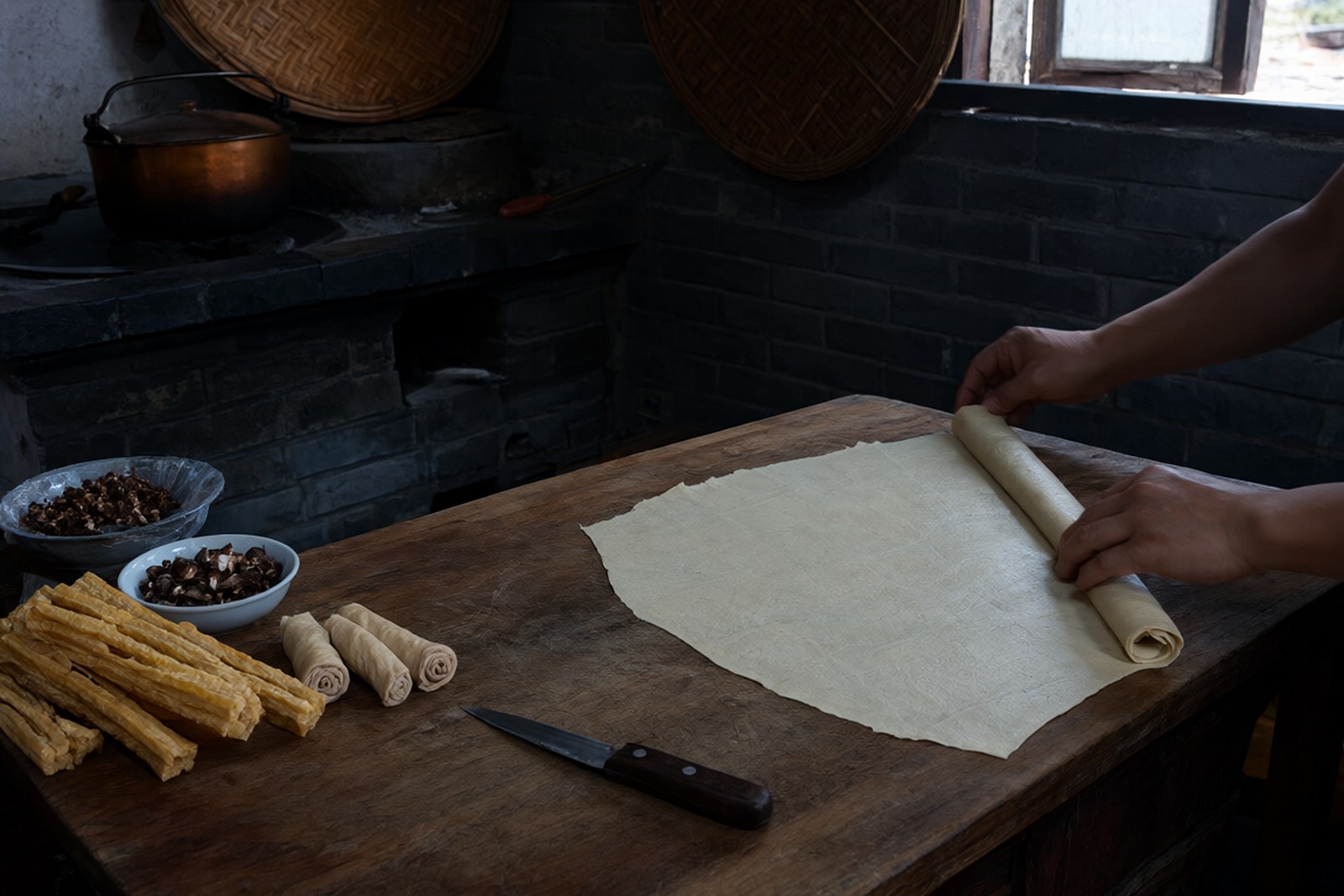
The cuisine exists because of pilgrims. Mount Heng has been a place of worship for well over a thousand years, with a rare arrangement at its heart: the mountain’s 南岳大庙 Nányuè Dàmiào, the Grand Temple, houses Buddhist monks on the west side and Taoist priests on the east, and both traditions fed the people who climbed. Temple food in China is governed by rules rather than by flavours — no meat, no fish, and for observant kitchens no strong aromatics — so the cooks learned to build savour from plant ingredients alone. Tofu and its many forms do most of the work: 豆腐 dòufu itself, 豆皮 dòupí as sheets, 腐竹 fǔzhú as dried sticks, 油豆腐 yóudòufu fried, and 面筋 miànjīn wheat gluten, which is the only ingredient elastic enough to imitate muscle. Add wild mushrooms, bamboo shoots, lotus root, 山药 shānyào yam, and the mountain’s own vegetables, and the repertoire turns out to be enormous.
The Imitation Problem
The most argued-about part of 南岳素食 is its devotion to mimicking meat, and the argument is not new. A vegetarian dish shaped and named like a chicken — 素鸡 sùjī — can be read as a skilful tribute to tradition or as a longing for what has been given up, and different temples take different positions. The 南台寺 Nántái Sì kitchens, among the best known on the mountain, are famous for both approaches: dishes that imitate and dishes that simply present a mushroom as a mushroom. What everyone agrees on is the technique. The savour comes from slow-simmered mushroom and kombu-type stocks, from 霉豆腐 méidòufu, fermented bean curd, used as a seasoning the way a western kitchen uses aged cheese, and from the deliberate use of 茶油 cháyóu and sesame oil for richness where fat would otherwise be missing.
Words and Names
素食 sùshí is vegetarian food, 素斋 sùzhāi a vegetarian ritual meal or the formal banquet form of it. 素 sù is the prefix that marks the imitation dishes: 素鸡 sùjī vegetarian chicken, 素鸭 sùyā vegetarian duck, 素扣肉 sùkòuròu vegetarian pork belly, 素火腿 sùhuǒtuǐ vegetarian ham. 五辛 wǔxīn is the set of pungent plants excluded from observant Buddhist cooking — garlic, onion, leek, chives and asafoetida. 豆皮 dòupí is bean curd skin, 腐竹 fǔzhú dried tofu sticks, 面筋 miànjīn wheat gluten, 霉豆腐 méidòufu fermented bean curd.
What the Locals Know
Do not order the feast by yourself. The best versions are set menus of eight to twelve small dishes arranged to move from cold and crisp through braised and soft to a soup and a noodle finish, and a table of two will be defeated. Prices are more reasonable than the setting suggests — a basic 素斋 sùzhāi of four dishes runs ¥30 to ¥60 a head, a formal banquet more — and the shops around the temple’s north gate do a plain 素面 sùmiàn, vegetarian noodle bowl, for ¥15 or so, which is what pilgrims actually eat. Ask what is in season; the mountain’s 春笋 chūnsǔn, spring bamboo shoot, and autumn mushrooms are worth timing a visit for. And notice the tea: 南岳云雾茶 Nányuè Yúnwù Chá, the mountain’s cloud-and-mist green tea, is served with the meal and is one of the region’s genuine products.
flowcloud would say that 南岳素食 is what happens when a cuisine is designed around a rule instead of an ingredient, and that the rule turns out to be the most interesting thing about it.
Where to find it: the vegetarian kitchens and 素菜馆 sùcàiguǎn of 南岳镇 Nányuè Zhèn in 衡山县 Héngshān Xiàn, concentrated around the streets north of 南岳大庙 Nányuè Dàmiào and at the temples up the mountain, with 南台寺 Nántái Sì and 祝圣寺 Zhùshèng Sì among the best known. Order the 素斋 sùzhāi set rather than individual dishes, ask for the 素面 sùmiàn if you want the pilgrim’s version, and drink the local 云雾茶 Yúnwù Chá with it.