
Old-Fire Soup
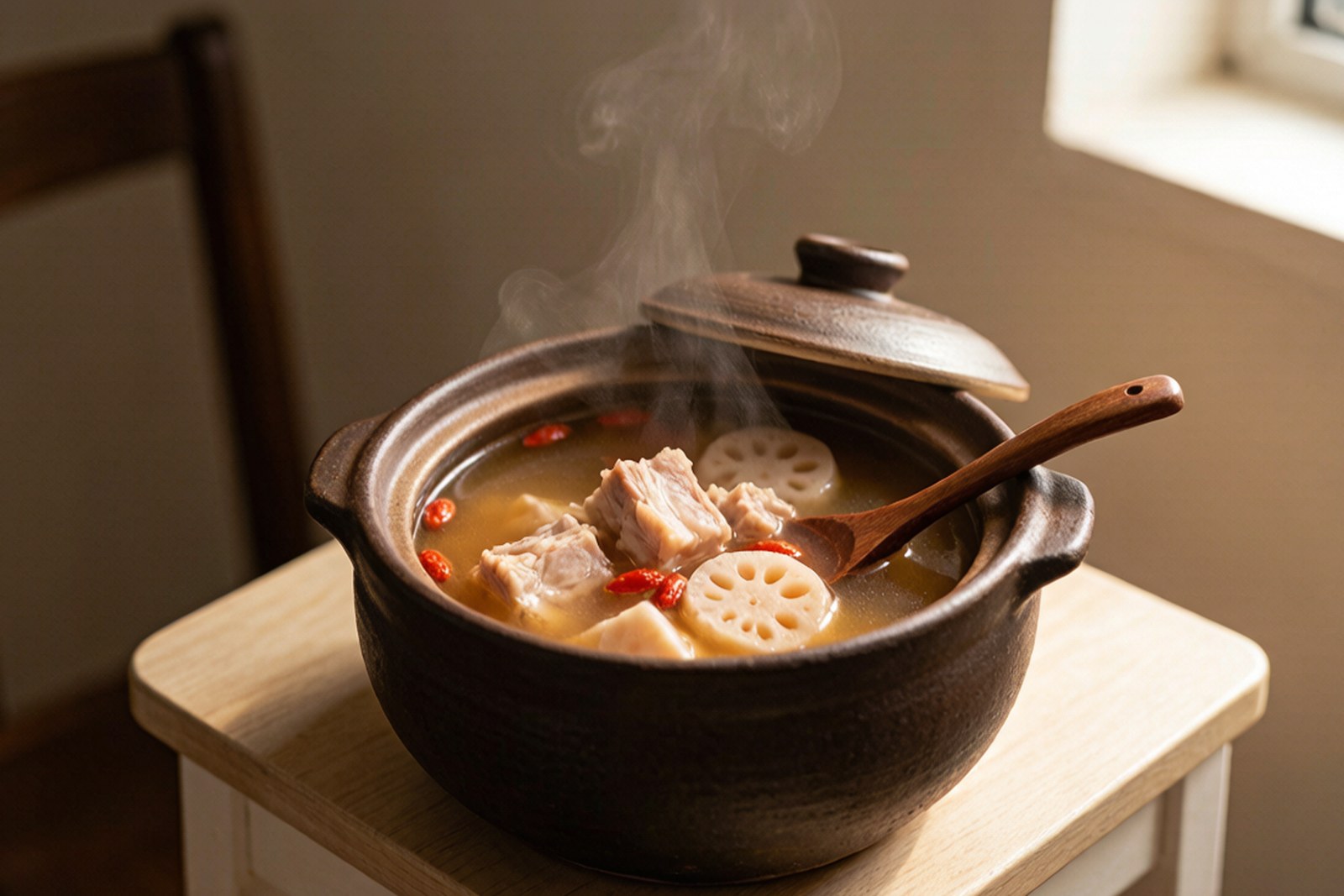
It arrives without ceremony, usually somewhere near the end of the meal when you have already decided you are full, and it is almost always the best thing on the table. A waitress sets down a heavy clay pot, lifts the lid, and the smell that comes up is not the smell of a dish — it is the smell of someone’s afternoon. Pork, dried scallop, lotus root, a sweetness that has nothing to do with sugar. I have eaten expensive things in Guangzhou that I have forgotten entirely, and I still think about a bowl of soup I did not order.
老火汤 (lǎohuǒ tāng) means “old-fire soup,” and the name is the entire recipe. Not a technique you can learn in an afternoon, not a sauce, not a flourish — a fire that was lit hours ago and has been left to do its slow work ever since, while somebody went about their day.
The Idea
Cantonese cooking has a category that the rest of Chinese cuisine only gestures at: 汤 (tāng), soup, treated not as a course but as a form of care. There is a whole body of folk knowledge attached to it — which ingredients are 清 (cooling) and which are 燥 (heating), what a person should drink when the weather turns humid, what a mother makes when her child has been studying too hard. This is not quite medicine and not quite superstition; it sits somewhere in between and is taken entirely seriously in every Guangdong household.
老火汤 is the most committed form of it. The point is extraction. You are not making a broth to cook other things in; the broth is the dish, and everything else in the pot is there to give itself up to it.
The Craft
The method is boring, which is precisely the difficulty.
You start with meat on the bone — pork ribs, chicken, sometimes a whole fish or a piece of 猪骨 (zhū gǔ, pork bone). The bones are 飞水 (fēi shuǐ, “flying water”): plunged into boiling water for a minute or two, then drained and rinsed. This is not optional. It is what pulls the blood and impurity out so the finished soup stays clear instead of turning grey and muddy, and it is the step beginners skip.
Then everything goes into a clay pot — the blanched bones, the aromatics, and the long-cooking ingredients of the day. Lotus root. Dried scallop. Lotus seeds. Job’s tears. Chinese yam. Dried dates. A few slices of ginger, never much. Water to cover, brought once to a boil, and then turned down to a state the Cantonese call 煲 (bāo) — a bare, patient tremble, tiny bubbles rising in a slow column, never a rolling boil.
And then you wait. Two hours minimum. Three is normal. Four is not unusual. The pot is not stirred constantly and it is not fussed over; it is simply left. Somewhere in the third hour the broth goes from pale and thin to gold and slightly viscous, and the kitchen fills with a smell that makes everybody in the house wander in to look at the pot.
Seasoning happens at the very end, and it is insultingly simple: a pinch of salt. That is all. No soy, no stock cube, nothing that would compete with what the two hours already did.
How It Is Eaten
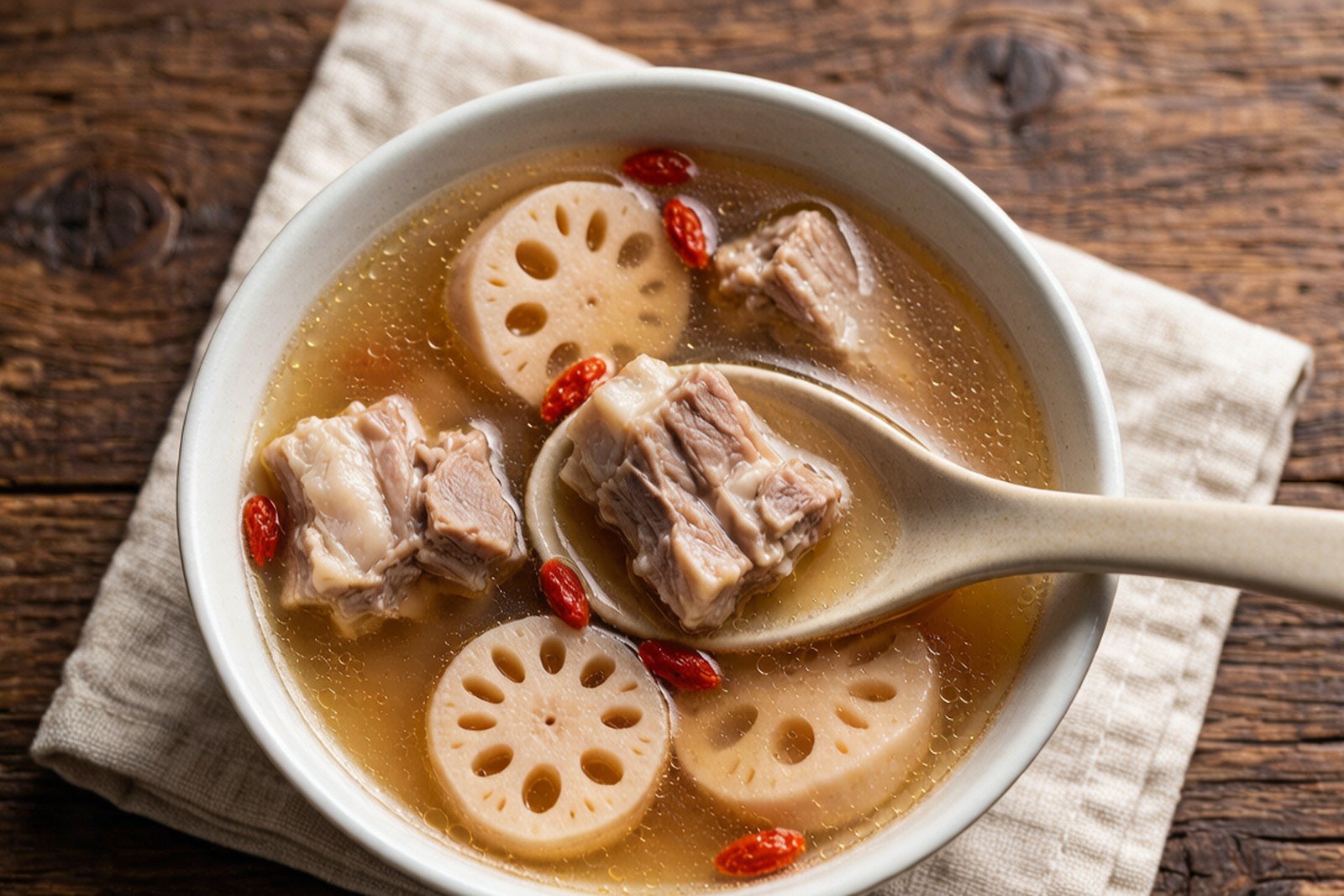
There is a fixed order to this that outsiders get wrong. The soup is drunk first — before the rice, before the meat dishes, before anything else on the table. A bowl of it goes round, everyone takes a few slow mouthfuls, and only then does the rest of the meal begin. Cantonese hosts will not start without it, and if you reach for the rice first you will get a look.
The solids in the pot — the ribs, the lotus root — are eaten afterwards, or not at all. Traditionally they are considered 汤渣 (tāng zhā, “soup dregs”): spent, their flavour already given to the liquid, and eaten mostly out of thrift. This is one of the genuinely counter-intuitive things about 老火汤, and it is worth knowing before you proudly finish the pork and get a politely baffled stare.
Words and Names
The name breaks down cleanly. 老 lǎo is “old,” 火 huǒ is “fire,” 汤 tāng is “soup” — old-fire soup, in the sense of a fire that has burned a long time. You will also see 煲汤 (bāotāng), “to simmer soup,” and 炖汤 (dùntāng), which is the double-boiled cousin: the same idea taken further, with the pot sealed and set inside a larger pot of water so nothing escapes at all. 炖汤 is the more expensive technique and the one restaurants charge the most for.
A related phrase you will hear constantly in Guangdong is 湿气 (shī qì), literally “damp qi” — the humidity that Cantonese cooking spends a great deal of energy countering. A soup that clears 湿气 is a good soup, and every auntie in the province has a different opinion on which one does it best.
What the Locals Know
The broth should be clear, not cloudy — cloudiness means it boiled hard, or the bones were not blanched properly.
Salt goes in at the end, never at the start — early salt tightens the meat and you get less out of it.
Do not boil it. The difference between 煲 (a tremble) and a rolling boil is the difference between clear soup and grey soup.
Ask what is in season — the good shops change their 老火汤 daily and the daily one is almost always the right order.
Drink it before the rice, whatever your instincts say.
Do not feel obliged to finish the solids — they have already done their job.
flowcloud would say that 老火汤 is the least photogenic thing in Cantonese cooking and the most honest: three hours of somebody’s afternoon reduced to a bowl of something that looks like nothing, and tastes like being looked after.
Where to find it: 老火汤 (lǎohuǒ tāng) is not really a restaurant dish — it is a household one, and the best bowl you will ever have is in somebody’s home. That said, the proper 汤 shops (汤馆, tāngguǎn) of 广州 Guǎngzhōu, the old neighbourhoods of 荔湾 Lìwān and 越秀 Yuèxiù, serve a different soup for every day of the week and are a genuine institution; a bowl runs about ¥15 to ¥40 depending on what went in. In 顺德 Shùndé, where Cantonese cooking is at its most serious, nearly every serious restaurant keeps a 老火汤 of the day — ask for 今日例汤 (jīnrì lìtāng, “today’s soup of the day”) and take whatever you are given. Order it at the start of the meal, drink it before the rice arrives, and remember that in Guangdong a good soup is not an appetiser. It is the point.