
The first thing to understand about Pingjiang dried tofu is that it is not soft. A block of it is dark, almost mahogany at the edges, firm enough to snap, and dry enough to survive a day in a coat pocket. It is sold in small bags, cut into slabs or triangles, sometimes threaded onto a skewer, and eaten with the fingers while walking. In 平江县 Píngjiāng Xiàn, a mountainous county in the far east of Yueyang that runs up against the Jiangxi border, this is the local snack the way a bag of crisps is a snack elsewhere — except that it has been made here since the Qing dynasty, it employs a great many people, and it is now a business worth a serious amount of money.
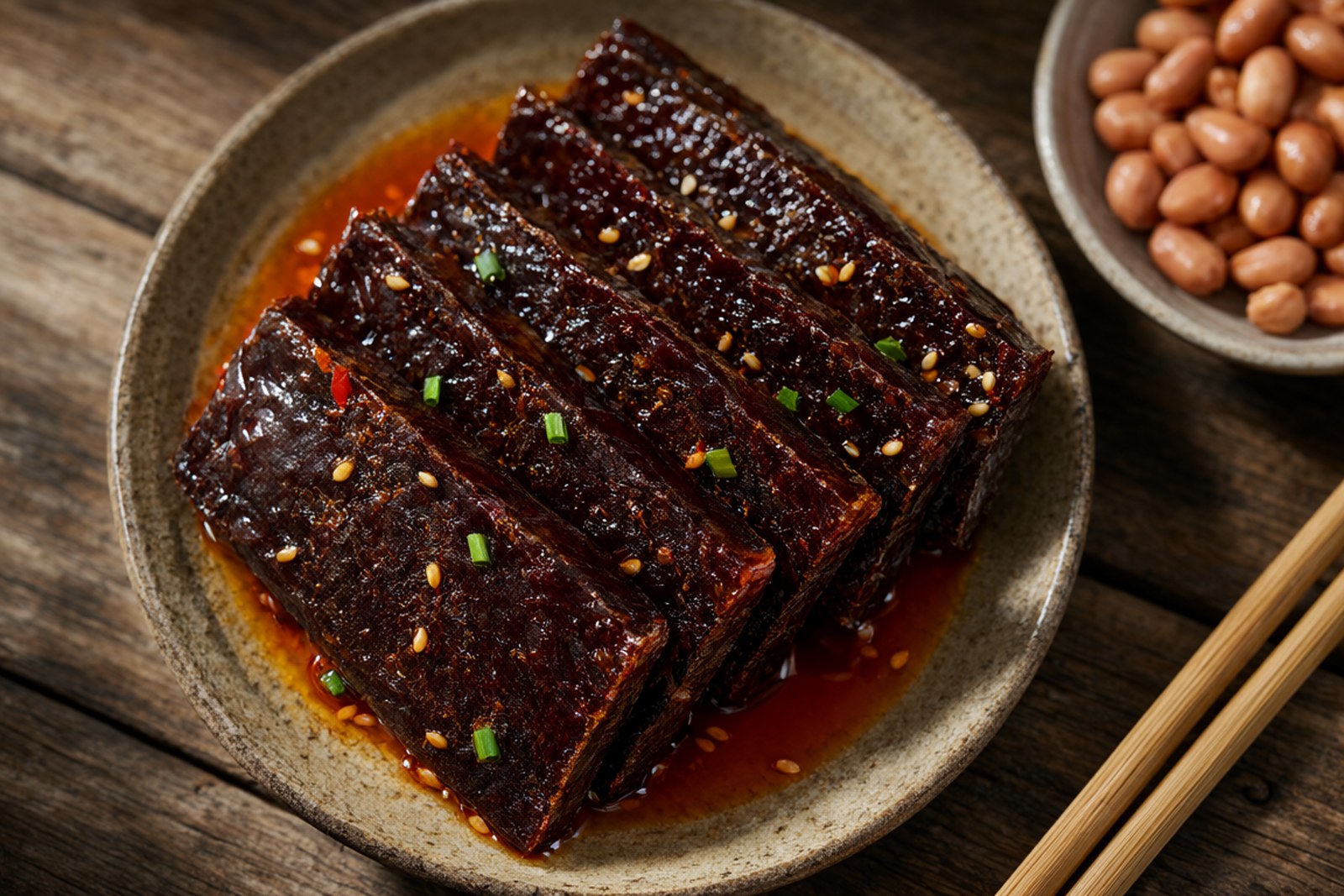
The process is a long series of subtractions. Soybeans are soaked and ground, the milk is boiled and coagulated, and the curds are pressed hard in a mould until the water is out and a firm 豆腐 dòufu remains. That block is then cut, seasoned in a brine of salt, soy, star anise and cinnamon, and dried — traditionally in the sun on bamboo trays, now often in a warm-air dryer. Some makers smoke it over tea leaves, camphor wood or rice husks, which is what gives the best of it its brown skin and its smell of resin and toast. Then it is finished: tossed in chili oil, dusted with ground pepper and sesame, or braised again in a spiced liquor until the edges turn glassy. The whole cycle takes days, and the product is shelf-stable precisely because almost all the water is gone.
From a Mountain County to a National Trade
Pingjiang is poor, mountainous, and historically short of flat land, and the county’s response was to make a food that travels. Dried tofu needs no cold chain, weighs little, and keeps; it went out with migrant workers and came back as orders. There is a well-worn local account that the industry grew out of the county’s relative isolation and the abundance of spring water and soybeans in its valleys, and whatever the precise history, the result is visible today: Pingjiang is one of the recognised home counties of Chinese soy snacks, the name appears on packaging sold nationwide, and a district of workshops in the county town produces at a scale that would be hard to guess from the small bags on a shelf.
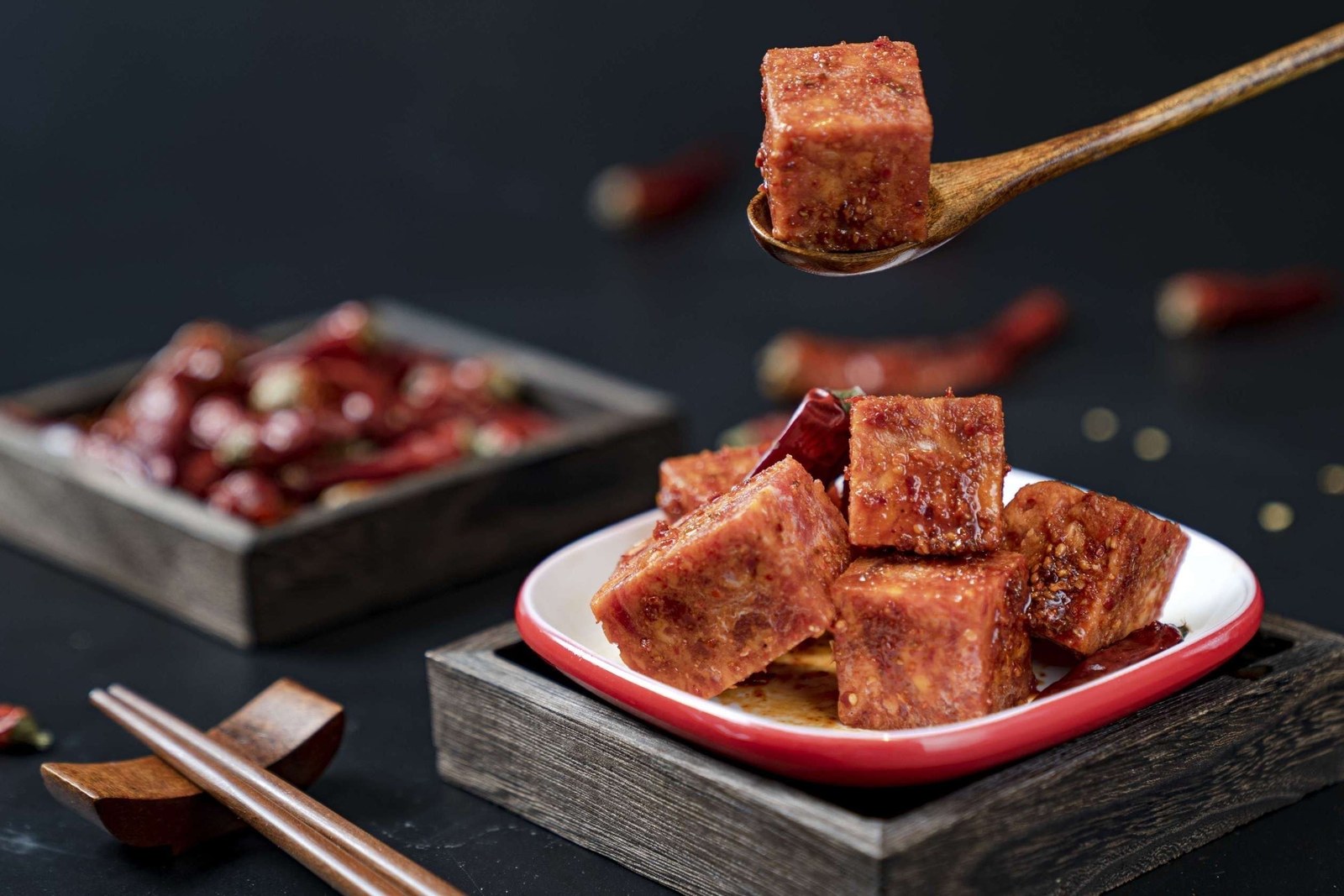
The flavours have multiplied with the market. There is a plain salted version, a 麻辣 málà numbing-hot one, a five-spice one, and a version braised with 卤水 lǔshuǐ, a master stock that some workshops keep going for years, topping it up rather than replacing it. There is also a soft, wetter style sold loose in the county itself, which does not travel and which the locals regard as the better product — eaten within a day or two, sliced and warmed in a pan with a little chili and garlic, or simply with rice.
Words and Names
豆干 dòugān and 香干 xiānggān are both dried tofu; 香干, fragrant dried tofu, is the name that carries the flavour claim, and 平江香干 Píngjiāng xiānggān pins it to the county. 酱干 jiànggān, sauce-dried tofu, is the braised form. 卤 lǔ means to braise in a spiced master stock, and 卤水 lǔshuǐ is that stock. 麻辣 málà is the numbing-and-hot combination that comes from Sichuan pepper and chili together. 五香 wǔxiāng, five spice, is the standard braising mix of star anise, cinnamon, clove, fennel and Sichuan pepper. 豆腐 dòufu is tofu itself, 黄豆 huángdòu the soybeans it is made from.
What the Locals Know
Judge it by the cut face. A well-made dried tofu is uniform in colour all the way through; a grey or darker centre means the block was not pressed or dried evenly, and the texture will be gritty. The best pieces have a slight sheen and give a little when bitten, rather than being brittle like a biscuit. Buy from workshops that sell it loose by weight rather than in sealed branded bags, and ask for the batch made that week. Eaten at home, the local habit is to 炒 chǎo it: sliced thin, fried with green chili, garlic shoots and a little pork, so that the dry tofu takes up the fat and softens. Prices are low in the county — a bag for ten to twenty yuan — and much higher once the same product has been branded and shipped.
flowcloud would say that Pingjiang dried tofu is a mountain county’s answer to a difficult question, which is how to sell something perishable from a place with no road to the sea, and that the answer was to take the water out and let the flavour stay.
Where to find it: the workshops and dried-food stalls of 平江县城 Píngjiāng xiànchéng, and any Hunan supermarket for the shipped version. Buy it loose, ask for 香干 rather than 豆腐干 if you want the flavoured sort, and eat it in the county if you can, where the wetter style is available and the price still reflects what it costs to make.