
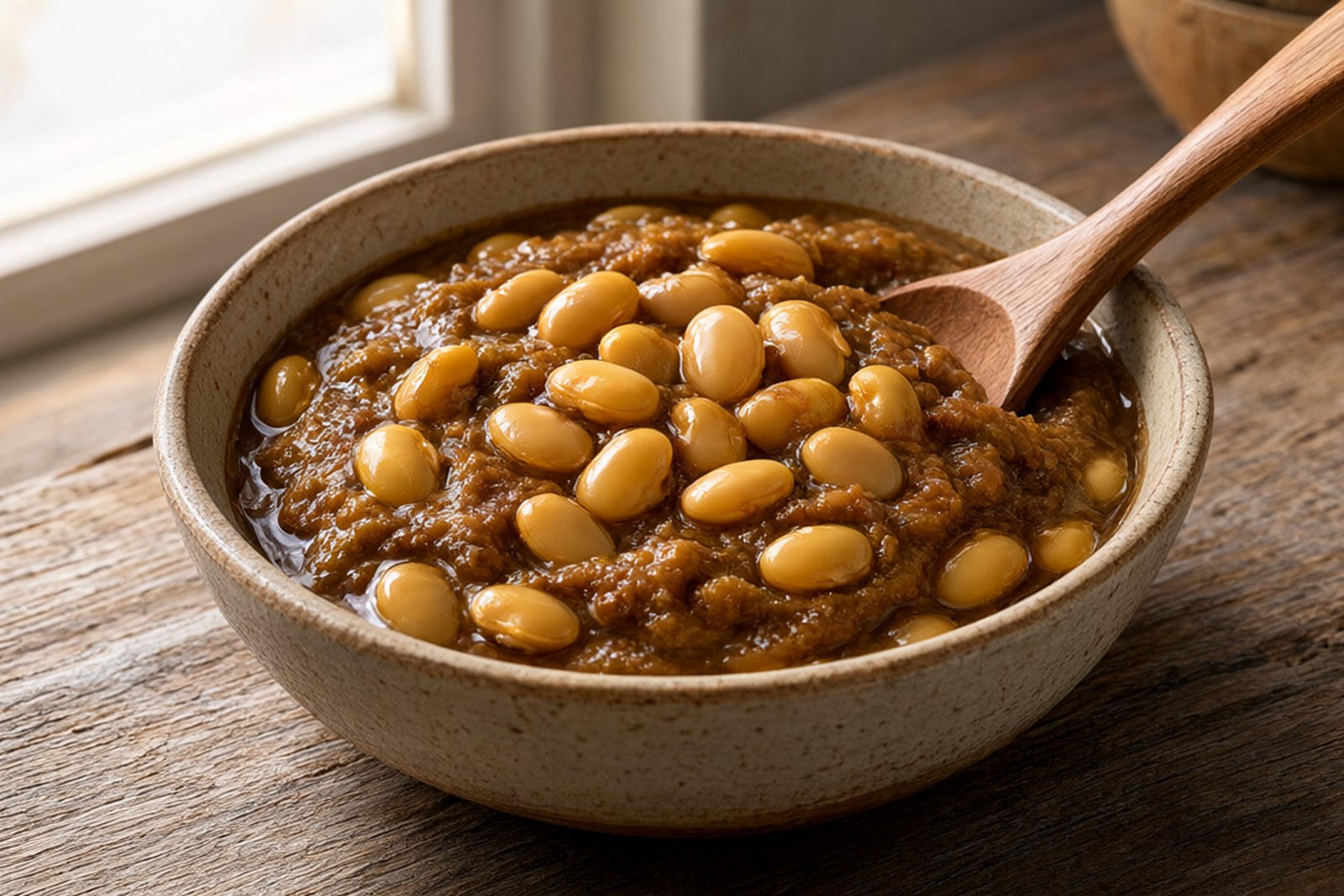
普宁豆酱 pǔ níng dòu jiàng is a fermented yellow-bean paste made in and around 洪阳镇 Hóng yáng zhèn, the old county town of 普宁市 Pǔ níng shì in the east of 揭阳市 Jiē yáng shì, and it is the one condiment without which a 潮汕 kitchen will not start cooking. It is not a sauce in the southeastern-Asian sense and not a soy sauce in any sense: whole soybeans are cooked, fermented twice and then finished in the sun for three to five months, and what comes out is a thick ochre mash of soft beans in a dark amber liquor that is salty, faintly sweet, deeply savoury and, to anyone who grew up here, the smell of lunch. The 普宁县志 Pǔ níng xiàn zhì, the county gazetteer, dates organised production and sale to 清道光二十年 Qīng Dào guāng èr shí nián, the twentieth year of the Daoguang reign, which is 1841, and the families who still make it put the craft itself at more than four hundred and sixty years. Neither date is modest, and both are printed locally without embarrassment.
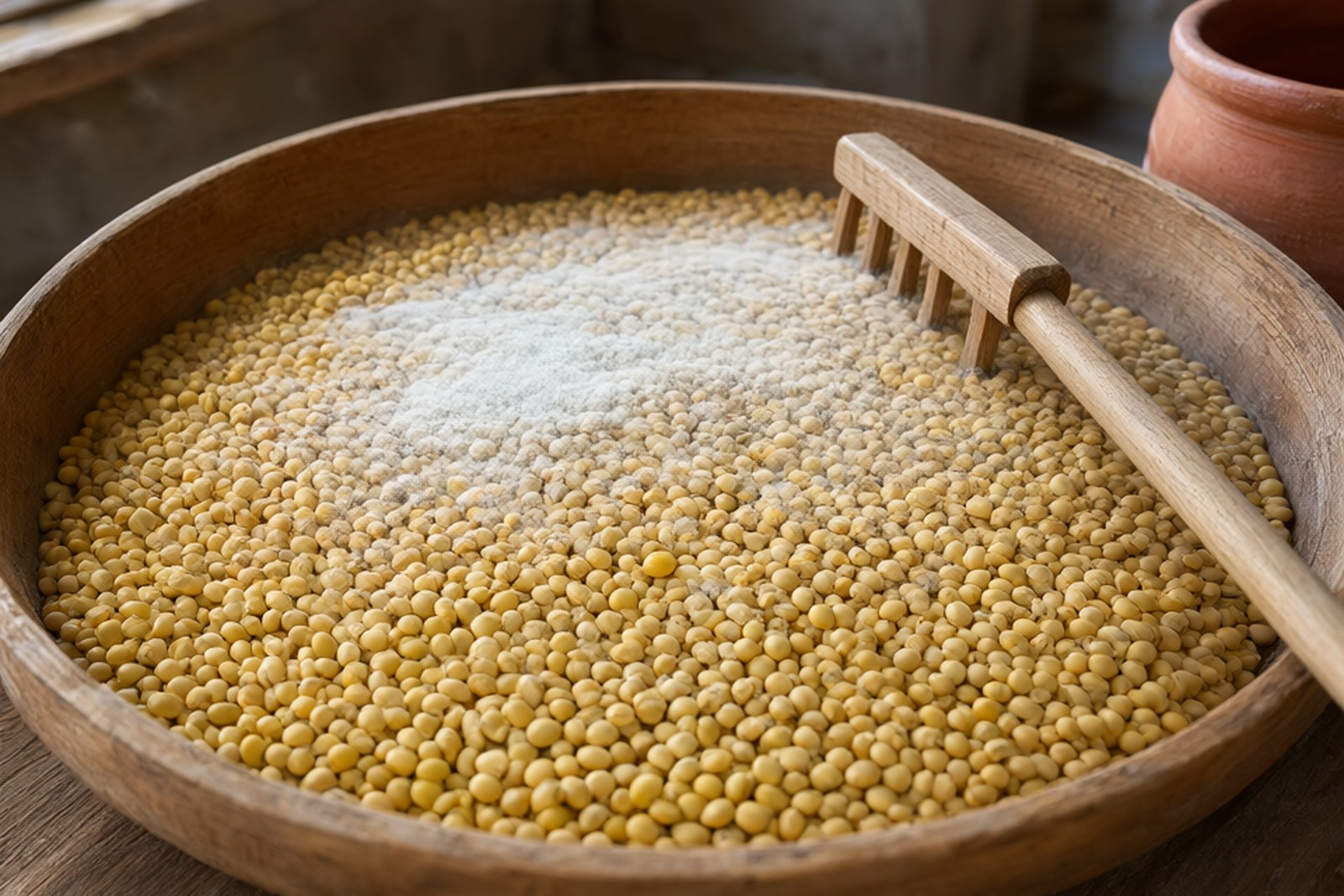
The method is a sequence of named steps and it has hardly been altered. Soybeans are ground and then soaked, steamed until they crush to paste between the fingers, and spread out to be dusted with wheat flour and left to grow a mould – the step called 饲醭 sì bú, feeding the mould, after which the beans are broken up and turned in what the trade calls 推醭 tuī bú. The mould stage is done indoors in the 醭房 bú fáng, the culture room, where temperature and damp are managed by opening and shutting doors, and it is the point at which the flavour is decided; the second fermentation moves outdoors into a great jar, the 推水醭 tuī shuǐ bú, where the cured beans are covered with brine and stood in full sun. From here the work is stirring. The brine is stirred two or three times a day, every day, for three to five months, and the purpose is not to mix but to keep the surface from drying to a skin and to let the sun reach the beans evenly. The colour goes from pale straw to gold and then to a deep reddish brown, and the trade judges the readiness of a batch by eye and by taste rather than by a clock. Once the beans are right they are boiled at high temperature, a step the county’s tradition records as 煮酱 zhǔ jiàng, and the finished paste is tasted by 试酱 shì jiàng, ladled from the jar by 装酱 zhuāng jiàng. Nothing in the pot except soybean, wheat flour, salt and water ever goes in.
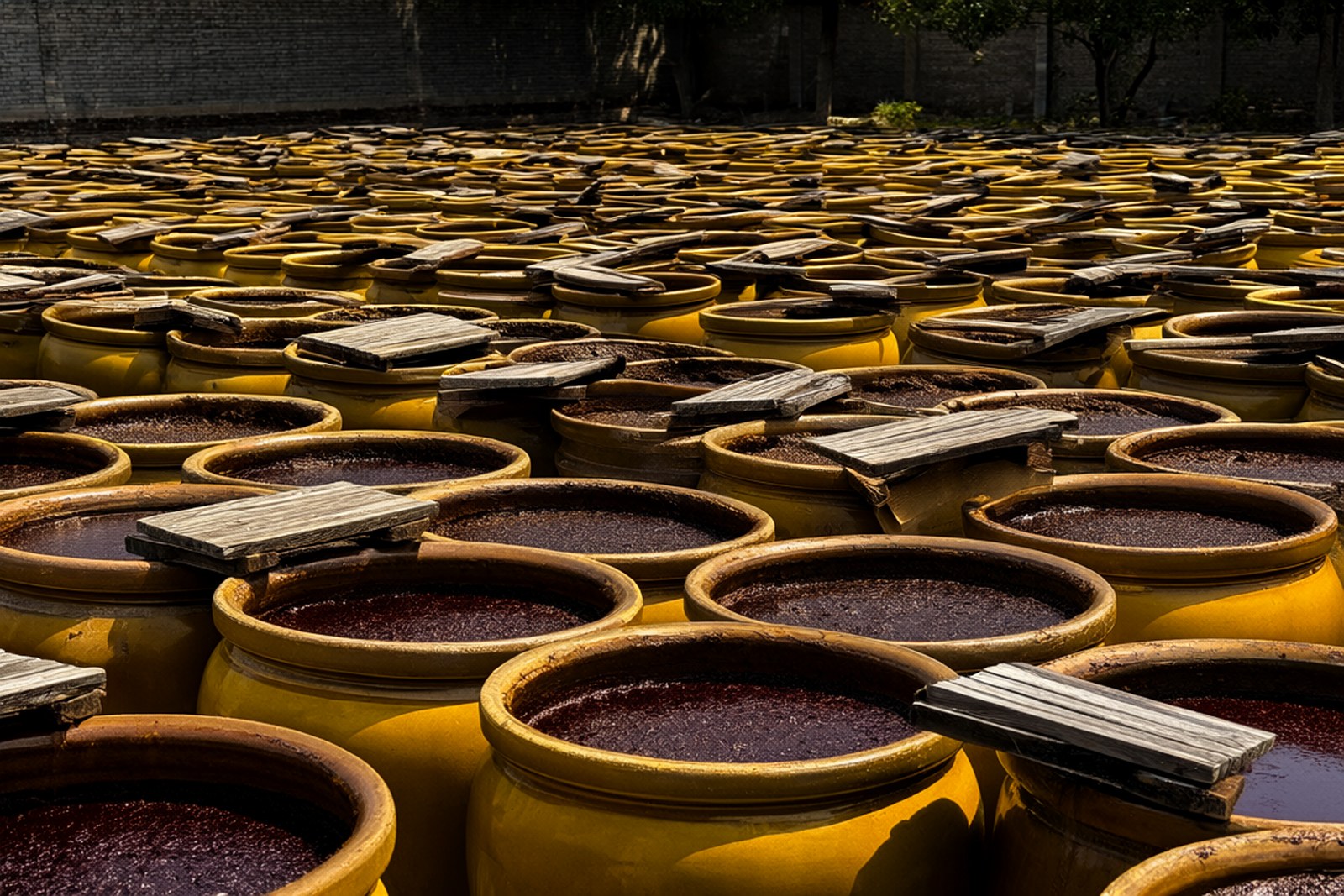
The industry the paste built is visible in the town. In the 民国 Mín guó years, the Republican decades, 洪阳 had more than a dozen 酱园 jiàng yuán, sauce yards, in competition, and the best known of them was 祥裕号 Xiáng yù hào, whose line is carried today by 松兴酱油厂 Sōng xīng jiàng yóu chǎng, the Songxing soy factory in 洪阳. The old county town still has a drying yard holding several hundred yellow-glazed crocks packed shoulder to shoulder, which is one of the few sights in the 潮汕 region that has not been stage-managed for visitors, and the yard works the way it always worked, with men walking the rows to stir.
What pushed the paste out of the county was a change in packaging, not a change in taste. The traditional product had a short life and was sold by the scoop to people who lived close enough to walk to the shop. 郑楷松 Zhèng Kǎi sōng, a provincial-level inheritor of the craft, reworked the finishing of the paste with a high-temperature sterilisation step, which extended the shelf life of a sealed jar from a few weeks to a year or two, and it is that single technical change that allowed 普宁豆酱 to be bottled and shipped to the rest of China and to the overseas 潮汕 communities rather than being eaten within sight of the jar it was made in. He was named a provincial inheritor in 2011, and in 2013 松兴酱油厂 was designated a provincial 非遗生产性保护示范基地 fēi yí shēng chǎn xìng bǎo hù shì fàn jī dì, a production-based demonstration base for intangible heritage. The paste was listed on the third provincial intangible-heritage batch in 2009. It is the kind of bureaucratic paper trail that usually sits on top of a craft that has already gone quiet; here it sits on one that is still turning crocks in the sun.
Words and Names
普宁豆酱 pǔ níng dòu jiàng is the paste, 普宁 the county-level city, 豆 dòu bean and 酱 jiàng a salted ferment of beans or grain, so 豆酱 is bean paste and shares its second character with soy sauce, 酱油 jiàng yóu, which is the liquid drawn off the same kind of ferment. 洪阳 Hóng yáng is the old town at the centre of the trade. 醭 bú is the mould that grows on the cooked beans, and 饲醭, 推醭 and 推水醭 are the three stages named for it; 醭房 bú fáng is the room the first of them happens in. 酱园 jiàng yuán is a sauce yard, 祥裕号 Xiáng yù hào the old firm and 松兴酱油厂 the modern one that carries its line. 郑楷松 Zhèng Kǎi sōng is the provincial inheritor of the craft.
What the Locals Know
Buy it in a glass jar you can see through and hold it up to the light. A good 普宁豆酱 is a yellow-gold mash with the whole beans still distinguishable, sitting under a thin layer of dark liquor, and it should be thick enough that the jar does not slosh. If it has been mashed to a smooth paste, or if the colour is grey or a flat bottle-brown, it is not the same thing. The smell should be savoury and slightly sweet with a clean salty edge and nothing sour or sharp; a paste that has gone acidic has been kept too warm. The jar is opened and then must be kept in the refrigerator with a dry spoon, because it is a live ferment and a wet spoon will bring it down. In the kitchen it does two jobs. As a 酱碟 jiàng dié, a dipping dish, it is put on the table as it is for 白灼 bái zhuó poached seafood, plain boiled pork and cold vegetables, and it is one of the small dishes that the 潮汕 table treats as a course in its own right rather than a condiment. As a seasoning it is cooked in, stirred into braised pork, into fish soup and into fried greens, where it brings salt and body and a sweetness that soy sauce does not have. The county has a proverb for its own reputation: 普宁出名好豆酱,新亨出名老菜脯 Pǔ níng chū míng hǎo dòu jiàng, Xīn hēng chū míng lǎo cài pú, Puning is famous for good bean paste, Xinheng for old preserved radish, which is the way the county puts itself on a map of flavours rather than of roads.
flowcloud would say that the difference between a county product nobody outside the county has tasted and one that is sold on three continents is often not the recipe but a lid, and that 郑楷松’s contribution to 潮汕 cooking was less a flavour than a seal.
Where to find it: the sauce yards and shops of 洪阳镇 Hóng yáng zhèn in 普宁市 Pǔ níng shì, where the drying yards of glazed crocks can be seen from the street and where 松兴酱油厂 keeps the trade going, and the 中药 and dried-goods markets of 普宁 city itself; 普宁 is in the east of 揭阳市, about forty minutes by road from 揭阳市区 and reached by the high-speed line at 普宁站 on the 厦深 line. The paste is sold in every 潮汕 market and in most Chinese supermarkets abroad under several brands, so the thing to look for when buying is the geographical-indication mark and the words 普宁豆酱 together. It is cheap, it travels, and a jar bought in the drying yard in 洪阳 is the one souvenir from this part of Guangdong that a cook at home will actually finish.