
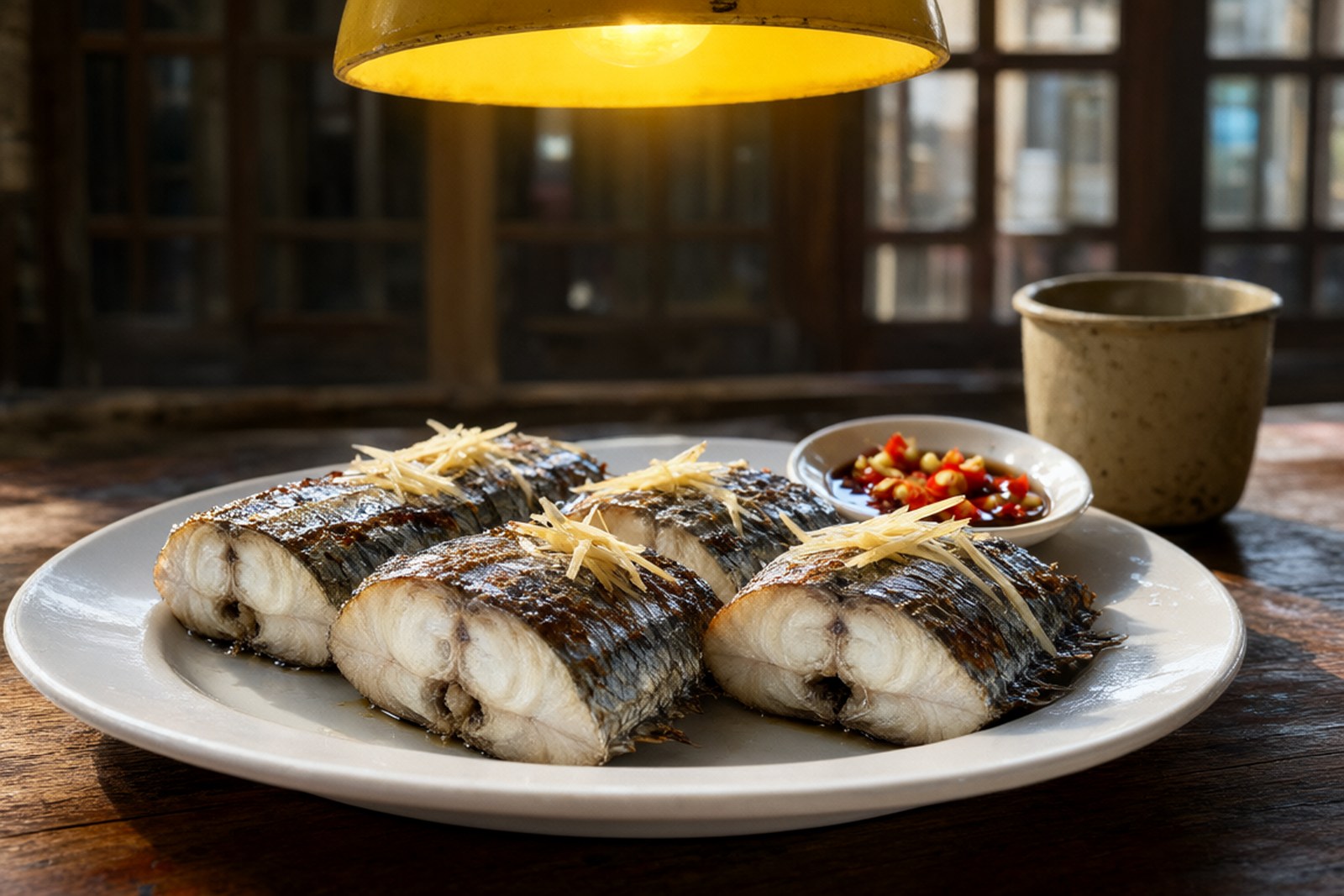
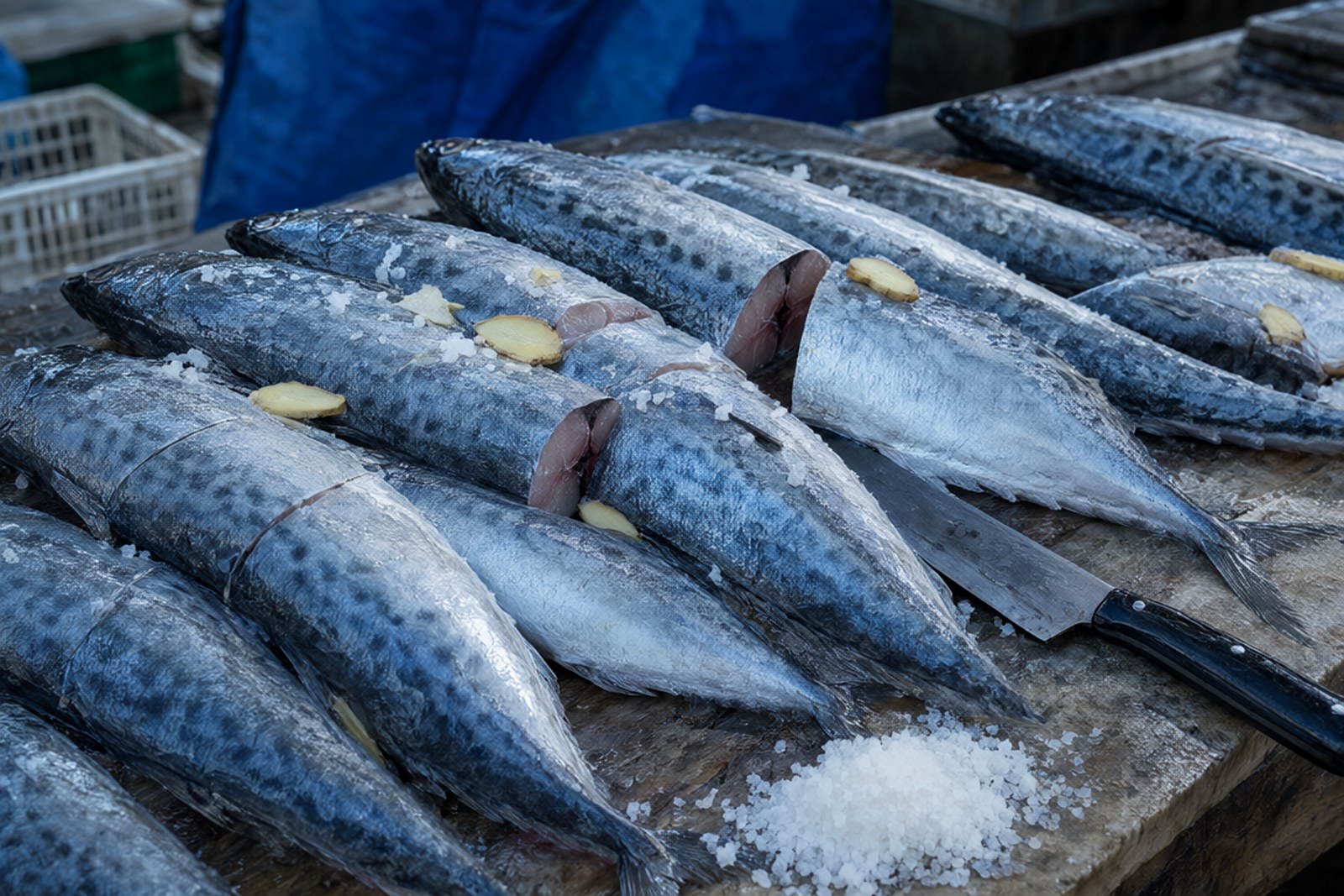
The fish arrives in slabs the length of a forearm, silver with a row of dark spots down the flank and skin still cool from the ice, and by the time it reaches the pan it has been salted for an hour and turned once in ginger. What comes off the fire is a steak with a crust on it and a centre that still gives, and there is a moment around the second mouthful when you understand why the northern coast of 海南 Hǎinán plans its spring around one fish. 马鲛鱼 mǎjiāoyú — Spanish mackerel — is not a delicacy in the way a grouper or a lobster is a delicacy. It is something better than that: a fish that arrives on a schedule, that everybody along this coast knows how to cook, and that tastes of the exact fortnight it was caught in.
I ate it first at 铺前 Pùqián, the old port at the very northern tip of 文昌 Wénchāng, where the island finally gives up and the water between it and the mainland narrows to a few kilometres. The town has been a harbour since the Song dynasty, and its 解放路 still has the arcades and the shuttered shopfronts of a place that spent several centuries being important. Since the 海文大桥 Hǎiwén Dàqiáo opened, you can drive across from 海口 Hǎikǒu in under an hour, which has been good for the fish and possibly not for the town’s sleep.
A Fish With a Season
Almost everything on this coast is available whenever you want it. The mackerel is not. It runs.
马鲛鱼 mǎjiāoyú moves north through these waters in spring to spawn, and it comes close in — close enough that the boats out of 铺前 and 清澜 Qīnglán do not have to work very hard to find it. The season is short and everybody counts it in fortnights rather than months. From the last cold snap to 清明 Qīngmíng, the tomb-sweeping festival in early April, the fish is fat, firm and full of flavour. After that it spawns, the flesh loosens, and the same fish that was worth arguing over in March becomes ordinary.
There is a Hainanese saying that the old people still use: 山上鹧鸪獐,海里马鲛鲳 — on the mountain the partridge and the river deer, in the sea the mackerel and the pomfret. It is a ranking, and the mackerel is on it. Ask a fisherman in 铺前 why and he will tell you it is because this fish does not taste of the sea in the way that most fish taste of the sea. It is dense and almost meaty, with a sweetness under the salt, and the only thing it really wants is heat and a little ginger.
How It Gets Cooked
There is one correct way and the town will not entertain arguments about it. 香煎马鲛鱼 xiāngjiān mǎjiāoyú — pan-fried mackerel — begins with steaks cut two fingers thick, on the bone, and a rub of salt and sliced ginger. Nothing else. No batter, no flour, no marinade of soy. The steaks are laid in a hot pan and left alone until the underside has gone the colour of weak tea, then turned once. The skin crisps. The bone, if you have been given one, keeps the middle moist.
The second use for the fish is 马鲛鱼丸 mǎjiāoyú wán, fish balls. The flesh is scraped off the bone, pounded with salt water until it turns into a pale paste that holds its shape, then spooned into simmering stock in the same pot as a handful of 螺 or a few slices of winter melon. A good mackerel ball bounces. A bad one is a rubber pellet, and you will know within one bite.
Every household in 铺前 also keeps a supply of the fish salted and dried for the months when there is none, which is most of them. 马鲛鱼干 is a different pleasure — harder, saltier, the flavour pulled tight — and it goes into rice or into a soup with pork ribs. Try the fresh fish first and the dried fish on the way home.
Words and Names
马鲛 mǎjiāo is the standard Mandarin name, 鲛 jiāo being an older character used for a fish with rough skin; in the local 海南话 Hǎinánhuà the fish has a name of its own that visitors rarely hear, because everyone switches to Mandarin the moment they see you. In English it is usually filed under Spanish mackerel, which is a loose term covering half a dozen similar 鲅科 species across the Indo-Pacific, and the one here is closer to what the Japanese call 鰆 sawara than to anything caught off Spain.
铺前 Pùqián means, flatly, “in front of the shops” — the name of a waterfront where the trading row stood in front of the harbour. The old street is 解放路, Liberation Road, which is the name almost every Chinese town gave to its main commercial street after 1949 and which here sits over a much older layout. The 海文大桥 Hǎiwén Dàqiáo is simply 海 from 海口 and 文 from 文昌 — the two places it joins.
What the Locals Know
Buy in the morning, from the boats, and look at the eyes. Clear, domed, wet eyes and a body that is stiff when you lift it by the tail. Cloudy eyes mean it has been sitting in ice since yesterday.
Ask for a female in March. Before it spawns, the fish carries a sack of roe, 鱼籽 yúzǐ, which is fried with the steaks and is for many people the best part of the whole exercise. Nobody will offer it; you have to ask, and you should ask early.
Tell them how you want the fish cut. A 铺前 fishmonger will cut a two-kilo fish into four steaks or into sixteen slices without being told twice, and the answer changes the dish. Steaks for pan-frying, thin slices for soup.
Expect the price to jump at 春节. Spring festival is when every family on the coast wants mackerel for the reunion dinner, and the price roughly doubles for the ten days around it. Come in March instead and pay a third of that for a better fish.
Where to Eat It
The shops to look for are on and around the 铺前老街, the arcaded old street, where several families have been frying mackerel for three or four generations and where the menu is written on a whiteboard that gets rewritten when the boats come in. Order the 香煎马鲛鱼 xiāngjiān mǎjiāoyú first, then a bowl of fish ball soup, then whatever 螺 the market had that morning. Two people can eat well for under ¥150 and there is no version of this meal that costs more than a bad hotel breakfast in 三亚 Sānyà.
flowcloud would say that the whole point of a fish with a season is that it teaches a town patience — that the reason 铺前 still knows how to fry a mackerel properly is that for eleven months of the year it has to think about something else.
Where to find it: 马鲛鱼 (mǎjiāoyú, Spanish mackerel), 铺前镇 (Pùqián), 文昌 (Wénchāng), northern Hainan. Best from late February to 清明 (Qīngmíng) in early April; best eaten on 铺前老街, the arcaded old street a short drive from the 海文大桥 (Hǎiwén Dàqiáo) bridge. 香煎马鲛鱼 ¥50–80 for a plate of steaks depending on the day’s market price, 马鲛鱼丸 soup ¥15–25, 马鲛鱼干 about ¥80 per jin for taking home. Ask for 鱼籽 (yúzǐ) if the fish is a spring female, order it pan-fried, and get to the old street before one o’clock, because when the morning’s fish is gone the shutters come down.