
The duck comes to the table flat, dark and shining, a bird that has been folded out of three dimensions into something closer to a book. It has spent a month being salted, weighted and dried on somebody’s roof, and it arrives at the table steamed and sliced into pieces with the fat a translucent amber and the meat a deep mahogany red. One bite and the whole method makes sense: 板鸭 bǎnyā, “board duck”, is a duck that has been pressed and preserved, and what drying does to a duck is the same thing it does to a good ham, which is to concentrate everything into less and make that less taste like more.
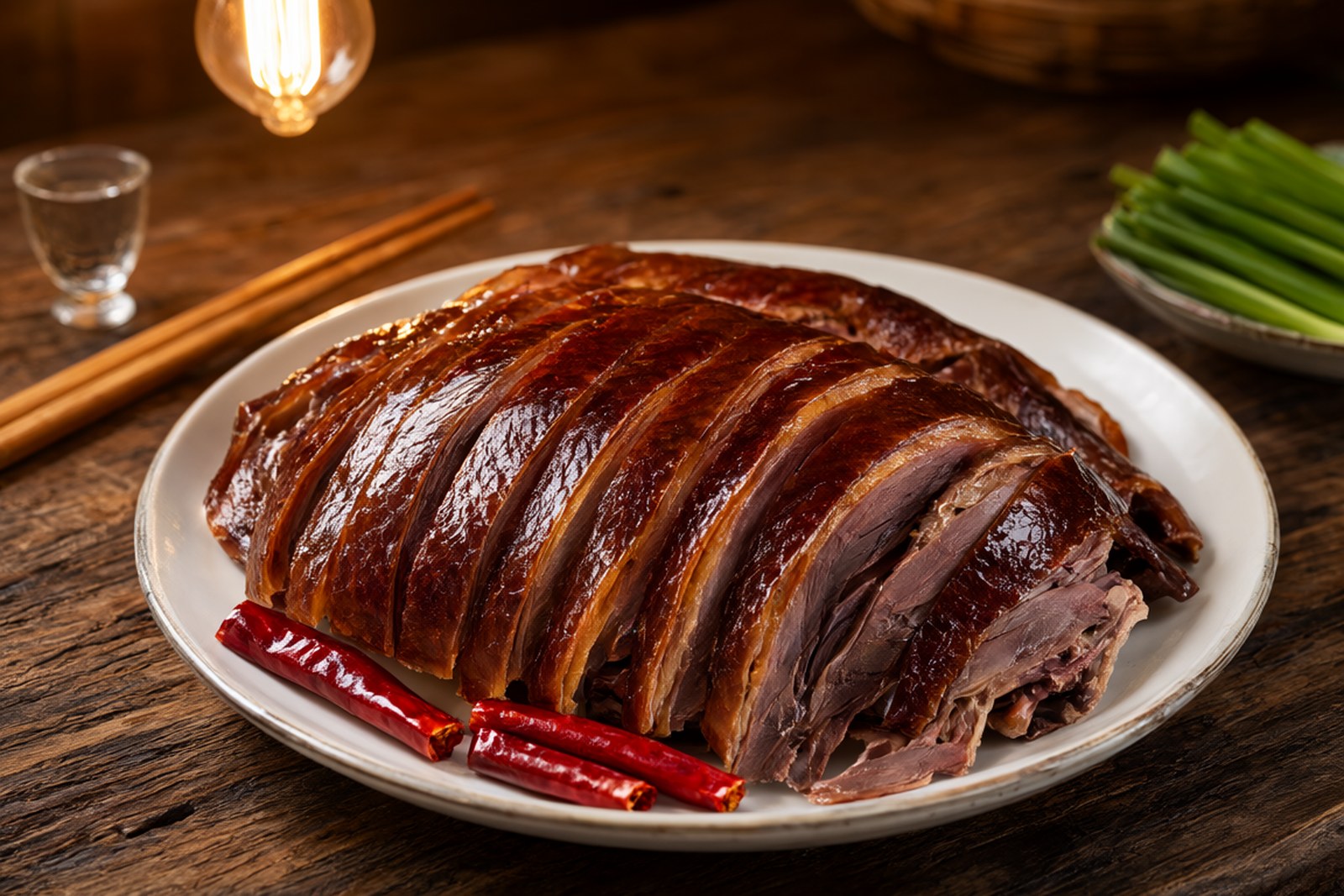
I first met it in 乾州 Qiánzhōu, the old walled town inside 吉首 Jíshǒu, the capital of 湘西土家族苗族自治州 Xiāngxī Tǔjiāzú Miáozú Zìzhìzhōu, the Tujia and Miao autonomous prefecture that fills the north-west corner of 湖南 Húnán. 乾州 was a military garrison town on the frontier in the Ming and Qing, and frontier towns needed food that kept. The duck kept. Two hundred years later it is still what the town cooks when the weather turns.
Why a Duck Gets Flattened
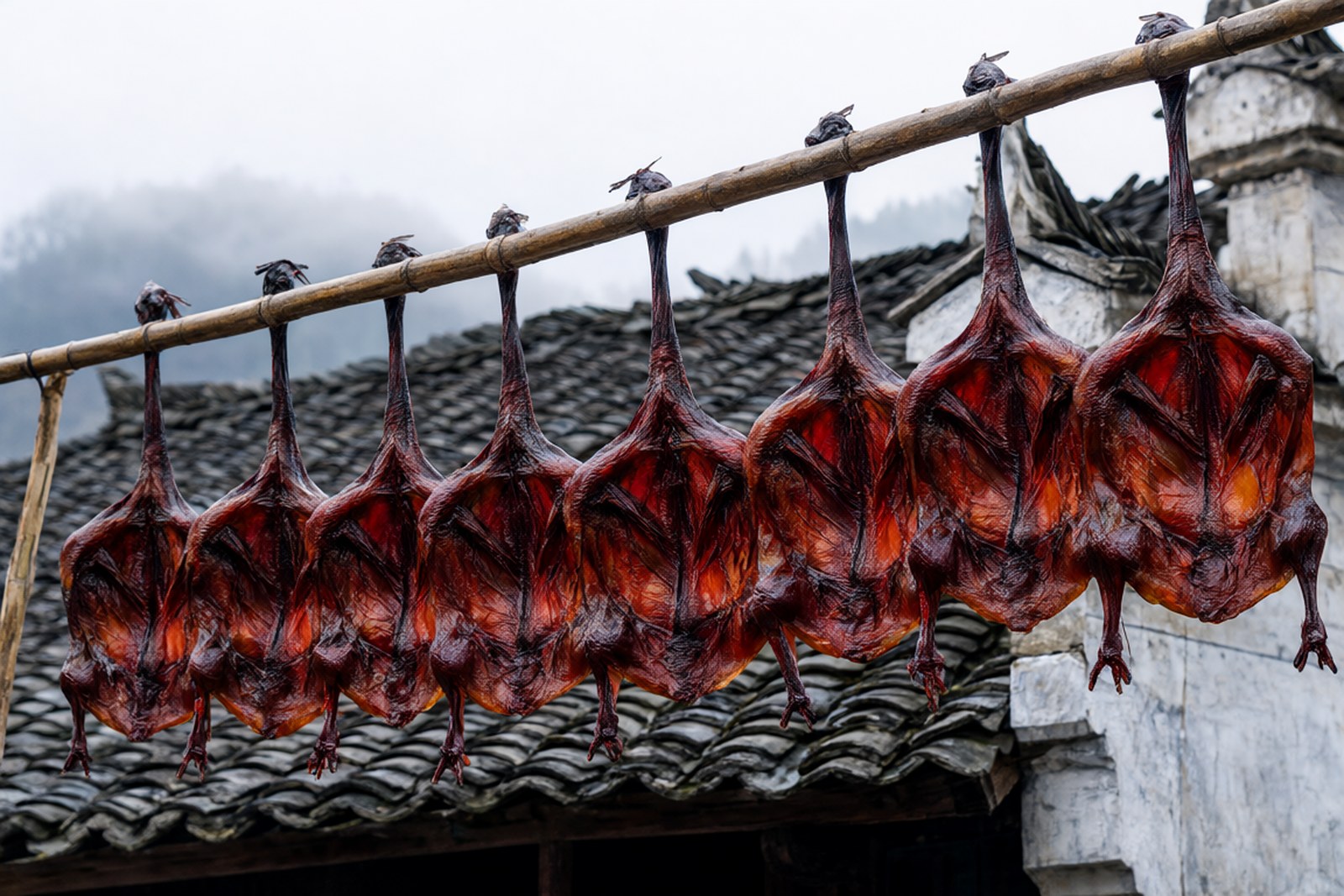
The logic of 板鸭 bǎnyā is the logic of every preserved food in a wet mountain province: salt draws out water, water is what spoils, and what is left behind is flavour. The specific technique is what gives the dish its name. The bird is opened along the back, the breastbone cracked, the whole carcass spread out and laid flat, and then weighted with a board or a stone for several days so that it holds that shape while it dries.
The working season is 冬至 Dōngzhì to 立春 Lìchūn — the six weeks either side of the winter solstice — and the reason is nothing more mystic than temperature and dry air. A duck hung in 腊月 dries without going sour. A duck hung in June in a river valley in Hunan is a duck you throw away. If you see 板鸭 on a menu in July, it is either from the freezer or it is not what it claims to be.
In 乾州 the curing mix is coarse salt, 花椒 huājiāo Sichuan pepper, a splash of 高度白酒 gāodù báijiǔ to keep the surface clean, and sometimes a little 五香粉. Nothing sweet. The ducks go up on bamboo poles under the eaves and on flat roofs, and in a good December the whole old town smells of salt and pepper and cold fat.
How It Is Eaten
There are three ways and they are ranked in this order by everyone in the prefecture.
Steamed, plain. The duck is cut into large pieces, laid on a plate, and steamed for twenty minutes over a pot of rice so that the rice takes the drippings. This is the way to eat it if you want to know what the duck actually tastes like, and it is the way a family eats it on the first night after taking it down from the roof.
Steamed with 干辣椒 gānlàjiāo and a little 豆豉 dòuchǐ. The dried chilli softens, the duck’s fat loosens, and the whole thing turns into something that needs to be eaten with a great deal more rice than you planned. This is the version you will get in a restaurant.
Stir-fried with 蒜苗 suànmáo or 冬笋 dōngsǔn. The duck is sliced thin, the green garlic is thrown into the wok for thirty seconds, and it comes out as a dish of contrasts — salty, smoked, vegetal, hot.
The bones do not go out. They go into a soup with 萝卜 luóbo or 冬瓜 dōngguā, and that soup is better than the duck deserves.
Words and Names
板 bǎn is a board, a plank, a slab — the character appears in 板栗 bǎnlì, chestnut, and 木板 mùbǎn, a plank of wood. 板鸭 bǎnyā therefore means, without ornament, “board duck”, and the name describes the process rather than the bird.
乾州 Qiánzhōu is an old name. Under the Ming it was 乾州哨, a frontier guard post; under the Qing it became 乾州厅, a sub-prefecture, and the walls that still stand at the north end of the town are from that period. The town lost its administrative status long ago to 吉首 Jíshǒu, a name from the local Miao language that is usually glossed as “the place where the soil is firm”. 湘西 Xiāngxī simply means “west of Hunan” — 湘 Xiāng being the river that gives the province its one-character name.
What the Locals Know
Buy it in 腊月, or buy nothing. The best ducks come off family roofs between the winter solstice and the spring festival. By March the shops are working through stock, and by summer there is none that was made properly.
Look at the colour, then press it. A good 板鸭 is amber to deep red with white streaks of fat. Grey is old. Press the breast with a thumb: it should feel firm and slightly tacky, never wet.
Ask for 散养鸭 sànyǎng yā. The locals will tell you that a duck that swam and ate snails tastes different from a shed bird, and they are right — the meat is darker and has a minerality that no amount of salt can fake.
You do not need to cook it a long time. Twenty minutes of steaming is enough. Overcooked pressed duck goes stringy, and there is no way back.
Take one home. A whole dried duck weighs under a kilo, travels in a plastic bag without complaint, and keeps for months in a fridge. It is the single best food souvenir in western Hunan.
Where to Eat It
In 乾州 the dish appears on the menu of most 土家菜 restaurants inside the old town, usually as 蒸板鸭 or 板鸭炒蒜苗. The places around 胡家塘 Hújiātáng, the small pond at the heart of the walled town, are the ones the locals use. Order the steamed version first, get a plate of 腊肉 lāròu and a bowl of 酸菜 suāncài to go with it, and finish with the bone soup. Prices are mountain-town prices: two people eat for ¥120 without trying.
flowcloud would say that a place which invented a way to keep a duck for six months has told you something honest about its winters, and that the best food in the mountains has always been the food that had to survive them.
Where to find it: 板鸭 (bǎnyā, pressed duck), sold and served in 乾州 (Qiánzhōu) old town, 吉首 (Jíshǒu), 湘西土家族苗族自治州 (Xiāngxī), western Hunan. Best from 冬至 to 立春 (late December to early February) for newly dried birds; look for it on menus as 蒸板鸭 or 板鸭炒蒜苗. A whole dried duck runs ¥60–100 depending on size and how well it was fed, a restaurant plate ¥38–58, and the 板鸭萝卜汤 bone soup about ¥28. Buy from the families drying ducks over the streets off 胡家塘, and if you only eat one version, eat it steamed.