
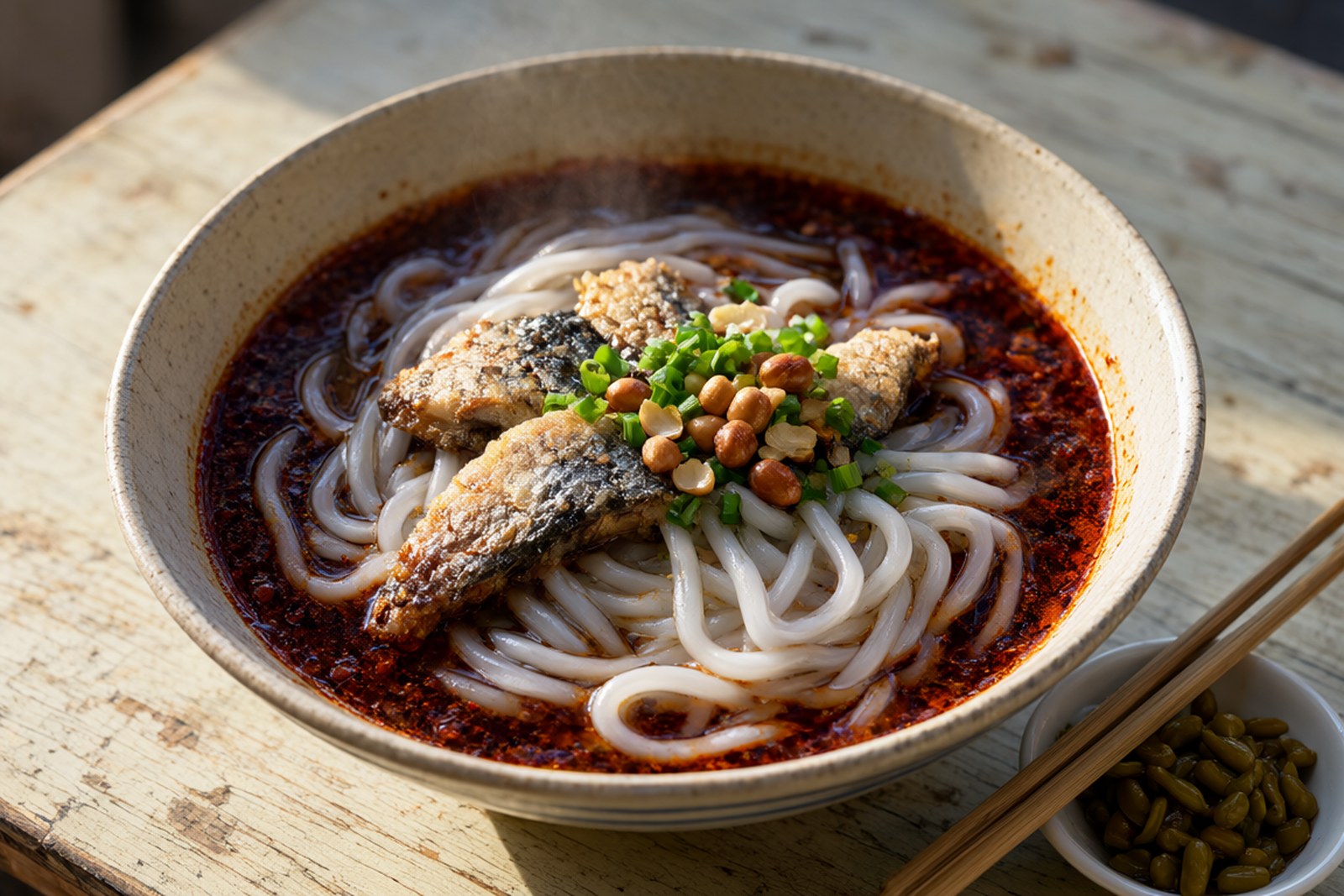
It is a quarter past six in the morning on the older streets of 苏仙 Sūxiān district and there are already four people in front of you. The shop is one room with a glass counter and a wall of steam, and the woman behind the counter is doing the same thing she has done for thirty years: lifting a fistful of rice noodles into a wire basket, dropping them into boiling water for eleven seconds, and then ladling over them a broth so red it looks like it has been lit rather than cooked. You take the bowl to a plastic stool. The first mouthful is fish, hard and clean, and then the chilli arrives from behind it and stays for the rest of the bowl. By the time you put the chopsticks down you have sweated through your shirt and you are entirely awake. This is 栖凤渡鱼粉 Qīfèngdù yúfěn — Qifengdu fish noodles — and in 郴州 Chēnzhōu it is not breakfast, it is a civic institution.
The town that gave the dish its name, 栖凤渡 Qīfèngdù, sits on the 西河 Xīhé river about twenty kilometres north of the city, and the story attached to it goes back to the Three Kingdoms. 庞统 Páng Tǒng, the strategist known as 凤雏 Fèngchú — the Fledgling Phoenix — was posted to nearby 耒阳 Lěiyáng as county magistrate and, by the standard telling, arrived sulking. He had wanted a command, not a county, and he spent his first weeks drinking and ignoring the paperwork. Sent downriver on some errand, he put in at the ferry crossing one evening, could not sleep, and by noon the next day was hungry enough to eat whatever the ferrymen were eating. A fisherman had just come in with fresh 鲢鱼 liányú — silver carp. The innkeeper boiled them down the way river people do, thickened the soup with nothing at all, poured it over rice noodles and spooned in red chilli oil to cut the river taste. 庞统 ate two bowls, is said to have sat up straight for the first time in weeks, and went back and did the job he had been avoiding. Whether or not the man actually ate here, the ferry crossing has been called 栖凤渡 — the Phoenix’s Crossing — ever since, and the dish has carried the name with it. The technique is now on the provincial intangible heritage list, which in practice means the old shops get to keep claiming they do it the real way.
What Makes It Work
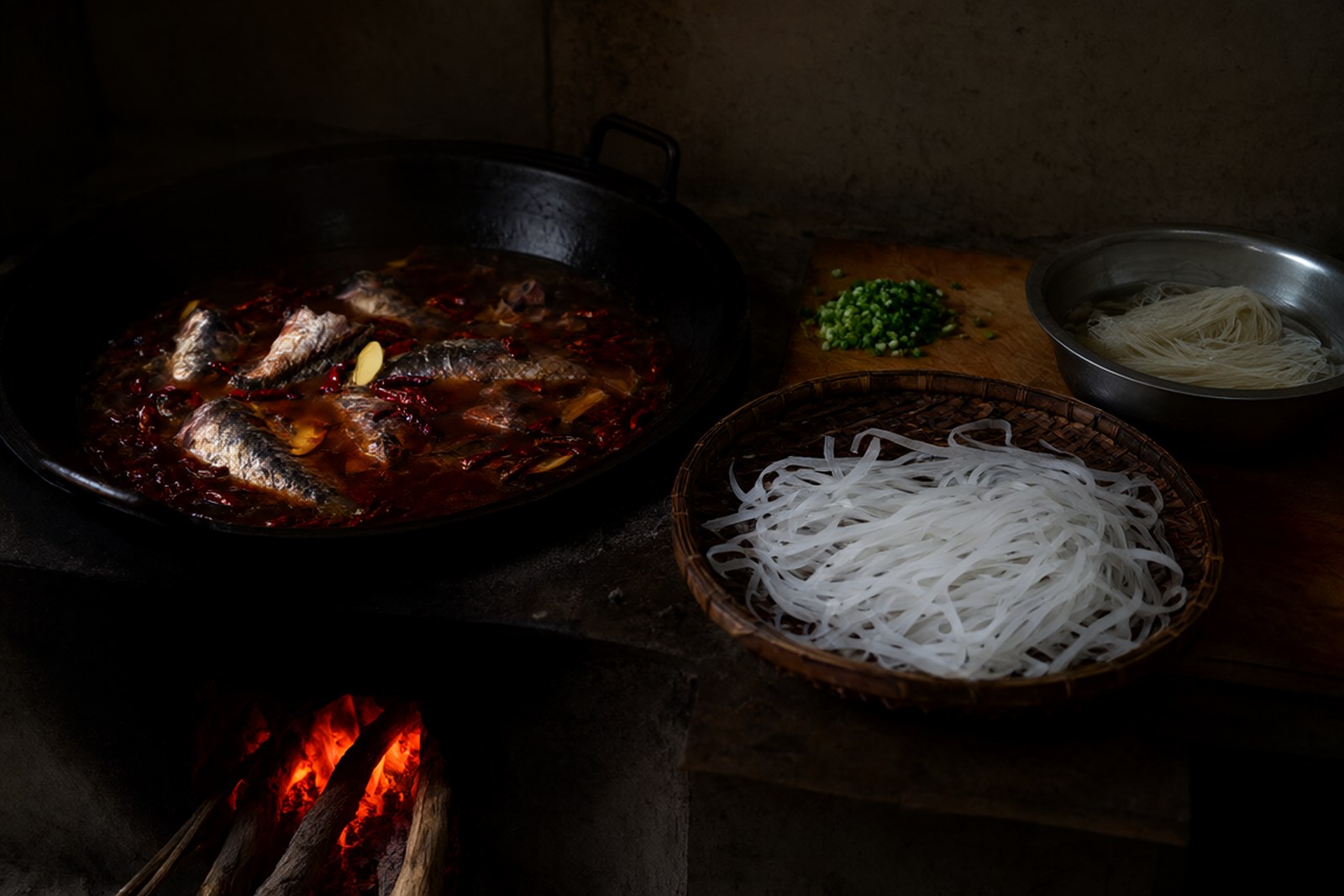
The broth is a river broth and it is not subtle. Freshwater fish in this part of Hunan carry a muddy note that has to be driven out, and the local solution is to fry the fish hard in ginger and chilli before any water goes in, then boil it to a cloudy pale soup and only then add the chilli oil that turns it red. Silver carp, with their soft flesh and plentiful bones, break down into the liquid, which is why the broth tastes thick even though nothing has been added to thicken it. Some shops use 禾花鱼 huāhuā yú, the small field carp raised in rice paddies above 500 metres, which are cleaner tasting and considerably more expensive.
The noodle half of the equation is 干切粉 gān qiēfěn, a flat dried rice noodle rather than the round fresh sort. It has to hold its shape for the twenty seconds it spends in the broth without going to paste, and it has to be able to carry chilli oil without turning greasy. Then come the extras, which are where the argument starts. 酸豆角 suān dòujiǎo, pickled long beans, for sourness and crunch. 炸黄豆 zhà huángdòu, fried soybeans, for noise. Chopped spring onion across the top. In some shops a spoonful of the previous day’s broth, kept and reused as a starter, the way a sourdough bakery keeps a mother culture.
Words and Names
粉 fěn is the general word for rice noodles and it is used with a generosity that startles visitors: 米粉 mǐfěn, 河粉 héfěn, 切粉 qiēfěn are all 粉. 鱼粉 yúfěn is simply fish noodles, and 栖凤渡鱼粉 pins it to the town. 鲢鱼 liányú is silver carp, the cheap, bony, faintly muddy fish that makes the whole thing work, and no amount of good intentions will substitute for it. 湖南 Húnán spells the province, and 郴州 Chēnzhōu the city: a character made deliberately, from 林 lín, woods, and 邑 yì, a settlement, because this is the one Chinese city whose name means “forest town” and belongs to nobody else.
What the Locals Know
The red is not a garnish, it is the point. A bowl that arrives pale has been made for someone the kitchen does not respect, and asking for it mild will get you a nod and a bowl that is still hotter than whatever you were imagining. Locals eat this between six and nine in the morning and again at eleven at night; the shops that close at two in the afternoon are not being lazy, they have simply sold out of broth and consider the day finished. In winter you add 仔姜 zǐjiāng, young ginger, which pinks the surface and tastes of something sharper than old ginger. In summer you drink the soup cold the next morning and claim it cures hangovers, which, given the quantity of chilli, is at least partly true.
The other thing the locals know is that a fish noodle shop is judged on its fish and not its cooking. At four in the morning a van arrives at the back door and the fish are still moving. Any shop without a wet back step and a drain smelling of scales is buying frozen, and everyone in the queue can tell within two bites.
flowcloud would say that what makes a breakfast great is when the whole town agrees about it: no menu debate, no deciding, just a bowl that has been the same for two hundred years and a queue that starts before the sky is grey.
Where to find it: the streets around 栖凤渡镇 Qīfèngdù Zhèn itself are the historical answer, but the thickest concentration of good shops is in the older parts of 苏仙区 Sūxiān Qū, where the 老字号 lǎozìhao — old-brand — shops open at five thirty and shut when the broth runs out. Order the 中辣 zhōnglà if you want to taste the fish at all.