
芒果肠粉 máng guǒ cháng fěn is the cold dessert roll of 琼海市 Qiónghǎi shì, and the name is a deliberate borrowing that has cost it a good deal of confusion. 肠粉 cháng fěn, rice-noodle roll, is the savoury Cantonese breakfast: a sheet of steamed rice batter wrapped round pork, prawn or beef and dressed with soy. 芒果肠粉 is a sheet of set coconut milk wrapped round ripe mango, chilled, cut into lengths and dressed with more coconut milk, and there is no rice, no soy and no meat anywhere near it. The borrowing is not an accident either, because the texture is the same idea – a soft, cool, slightly elastic wrapper around a filling – and 琼海 has taken it over so completely that the sweet version is now the one the 杂粮 zá liáng shops sell by the hundred on a hot night.
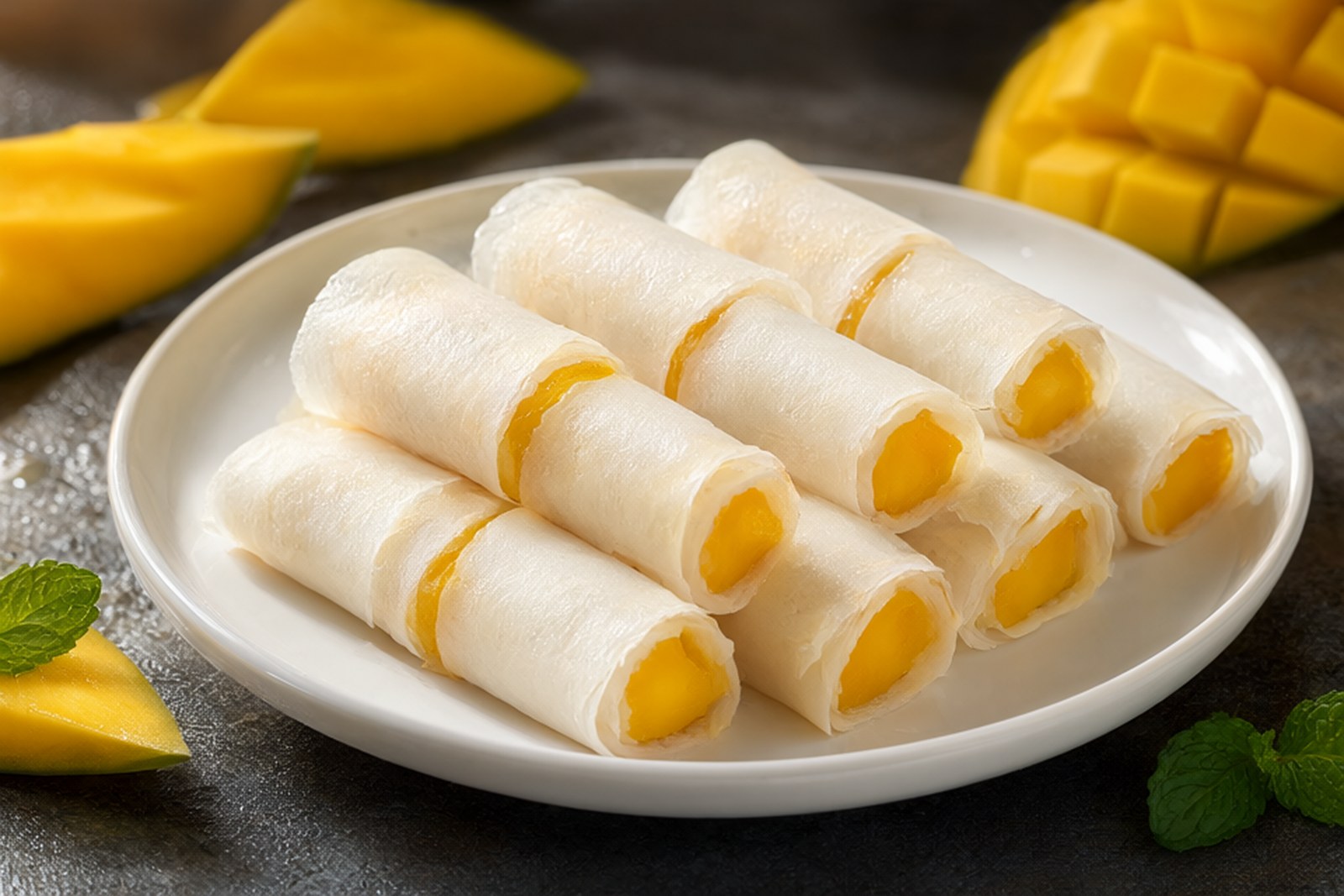
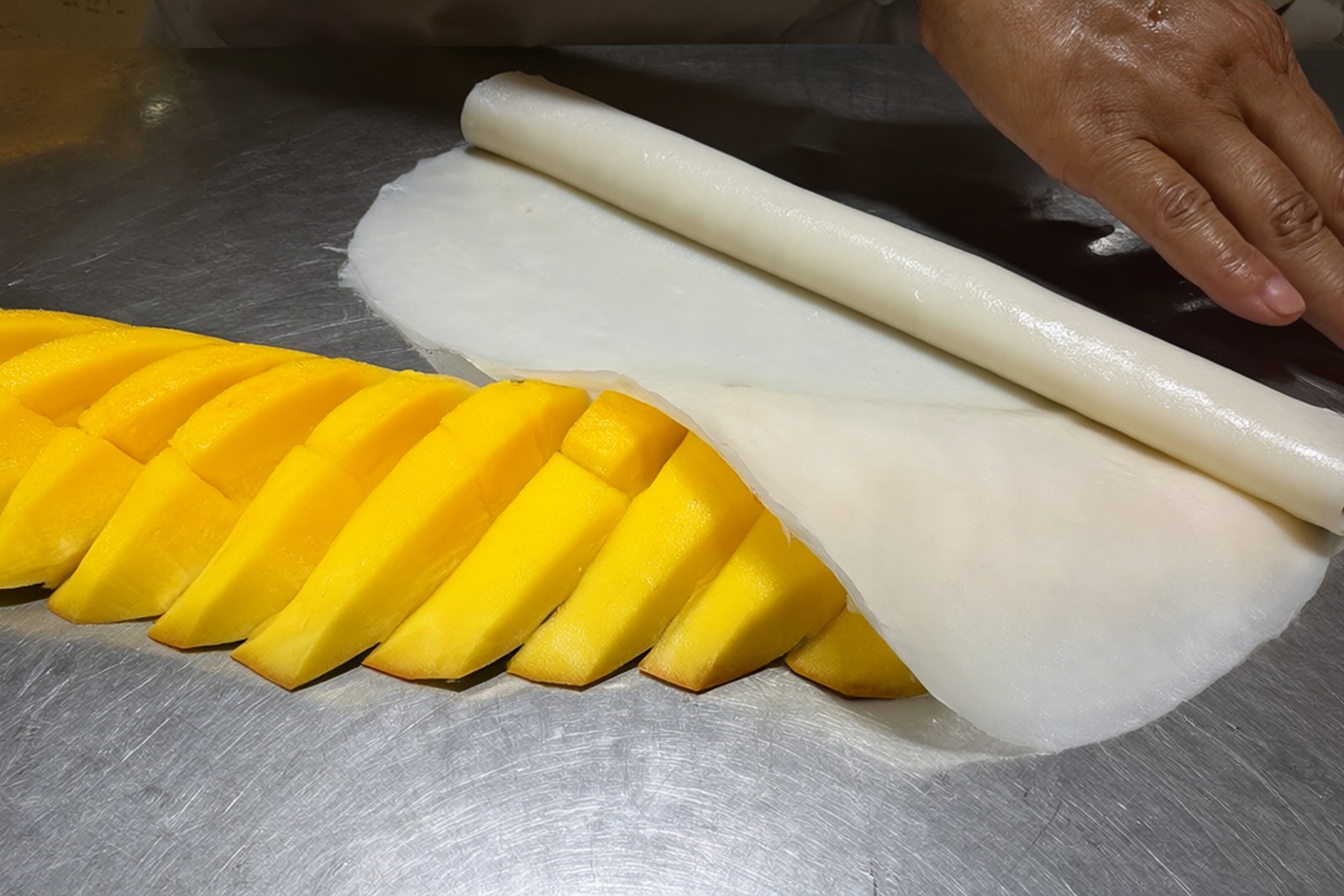
It is made with coconut milk, sugar and a setting agent, and the skill is in the thickness. The milk is sweetened and lightly set – some kitchens use agar or gelatine, the older ones use a rice-flour batter steamed thin and cooled, which gives a chewier skin and is closer to the name – and then poured into a flat tray and left to go firm. The mango is cut into batons, the set sheet is cut into strips wide enough to wrap one, and the roll is made cold and quickly, then chilled again before it is cut into lengths so that the edges stay clean. The fruit has to be ripe enough to be soft and firm enough not to collapse, which is why the local 芒果 máng guǒ of the island’s hot months is the fruit of choice rather than the fibrous kinds used for juice.
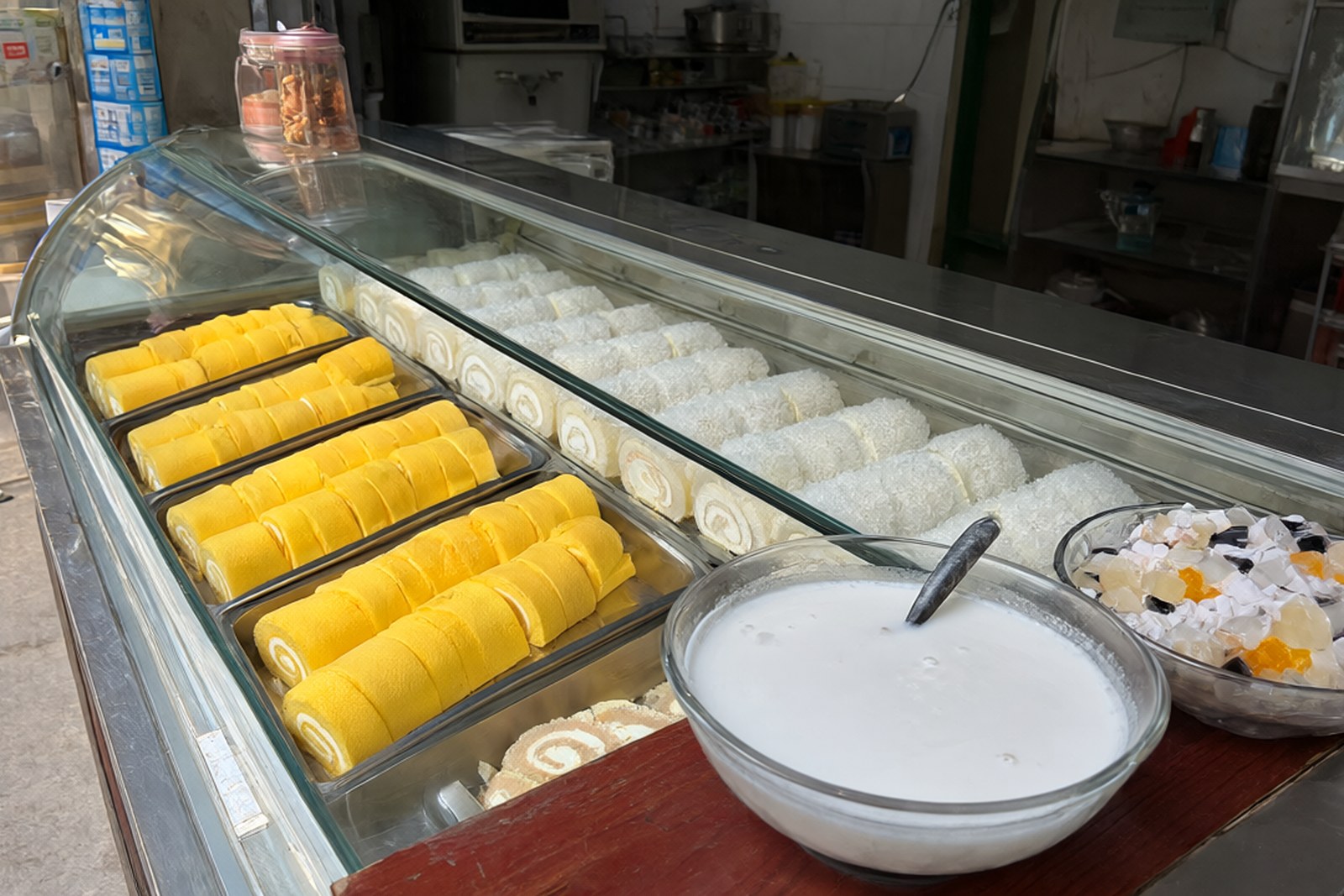
The dressing is where a good shop separates itself from a bad one. The plain version is more coconut milk, thin, with a spoon of sugar syrup and sometimes a pinch of salt, so that the whole bowl is cool and light; the richer version is 椰浆 thickened and poured as a cream, with condensed milk, a scatter of fruit, a spoon of 西米 xī mǐ, the tiny sago pearls, or a few strands of pomelo. What has no business being there is chocolate, ice cream or syrup in three colours. The 杂粮 house version is deliberately plain because it is eaten at four in the afternoon or at nine at night and is meant to be refreshing rather than filling, and it is served with the other cold bowls on the same tray: 清补凉 qīng bǔ liáng, the coconut-milk bowl of beans and jelly, and the iced 鸡屎藤 with its green rice balls.
琼海’s standing as the island’s sweet-shop town is not a new claim. The county has run on 杂粮 for a long time, 嘉积 Jiā jī has a street’s worth of 老字号 that have been selling the same bowls for decades, and the local formula for the whole industry is the one the provincial food campaigns use: 食在海南、味在琼海, eat in Hainan but taste in Qionghai. The mango roll is the newest of the repertory and the one that travels best in photographs, which is why it has spread to every island resort, but it is still made in 嘉积 the same way, in small trays, to be eaten within a few hours of the fruit being cut. The county also grows the fruit: 芒果, 菠萝, 荔枝 and 番石榴 come off the fields around 中原 and 大路, and the roll is one of the places where the island’s fruit and the island’s coconut meet without a sauce getting in the way.
Words and Names
芒果肠粉 máng guǒ cháng fěn is the mango roll, borrowed from 肠粉 cháng fěn, the savoury rice-noodle roll, which it resembles only in shape. 椰浆 yē jiāng is thick coconut milk and 椰奶 yē nǎi the thinner drinking sort, and 西米 xī mǐ are the small sago pearls sometimes scattered over the top. 杂粮 zá liáng is the 琼海 word for the whole family of cold sweet bowls, 清补凉 qīng bǔ liáng the most famous of them, and 老字号 lǎo zì hào a long-established shop. 嘉积 Jiā jī is the town where most of them are, and 芒果 máng guǒ is the mango.
What the Locals Know
Ask whether the skin is 蒸 or 冻, steamed or set with gelatine, because a shop that steams a thin rice batter for it is doing the thing the name promises and the result is better with a spoon than a gelatinous one. Look at the roll before ordering: the mango should show at both ends and be a solid piece rather than a dice of odds and ends, and the jelly should be pale rather than a bright orange, since a strong colour means flavouring rather than fruit. Eat it within a few minutes of its coming out of the chiller, because a set coconut skin goes soft and slippery in this heat, and order it together with a 清补凉 for the same reason the locals do: one rich bowl and one thin one, and the two together are an afternoon.
flowcloud would say that a county which took the name of a working man’s breakfast, kept the shape, threw out the rice and the soy and the pork, and filled it with fruit and coconut milk instead, has done what every good kitchen does when it moves from the savoury side of the street to the sweet one.
Where to find it: the 杂粮 shops and cold-drink stalls of 琼海市, with 金海路 Jīn hǎi lù and the streets off 爱海南路 Ài hǎi nán lù in 嘉积镇 Jiā jī zhèn holding several of the long-established ones, open from late morning until about ten at night. A plate of 芒果肠粉 is ¥12 to ¥25, a 清补凉 ¥10 to ¥20 and a bowl of the iced 鸡屎藤 ¥8 to ¥18. 琼海 is on the 东环 high-speed line with 琼海站 Qiónghǎi zhàn in the town’s own district and 博鳌站 Bó’áo zhàn twenty minutes further south.