
Wenquan Goose, the Bird That Took a Town’s Name
温泉鹅 wēn quán é is the goose of 琼海市 Qiónghǎi shì, and the name misleads almost everyone who meets it for the first time. 温泉 wēn quán means hot spring, so the obvious reading is a bird raised in warm water, which is nonsense; 温泉 here is a place, the town of 温泉镇 Wēn quán zhèn west of 嘉积 Jiā jī, and 温泉鹅 means the goose of Wenquan. The town sits on the 万泉河 Wàn quán hé where the river comes down off the hills, and the birds are raised the old way: turned out to range and graze for the first months of their lives, eating whatever grows in the fields and drinking river water, and then taken in and fattened in pens on bran and broken rice for the last few weeks.
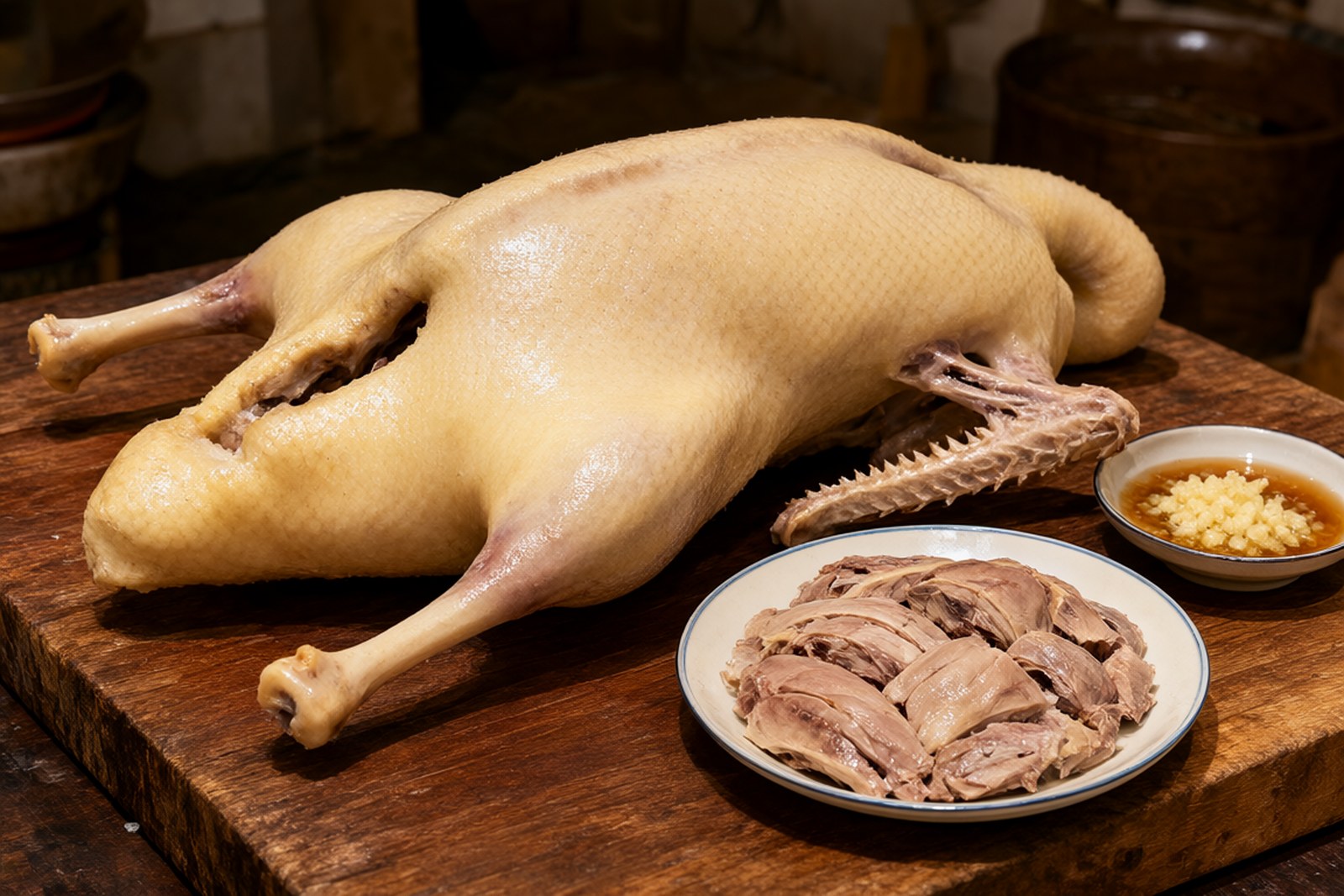
The rearing is the reason the dish exists, and it is the part 琼海 talks about. The birds put out to graze take longer to make weight than a battery goose and come out with a thin skin, a fine grain in the flesh and fat that has been laid down between the fibres rather than in a slab under the skin. The pen stage uses 糠 kāng, rice bran, and 糙米 cāo mǐ, unmilled rice, forced in by hand rather than left out in a trough, and the birds are usually taken at seventy to ninety days. The result is what the county advertises: 肥而不腻 féi ér bù nì, rich without being greasy, 清甜微脆 qīng tián wēi cuì, faintly sweet with a little bite to the skin, and a flesh with none of the coarseness that goose usually has.
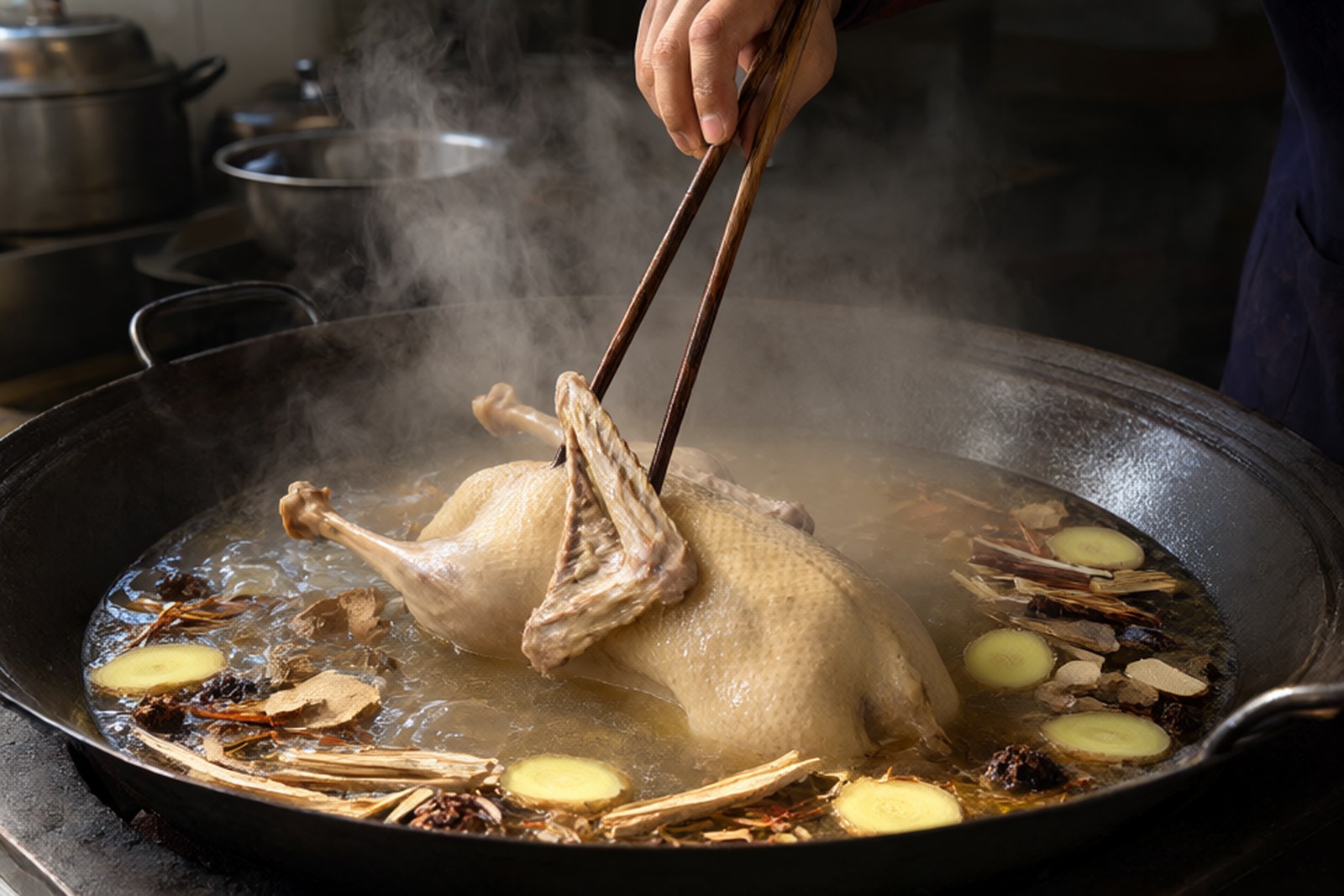
The cooking is a single decision and it is always the same one. 白切 bái qiē, poached whole and served cold, is what 琼海 orders, and it is not a neutral choice: a bird with a thin skin and interleaved fat has nothing to hide behind, so white-cutting is the only way to taste it and also the only way to lose it if the bird is poor. The bird goes into water with ginger and a set of aromatics that the good kitchens keep to themselves – the local boast is that ten or more medicinal roots and herbs go into the pot – and it is held at a bare simmer and lifted at the point where the flesh is cooked through and the bone at the joint is still faintly red, which is the mark a 琼海 cook looks for. Cut it open and the meat is juicy and the skin has set to a translucent gold.
The dip is the other half of the dish and it is not negotiable either. 蒜蓉 suàn róng, chopped garlic; 沙姜 shā jiāng, the small aromatic ginger of the south; light soy; a handful of coriander; and the juice of the 小青桔 xiǎo qīng jú, the small green lime that grows everywhere on the island and does the work a lemon would do in a European kitchen. That juice is the point: it cuts the fat, lifts the garlic and makes the goose taste lighter than it is, and the whole 海南 trick of sourness over rich meat is in that one small fruit. Ask for the rice too, because it is cooked in the goose stock and the skimmed goose fat, and a bowl of it beside a piece of the bird is the reason the meal is worth having in the morning rather than at night.
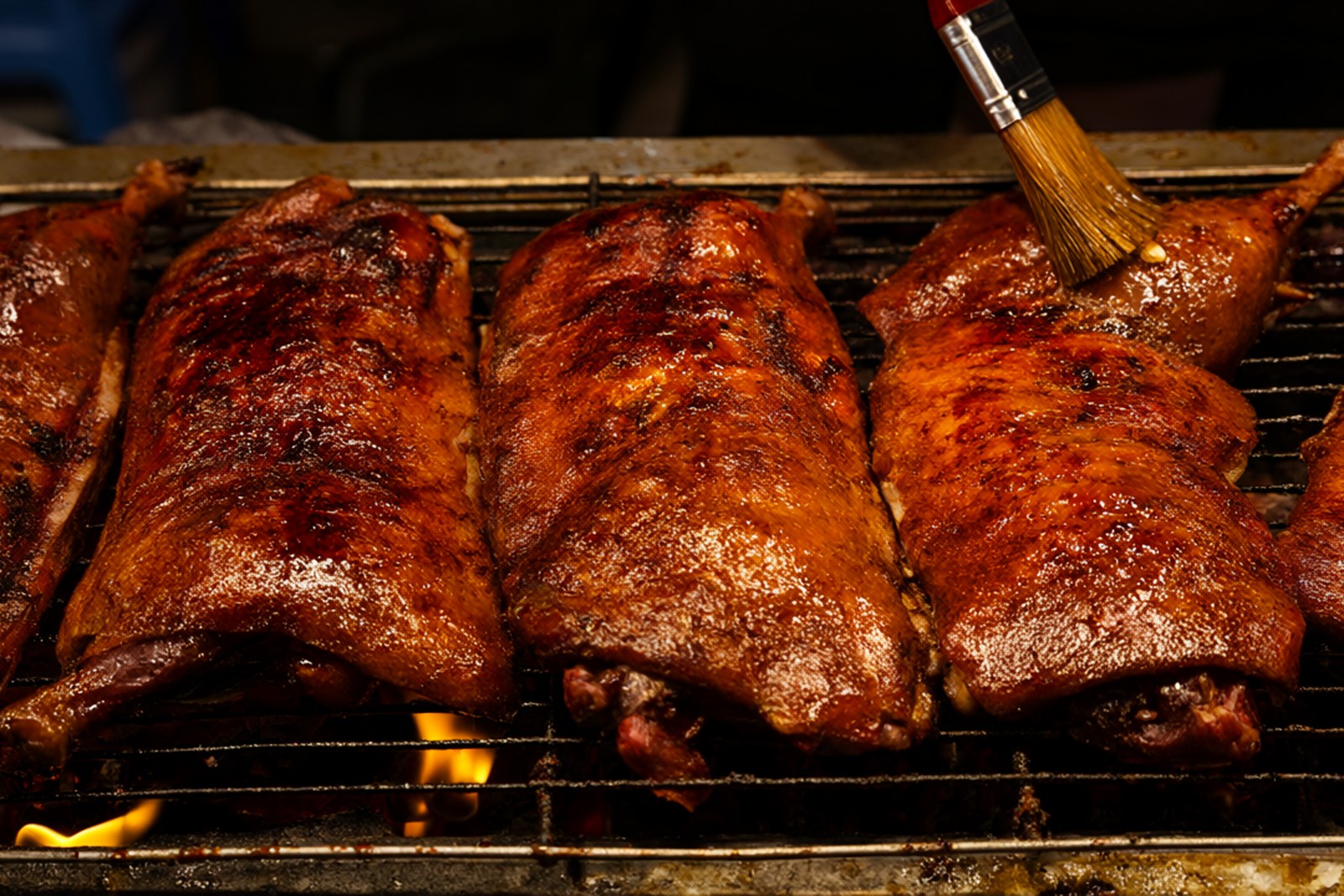
温泉鹅 is a recent arrival at the top table and the paperwork is recent as well. The name 琼海温泉鹅 Qiónghǎi wēn quán é was registered as a geographical indication certification mark in 2011, and in 2018 the China Hotel Association named 琼海 the country’s home of goose cookery – 中国温泉鹅美食之乡. It sits in the county mind as the everyday counterpart to 文昌鸡: the chicken is what you serve a guest, the goose is what you eat on a Tuesday, and 琼海 is not remotely apologetic about the comparison. The bird is boiled, roasted over charcoal, red-braised in a pot or eaten as part of a whole-goose spread in which the eggs, the blood and the offal all appear, with the blood made into a congee with rice and goji. A county that will build a menu out of one animal that way has usually earned the right to.
Words and Names
温泉鹅 wēn quán é is the goose of 温泉镇, confusingly named after a town and not after a hot spring. 白切 bái qiē is the poach-and-chill method used for it, 红焖 hóng mèn the red-braised version and 炭烧 tàn shāo the charcoal-roast one. 蒜蓉 suàn róng is chopped garlic and 沙姜 shā jiāng the small southern ginger; 小青桔 xiǎo qīng jú is the tiny lime whose juice goes into the dip, and 糠 kāng and 糙米 cāo mǐ are the bran and unmilled rice the birds are finished on. 鹅饭 é fàn is rice cooked in the goose stock, 鹅血羹 é xuè gēng the blood congee, and 万泉河 Wàn quán hé the river the geese graze beside.
What the Locals Know
Ask whether the goose was 散养 and then 填养, because the two-stage rearing is the whole of the difference and a bird that was penned from the start will be coarse. Look at the skin: it should be pale, thin and slightly translucent, and the fat under it should be in fine lines through the flesh rather than in a separate layer. Order the 白切 first and the 炭烧 or the 红焖 only if there are enough of you, since the roast is a different dish with a different point. Ask for 鹅饭 rather than plain rice, and ask for the small limes on the side so you can add the juice yourself, because the dip goes flat if it is squeezed too early.
flowcloud would say that a county which took an ordinary farm bird, spent two months giving it a range to walk on and one month giving it bran, and then decided the only honest thing to do was boil it in water and hand you a lime, has built a reputation out of restraint.
Where to find it: the goose restaurants of 琼海市, with the old houses in 温泉镇 itself and the long-established 老字号 in 嘉积镇 the two addresses people give, several of them open from mid-morning and staying busy through the evening. A plate of 白切鹅 is ¥45 to ¥90, half a bird ¥80 to ¥150, a whole bird ¥150 to ¥280, and a bowl of 鹅饭 ¥5 to ¥12. 琼海 is on the 东环 high-speed line with 琼海站 Qiónghǎi zhàn and 博鳌站 Bó’áo zhàn, about an hour from 海口 and forty minutes from 三亚 on the through trains.