
This is a fish that looks wrong. It comes to the table in blocks the size of a matchbox, not a whole fish, and every surface is a deep rose red — not the red of chilli oil but the red of something dyed, matte and slightly grainy, the colour of old lacquer. You pick one up with chopsticks and it holds its shape. You bite and the texture is dense, almost firm, with a faint sourness behind the salt and the heat, and a smell of tea oil that you will not place at first. 祁阳曲米鱼 Qíyáng qūmǐ yú — the fermented-red-rice fish of Qiyang — is the great preserved food of the middle Xiang River, and it is not really a dish so much as a method of keeping a large fish edible and delicious all winter.
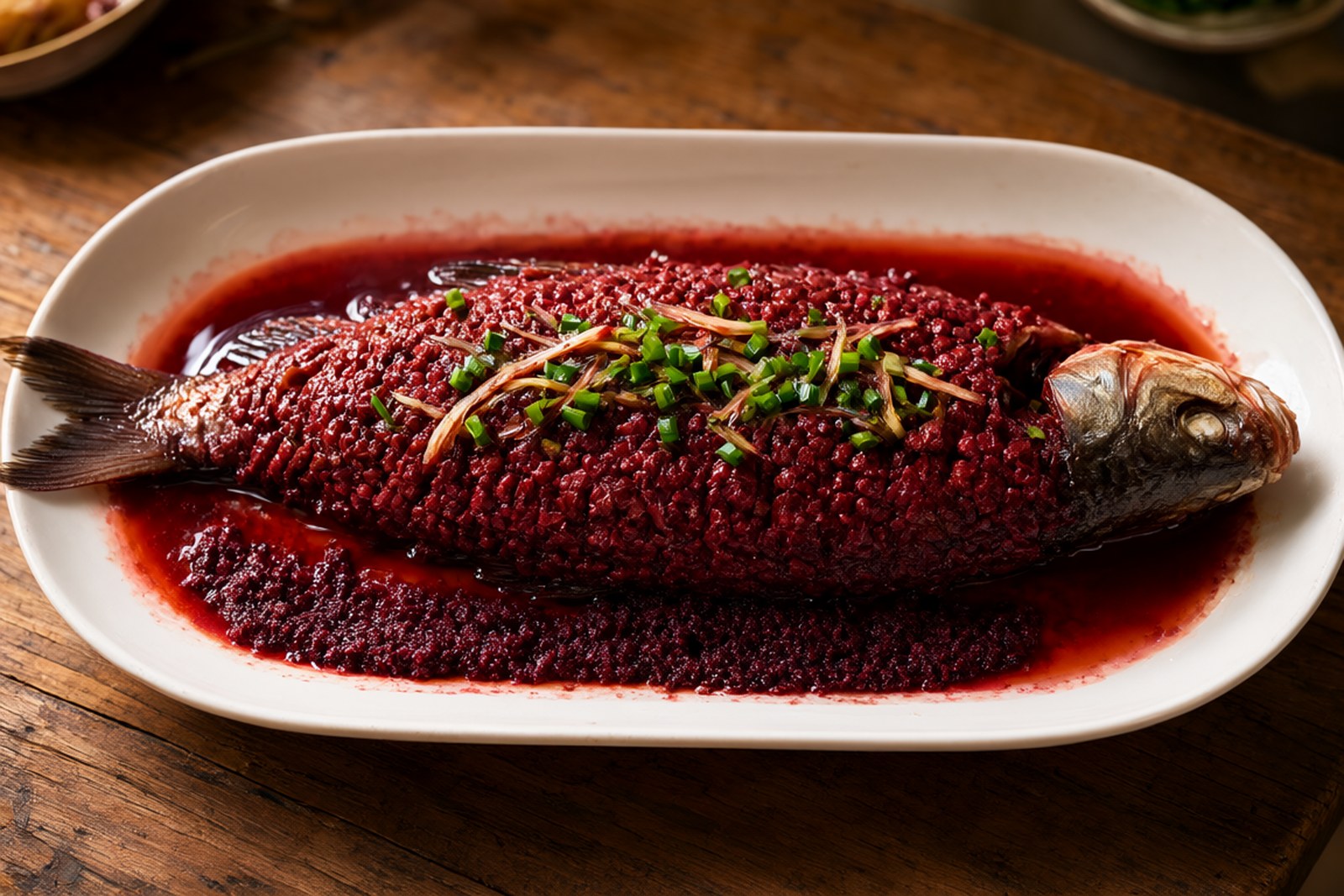
It belongs to 祁阳市 Qíyáng shì, the county-level city downstream of Yongzhou, and specifically to 白水镇 Báishuǐ Zhèn, a river port that was once prosperous enough to be nicknamed 银白水 Yín Báishuǐ, “Silver White Water”, because of the money moving through its wharves. The technique is documented as far back as the Song: it was being made in the villages around Baishui by the twelfth century, and one local account says that during the Xuanhe era of Emperor Huizong — around 1120 — it was sent to the court as tribute. In 2018 the method was placed on Hunan’s intangible cultural heritage list, and it is now a brand as much as a food, with flavoured industrial versions sold nationwide and a festival circuit of cooking demonstrations.
The Red Rice and the Two-Day Cure
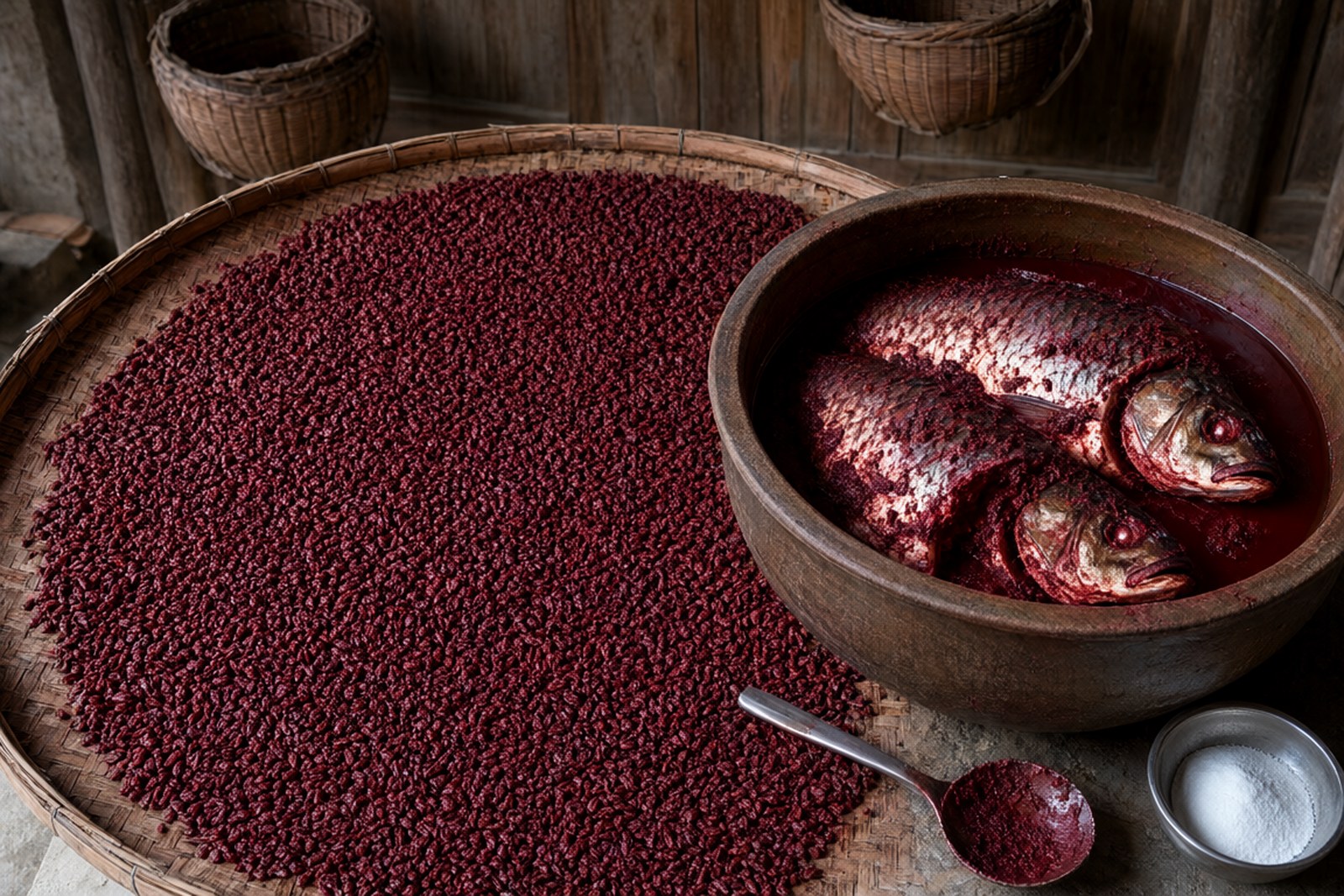
Everything begins with 红曲米 hóngqūmǐ, red fermented rice, the same mould-cultured grain that gives Chinese roast pork and rice wine their colour. The Qiyang version is not bought from a packet: traditionally the starter culture is built from a formula of some seventy herbs, mixed with steamed rice and left to ferment for several days, which is a slow business and produces a grain that is far more aromatic than the commercial article. The rice is ground to a coarse meal and it does three jobs at once — it colours the fish, it feeds a second, gentle fermentation on the flesh, and it carries the spices.
The fish is 草鱼 cǎoyú, grass carp, and it wants to be a big one, three kilos and up, from a reservoir or a spring-fed pond rather than a stagnant ditch. It is killed, scaled, and cut into blocks three or four centimetres wide; the head and tail are not used. The blocks are cured in heavily salted water for a day and a night, then rinsed in clean water until the surface salt is gone and the blood is out, then dressed with ginger, high-proof spirit or rice wine, tea-seed oil, ground red rice, chilli powder and a local thirteen-spice mix. After several more hours the coated blocks are laid on a bamboo rack and steamed for half an hour to fifty minutes. What comes out is cooked, coloured through, and firm.
Then comes the part that makes it a preserved food. The blocks are cooled, spread out, and either air-dried in the sun or packed into a jar. Once dried they can sit for months. When you want to eat them you steam them again — and the second steaming is generally agreed to be better than the first, because the flesh has had time to firm up and the rice to penetrate. A plate of cold curd-rice fish, eaten straight from the jar with rice congee, is breakfast in half the farmhouses of the county.
Words and Names
曲米 qūmǐ is the local word for the red starter rice — 曲 qū being both the mould culture and, by extension, anything fermented with it; the same character sits inside 酒曲 jiǔqū, wine starter. 曲鱼 qūyú, fermented fish, is the short form of the dish’s name. 草鱼 cǎoyú is grass carp, the workhorse freshwater fish of central China.
The town’s name is worth knowing for its irony: 白水 Báishuǐ means “white water”, and the whole point of the local craft is turning that white river fish the colour of a rose. The city’s own name, 祁阳 Qíyáng, is older than the dish, and its most famous product after fish is 祁剧 Qíjù, a form of opera with a hard, high style supposed to suit the local temperament.
What the Locals Know
Cold is the correct temperature. 曲米鱼 is usually eaten at room temperature or cold from the jar, not hot. Heating it too aggressively dries the flesh out and drives off the fermented aroma that is the entire reason for making it.
Look at the cut, not the colour. The dye will make any fish red. A good piece has visible muscle flakes and a slightly translucent pink edge; a bad one is uniformly opaque and pasty, which means the fish was small or the cure was rushed.
It is a gift, not a snack. In Qiyang it is what you take when you visit someone at New Year — the whole fish is made in quantity in the twelfth month and given away in jars. If somebody hands you a jar, you have been formally welcomed.
The tea oil is not optional. 山茶油 shāncháyóu, oil pressed from camellia seeds, is local, expensive and faintly bitter, and it is what keeps the rice meal from tasting raw. Substituting ordinary oil is the most common reason a home-made batch tastes flat.
Where to Eat It
The county town and 白水镇 Báishuǐ Zhèn above all, where it is sold in markets by weight and served in the small restaurants that line the old port. Ask for it 蒸 zhēng, steamed, rather than the fried versions that have spread through the cities. A jar of about half a kilo runs ¥40–80 depending on the fish and how much herb went into the starter; a plate in a restaurant with rice is ¥25–45. Buy it in the twelfth lunar month if you want the good batch, and keep it in the fridge once opened.
flowcloud would say that this is what a cuisine does before it has refrigeration — it takes the most ordinary river fish, gives it a colour nobody would mistake for fresh, and invents a flavour that only exists because the fish had to survive until February, and then quietly decides that the waiting is the better half of the recipe.
Where to find it: 祁阳曲米鱼 (Qíyáng qūmǐ yú), 祁阳市 (Qíyáng shì), 永州市 (Yǒngzhōushì), 湖南 (Húnán). Best in 白水镇 (Báishuǐ Zhèn) and the markets of 祁阳 (Qíyáng). Jar of 500g ¥40–80, restaurant plate with rice ¥25–45. Eat it cold or at room temperature, and buy it in the last month of the lunar year.